

Introduction
Running a small business in Australia means juggling many hats, but one task you don’t have to handle alone is your finances. The best accounting services for small business provide professional support that ensures ATO compliance, uncovers valuable tax deductions, and delivers clear financial insights so you can focus on growth. Whether you’re a sole trader in Brisbane, a startup in Melbourne, or a tradie in Perth, the right accounting partner can save thousands in tax and penalties while freeing up hours each week. In this guide, we explore what makes the best accounting services for small business stand out, how to choose the right provider, and why outsourcing is now the smart choice for most Australian small businesses.
Key Takeaways
- The best accounting services for small business combine bookkeeping, BAS lodgement, tax returns and strategic advice.
- Outsourced services are usually more cost-effective and scalable than in-house staff.
- Look for ATO-registered agents, cloud-based tools, and clear communication.
- Top providers offer fixed monthly fees, real-time reporting, and proactive tax planning.
- Avoid common pitfalls like poor record-keeping and missing deductions by partnering early.
Why Small Businesses Need Professional Accounting Services
Compliance with ATO Rules
The Australian Taxation Office expects accurate, timely lodgements of BAS, GST, PAYG, super guarantee, and annual tax returns. The best accounting services for small business keep you compliant, reducing the risk of audits and penalties that can reach thousands of dollars. Professional accountants stay updated with ATO changes, such as single touch payroll updates and instant asset write-off, so you don’t have to.
Maximising Tax Deductions and Savings
A skilled accountant knows which expenses are deductible: home office running costs, vehicle logbooks, depreciation, instant asset write-offs, and R&D tax incentives. Tax services for small business can save you far more than their fees through strategic planning, timing of asset purchases, and correct classification of costs. Many small business owners claim thousands of dollars in overlooked deductions every year.
Saving Time and Reducing Stress
Bookkeeping, payroll, and tax preparation can take 10–20 hours a month. Virtual accountant Australia options remove that burden, letting you focus on revenue-generating activities. Regular financial reports give you clarity on cash flow, profitability, and upcoming tax liabilities, so you’re never caught off guard.
Financial Clarity for Better Decisions
The best accounting services for small business deliver monthly reports, cash flow forecasts, and profit & loss statements in easy-to-read formats. This clarity helps you decide when to hire, invest in equipment, or adjust pricing, turning numbers into an actionable strategy.
In-House vs Outsourced Accounting Comparison
Cost Comparison
In-house accounting usually costs $60,000–$90,000 per year (salary + super + software + training). Outsourced accounting Australia starts at $300–$1,500 per month ($3,600–$18,000 annually), with no payroll tax, leave, or sick pay. For most small businesses, outsourcing is 40–70% cheaper.
Expertise and ATO Knowledge
In-house staff may lack deep tax knowledge, leading to missed deductions or compliance errors. Top accounting firms for small business employ CPAs and registered tax agents who specialise in small business rules, ATO rulings, and industry-specific deductions.
Scalability and Flexibility
In-house accounting is fixed; you pay the same whether you have 50 or 500 transactions. Outsourced services scale up or down with your business, adding payroll, advisory, or CFO-level support as needed. This flexibility is ideal for seasonal businesses or startups.
Access to Technology
Modern virtual accountant Australia providers use cloud platforms (Xero, QuickBooks Online, MYOB) with bank feeds, automated bank reconciliation, and real-time dashboards. In-house setups often lag in technology unless you invest heavily in software and training.
Essential Services in the Best Accounting Packages
Bookkeeping and Record-Keeping
Daily transaction entry, bank reconciliations, accounts payable/receivable, and expense categorisation keep records accurate and audit-ready. Cloud-based systems allow you to view live data anytime.
BAS and GST Lodgement
Quarterly or monthly BAS preparation and lodgement, including GST credits and PAYG instalments. The best accounting services for small business automate calculations and file directly with the ATO.
Income Tax Returns
Preparation and lodgement of individual, company, trust, or partnership returns. Professionals maximise deductions and ensure correct classification of business income and expenses.
Payroll Processing
Single Touch Payroll reporting, superannuation calculations, PAYG withholding, and employee payment runs. Many providers integrate payroll with timesheets and rostering apps.
Financial Reporting and Advisory
Monthly profit & loss statements, balance sheets, cash flow forecasts, and budget vs actual reports. Advisory services include benchmarking, pricing advice, and growth planning.
Common Mistakes Small Businesses Make with Accounting
Mixing Personal and Business Finances
Using the same bank account for personal and business transactions complicates deductions and increases audit risk. The best accounting services for small business insist on separate accounts from day one.
Ignoring BAS and Super Deadlines
Missing BAS lodgement or super guarantee payments incurs penalties and interest. Outsourced providers set automated reminders and file on time.
Underclaiming Deductions
Many miss home office expenses, vehicle costs, or instant asset write-offs. A good accountant audits records annually to find every legitimate deduction.
Poor Record-Keeping
Keeping paper receipts or incomplete digital records delays tax preparation and invites ATO scrutiny. Cloud bookkeeping and receipt-scanning apps solve this problem.
Choosing the Wrong Provider
Selecting on price alone often leads to poor service or compliance issues. Look for ATO registration, client reviews, cloud proficiency, and clear communication.
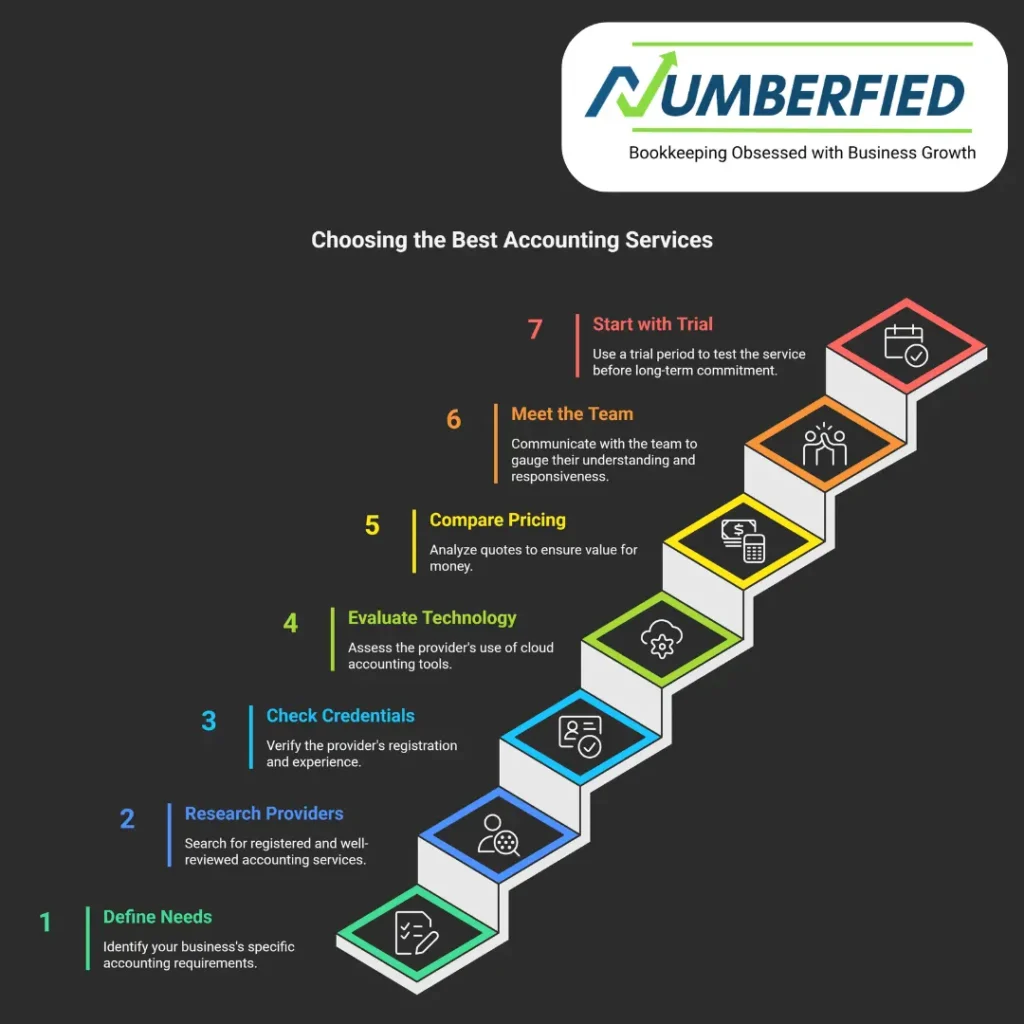
Step-by-Step Guide to Choosing the Best Accounting Services for Small Business
Step 1: Define Your Needs
List your current pain points: bookkeeping backlog, BAS lodgement, payroll, tax returns, or advisory. For small business accounting in Australia, consider your industry (tradie, retail, professional services) and transaction volume.
Step 2: Research Providers
Search for ATO-registered tax agents and BAS agents with strong reviews on Google and industry forums. Look for specialisation in small business and cloud accounting.
Step 3: Check Credentials and Experience
Confirm the provider is a registered tax agent with the Tax Practitioners Board and has experience with your entity type (sole trader, company, trust). Ask for case studies or client references.
Step 4: Evaluate Technology Stack
The best accounting services for small business use cloud platforms (Xero, QuickBooks Online, MYOB) with bank feeds, automated reconciliation, and client portals. Ensure they offer mobile apps and secure data handling.
Step 5: Compare Pricing and Value
Request detailed quotes with fixed monthly fees or hourly rates. Compare inclusions: bookkeeping, BAS, tax returns, advisory hours. Look for value-adds like tax planning sessions or financial reviews.
Step 6: Meet the Team and Test Communication
Have an introductory call or meeting. Assess responsiveness, clarity of explanations, and whether they understand your business. Ask how they handle ATO audits or complex queries.
Step 7: Start with a Trial or Fixed Period
Many providers offer a trial month or a fixed first-quarter fee. Use this to test the service before committing long-term.
Top Accounting Providers and ATO Trends in 2026
Popular providers for small business accounting in Australia in 2026 include:
- H&R Block affordable tax returns and BAS lodgement
- MYOB-certified firms are strong for tradies and retail
- Xero-certified partners offer excellent cloud integration and real-time reporting
- Bench and Pilot virtual accountant Australia options with fixed pricing
- Local firms like TaxStore and My Accountant offer personalised service
ATO trends in 2026 focus on digital lodgement, single touch payroll phase 2 reporting, e-invoicing adoption, and increased scrutiny of work-related deductions. The best accounting services for small business now offer AI-assisted reconciliation, automated BAS prep, and proactive ATO communication to stay ahead of changes.
Conclusion
Choosing the best accounting services for small business in Australia is one of the smartest investments you can make. Professional support ensures ATO compliance, uncovers tax savings, saves you time, and provides the financial clarity needed to grow confidently. Whether you need basic BAS and tax returns or strategic advisory, the right partner becomes a valuable part of your team. Ready to simplify your finances and focus on building your business? Request a free consultation with a trusted provider today and take the first step toward financial peace of mind.
FAQs
How much should a small business spend on an accountant?
Small businesses in Australia typically spend $1,500–$5,000 per year on accounting services. This covers tax returns, BAS lodgements, and basic advice; monthly retainers often range from $300–$1,200 depending on transaction volume and complexity. The amount is worth it if the accountant saves more in tax deductions and avoids penalties than the fees cost.
How much are accountants fees for a small business?
Accountants charge small businesses $150–$400 per hour or $800–$3,500 for annual tax preparation. Monthly packages for ongoing services (bookkeeping, BAS, payroll) usually fall between $500–$2,000.Fees vary by business size, entity type, and whether advisory or tax planning is included.
How much does a small business spend on accounting?
Most small businesses spend $2,000–$6,000 annually on accounting, including tax returns, BAS, and basic bookkeeping. Self-employed sole traders often pay $1,000–$3,000, while companies or partnerships with employees pay $4,000–$8,000+.Outsourcing is usually cheaper than hiring in-house staff.
How much does an accountant cost for your business?
An accountant costs a small business $1,000–$5,000 per year for standard services like tax returns and BAS. Monthly ongoing support typically ranges from $300–$1,500, depending on transaction count and extras like payroll. Complex businesses or those needing frequent advice pay more, often $6,000–$10,000 annually.
How much should I expect to pay for an accountant?
Expect to pay $150–$400 per hour or $800–$4,000 for annual tax preparation and planning. Monthly retainers for small businesses usually range from $400–$1,500, covering bookkeeping, BAS, and basic advice. Get quotes from multiple providers to find a value that matches your needs.
Do I need an accountant if I’m self-employed?
Yes, most self-employed individuals benefit from an accountant, especially for BAS, tax returns, and maximising deductions. If your turnover is low and finances are simple, you can manage alone using software like Xero or MYOB. An accountant is essential if you have employees, claim home office expenses, or want to avoid ATO penalties.
What is cost accounting for a small business?
Cost accounting for a small business involves tracking and analysing the costs of producing goods or delivering services to determine profitability. It helps identify expensive processes, set accurate pricing, and improve margins by separating fixed and variable costs. Small businesses use cost accounting to understand true product/service costs and make better operational decisions.
What type of accountant is best for a small business?
A registered tax agent or BAS agent with small business experience is usually the best fit. CPAs (Certified Practising Accountants) are ideal for complex needs like tax planning, audits, or business structuring. Many small businesses start with a qualified bookkeeper or BAS agent and upgrade to a CPA as they grow.
Which accounting package is best for a small business?
QuickBooks Online Plus or Xero Growing/Established packages are among the best for small businesses. They offer invoicing, expense tracking, bank feeds, BAS reporting, and payroll integration. Choose based on your needs: QuickBooks for strong reporting, Xero for collaboration and multi-currency.
How much should a small business spend on an accountant?
A small business should budget $2,000–$6,000 per year for accounting services. This typically includes tax returns, BAS lodgements, and basic advisory; monthly fees range from $300–$1,200.Spending more on a good accountant often returns more through tax savings and compliance peace of mind.
Also Read: Why Accounting Services for Ecommerce Are Your Australia Online Store’s Secret Sauce