

Introduction
Effective bookkeeping is a foundation for business success. This article explains how Australian bookkeeping services deliver accuracy, time savings, ATO compliance and strategic growth insights for Perth and Australian business owners. We outline benefits, challenges, rules, selection advice, software tools, BAS and tax preparation, onboarding steps and ways to measure value with practical tips you can apply immediately.
Quick takeaways
- Australian bookkeeping services improve accuracy and free time for business owners.
- Compliance with ATO rules and BAS deadlines reduces risk and penalties.
- Choose providers who secure your data, use preferred software and provide growth insights.
- Onboarding, clear KPIs and regular reviews help measure value.
- Contact Numberfied for Perth-based expert support and growth coaching.
Benefits of Australian bookkeeping services
Professional bookkeeping delivers practical benefits beyond neatly balanced accounts. Reliable Australian bookkeeping services let you focus on operations while ensuring records are accurate and compliant.
Accuracy and financial integrity
Accurate records reduce errors in payroll, GST reporting and BAS lodgements. Australian bookkeeping services use reconciliations and regular reviews to detect discrepancies early and correct source data.
Time savings and operational focus
Outsourcing day-to-day transaction recording and reconciliations saves the owner time. Australian bookkeeping services free you to work on sales, product development and staff management instead of routine accounting tasks.
ATO compliance and reduced risk
Staying up to date with ATO requirements, superannuation rules and BAS deadlines is a core deliverable from Australian bookkeeping services. This reduces the risk of late lodgement penalties and audits.
Challenges with Australian bookkeeping services
Choosing a bookkeeping provider requires due diligence. Awareness of common challenges helps you avoid weak providers and protects business data.
Finding a reliable provider
Not all providers have the same standards. Check qualifications, industry experience, and client references. Ask for examples of reconciliations and BAS lodgements they manage.
Data security and access control
Protecting financial data is essential. Ensure the provider uses secure cloud platforms, multi-factor authentication and role-based access to safeguard sensitive information.
Cost and return on investment
Cost structures vary: hourly, fixed monthly or per-service fees. Compare the expected time savings and reduced risk to determine the true return on investment when choosing Australian bookkeeping services.
Australian rules: ATO, BAS and compliance
Understanding tax and reporting rules is central to selecting and evaluating bookkeeping support. Proper compliance keeps your business in good standing with the Australian Taxation Office.
Business Activity Statements (BAS)
Australian bookkeeping services prepare and lodge BAS on your behalf. They manage GST reporting, PAYG withholding and other BAS obligations according to your reporting cycle.
Income tax and PAYG matters
Bookkeepers coordinate BAS data with tax agents and accountants to ensure accurate annual income tax returns and PAYG instalments for businesses and directors.
Superannuation guarantee and payroll compliance
Timely superannuation payments and correct payroll classifications are part of compliance. Australian bookkeeping services ensure payroll records support correct superannuation reporting and Single Touch Payroll (STP) requirements.
Choosing Australian bookkeeping services
Select a provider who matches your size, industry and growth ambitions. Focus on expertise, tools, communication and measurable outcomes.
Evaluate qualifications and experience
Verify BAS agent registration or bookkeeping certifications where appropriate. Ask about industry experience relevant to your business type and volume of transactions.
Assess software compatibility
Ensure the provider supports the cloud platform you prefer or can migrate your records securely. Look for experience with your point-of-sale or invoicing systems.
Define deliverables and KPIs
Set clear expectations: monthly reconciliations, BAS lodgement dates, reporting formats and response times. Agree on KPIs such as days to close monthly books and error rates.
Tools: Xero, MYOB, QuickBooks for Australian bookkeeping services
Cloud accounting platforms are central to modern bookkeeping. Each has strengths for Australian businesses; your provider should be proficient in your chosen platform.
Using Xero effectively
Xero is widely used in Australia for real-time bank feeds, automatic reconciliation rules and multi-user access. Australian bookkeeping services leverage Xero’s reporting and fixed asset tracking to streamline BAS and tax preparation.
MYOB for medium-sized businesses
MYOB suits businesses needing advanced payroll and local support options. Bookkeepers experienced in MYOB can manage complex payroll, award interpretation and integrated payroll tax reporting.
QuickBooks and flexibility
QuickBooks Online provides a strong small-business feature set with customisable invoicing and reporting. Australian bookkeeping services using QuickBooks focus on efficient workflow, bank rules and matched tax categories for BAS.
Onboarding, BAS and tax preparation with Australian bookkeeping services
Onboarding sets the tone for a successful working relationship. A structured approach ensures clean records and reliable reporting from the start.
Initial data review and cleanup
Start with a comprehensive review of historical transactions. Australian bookkeeping services will correct coding errors, reconcile bank accounts and archive redundant records to establish a clean baseline.
Configuration and integration
Configure your accounting platform, chart of accounts, tax codes, payroll integration and bank feeds. Integrate point-of-sale, time-tracking and billing systems so data flows accurately into the ledger.
Regular BAS preparation and lodgement
Bookkeepers prepare BAS, verify GST classifications and reconcile GST ledgers to ensure lodgements are accurate and submitted on time. They coordinate with tax agents for annual tax return adjustments.
Measuring value from Australian bookkeeping services
Track outcomes to ensure your bookkeeping investment delivers measurable benefits. Focus on efficiency, compliance and business insights.
Key performance indicators to track
Track KPIs such as time to finalise monthly accounts, number of reconciliation exceptions, BAS accuracy rate and timely payroll runs. These metrics show operational improvements.
Financial reports that drive decisions
Request tailored management reports: cashflow forecasts, budget vs actuals and margin analysis. Australian bookkeeping services can present these reports monthly to support strategic decisions.
Regular reviews and continuous improvement
Schedule quarterly reviews to assess processes, review KPI trends and update workflows. Continuous improvement ensures bookkeeping supports growth and changing compliance requirements.
Practical tips for working with your bookkeeper
Maximise the relationship with active collaboration, clear communication and defined responsibilities.
Set communication protocols
Agree on preferred channels, response times and reporting cadence. Australian bookkeeping services typically provide access to a client portal or shared dashboards for transparency.
Provide timely source documents
Supply invoices, receipts and payroll records promptly. Digital capture tools and standardised submission procedures reduce processing time and errors.
Regularly reconcile and review
Even with outsourced bookkeeping, review reconciliations and management reports monthly. Ask questions early to maintain clarity on financial positions and upcoming obligations.
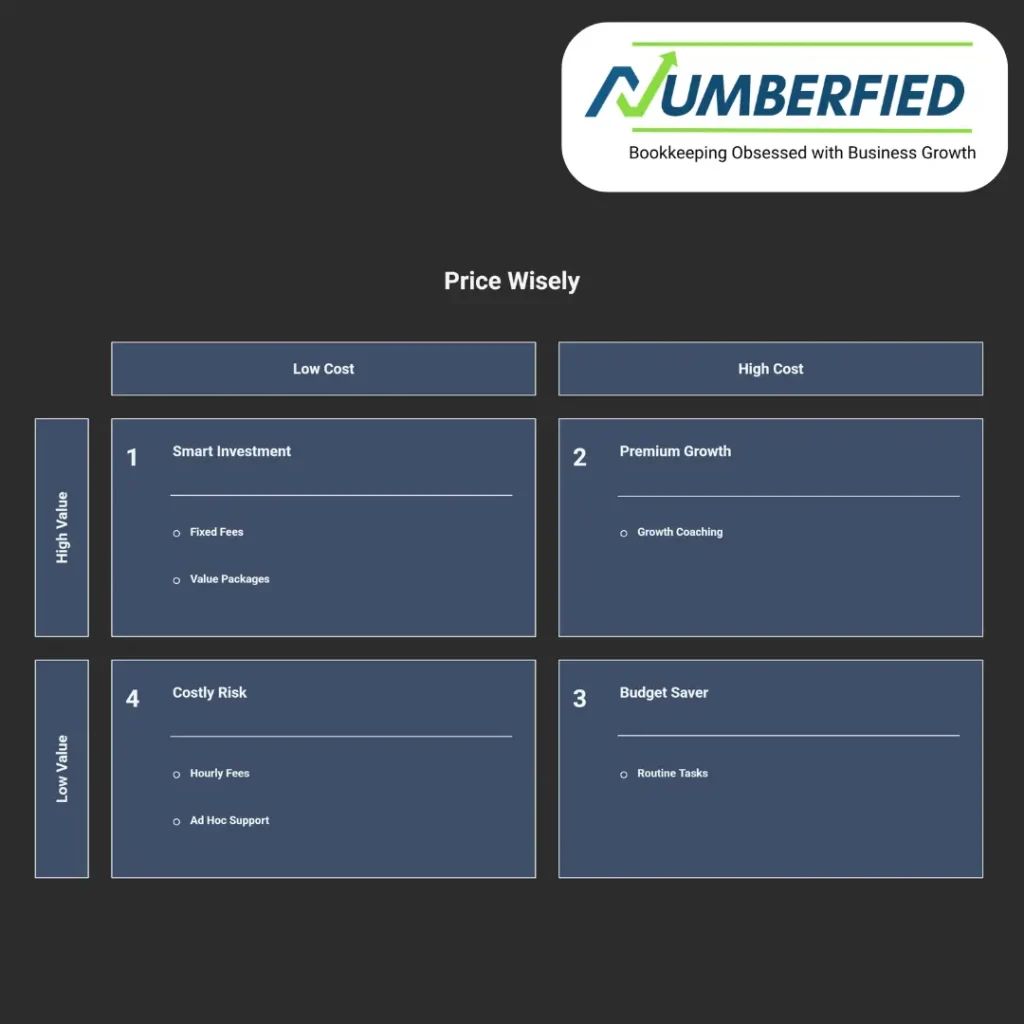
Pricing models and contract considerations
Understanding pricing helps you select a model aligned with your budget and expected value.
Fixed monthly fees
Fixed fees cover routine tasks like reconciliations and BAS lodgements. They provide predictable budgeting and are common for small to medium clients.
Hourly or ad hoc fees
Hourly arrangements suit project-type engagements such as cleanup, migration or irregular support. Ensure you have estimates and caps to control costs.
Value-based or growth-focused models
Some providers offer packages that combine bookkeeping with advisory or growth coaching. These can align costs with business outcomes and encourage proactive financial management.
How Australian bookkeeping services support business growth
Beyond compliance, bookkeeping can fuel strategy. Well-prepared records enable cash flow planning, margin analysis and investment decisions.
Cashflow forecasting and management
Accurate bookkeeping feeds reliable cash flow forecasts. Providers can model scenarios to plan for slow seasons, tax payments or expansion investments.
Profitability and margin analysis
Bookkeepers produce reports that highlight profitable products, services and customer segments. Use these insights to prioritise high-return activities.
Scaling processes and automation
Automating invoicing, payments and reconciliations reduces manual work as you scale. Australian bookkeeping services implement workflow automation that grows with your business.
Common onboarding checklist for Australian bookkeeping services
Use this checklist to ensure a smooth start and quick value delivery.
- Grant secure access to accounting software and bank feeds.
- Provide recent bank statements, payroll files and supplier lists.
- Agree on the chart of accounts and tax code mappings.
- Set BAS frequency and BAS lodgement responsibilities.
- Confirm communication channels and reporting templates.
Why Perth business owners choose local support
Local providers understand WA regulations, local tax nuances and market conditions. Proximity also supports face-to-face meetings when needed and timely on-the-ground advice.
Local ATO and industry knowledge
Perth-based bookkeepers understand regional tax issues, payroll conditions and industry seasons typical in WA. This helps tailor cashflow and compliance strategies.
Personalised advisory and coaching
Local engagement enables more personalised growth coaching, aligning bookkeeping outputs with strategic initiatives and operational realities.
Rapid response and practical support
Being local reduces turnaround times for urgent queries, bank issues or BAS amendments, and supports closer collaboration with your accountant.
Conclusion
Australian bookkeeping services are essential for accuracy, time savings, ATO compliance and strategic growth. Select a provider that combines technical skill, secure systems and clear KPIs. A structured onboarding process, regular reviews and the right software will ensure bookkeeping becomes a driver of business performance.
If you are a Perth-based business owner seeking trusted bookkeeping and growth coaching, contact Numberfied for local expert support and tailored advice on next steps.
Frequently asked questions
What is included in standard bookkeeping services?
Standard services generally include bank reconciliations, accounts payable and receivable management, payroll processing, BAS preparation and month-end reports. Providers can tailor packages to cover additional tasks such as fixed asset registers or inventory tracking.
How often should I reconcile my accounts?
Monthly reconciliations are the minimum to maintain accuracy and prepare BAS. High-volume businesses may benefit from weekly reconciliations to catch and resolve discrepancies quickly and maintain cash flow control.
Do bookkeepers prepare tax returns?
Bookkeepers prepare and organise the data required for tax returns, but do not file company income tax unless they are also registered tax agents. Work closely with your tax agent to finalise returns using bookkeeping records.
Which software is best for my business?
The best platform depends on business size, payroll complexity and ecosystem needs. Xero is strong for cloud-first small businesses, MYOB suits payroll-heavy mid-sized businesses, and QuickBooks offers flexible small-business tools. Choose based on integration and provider expertise.
How do I know my data is secure?
Ask providers about their cloud security practices, multi-factor authentication, data encryption and access controls. Ensure contractual clauses specify data management and backups to protect your financial information.
What are typical bookkeeping costs?
Costs vary by transaction volume, services required and reporting complexity. Expect fixed monthly fees for routine work, with additional hourly rates for ad hoc projects. Request a clear fee schedule and scope to compare providers effectively.
How long does onboarding take?
Onboarding typically takes one to four weeks, depending on data quality, migration complexity and integrations. Clean historical records shorten the timeline; allow more time if a full cleanup and migration are needed.
Can bookkeeping provide strategic insights?
Yes. Bookkeepers produce management reports such as cashflow forecasts, margin analysis and budget comparisons that support operational and strategic decisions when reviewed regularly with owners.
How do I handle BAS lodgement responsibilities?
Clarify who prepares and lodges BAS during onboarding. Bookkeepers commonly prepare BAS and coordinate lodging through a registered agent or directly if authorised. Agree on BAS frequency and deadlines to avoid penalties.
When should I switch bookkeeping providers?
Consider switching if you experience repeated errors, poor communication, a lack of proactive advice or insufficient security standards. A smooth transition plan and clear handover minimise disruption to BAS and payroll obligations.
Also Read: Why Bookkeeping Services Small Business Owners Love Can Transform Your Success