

Introduction
Hiring a bookkeeper in Australia is no longer a one-size-fits-all cost, especially in 2026, when pricing varies widely by business size, transaction volume, and service complexity. Whether you are a small business owner, tradie, startup founder, or SME manager, understanding the bookkeeping services cost is essential for budgeting and growth planning. In Australia, bookkeeper hourly rates typically range from about $30 to $150+, while monthly bookkeeping fees can start from around $125 and scale to $5,000+ depending on workload and services like payroll and BAS lodgement. This guide breaks down pricing models, compares in-house versus outsourced bookkeeping, explores the impact of cloud tools like Xero, and highlights regional variations such as Perth and WA, helping you confidently compare providers and choose the right bookkeeping solution for your business.
Key Takeaways
- Bookkeeping costs in Australia (2026) vary widely based on business size, transaction volume, and service complexity.
- Hourly rates typically range from $30 to $150+, while monthly packages can start low and scale significantly with added services.
- Outsourced bookkeeping is often more cost-effective than hiring in-house staff, especially for small businesses and startups.
- Services like payroll, BAS lodgement, and reporting increase overall bookkeeping fees.
- Cloud accounting tools like Xero can influence pricing through automation and efficiency gains.
- Regional differences (e.g., Perth and WA) may affect pricing due to market demand and availability of skilled bookkeepers.
- Choosing the right pricing model (hourly vs fixed package) helps control costs and align with your business needs.
Why does the cost of bookkeeping services matter
Immediate financial clarity
Bookkeeping services cost affects your cash flow, tax planning and business profitability. When you invest in accurate bookkeeping, you gain immediate clarity on expenses, GST obligations and payroll liabilities.
Long-term business health
Understanding bookkeeping services helps protect your business from penalties, missed claims, and bookkeeping errors that can escalate into larger financial problems.
Choosing the right level of support
Not all businesses need the same level of service. Knowing what goes into bookkeeping services cost helps you select a package that matches your size, industry and growth plans.
How the cost of bookkeeping services is calculated
Time-based billing and hourly rates
One common way providers determine the cost of bookkeeping services is by charging an hourly rate. Rates vary by experience and region, and the complexity of your work will influence how many hours are needed.
Fixed monthly packages
Fixed monthly packages offer a predictable cost for bookkeeping services. These packages often include a set number of transactions, reconciliations and reporting deliverables.
Per-transaction pricing
Per-transaction pricing charges based on the number of invoices, bills or bank transactions processed. For high-transaction businesses, this significantly affects the overall cost of bookkeeping services.
Key factors that drive the cost of bookkeeping services
Volume of transactions
The number of invoices, payments, and bank feeds directly increases the cost of bookkeeping services. More transactions mean more time spent reconciling and categorising.
Complexity of your affairs
Complex structures, multiple entities, payroll, inventory, and specialist compliance requirements will increase the cost of bookkeeping services due to additional expertise and systems required.
Software and integrations
Using cloud accounting platforms and multiple integrations may change bookkeeping services cost. Providers often include software setup and ongoing management in their pricing or charge an additional fee.
Typical bookkeeping services cost ranges in Australia
Small sole traders and microbusinesses
For sole traders with low transaction volumes, the cost of bookkeeping services can be modest. Expect entry-level monthly packages or hourly rates suitable for lean businesses.
Small to medium enterprises (SMEs)
SMEs with regular sales, payroll and GST reporting will face higher bookkeeping services costs. Monthly packages or dedicated bookkeeping hours are common for these businesses.
Larger businesses and specialised bookkeeping
Larger businesses or those requiring specialist bookkeeping services cost more due to scale, advanced reporting and multiple compliance layers.
Pricing models compared: Which is best for your business?
Hourly vs fixed monthly pricing
Hourly pricing offers flexibility but less predictability in the cost of bookkeeping services. Fixed monthly pricing delivers budget certainty and often better value for consistent transaction volumes.
Per-transaction vs outcome-based fees
Per-transaction fees scale directly with activity and can be cost-effective for low-volume periods. Outcome-based fees focus on deliverables, such as BAS lodgements and payroll runs, and tie bookkeeping services costs to clear outcomes.
Hybrid and custom packages
Many providers offer hybrid packages combining fixed monthly fees for core tasks with add-on hourly or per-transaction charges. This approach keeps bookkeeping services costs transparent while allowing flexibility.
How to estimate your bookkeeping services cost
Step 1: Audit your current transaction volume
Start by counting average monthly invoices, bills, bank transactions and payroll entries. This base figure is central to estimating the cost of bookkeeping services.
Step 2: Identify required services
Do you need BAS preparation, payroll, debtor management or inventory reconciliations? Each service adds to the cost of bookkeeping services, so list essentials and nice-to-haves separately.
Step 3: Request tailored quotes
Provide potential providers with transaction data and required services. A tailored quote will show how bookkeeping service costs change with scope or frequency.
How Numberfied structures bookkeeping services cost
Transparent fixed-fee packages
Numberfied offers clear fixed-fee packages so you know your bookkeeping services cost each month. Packages are designed to suit common business sizes and needs, reducing unexpected billing spikes.
Scalable options for growth
As your business grows, Numberfied’s pricing adapts. Scalable plans keep bookkeeping services costs aligned with your transaction volumes and reporting needs.
Personalised advice and onboarding
Numberfied provides a tailored onboarding process to ensure your bookkeeping services cost reflects the actual work required and avoids unnecessary extras.
What is typically included in the cost of bookkeeping services?
Bank reconciliations and transaction categorisation
Most packages include regular bank reconciliations and transaction categorisation, forming the backbone of any bookkeeping services cost.
GST and BAS preparation
GST tracking and BAS preparation are common inclusions; confirm whether lodgement is included or charged separately, as this will affect the cost of bookkeeping services
Payroll processing and superannuation
Payroll setup, regular pay runs, and superannuation processing may be included in higher-tier packages or offered as an add-on that increases the cost of bookkeeping services.
Ways to reduce bookkeeping services cost without losing quality
Streamline transaction flows
Automating bank feeds and invoicing reduces manual work and can lower bookkeeping services costs by cutting processing time.
Keep records organised
Maintaining clear documentation and categorised receipts reduces time spent clarifying transactions, which directly helps manage bookkeeping services costs.
Choose the right software
Select accounting software that integrates with your systems. Better integrations mean less manual intervention and lower bookkeeping service costs.
Red flags: When the cost of bookkeeping services might be too high or unclear
Unexpected invoices and add-ons
If a provider frequently issues unexpected invoices, your bookkeeping services cost can escalate. Clear scope and fixed-fee options reduce this risk.
Poor communication and reporting
Hidden fees often accompany inadequate reporting. Insist on transparent deliverables so bookkeeping services cost aligns with measurable outcomes.
Lack of industry expertise
Bookkeeping services cost may rise if your provider needs to learn industry-specific rules. Choose a provider experienced in your sector to keep costs predictable.
How to compare the cost of bookkeeping services between providers
Compare apples to apples
Ask providers for the same scope, transaction volumes and deliverables. Comparing like-for-like helps you gauge the true cost differences in bookkeeping services.
Request sample reports and references
Sample month-end reports and client references reveal the value you receive for the cost of your bookkeeping services.
Consider total value, not lowest price
Lower bookkeeping services costs that result in errors or missed compliance can be more expensive in the long term. Assess quality, support and turnaround times.
Accounting software and its impact on the cost of bookkeeping services
Cloud platforms and automation
Cloud accounting reduces manual workload and often lowers bookkeeping services costs through automation and real-time collaboration.
Subscription and integration fees
Software subscriptions and third-party integrations may be billed separately, which can affect your overall bookkeeping services cost.
Training and support
Training your team on new software can be a one-off cost, but it may reduce ongoing bookkeeping services costs by improving internal handling of routine tasks.
Sample cost scenarios and case studies
Sole trader with low volume
A sole trader with minimal transactions might choose a basic monthly package or a pay-as-you-go plan, keeping bookkeeping costs low while covering essentials like BAS and end-of-year statements.
Retail SME with inventory
Retail businesses often require inventory reconciliations and point-of-sale integrations, increasing the cost of bookkeeping services. A tailored package that includes integrations is usually most efficient.
Growing services firm
A professional services firm adding staff and projects will see bookkeeping service costs rise as payroll and project-tracking needs increase. Switching to a scalable package can control costs while expanding services.
Questions to ask when evaluating bookkeeping services cost
What exactly is included in your fee?
Request a detailed list of tasks covered by the quoted bookkeeping services cost, including reconciliations, BAS preparation and payroll.
How do you handle peak periods and additional work?
Clarify whether extra work during busy seasons is included or billed separately, as this will affect the total cost of bookkeeping services.
What are your turnaround times and reporting frequency?
Faster reporting may cost more but delivers timely insights. Align reporting frequency with the cost of the bookkeeping services you are willing to pay for real-time information.
How Numberfied makes bookkeeping services cost-effective for Australian businesses
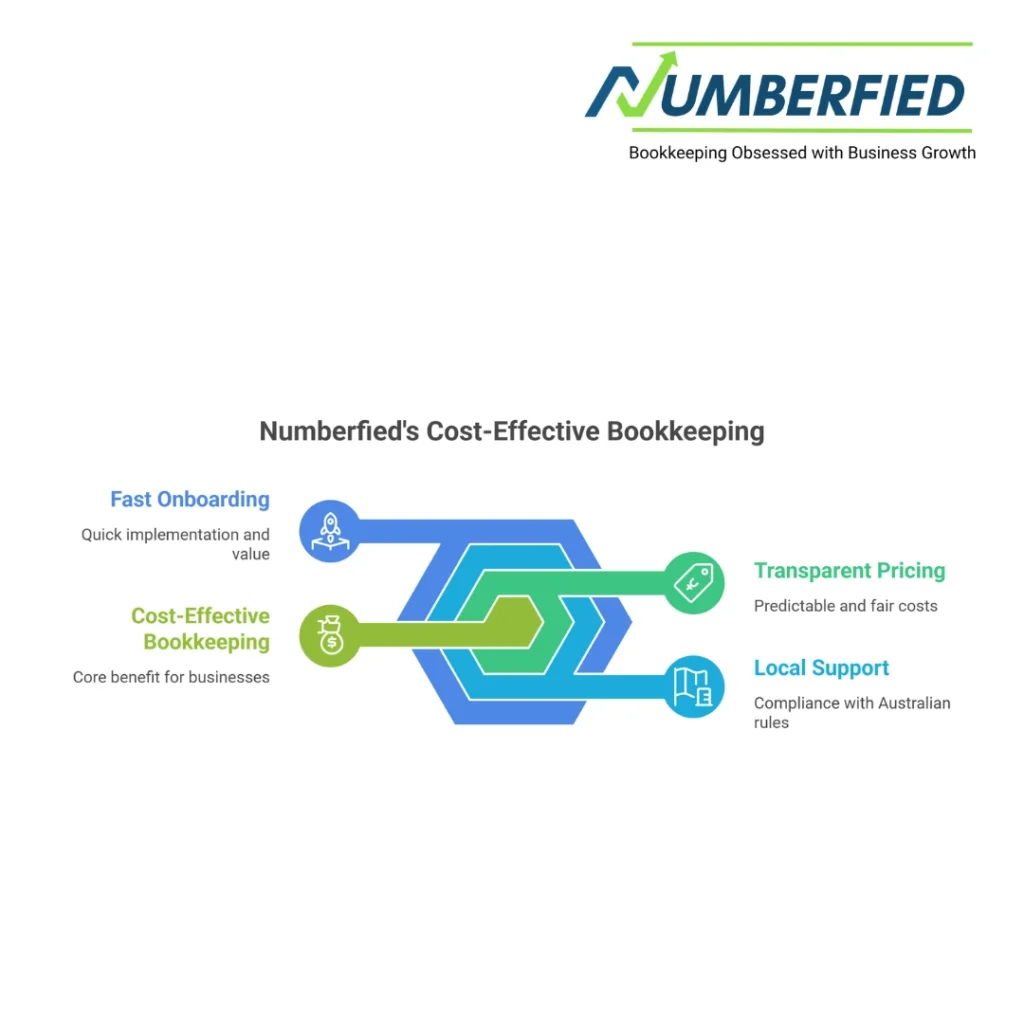
Transparent pricing and clear deliverables
Numberfied publishes clear packages that outline what is included so your bookkeeping services cost is predictable and fair.
Local support with national reach
With a team experienced in Australian rules and GST, Numberfied helps control bookkeeping services costs while ensuring compliance across states and territories.
Fast onboarding and measurable results
Numberfied focuses on quick implementation and regular reporting, delivering value that offsets the cost of bookkeeping services through better cash flow and reduced errors.
Preparing to switch providers: minimising transition bookkeeping services cost
Plan your transition timeline
Coordinating handover during a low-activity period reduces additional work charges and keeps bookkeeping services costs predictable during the switch.
Provide organised historical data
Handing over well-structured accounts and documentation limits catch-up work and reduces transitional bookkeeping services costs.
Agree on a clear handover scope
Document the responsibilities of both parties during the transition to avoid disputes and unexpected bookkeeping costs.
ROI: How to measure whether the cost of bookkeeping services is worth it
Time savings and productivity
Calculate the hours saved and price them against the cost of bookkeeping services to gauge labour savings and ROI.
Reduction in compliance risks
Fewer errors and timely lodgements reduce fines and interest, often justifying the cost of bookkeeping services through avoided penalties.
Improved financial decision-making
Better reporting leads to smarter decisions, increased profitability and strategic investment, demonstrating the value of your bookkeeping services.
Final tips for negotiating bookkeeping services cost
Bundle services for better value
Combining bookkeeping with BAS lodgement, payroll, or advisory services can lower total bookkeeping costs and simplify vendor management.
Ask for trial periods or pilot months
Trial periods help you assess the quality and confirm that the cost of bookkeeping services is appropriate before committing to them long-term.
Negotiate service levels, not just price
Adjusting the frequency of reconciliations or reporting can lower bookkeeping services costs while preserving essential controls.
Conclusion
Understanding bookkeeping services’ costs empowers you to choose the right provider, optimise spend, and improve financial outcomes. From hourly rates to fixed monthly packages, the factors that influence the cost of bookkeeping services are clear: transaction volume, complexity, software, and the level of support you require. The Numberfied team offers transparent pricing, scalable packages and Australian-based expertise to ensure your bookkeeping services deliver real value.
Ready to explore an accurate quote and see how Numberfied can tailor bookkeeping services to your needs? Visit Numberfied to get started today.
Frequently Asked Questions
What is the average cost of bookkeeping services for a small business in Australia?
The average cost of bookkeeping services for small businesses varies widely, depending on transaction volume and required services. For very small operations, it can be a modest monthly fee or pay-as-you-go hourly rates. For businesses with regular payroll, GST and higher transaction volumes, bookkeeping services cost increases accordingly. Getting tailored quotes based on your actual transactions gives the most accurate estimate.
Are fixed monthly bookkeeping services cost packages better than hourly rates?
Fixed monthly packages offer predictability and often better value for businesses with consistent activity. Hourly rates can be useful for irregular needs or short-term projects. Consider your transaction consistency and cash flow predictability when assessing whether hourly or fixed bookkeeping services suit you best.
How can I reduce my bookkeeping services cost without lowering quality?
Automating bank feeds, using integrated accounting software, and maintaining clear records reduces manual processing time and lowers bookkeeping service costs. Also, choosing a package that matches your exact needs rather than paying for unnecessary services helps keep costs down while maintaining high-quality results.
Do bookkeeping services cost include software fees?
Not always. Some providers include software subscriptions in their bookkeeping services cost, while others bill software fees separately. Always confirm whether subscription and integration costs are included in the package or are additional charges to avoid surprises.
Will switching to a new provider increase my bookkeeping services cost?
Initial transition work can increase the cost of bookkeeping services if historical data requires significant cleanup. Plan your switch during a quieter period, supply organised records and agree on handover responsibilities to minimise transitional costs and ensure a smooth changeover.
How does payroll affect the cost of bookkeeping services?
Payroll adds complexity due to pay runs, tax withholdings and superannuation processing. Including payroll in your bookkeeping service will increase the cost of bookkeeping services, but bundling payroll with bookkeeping often yields better value than separate arrangements.
What should be included in a bookkeeping services cost quote?
A comprehensive quote should list included tasks, reporting frequency, turnaround times, software and integration details, and any likely additional charges. This transparency helps you compare the true cost of bookkeeping services between providers.
Can the cost of bookkeeping services be tax-deductible?
Yes, bookkeeping fees are generally tax-deductible as a business expense in Australia. Keep invoices and records of the services provided to support deductions, and consult your tax advisor for specifics related to your business situation.
How do cloud accounting platforms influence the cost of bookkeeping services?
Cloud platforms can reduce bookkeeping services costs through automation and real-time collaboration. However, initial setup and subscription fees may be additional. Over time, automation typically delivers net savings and improved accuracy, which justifies the cost of bookkeeping services.
How do I know if I’m getting value for the cost of my bookkeeping services?
Measure value by comparing the clarity of financial reports, time saved, accuracy of BAS lodgements and reduced compliance issues. If bookkeeping services deliver timely insights, fewer errors and better cash flow management, they are providing strong value for your business.
Also Read: Why Bookkeeping Services Small Business Owners Love Can Transform Your Success