

Introduction
Startup founders, early-stage entrepreneurs, and small business owners face constant pressure to move quickly, conserve cash, and focus on achieving product-market fit. Outsourced accounting for startups provides a practical solution to access accurate bookkeeping, reliable financial reporting, and expert tax compliance without the overhead of hiring a full in-house accounting team. By partnering with professional outsourced accountants, startups can streamline financial processes, improve cash flow management, and make data-driven decisions that support growth.
Key Takeaways
- Outsourced accounting helps startups reduce overhead and gain access to professional financial expertise.
- Services include bookkeeping, payroll, tax compliance, financial reporting, and advisory support.
- Costs vary based on transaction volume, payroll complexity, and level of advisory services required.
- Cloud accounting, AI tools, and fractional CFO support are increasingly popular trends for startups.
- Partnering with the right outsourced accounting provider ensures scalability, flexibility, and compliance with Australian tax requirements.
Why startups in Australia are choosing outsourced accounting services
Startups gain measurable benefits when they choose accounting outsourcing rather than hiring full-time staff. Outsourced accounting for startups reduces burn rate, delivers access to accounting standards and ATO knowledge, and frees the business owner to focus on growth and core business activities. Australian startups benefit from local accounting firms that understand GST, BAS, payroll rules, and the compliance demands of the Australian market.
Common startup challenges solved by outsourcing your accounting
- Limited cash flow and tight headcount make hiring in-house accounting difficult.
- Founders need real-time financials to make business decisions without being bogged down by bookkeeping.
- Compliance complexity (BAS, PAYG, ASIC, tax) requires specialist knowledge.
- Scaling quickly requires flexible accounting solutions that grow with the business.
Outsourced accounting for startups provides bookkeeping, tax services, payroll, cash flow management and financial reporting with a variable cost model that suits startup needs.
Core outsourced accounting services for startups and what they include
An effective outsourced accounting service for startups covers a wide set of tasks. Below are common services offered by outsourcing firms and accounting firms focused on startups in Australia.
Bookkeeping & starter finance setup
Basic bookkeeping and startup bookkeeping outsourcing include bank reconciliations, accounts payable and receivable, expense categorisation, and setup of accounting software. Cloud accounting startups commonly use Xero or QuickBooks Online to provide founders with up-to-date financials accessible from anywhere. Many businesses choose startup bookkeeping outsourcing for an immediate lift in financial control and reporting accuracy.
Payroll, superannuation and BAS
Payroll processing, PAYG withholding, superannuation and Business Activity Statement (BAS) lodgement are critical compliance tasks. Outsourced accounting for startups ensures payroll compliance, timely BAS submissions and reduces the risk of ATO penalties.
Tax services and compliance
Tax planning, company tax returns, GST advisory and tax compliance are integral to accounting services for startups. Using professional outsourced accountants familiar with Australian accounting standards and tax rules reduces compliance risk.
Financial reporting and cash flow management
Regular management reporting, forecasting, cash flow modelling and KPI dashboards help founders understand runway and burn rate. Fractional CFO services or finance and accounting outsourcing arrangements provide strategic reporting tailored to a startup’s stage and industry.
Advisory, fundraising support and fractional CFOs
More mature startups often need advisory services, including investor-ready financials, cap table management, valuations and fundraising support. Fractional CFO startup solutions provide leadership without the cost of hiring a full-time CFO.
How outsourced accounting for startups is priced in Australia
Pricing models vary widely depending on scope, frequency and level of expertise. Typical pricing approaches for accounting outsourcing services include fixed monthly packages, hourly rates and retainer-based fractional CFO engagements. Factors that affect cost include transaction volume, complexity, number of employees, and whether you require advisory or CFO services.
Typical price ranges
- Startup bookkeeping outsourcing: A$200–A$1,000 per month, depending on transaction volume and cloud integration.
- Payroll and BAS services: Often bundled; A$100–A$800 per month depending on payroll frequency and size.
- Accounting and tax compliance: Company tax return and compliance work can range from A$1,000 to A$5,000 annually for simple structures.
- Fractional CFO startups: Part-time CFO services are typically A$2,000–A$10,000 per month, depending on hours and seniority.
Outsourced accounting services for startups Australia pricing delivers predictable cost savings compared to employing an in-house accounting team, especially when considering salaries, benefits and recruitment costs.
How to choose the right outsourced accounting service for your startup
Selecting the right outsourced accounting for startups provider means aligning services with your business needs, growth stage and budget. Follow a structured approach to evaluate potential partners.
Step-by-step guide to implementing outsourced accounting for startups
Following these steps reduces friction when outsourcing your accounting and ensures a smooth transition from in-house or ad-hoc processes.
- Define your accounting needs: Identify must-have services (bookkeeping, payroll, BAS, tax, reporting) and aspirational services (fractional CFO, fundraising support).
- Decide on software stack: Choose cloud accounting software that supports growth. Xero is common for Australian startups, but consider integrations for payroll and expense management.
- Compare providers: Look at experience with startups in your industry, pricing transparency, local ATO knowledge, and whether they provide a dedicated outsourced team or offshore accounting support.
- Request references and case studies: Ask for examples of accounting outsourcing successes with startups in Australia or similar markets.
- Plan the migration: Outline data transfer, access to bank feeds, chart of accounts setup, and timelines to avoid disruption to reporting and cash flow visibility.
- Agree on KPIs and reporting cadence: Define deliverables, reporting frequency, and escalation points for the relationship.
- Onboard and train: Ensure your team understands how to submit expenses, use accounting software, and liaise with the outsourced accountants.
Benefits and advantages of Australian outsourced accounting providers
Choosing local outsourced accounting services for startups in Australia delivers specific advantages. Australian providers bring ATO knowledge, local compliance expertise, and an understanding of the startup ecosystem across cities like Sydney, Melbourne and Perth. Whether you need startup accounting outsourcing in Perth or services in other regions, local firms can navigate state regulations, ASIC lodgements, and investor expectations in the domestic market.
Key benefits
- ATO and GST expertise: Local accountants know Australian tax law and BAS cycles.
- Access to startup networks: Accounting firms often connect startups with advisors, investors and legal services.
- Time zone alignment and local support: Faster responses and easier collaboration with founders in Australia.
- Tailored services: Services tailored to Australian startups include SMSF services, tax incentives and R&D tax rebate support where applicable.
Australian accounting outsourcing services help startups stay compliant while providing timely financials that support business decisions and growth.
Factors to consider: stage, volume and industry
Not every startup needs the same level of outsourced accounting. Consider these factors when choosing the right outsourced accounting for startups solution:
- Volume: High transaction volumes (ecommerce, marketplaces) may benefit from hybrid offshore-onshore accounting outsourcing to manage cost and speed.
- Stage: Pre-revenue startups often require basic bookkeeping and cash flow modelling; scaling startups need more robust reporting and fractional CFO input.
- Industry: Regulated industries or those with complex revenue recognition need accounting firms familiar with relevant accounting standards.
Matching the outsourcing solution to your startup’s needs ensures you pay for the right level of expertise and capacity.
Trends shaping outsourced accounting for startups
The finance and accounting outsourcing market is evolving rapidly. Startups should look for providers that embrace technology and flexible service models.
Cloud accounting startups and integrations
Adoption of best-in-class accounting technology like Xero, cloud accounting startups, apps and integrated payment platforms allows outsourced accountants to deliver near real-time financials and automate routine tasks. Startup accounting outsourcing relies heavily on cloud tools to scale efficiently.
AI and automation
Accounting firms are using AI to auto-categorise transactions, accelerate reconciliations and detect anomalies. Outsourced accounting for startups that leverages AI reduces manual workload and improves accuracy.
Hybrid and offshore models
Hybrid models combine professional outsourced accountants onshore with offshore accounting teams to balance cost and expertise. Offshore accounting can deliver volume processing while onshore teams handle compliance, advisory and complex reporting.
Fractional CFO startups and advisory-led outsourcing
There’s growing demand for fractional CFO startup services, outsourced CFO support that provides strategic financial management without the commitment of a full-time hire. This is often bundled into accounting outsourcing services for startups to provide a clear runway and fundraising-ready financials.
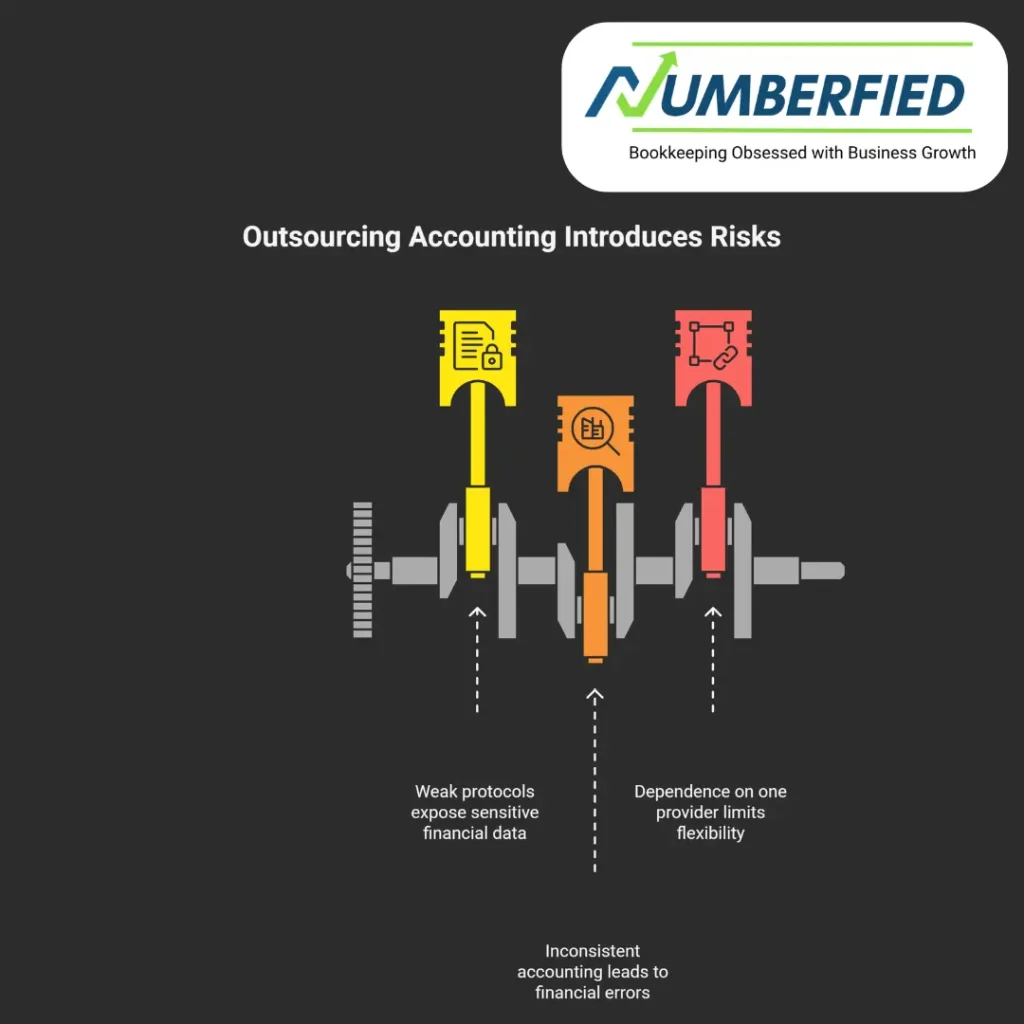
Risks and how to mitigate them when outsourcing accounting
While outsourced accounting for startups offers many benefits, there are risks that founders should manage proactively.
Data security and access control
Mitigate risk by selecting providers with strong security protocols, restricted access controls, and clear data handling policies. Ensure contracts specify confidentiality and data ownership.
Quality and consistency
Maintain quality by setting KPIs, regular finance reviews and including SLAs in your agreement. Regular reporting and monthly reconciliations keep the accounting accurate and consistent.
Dependence on a single provider
Avoid vendor lock-in by maintaining local backups, ensuring you have access to raw data, and documenting processes so that transitioning providers is straightforward.
How outsourcing your accounting helps you focus on growth
Outsourced accounting for startups lets founders focus on core business activities, such as product development and customer acquisition, while finance experts manage the accounting tasks. Outsourcing solutions free up time, provide better cash flow visibility and deliver financial insights that inform business decisions, supporting your growth trajectory.
Practical outcomes startups can expect
- Faster month-end closes and reliable monthly financials.
- Clear cash flow forecasts and runway management to reduce burn rate anxiety.
- Better compliance and reduced risk of fines or penalties.
- Cost savings versus an in-house accounting team for many startups.
Case study snapshot: From ad-hoc bookkeeping to a scalable outsourced accounting service
A SaaS startup in Melbourne moved from ad-hoc bookkeeping to outsourced accounting for startups to manage rapid customer growth. The outsourced accounting service implemented cloud accounting, monthly management reports, payroll and BAS lodgements. Within three months, the startup had clear cash flow forecasts, improved KPI reporting for investors and a 30% reduction in accounting costs compared to hiring a full-time team. This is typical of outcomes when partnering with the right outsourced accounting firm.
Best practices when partnering with an outsourced accounting firm
Follow these best practices to get the best value from outsourced accounting services for startups:
- Choose providers with startup experience and local Australian accounting knowledge.
- Use cloud accounting and ensure integrations are implemented correctly.
- Define reporting needs, KPIs and cadence up front.
- Retain ownership of your data and establish clear access and security processes.
- Start small with core bookkeeping and scale to advisory or fractional CFO services as needed.
Conclusion
Outsourced accounting for startups is a compelling option for founders who need accurate financials, compliance and strategic finance support without the fixed costs of an in-house accounting team. Whether you need startup bookkeeping outsourcing, payroll and BAS support, or fractional CFO services, there are accounting outsourcing services suited to every stage. Australian startups benefit from local accounting firms that understand ATO rules, compliance and the local startup ecosystem. If your business needs the right outsourced partner that combines best-in-class accounting technology, experienced accountants and advisory-led finance and accounting outsourcing, consider partnering with Numerfied to tailor services to your growth plan.
Contact Numerfied to discuss outsourced accounting for startups and get a tailored plan to reduce costs, improve financial reporting and free you to focus on growing your business.
Frequently Asked Questions
What is outsourced accounting for startups?
Outsourced accounting for startups refers to hiring an external provider to manage bookkeeping, payroll, tax compliance, BAS lodgements, financial reporting and advisory tasks so founders can focus on core business activities.
How much does startup accounting outsourcing cost in Australia?
Costs vary by service. Basic bookkeeping can be A$200–A$1,000 per month; payroll and BAS bundled services A$100–A$800 per month; fractional CFO startup services A$2,000–A$10,000 per month, depending on hours and expertise.
Can outsourced accounting for startups handle compliance with the ATO?
Yes. Australian outsourced accountants are familiar with BAS, GST, PAYG and company tax requirements, and can manage lodgements and compliance to reduce ATO risk.
Is offshore accounting outsourcing suitable for startups?
Offshore accounting can be suitable for high-volume transactional work to reduce costs, but a hybrid model combining local advisory and offshore processing often provides the best balance of cost and compliance.
When should a startup hire a fractional CFO?
Consider fractional CFO services when you need strategic financial leadership for fundraising, forecasting, cash flow management and investor reporting, but do not yet require a full-time CFO.
Which accounting software is best for startups?
Xero is widely used among startups in Australia due to its integrations and ATO-friendly features. QuickBooks Online and MYOB are alternatives. Choose software that integrates with your payment, payroll and CRM systems.
How does outsourced accounting reduce burn rate?
Outsourced accounting reduces fixed payroll costs, offers predictable monthly fees and delivers efficiencies through automation and experienced processes, lowering overall accounting expenses.
Can outsourced accounting help with investor reporting?
Yes. Outsourced accounting services often include financial reporting and investor-ready statements, and can prepare the financials and models required for fundraising.
What security measures should I expect from an outsourced provider?
Expect secure data storage, restricted access controls, encrypted communication, and documented data ownership and confidentiality clauses. Ask providers for their security certifications and policies.
How do I switch from in-house accounting to outsourced services?
Plan the migration: map processes, export data from your current system, set up cloud accounting, select a provider, and run a parallel month if necessary. Clear timelines and KPIs ensure a smooth transition.
Also Read: Why Outsourced Accounts Receivable Services Are Your Business’s Secret Weapon