
Introduction
Gone are the days when accounting was purely about balancing books, filing taxes, and ensuring compliance with financial regulations. Today, the global business landscape is undergoing a seismic shift. Stakeholders -from investors and regulators to consumers and employees -are demanding more than just profits. They want proof of purpose. They want transparency on how businesses impact the planet and its people.
This demand has given rise to one of the most significant trends in the corporate world: Sustainability and Environmental, Social, and Governance (ESG) Reporting.
Once considered a niche concern for large corporations or ethical investment funds, ESG and sustainability reporting have moved squarely into the mainstream. For businesses across Australia and the globe, it is no longer a question of if they should adopt ESG reporting, but how.
And this is where professional accounting services are stepping into a crucial new role. As the trusted stewards of financial data, accountants are uniquely positioned to help businesses measure, manage, and communicate their non-financial performance. This blog explores the convergence of ESG and accounting, why it matters for your business, and how the right accounting partner can help you turn sustainability into a strategic advantage.
What Are Sustainability and ESG Reporting? (And Why Do They Matter?)
To understand the growing demand for ESG expertise, we first need to clarify what sustainability and ESG reporting actually entail.
Defining ESG: Environmental, Social, and Governance
ESG is a framework used to evaluate an organisation’s collective conscientiousness for social and environmental factors. It breaks down into three core pillars:
- Environmental (E): This focuses on a company’s impact on the planet. Key metrics include carbon emissions (Scope 1, 2, and 3), energy efficiency, water usage, waste management, pollution, and biodiversity. For example, a manufacturer might report on its progress toward net-zero emissions.
- Social (S): This examines how a company treats people -both internally and externally. It covers labour practices, employee health and safety, diversity and inclusion, human rights, community engagement, and data privacy.
- Governance (G): This relates to how a company is led and managed. It includes board diversity, executive pay, shareholder rights, anti-corruption measures, tax transparency, and ethical business conduct.
From Voluntary to Mandatory: The Regulatory Push
While early ESG reporting was largely voluntary, that is changing rapidly. Regulators worldwide, including in Australia, are introducing mandatory climate-related financial disclosures. The Australian Accounting Standards Board (AASB) and the Australian Securities and Investments Commission (ASIC) are increasingly aligning with international frameworks like the International Sustainability Standards Board (ISSB).
This means that many medium and large businesses will soon be legally required to report on sustainability metrics with the same rigour as financial data. According to the IMARC Group’s report on the Australia Accounting Services Market, “the rising focus on sustainability and ESG reporting” is a key driver propelling the market toward a projected value of USD 21.3 Billion by 2034.
Why It Matters for Your Business
Beyond compliance, robust ESG reporting offers tangible benefits:
- Access to Capital: Investors are increasingly using ESG scores to make decisions. Poor performance can limit access to funding.
- Risk Management: Identifying environmental or social risks early can prevent regulatory fines, lawsuits, and reputational damage.
- Operational Efficiency: Tracking energy and water usage often reveals cost-saving opportunities.
- Competitive Advantage: Customers and partners prefer to associate with responsible brands.
As the complexity of these requirements grows, businesses are turning to specialised accounting services to guide them.
How Professional Accounting Services Are Adapting to the ESG Revolution
The IMARC Group report clearly identifies “sustainability and ESG reporting” as a significant growth opportunity for the Australian accounting sector. But what does this adaptation look like in practice?
Beyond Traditional Bookkeeping: The Rise of the ESG Accountant
Traditional accounting focused on historical financial transactions -profit and loss, assets and liabilities. ESG accounting, however, involves gathering and verifying non-financial data, much of which is forward-looking (e.g., future carbon reduction targets).
Professional accounting services are now expanding their skill sets to include:
- Carbon Accounting: Measuring and reporting greenhouse gas emissions using established protocols like the GHG Protocol.
- Data Assurance: Providing independent verification of ESG metrics, similar to a financial audit, to build stakeholder trust.
- Framework Alignment: Helping clients report under various frameworks (e.g., GRI, SASB, TCFD, and soon the ISSB’s IFRS S1 and S2).
As Nathan Baws of Numberfied notes, business owners are asking for “so much more” from their financial partners than mere compliance. They want growth-driven insights that now increasingly include sustainability performance.
Integrating ESG Data with Financial Systems
One of the biggest challenges for businesses is data silos. ESG data often resides in spreadsheets or operational departments separate from financial systems. This leads to inefficiency and errors.
Modern accounting services solve this by integrating ESG metrics into the same cloud-based platforms used for financial reporting. For instance:
- Automatically linking utility bill data to carbon emissions calculations.
- Integrating payroll and HR data to track diversity metrics (Social pillar).
- Connecting procurement systems with supplier sustainability ratings (Governance pillar).
This integration ensures that when it is time to report -whether to ASIC, investors, or the public -the data is as reliable and auditable as the financial statements.
Strategic Advisory: Turning Sustainability into Value
Compliance is the baseline, but advisory is where the real value lies. As the IMARC report highlights, there is a “notable shift from traditional bookkeeping to advisory and consulting services” in Australia.
Accountants are now advising clients on how to:
- Access green tax incentives and grants.
- Structure sustainable supply chains.
- Model the financial impact of climate risk (e.g., carbon pricing).
- Develop internal carbon pricing mechanisms to guide investment decisions.
A growth-driven accounting partner will help you see ESG not as a cost of doing business, but as a driver of long-term profitability and resilience.
Navigating the Challenges: Competition, Technology, and Cybersecurity
While the opportunities are immense, the rapid integration of ESG into accounting services is not without challenges. The IMARC report outlines several hurdles that businesses and their accounting partners must navigate.
The High Cost of Compliance and Competition
The Australian accounting services market is highly competitive, with firms ranging from the Big Four (Deloitte, PwC, EY, KPMG) to smaller independents. This competition, according to IMARC, has led to “pricing pressure,” which can make specialised ESG services seem expensive for small and medium-sized enterprises (SMEs).
However, for businesses, the cost of not having proper ESG reporting -in terms of lost investment, regulatory fines, or damaged reputation -is often far higher. The key is finding accounting services that offer scalable solutions, from basic carbon footprinting for startups to full assurance for larger firms.
Overcoming Technology Adoption Barriers
The same report notes that “technology adoption barriers” exist, especially for smaller firms. Implementing AI-driven analytics or cloud-based ESG platforms requires investment and training.
Yet, automation is precisely what makes ESG reporting manageable. AI tools can:
- Automatically collect and categorise environmental data from thousands of invoices.
- Identify anomalies or gaps in ESG data.
- Generate real-time dashboards for board reporting.
Businesses should seek accounting partners who have already made this technological leap, thereby saving their clients the heavy lifting of tech adoption.
Addressing Cybersecurity Risks in ESG Data
ESG data is sensitive. Information on supply chains, employee demographics, and internal governance can be a target for cyber threats. The IMARC report explicitly lists cybersecurity risks as a major challenge.
Therefore, any accounting services provider handling your ESG data must demonstrate robust cybersecurity measures, including encryption, multi-factor authentication, and regular audits. At Numberfied, for example, security is embedded into the virtual accounting and bookkeeping framework.
Conclusion
The rise of sustainability and ESG reporting marks a fundamental shift in what it means to be a responsible, forward-thinking business. It is no longer enough to simply report profits; companies must also account for their impact on the planet and society.
For business owners, this new landscape can seem daunting. The regulatory environment is evolving, the data is complex, and the stakes are high. But you do not have to navigate it alone.
Professional accounting services have evolved to meet this moment. They are moving beyond compliance to become strategic partners -helping you integrate ESG data with financial systems, ensure regulatory compliance, manage risks, and uncover opportunities for sustainable growth.
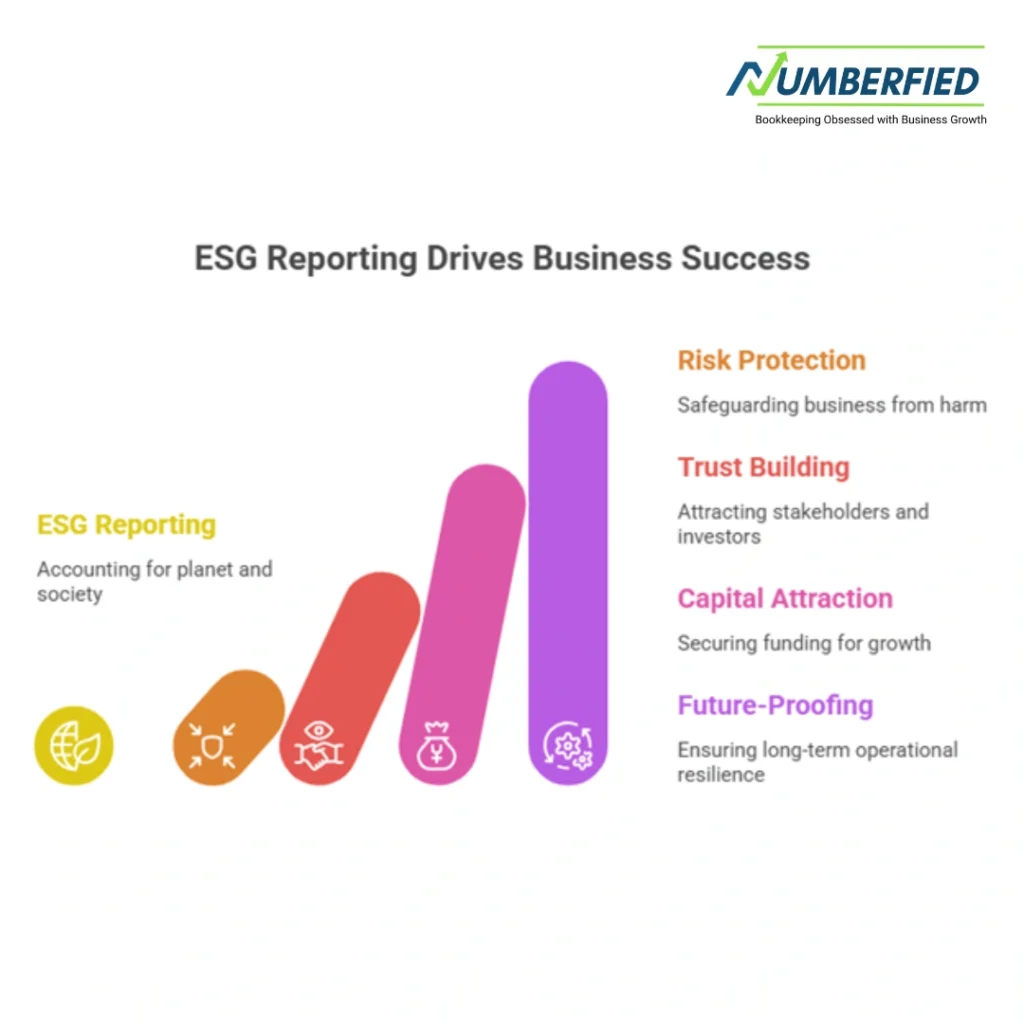
By embracing ESG reporting with the help of a skilled accounting team, you are not just protecting your business from risk; you are building trust, attracting capital, and future-proofing your operations for decades to come. The businesses that will thrive in the 2034 economy are those that start their ESG journey today.
Frequently Asked Questions (FAQs)
What is the difference between sustainability reporting and ESG reporting?
Sustainability reporting is a broader term that covers a company’s economic, environmental, and social impacts. ESG reporting specifically focuses on Environmental, Social, and Governance metrics that are material to investors and stakeholders.
Is ESG reporting mandatory in Australia?
For many large and medium-sized businesses, it is becoming mandatory. The Australian government is aligning with ISSB standards, requiring climate-related financial disclosures. Small businesses may not be mandated yet, but many supply chains require it.
How can accounting services help with ESG?
Professional accountants help by establishing data collection processes, ensuring data accuracy, aligning reports with regulatory frameworks, providing assurance (audits) over ESG data, and advising on how to improve ESG performance.
What frameworks are used for ESG reporting?
Common frameworks include the Global Reporting Initiative (GRI), Sustainability Accounting Standards Board (SASB), Task Force on Climate-related Financial Disclosures (TCFD), and the newly released IFRS S1 and S2 from the ISSB.
Does ESG reporting apply to small businesses?
While smaller businesses may not face mandatory reporting, they often need to provide ESG data to secure loans, attract certain investors, or win contracts with larger corporations that require supply chain sustainability.
What is carbon accounting?
Carbon accounting is the process of measuring how much carbon dioxide equivalents an organisation emits. It is typically broken into Scope 1 (direct emissions), Scope 2 (energy indirect), and Scope 3 (supply chain and customer indirect).
How much does professional ESG accounting cost?
Costs vary based on company size, data complexity, and the level of assurance required. Many accounting services now offer modular packages, from basic gap analysis to full assurance, making it accessible for SMEs.
What is the role of technology in ESG reporting?
Technology, including AI and cloud platforms, automates data collection from multiple sources (e.g., energy bills, HR systems), provides real-time analytics, and ensures data is audit-ready, reducing manual errors.
Can adopting ESG reporting save my business money?
Yes. The “Environmental” pillar often identifies inefficiencies in energy and water use. Moreover, good “Governance” can reduce legal risks and improve operational controls, directly impacting the bottom line.
How do I choose an accounting service provider for ESG?
Look for a provider with specific expertise in non-financial reporting, familiarity with ISSB/TCFD standards, a clear data security protocol, and a track record of integrating technology with traditional accounting.
Ready to turn sustainability into a strategic advantage? Whether you need help navigating new ESG regulations, integrating carbon accounting into your financial systems, or simply understanding where to start, the right accounting partner makes all the difference.
At Numberfied, we go beyond traditional bookkeeping and compliance. Our team combines expert virtual accounting services with growth-driven advisory -including the latest in sustainability and ESG reporting. We help business owners, accountants, and bookkeepers unlock real momentum by turning complex data into actionable insights.
Don’t wait for the “perfect timing.” The future of business is transparent, responsible, and sustainable.
Book Your Free Strategy Call Today and let’s discuss how we can help you master ESG reporting while growing your bottom line. Your future self (and your stakeholders) will be glad you did.