

Introduction
For decades, bookkeeping was viewed as a necessary evil -a rearview mirror for business owners, focused on historical data, compliance, and tax preparation. You would diligently record invoices, reconcile bank statements, and hope that your numbers were accurate. But in today’s fast-paced, data-driven economy, that traditional model is dying.
Enter Enterprise Resource Planning (ERP) Systems. Once reserved for multinational corporations with billion-dollar budgets, ERP technology has now trickled down to small and mid-sized businesses, fundamentally changing what bookkeeping means.
At Numberfied, we have witnessed this transformation firsthand. As noted in our analysis of modern financial tools, the lines between simple compliance and strategic growth are blurring. A recent study from Outbooks on Xero bookkeeping highlights a critical truth: business owners are suffering from a lack of in-house expertise and are unaware of the technological revolution in the accounting field.
This blog post will explore how ERP systems are moving bookkeeping beyond the spreadsheet, how they integrate with tools like Xero, and why your business needs to adopt this mindset now to survive the next decade.
What is an ERP System? (And Why It’s Not Just “Big Business” Software)
Before we dive into the impact on bookkeeping, we need to define the tool. An Enterprise Resource Planning (ERP) System is integrated management software that allows a business to collect, store, manage, and interpret data from its many activities.
Think of it as the central nervous system of your company. Instead of having separate software for bookkeeping (QuickBooks/Xero), inventory (Warehouse app), HR (Payroll software), and CRM (Salesforce), an ERP pulls all these functions into a single, unified database.
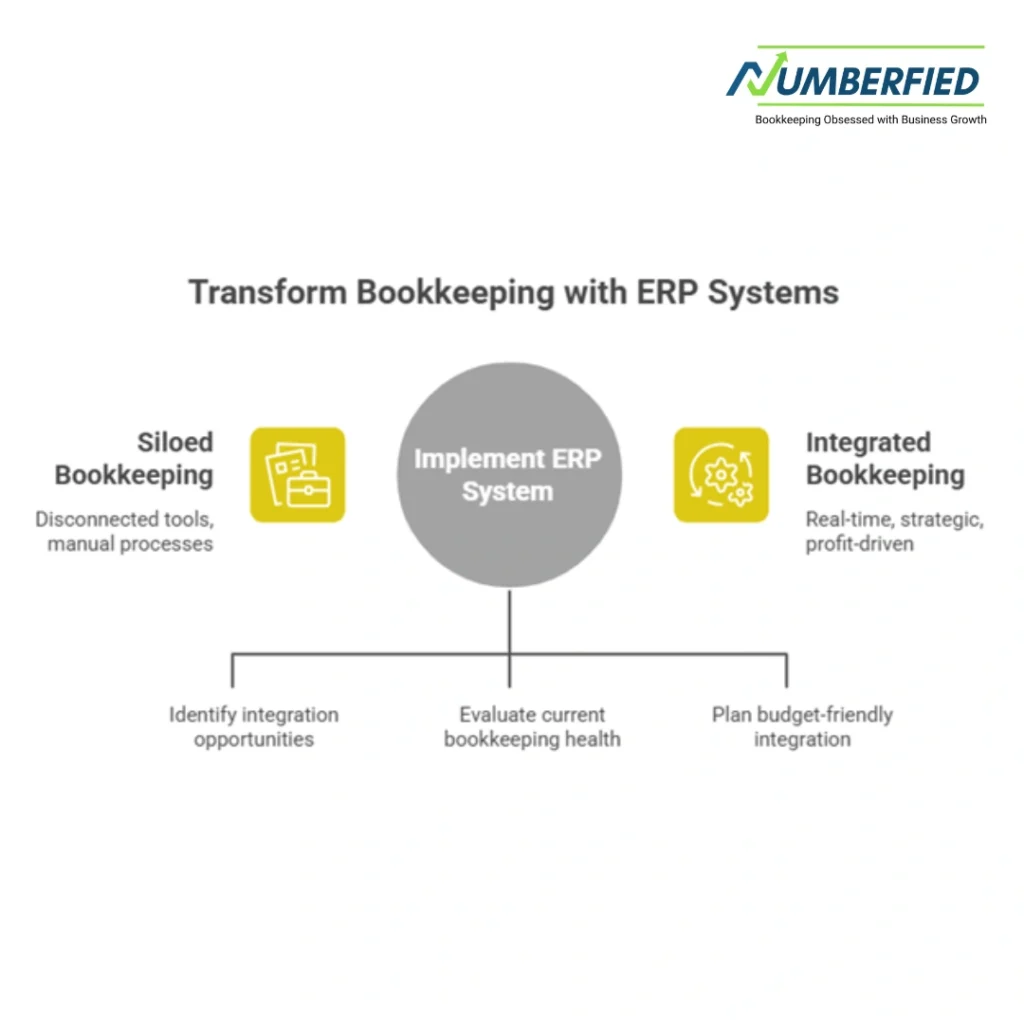
The Death of “Siloed” Bookkeeping
In the past, your bookkeeping software existed in a silo. The sales team closed a deal, but the invoice didn’t reach the accounts team for three days. The warehouse shipped a product, but the inventory count wasn’t updated in the bookkeeping ledger for a week.
With an ERP system, the moment a sale occurs:
- The inventory level drops automatically.
- The invoice is generated in the bookkeeping module.
- The bank feed updates the cash position.
- The revenue is recognized in the P&L.
This is the core shift: Bookkeeping is no longer a separate task; it is an automatic byproduct of doing business.
How ERP Integration Supercharges Your Bookkeeping (Keyword Focus)
When we talk about optimizing bookkeeping, we usually talk about speed and accuracy. However, ERP integration elevates the function to a strategic level. According to Numberfied’s philosophy, business owners are asking for more than compliance; they want growth-driven insights.
Here is how a modern ERP system changes the game for your bookkeeping department:
1. Real-Time Data Entry (The End of the Month-End Crunch)
Traditional bookkeeping is periodic. You gather receipts for a month, then spend a weekend “catching up.” ERPs automate this. Through bank feeds (like those found in Xero) and API connections, every transaction is pulled in and categorized in near real-time.
Referencing the Source: As noted by Outbooks, one major pain point is business owners being “unable to focus on core business activities as non-core activities, such as bookkeeping, cash flow and invoices take more of your time”. ERPs solve this by automating the capture, allowing you to focus on analysis, not data entry.
2. Error Reduction Through Automation
Humans make mistakes. We transpose numbers, double-pay invoices, or forget to record bank fees. ERPs apply “rules” to bookkeeping.
- Invoicing: Recurring invoices are generated automatically.
- Reconciliation: Xero and ERP integrations can match 90% of bank transactions without human touch.
- Audit Trails: Every change is logged. If a number changes, you know who did it, when, and why.
3. Cash Flow Visibility
The primary goal of bookkeeping is to know how much cash you have. However, traditional bookkeeping only tells you what happened yesterday. An ERP tells you what is happening right now. It combines accounts payable (what you owe) with accounts receivable (what you are owed) instantly. This allows for better decision-making regarding purchasing and investments.
The Xero Factor: Bridging ERP and Small Business Bookkeeping
You might be thinking, “This sounds expensive. I just use Xero. Is that enough?”
Xero is a fantastic cloud accounting platform. At Numberfied, we recognize it as a core tool for digital bookkeeping. However, Xero itself is not a full ERP. It is a financial ledger that integrates with ERPs.
The Hybrid Approach
For small to medium businesses, the “ERP Revolution” often looks like a “Best of Breed” approach. You keep Xero for the core bookkeeping (the general ledger, basic reporting, tax compliance), but you connect it to specialized inventory, warehousing, or project management tools via the Xero ecosystem.
Outbooks points out that Xero offers “integration with over 800 third-party apps and software” This effectively allows a small business to build a “micro-ERP.” You get the power of integrated data without the $100,000 price tag.
Why Numberfied Advocates for Integrated Tech Stacks
At Numberfied, we believe that bookkeeping should not be a bottleneck. Whether you are a bookkeeper looking to break free from the compliance grind or a business owner tired of carrying the weight alone, your tech stack matters.
By integrating your Xero bookkeeping with an ERP-lite tool (like Cin7, DEAR Systems, or even advanced Zapier connections), you achieve:
- Reduced Operating Costs: You avoid the expense of hiring a full-time data entry clerk because the system does the entry.
- Strategic Advisory: Your bookkeeping team stops chasing receipts and starts analyzing profit margins by product line.
Benefits of ERP-Driven Bookkeeping for Accountants & Owners
Who benefits most from this shift? Everyone. However, the specific advantages differ depending on your role.
For Business Owners
- No More Surprises: You log in on a Tuesday morning and see exactly where you stand, not where you stood 30 days ago.
- Scalability: Spreadsheets break when you hit a certain volume of transactions. ERPs scale with you.
- Bankability: Banks and investors trust financials that come from a robust ERP system more than those from a messy spreadsheet. The audit trail gives them confidence.
For Bookkeepers & Accountants
- Value-Added Services: As noted by Numberfied, most accounting services stop at compliance. By mastering ERP bookkeeping, you can offer “Strategic Growth Planning Sessions” and “Weekly Business Coaching.” You stop being a scorekeeper and start being a co-pilot.
- Client Retention: If you are integrated into a client’s ERP system, switching to a new accountant is a massive headache for them. You become sticky.
- Capacity: Automation frees you up to serve 50 clients instead of 20, or to dig deeper into the 20 you have.
Overcoming The Fears: Is ERP Too Complex for My Bookkeeping?
The biggest resistance to adopting ERP for bookkeeping is the fear of complexity. Many business owners and bookkeepers worry that they need an IT degree to operate these systems.
The User Experience Revolution
Modern ERPs (like Oracle NetSuite, Microsoft Dynamics 365 Business Central, or Odoo) have spent billions on user interface design. They now look and feel as simple as using Gmail or Xero.
- Dashboards: Customizable views for the bookkeeping team (showing reconciliation status) vs. the CEO (showing cash flow trends).
- Mobile Access: Just like Xero, most ERPs have mobile apps.
Implementation is a Partnership
You should not go it alone. This is where services like Numberfied come into play. We help bridge the gap between your current bookkeeping chaos and a streamlined ERP future. We turn your handover notes and team meetings into clear SOPs -an operations manual for smooth bookkeeping for life.
If you are a bookkeeper, learning a specific ERP (like Xero’s project tracking or advanced inventory) is the single best career move you can make right now to avoid being replaced by AI.
The Future of Bookkeeping: Predictive Analytics & Automation
We are standing at the edge of the next wave. The current ERP revolution is about integration (connecting silos). The next wave is about prediction.
From Recording to Predicting
Soon, your ERP + Bookkeeping system will not just tell you that you spent 5,000 on shipping last month. It will analyze your sales forecast for next month, predict that you will need 6000 for shipping, and automatically suggest holding cash in reserve.
The Role of Numberfied in This Future
At Numberfied, our mission is to ensure that business owners, accountants, and bookkeepers are not left behind by this technology. We combine professional bookkeeping with growth coaching because we know that numbers are only useful if they lead to action.
The future belongs to those who use ERPs to handle the mechanics of bookkeeping so that humans can focus on the magic of growth strategy, negotiation, and leadership.
Conclusion
The days of the green visor and the paper ledger are long gone. Even the era of the basic cloud spreadsheet is fading. To stay competitive in 2026 and beyond, your bookkeeping function must be integrated, real-time, and strategic.
Enterprise Resource Planning (ERP) Systems are the vehicle for that transformation. They turn bookkeeping from a cost center into a profit driver. Whether you are a small business using a Xero-integrated inventory system or a mid-market firm moving to NetSuite, the direction is clear: Silos are out. Integration is in.
If you are ready to stop chasing receipts and start chasing growth, it is time to audit your tech stack. Are you using 10 different tools that don’t talk to each other? Or are you building a unified system?
Take Action Now. Book a free strategy call with Numberfied. Let’s evaluate your current bookkeeping health and map out the ERP roadmap that fits your budget and ambitions. Don’t wait for the “perfect timing” -growth starts the second you integrate your data.
Also Read: Why Accounting Services for Ecommerce Are Your Australia Online Store’s Secret Sauce
Frequently Asked Questions (FAQs)
What is the primary difference between standard bookkeeping and ERP bookkeeping?
Standard bookkeeping involves manually recording transactions in a ledger (or basic software) after they happen. ERP bookkeeping automates the recording across all departments (sales, HR, inventory) in real-time, providing instant financial visibility.
Do I need to replace Xero with an ERP?
No. As highlighted by Outbooks, Xero is a powerful tool. For many SMBs, you can integrate Xero with ERP add-ons (inventory, CRM) to create a hybrid system. You only need a full ERP if your operations outgrow Xero’s native capacity.
Is an ERP system expensive for a small business?
Not anymore. Cloud-based ERPs have monthly subscription models (starting around 200−200−500/month) similar to paying for multiple SaaS tools. The cost is often offset by the efficiency gains in your bookkeeping department.
How does an ERP improve cash flow management?
By integrating accounts payable (bills to pay) with accounts receivable (invoices due), an ERP gives a real-time view of your “available cash,” preventing overdrafts and allowing for smarter vendor payment timing.
Can I implement an ERP myself?
It is risky. Bookkeeping data is sensitive. It is best to work with a partner like Numberfied or a certified consultant to ensure the data migration is accurate and the chart of accounts is set up correctly for your industry.
Is my data safe in a cloud ERP/Bookkeeping system?
Yes, most modern ERPs (and Xero) use bank-grade encryption, multi-factor authentication (MFA), and regular third-party security audits. They are often safer than a local computer in your office.
What is an “Audit Trail” in ERP bookkeeping?
An audit trail is a secure, computer-generated log that records every change made to a financial transaction. It shows the original value, the new value, who made the change, and the exact timestamp, eliminating fraud.
How does this affect my tax preparation?
It makes it much faster. Because your bookkeeping is always up-to-date and accurate, your tax accountant can close the books for the year in days rather than weeks. There is no frantic search for missing receipts in April.
Will AI replace bookkeepers if we use ERPs?
AI will replace data entry tasks. However, AI cannot replace the strategic advisor -the bookkeeper who interprets the data, advises on growth, and catches nuanced errors. Your role shifts from typist to analyst.
How do I know if my current bookkeeping is “ERP ready”?
If your current bookkeeping team spends more than 60% of their time on data entry and reconciliation, rather than analysis, you are ready for an upgrade. Contact Numberfied for a Health Check assessment.