

Introduction
Running a small business, being a sole trader, or launching a startup in Australia means wearing many hats and managing finances often feels like the heaviest one. Online bookkeeping accounting services change that by bringing professional financial management directly to your laptop or phone. These cloud-based solutions combine accurate record-keeping with powerful tools that save time, reduce stress, and keep you compliant with the ATO. In 2026, more Australian small business owners than ever rely on online bookkeeping accounting services to replace manual spreadsheets and late-night number-crunching. This guide explains the real benefits, compares options, highlights must-have features, and shows you exactly how to choose and implement the right service for your business.
Key Benefits of Online Bookkeeping Accounting Services
Online bookkeeping accounting services deliver clear, measurable advantages that directly impact your bottom line and day-to-day operations.
Real-Time Financial Visibility
One of the strongest benefits of online bookkeeping accounting services is instant access to your numbers. Bank feeds automatically pull transactions into the system, so you can see cash flow, profit margins, and outstanding invoices the moment they update. No more waiting for month-end reports; you can make informed decisions any day of the week.
Automation That Eliminates Manual Work
Modern platforms use AI categorisation, duplicate detection, and rule-based processing to handle repetitive tasks. What used to take hours of manual data entry now happens in minutes. This automation is a core reason online bookkeeping accounting services have become essential for busy sole traders and growing startups across Australia.
Significant Cost Savings
Compared with a full-time bookkeeper or in-house accountant, online bookkeeping accounting services typically cost 40–70% less. You pay only for the hours or package you need, with no superannuation, payroll tax, annual leave, or sick leave overheads. Many providers offer fixed monthly pricing, making budgeting simple and predictable.
Built-in ATO Compliance
Australian-compliant software automatically handles GST calculations, BAS preparation, Single Touch Payroll reporting, and super guarantee tracking. When you choose online bookkeeping accounting services from ATO-registered providers, you reduce the risk of penalties and interest charges that can quickly add up.
In-House vs Online/Outsourced Bookkeeping Comparison
Deciding between in-house staff and online bookkeeping accounting services comes down to cost, control, and capacity.
Cost Comparison
Hiring an in-house bookkeeper or junior accountant usually costs $60,000–$90,000 per year (salary + super + training + software). Online bookkeeping accounting services start from $300–$1,500 per month ($3,600–$18,000 annually), with no employment overheads. For most small businesses, outsourcing wins on price alone.
Expertise and ATO Knowledge
In-house staff may need ongoing training to stay current with ATO changes, such as STP Phase 2 or instant asset write-off rules. Online bookkeeping accounting services are delivered by specialists who live and breathe compliance updates, ensuring your BAS and tax returns are always accurate and up to date.
Scalability During Growth
An in-house role is fixed; you pay the same whether you have 50 or 500 transactions monthly. Online bookkeeping accounting services scale instantly: add payroll during hiring, increase transaction limits during peak seasons, or reduce scope in quieter months without redundancy costs.
Control and Real-Time Access
Some owners worry about losing control with outsourcing. Cloud platforms give you live dashboards, mobile apps, and approval workflows, so you see every transaction and can authorise payments from anywhere. Many providers offer dedicated account managers for regular check-ins, balancing hands-off efficiency with personal support.
Essential Features of Top Online Bookkeeping Accounting Services
The best online bookkeeping accounting services share features that make them genuinely valuable for Australian small businesses.
Automatic Bank Feeds & Reconciliation
Bank feeds pull transactions directly from your accounts, reducing manual entry. Smart reconciliation matches payments and highlights discrepancies instantly, saving hours and catching errors early.
AI Categorisation & Rule-Based Processing
Artificial intelligence learns your spending patterns and auto-categorises most transactions. Custom rules ensure consistent coding (e.g., all Uber Eats charges go to “Meals & Entertainment”). This cuts down on review time while maintaining accuracy.
Mobile Apps for On-the-Go Management
Leading platforms offer intuitive mobile apps where you can snap photos of receipts, approve bills, view cash flow, and check BAS status from your phone. Mobile access is now expected in online bookkeeping accounting services.
Seamless BAS & STP Integration
Australian-compliant software calculates GST, prepares BAS statements, and submits Single Touch Payroll data directly to the ATO. This removes the stress of quarterly deadlines and ensures superannuation and PAYG withholding are handled correctly.
Secure Client Portal & Collaboration
A secure portal lets you share documents, view reports, and communicate with your bookkeeper in one place. Real-time collaboration tools replace endless email threads and version-confusion issues.
Common Challenges and Mistakes to Avoid
Even with online bookkeeping accounting services, small business owners can trip over a few common issues.
Choosing on Price Alone
The cheapest option often lacks ATO expertise or reliable support. Low-cost providers may miss deductions or fail to keep up with compliance changes. Focus on value, expertise and communication matter more than the lowest dollar figure.
Poor Setup & Data Migration
Rushing the initial setup leads to messy historical data and ongoing corrections. Invest time upfront to map chart of accounts, connect all bank feeds, and clean legacy records. A proper setup saves months of frustration later.
Ignoring Receipt Capture Discipline
Relying on manual receipt uploads defeats the purpose of automation. Use mobile receipt-scanning apps religiously so every expense is captured and categorised correctly from day one.
Underestimating Advisory Needs
Many owners pick basic packages and later discover they need tax planning or cash flow forecasting. Start with a service that allows easy upgrades so you can access higher-level support as your business grows.
Weak Communication Expectations
Assuming the provider will “just know” your needs leads to misalignment. Set clear expectations for response times, reporting frequency, and escalation processes from the beginning.
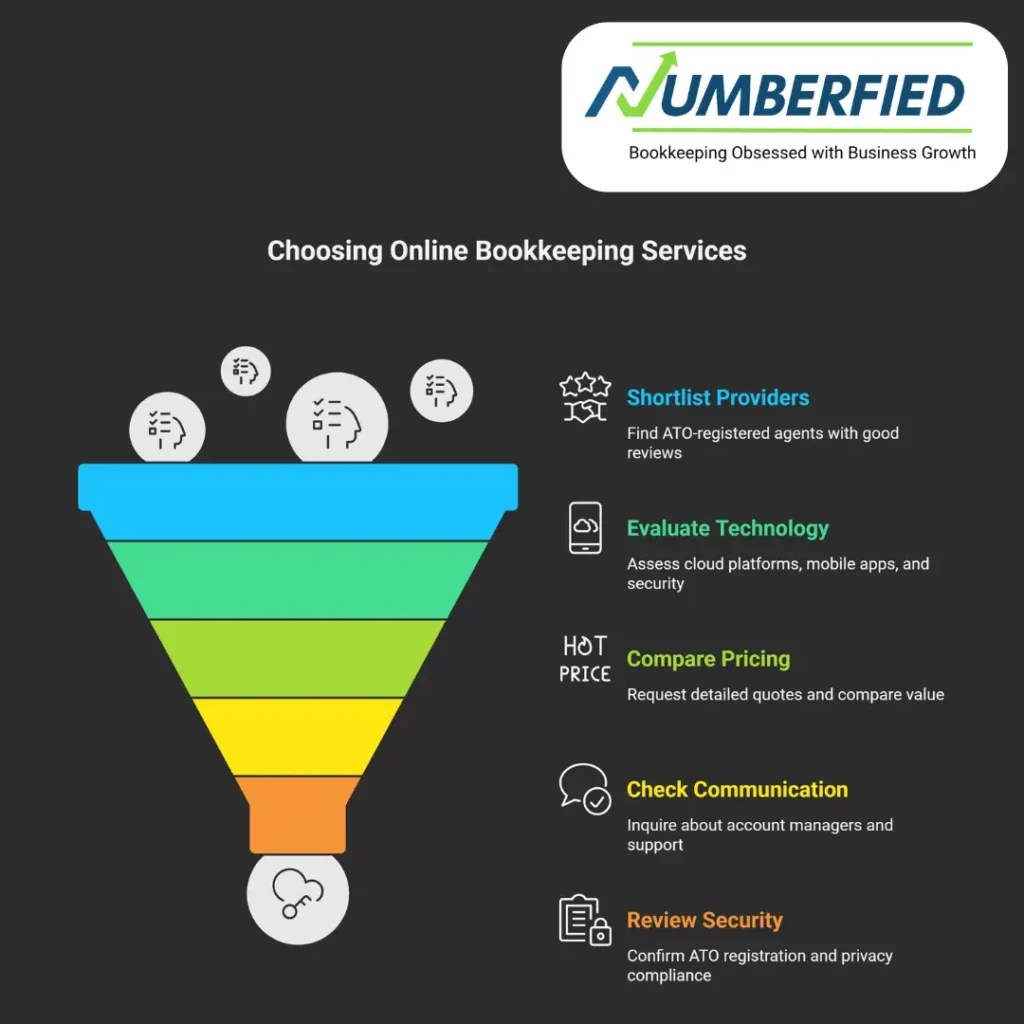
Step-by-Step Guide to Choosing Online Bookkeeping Accounting Services in Australia
Follow this practical process to find the right fit.
Step 1: Clarify Your Requirements
List must-have tasks: daily bookkeeping, BAS lodgement, payroll, tax returns, or advisory? Estimate monthly transactions and identify pain points (late BAS, poor cash flow visibility, etc.).
Step 2: Shortlist ATO-Registered Providers
Search for registered tax agents and BAS agents with strong reviews on Google and industry forums. Look for Xero or QuickBooks Online certification and experience with small business accounting in Australia.
Step 3: Evaluate Technology Stack
Ensure the service uses cloud platforms with bank feeds, mobile apps, and secure portals. Test the user interface; it should feel intuitive. Ask about data encryption and backup procedures.
Step 4: Compare Pricing & Inclusions
Request detailed quotes that list monthly fees, included services, and any extras (e.g., tax return preparation). Compare value, not just price, and look for fixed-fee packages that remove hourly surprises.
Step 5: Check Communication & Support
Ask about dedicated account managers, response times, and meeting frequency. Good online bookkeeping accounting services offer regular check-ins and clear escalation paths.
Step 6: Review Security & Compliance
Confirm the provider is ATO-registered and follows Australian privacy laws. Ask about cybersecurity measures and insurance coverage.
Step 7: Start with a Trial or Fixed Period
Many providers offer a trial month or a discounted first quarter. Use this to test accuracy, communication, and ease of use before committing long-term.
Top Providers and ATO Trends in 2026
ATO trends in 2026 centre on mandatory e-invoicing rollout, expanded Single Touch Payroll reporting, and increased data-matching for deductions. Online bookkeeping accounting services now use AI for 60–70% automatic categorisation and predictive cash flow alerts. Sustainability reporting is emerging in premium packages, and providers are strengthening cybersecurity to meet rising ATO data protection expectations.
Conclusion
Online bookkeeping accounting services have transformed financial management for Australian small businesses. They deliver real-time visibility, automation, cost savings, and ATO compliance without the overhead of in-house staff. By choosing the right provider, you gain not just accurate books but also the clarity and confidence to grow your business.
Ready to simplify your finances and reclaim your time? Request a free consultation today and see how online bookkeeping accounting services can work for you.
FAQ
What is the going rate for a full-charge bookkeeper?
The going rate for a full-charge bookkeeper in Australia in 2026 is typically $60–$100 per hour or $1,800–$4,000 per month for small to medium business clients. Monthly retainers most commonly fall between $2,000 and $3,500, depending on transaction volume, payroll needs, and reporting requirements.
Is online bookkeeping worth it?
Yes, online bookkeeping is worth it for most small businesses in Australia because it provides real-time financial visibility, automation, cost savings (40–70% less than in-house), and seamless ATO compliance. It frees up your time and reduces errors, making it especially valuable for busy owners and growing operations.
How much do bookkeepers charge per hour in Australia?
Bookkeepers in Australia charge $45–$90 per hour on average in 2026. Junior or freelance bookkeepers usually charge $45–$65 per hour, while experienced, BAS-registered, or full-charge bookkeepers typically charge $70–$90+ per hour, with higher rates in major cities like Sydney and Melbourne.
What is the hourly rate for a bookkeeper in Australia?
The hourly rate for a bookkeeper in Australia ranges from $45 to $90 in 2026. Most independent or freelance bookkeepers charge $50–$80 per hour, while certified BAS agents or full-charge professionals often charge $70–$90 or more, depending on experience and location.
What do freelance bookkeepers charge per hour?
Freelance bookkeepers in Australia generally charge $50–$100 per hour in 2026. Most freelancers charge $60–$80 per hour for standard services, with rates rising to $85–$100+ for those with specialisations, BAS agent registration, or experience in complex industries like e-commerce or trades.
How do I price myself as a bookkeeper?
As a bookkeeper in Australia, price yourself at $50–$90 per hour or $500–$2,500 per month per client in 2026. Start lower ($50–$70/hour or $500–$1,000/month) for basic services and increase to $80–$90/hour or $1,500–$2,500/month for full-service packages that include BAS, payroll, and reporting. Charge based on value, transaction volume, and your expertise level.
Is $40 an hour good in Australia?
$40 per hour is on the low end for a bookkeeper in Australia in 2026 and may be acceptable only for entry-level, very basic work or in regional areas. Most professional bookkeepers charge $50–$90 per hour, with $60–$80 being the realistic average for competent service. Charging $40 risks undervaluing your skills and attracting price-sensitive clients.
How much should I pay for bookkeeping services?
You should expect to pay $300–$2,000 per month for bookkeeping services in Australia. Basic packages for sole traders or low-volume businesses start at $400–$800, while full-service options (including BAS, payroll, and reporting) typically range from $1,200–$2,000+. The right price depends on transaction volume, complexity, and whether advisory is included.
What is the going rate for a full-charge bookkeeper?
The going rate for a full-charge bookkeeper in Australia is $60–$100 per hour or $1,800–$4,000 per month in 2026. Monthly retainers usually fall between $2,000 and $3,500 for comprehensive service covering reconciliations, payroll, BAS lodgement, and financial statements.
Is online bookkeeping worth it?
Yes, online bookkeeping is worth it for the majority of small businesses in Australia. It provides real-time access to your finances, automation that cuts manual work, significant cost savings compared to in-house staff, and built-in ATO compliance features. The convenience, accuracy, and time saved make it a smart investment for busy owners and growing operations.
Also Read: Why Accountant Services for Small Business Are Your Australia’s Ventures Secret Weapon