
Introduction
At Numberfied, we understand that running a small business in Australia comes with constant pressure to manage finances accurately while focusing on growth. Choosing to outsource bookkeeping for small business is not just a cost-saving decision; it’s a strategic move that gives you access to expert knowledge, improves compliance with ATO requirements, and provides real-time financial visibility. In this guide, we break down the practical reasons to outsource bookkeeping, how to select the right partner, and the step-by-step process for a smooth transition. With the right support, you can reduce administrative stress, gain clearer financial insights, and confidently make decisions that drive your business forward.
Key Takeways
- Outsource bookkeeping for a small business to access expertise, save time and improve accuracy.
- Clear steps for selecting a provider and transitioning smoothly to outsourced bookkeeping.
- Cost-benefit considerations, compliance tips and efficiencies you can expect immediately.
Why Australian Small Businesses Should Outsource Bookkeeping
Reduce administrative burden
When you outsource bookkeeping for a small business, routine tasks like bank reconciliations, BAS preparation and payroll processing are managed by experts. This reduces the administrative load on business owners and frees up time for strategic activities.
Improve accuracy and compliance
Outsourced bookkeeping for small businesses ensures transactions are recorded correctly, and GST reporting complies with ATO standards. Professional teams maintain up-to-date records, reducing the risk of errors that lead to penalties.
Access scalable expertise
Choosing to outsource bookkeeping for a small business gives you access to qualified bookkeepers, cloud accounting specialists and workflows that scale as your business grows. You gain capacity without the cost of hiring full-time staff.
Key benefits of outsourcing bookkeeping for small businesses
Cost savings and predictable pricing
Outsourcing bookkeeping for small businesses often reduces labour costs while providing predictable monthly fees. You avoid recruitment and training expenses, and you get a clear view of ongoing bookkeeping costs.
Faster financial insights
When you outsource bookkeeping for a small business, financial reports are produced regularly and accurately. That timelier reporting supports better cash flow management and faster decision-making.
Improved focus on core activities
Outsourced bookkeeping for small businesses lets you concentrate on sales, operations and customer service. Removing bookkeeping tasks from your workload increases focus on revenue-generating activities.
How to choose a provider to outsource bookkeeping for a small business
Assess qualifications and experience
Look for providers with certified bookkeepers, experience with Australian tax rules and a track record supporting businesses like yours. When you outsource bookkeeping for a small business, qualifications matter for accuracy and compliance.
Check technology and integrations
Ensure the provider uses cloud accounting platforms compatible with your systems. If you outsource bookkeeping for a small business, seamless integrations with Xero, QuickBooks or MYOB will save time and reduce errors.
Evaluate communication and service, model
When you outsource bookkeeping for a small business, clarify the communication channels, reporting cadence and turnaround times. Choose a provider that offers regular check-ins and clear escalation paths.
Step-by-step process to outsource bookkeeping for a small business
Step 1: Define requirements
Start by listing the tasks you want to outsource: daily transaction entry, reconciliations, payroll, BAS preparation or year-end support. A clear scope helps when you outsource bookkeeping for a small business and sets expectations.
Step 2: Request proposals and compare
Obtain proposals from multiple providers. Compare pricing, included services and sample reports. When you outsource bookkeeping for a small business, look for transparent fees and clearly defined deliverables.
Step 3: Plan the onboarding
Create a transition plan that includes access permissions, data migration, and key contacts. A structured approach smooths the transition when you outsource bookkeeping for your small business.
Onboarding checklist when you outsource bookkeeping for a small business
Data and access
Provide bank login details, accounting platform access and payroll systems. Securely share documentation and grant user permissions so the provider can begin when you outsource bookkeeping for a small business.
Historical records and reconciliation
Decide whether to convert historical records. Many businesses choose to reconcile the current year and archive prior years when they outsource bookkeeping for small businesses to manage costs and focus on current compliance.
Communication plan and reporting schedule
Agree on report formats, delivery frequency and the primary contact. When you outsource bookkeeping for a small business, a consistent reporting schedule ensures you receive the insights you need.
Pricing models and what to expect when you outsource bookkeeping for a small business
Fixed-fee packages
Fixed-fee packages include standard tasks and are common when you outsource bookkeeping for a small business. They provide cost predictability and are suitable for businesses with consistent volumes.
Hourly or ad-hoc pricing
Hourly rates suit project work or businesses with fluctuating needs. If you outsource bookkeeping for a small business for one-off tasks like BAS lodgement, hourly billing can be appropriate.
Tiered or custom pricing
Providers often offer tiered pricing based on transaction volume or tailored services. When outsourcing bookkeeping for a small business, request a service-level agreement to avoid scope creep.
Common services included when you outsource bookkeeping for a small business
Bank reconciliations and transaction entry
Core bookkeeping services include timely bank reconciliations and accurate transaction coding. When you outsource bookkeeping for a small business, these tasks form the foundation of reliable financial records.
Payroll and superannuation
Payroll processing, PAYG withholding and superannuation guarantee calculations are commonly included. Outsourcing these tasks ensures compliance with Australian employment and tax laws when you outsource bookkeeping for a small business.
BAS preparation and lodgement
Business Activity Statements require correct GST and PAYG reporting. Many clients choose to outsource bookkeeping for small businesses specifically to ensure BAS lodgements are accurate and on time.
Security, compliance and data handling when you outsource bookkeeping for a small business
Data security standards
Ask about encryption, secure file transfer and data backups. When you outsource bookkeeping for a small business, robust security practices protect sensitive financial information.
Privacy and confidentiality
Confirm confidentiality agreements and data access controls. When you outsource bookkeeping for a small business, clear privacy commitments are essential for regulatory compliance and trust.
Audit trail and documentation
Providers should maintain an audit trail for all adjustments and reconciliations. When you outsource bookkeeping for a small business, records must support future audits or tax reviews.
Measuring success after you outsource bookkeeping for a small business
Key performance indicators
Track KPIs such as days to reconcile, on-time BAS lodgements and month-end close time. When you outsource bookkeeping for a small business, measurable improvements demonstrate value.
Cash flow and profitability metrics
Regular reporting should highlight cash flow position, outstanding receivables and payables. After you outsource bookkeeping for a small business, expect clearer visibility of profitability drivers.
Client satisfaction and responsiveness
Evaluate the provider on communication quality and responsiveness. When you outsource bookkeeping for a small business, strong service levels are as important as technical competence.
Case studies: real outcomes when you outsource bookkeeping for a small business
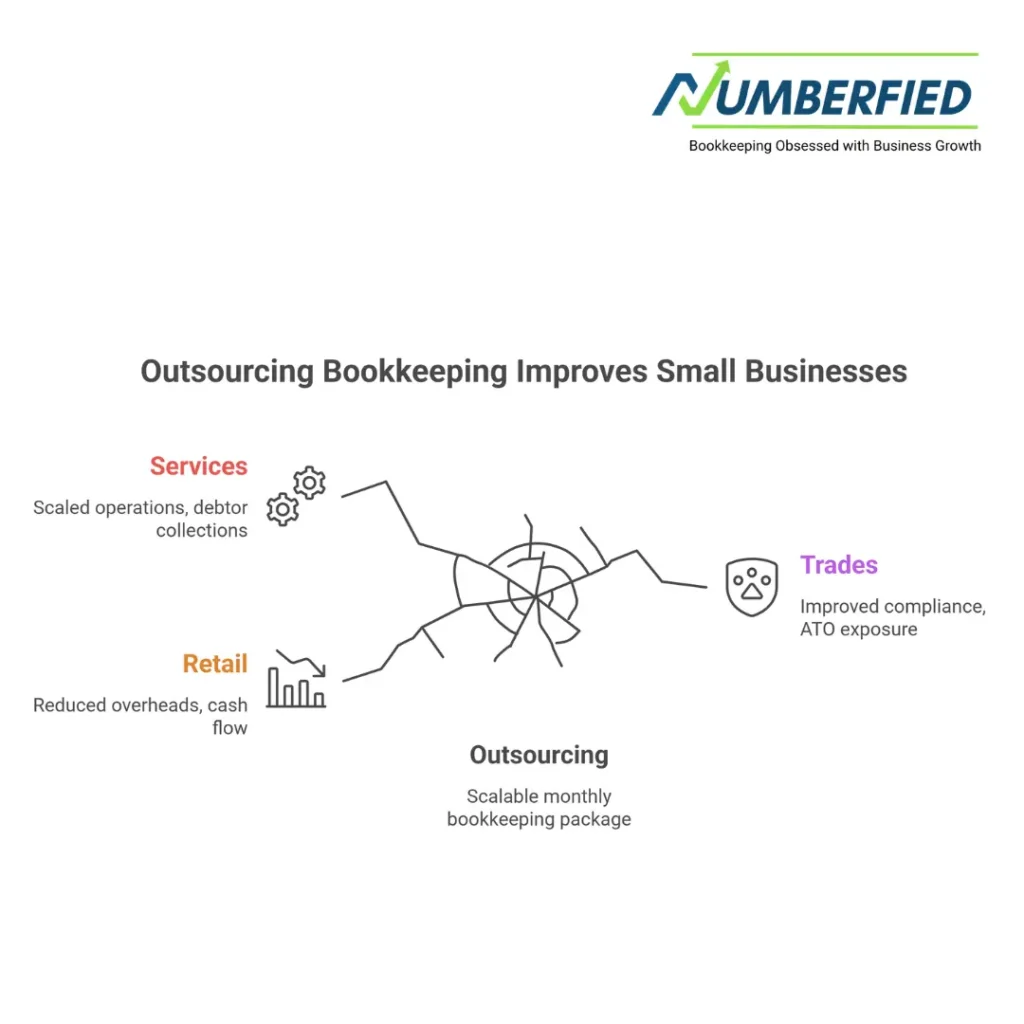
Retail business reduces overheads
A small retail operator outsourced bookkeeping for a small business and reduced overheads by replacing a part-time in-house role with a scalable monthly package. The business gained weekly cash flow reports and improved GST accuracy.
Professional services firm scales operations
A consultancy outsourced bookkeeping for small businesses to manage receivables and payroll as staff numbers grew. The consultancy avoided hiring additional administrative staff and improved debtor collections.
Trades business improves compliance
A trades business outsourced bookkeeping for small businesses to ensure BAS and payroll compliance. The resulting improvements reduced ATO exposure and provided better budgeting for seasonality.
Common objections and how to address them when you outsource bookkeeping for a small business
Concern about losing control
Maintaining read-only access and receiving regular reports keeps you in charge. When you outsource bookkeeping for a small business, well-defined controls and transparent processes preserve your oversight.
Worries about cost
Compare the full cost of in-house staff wages, superannuation, software and training with outsourced fees. When you outsource bookkeeping for a small business, you often gain better value and predictable costs.
Fear of security breaches
Request evidence of security measures and insurance. Reputable providers implement strong data protection when you outsource bookkeeping for a small business.
Practical tips to optimise the relationship once you outsource bookkeeping for a small business
Standardise documentation
Use consistent invoice templates, expense categories and bank naming conventions. Standardisation reduces errors when you outsource bookkeeping for a small business and speeds up processing.
Automate where possible
Set up bank feeds, receipt-capture tools, and automated rules. Automation lowers manual entry and increases accuracy when you outsource bookkeeping for a small business.
Schedule regular reviews
Hold monthly or quarterly review meetings to discuss reports, cash flow forecasts and upcoming tax obligations. Regular reviews ensure that outsourcing bookkeeping for small businesses remains aligned with business goals.
Transition and exit considerations when you outsource bookkeeping for a small business
Document processes and responsibilities
Maintain clear documentation of processes and access credentials. If you change providers, documented processes simplify the transition when you outsource bookkeeping for a small business.
Plan for data portability
Ensure the provider can export your data in standard formats. Data portability is important if you ever decide to change providers after outsourcing bookkeeping for your small business.
Contract terms and notice periods
Review contract terms for termination clauses, notice periods and finalisation fees. Clear terms protect your interests when you outsource bookkeeping for a small business.
How Numberfied helps when you outsource bookkeeping for a small business
Tailored service packages
Numberfied offers packages designed for Australian small businesses, covering day-to-day bookkeeping, BAS lodgements and payroll. When you outsource bookkeeping for small business with Numberfied, you receive service levels matched to your needs.
Cloud-based workflows and integration
We use leading cloud accounting platforms and implement integrations to reduce manual work. When you outsource small-business bookkeeping to Numberfied, you gain streamlined workflows and accurate data capture.
Dedicated support and transparent reporting
Numberfied provides a dedicated team, regular reporting and a client portal for easy access to documents. When you outsource bookkeeping for small business through Numberfied, you get clarity, timeliness and responsive support.
Conclusion
Outsourcing bookkeeping for small business is a strategic decision that improves accuracy, saves time and reduces costs. With the right provider and a clear onboarding plan, Australian small businesses gain better financial control and the freedom to focus on growth. If you are ready to outsource bookkeeping for small business, Numberfied offers tailored packages, secure workflows and transparent reporting to help you succeed.
Ready to reclaim time and secure your finances? Contact Numberfied today to discuss how we can help you outsource bookkeeping for small business and start delivering measurable results.
Frequently asked questions
What services are included when I outsource bookkeeping for small business?
Typical services include transaction entry, bank reconciliations, payroll processing, BAS preparation and reporting. Numberfied customises packages to match your needs when you outsource bookkeeping for small business.
How quickly can I transition when I decide to outsource bookkeeping for small business?
Transition times vary with complexity, but many small businesses can complete onboarding within 2–6 weeks. A clear plan accelerates the process when you outsource bookkeeping for small business.
Will I still have control over my accounts after I outsource bookkeeping for small business?
Yes. You retain ownership and can set permission levels. Providers work with you to ensure visibility and control when you outsource bookkeeping for small business.
Is outsourcing bookkeeping secure?
Reputable providers use encryption, secure portals and strict access controls. Confirm the security measures and privacy policies before outsourcing bookkeeping for a small business.
How much does it cost to outsource bookkeeping for small business in Australia?
Costs depend on transaction volumes and services required. Expect fixed monthly packages, hourly rates or tiered pricing. Compare full costs against in-house alternatives when you outsource bookkeeping for small business.
Can an outsourced bookkeeper handle payroll and superannuation?
Yes. Many outsourced providers manage payroll, PAYG withholding and superannuation. Ensure they are familiar with Australian legislation when outsourcing bookkeeping for small businesses.
Will outsourcing bookkeeping help with tax compliance?
Yes. Regular reconciliations and accurate records improve tax compliance and BAS lodgements. When you outsource bookkeeping for small business, you reduce risk and prepare for year-end processes.
How do I ensure a smooth handover to an outsourced provider?
Provide clear documentation, grant required access, agree on timelines and verify historical data scope. A formal onboarding plan is crucial when you outsource bookkeeping for small business.
Can outsourcing bookkeeping improve cash flow?
Yes. Faster invoicing, better debtor management and regular cash flow reports help you manage working capital. When you outsource bookkeeping for small business, you gain clearer cash flow visibility.
How does Numberfied measure success after clients outsource bookkeeping for small business?
We track reconciliation times, BAS timeliness, reporting accuracy and client satisfaction. These metrics demonstrate the value delivered when you outsource bookkeeping for small business with Numberfied.
Also Read: Why Accounting Services for Ecommerce Are Your Australia Online Store’s Secret Sauce