

Introduction
As a small business owner, sole trader, startup founder, or self-employed professional in Australia, your focus should be on growth, not grappling with financial paperwork. A reliable small business accounting service provides the professional support you need to handle daily records, BAS lodgements, tax returns, and more, all while keeping you compliant with the ATO. These services are a game-changer, offering expertise that saves time, reduces stress, and uncovers opportunities for savings. Whether you’re a cafe operator in Melbourne or a tradie in Perth, finding an exemplary small business accounting service can transform how you manage finances.
This guide explores the benefits, comparisons, essential components, mistakes to avoid, a practical selection process, top providers, ATO trends in 2026, and how to get started.
Key Benefits of Small Business Accounting Service
Small business accounting service delivers essential advantages that help you stay ahead in Australia’s competitive landscape.
ATO Compliance Made Simple
One of the greatest benefits of a small business accounting service is ensuring full ATO compliance. Professionals handle BAS lodgements, GST calculations, superannuation payments, and PAYG withholding, reducing the risk of audits or penalties. Small business accounting Australia experts keep you updated on rules like instant asset write-offs, preventing costly oversights.
Tax Savings Through Expert Planning
These services maximise deductions for expenses like home office setup, vehicle use, and depreciation, often saving thousands annually. Outsourced bookkeeping Australia allows for strategic timing of purchases to optimise tax outcomes. Virtual accountant for small business providers spot credits you might miss, turning tax time into an opportunity rather than a burden.
Time Freedom for Core Business Activities
Manual bookkeeping can consume 10-20 hours monthly. Small business accounting service automates much of this, freeing you to focus on sales, customer service, or innovation. BAS and tax services Australia streamline processes, eliminating late nights poring over spreadsheets.
Financial Clarity for Informed Decisions
With accurate, up-to-date records, you gain clear insights into cash flow, profitability, and trends. Cloud bookkeeping for small businesses offers real-time dashboards, helping you identify cost leaks or growth areas. This clarity supports better budgeting and forecasting, crucial for startups and sole traders.
In-House vs. Outsourced Small Business Accounting Service Comparison
Deciding between in-house and outsourced options for small business accounting services depends on your scale and resources.
Cost Implications
In-house staff typically costs $60,000–$90,000 annually (salary, super, training), plus software. Outsourced small business accounting service starts at $300–$1,500 monthly, with no employment overheads. For small businesses, outsourcing often saves 50-70%, making it more affordable while providing similar expertise.
Expertise and ATO Knowledge
In-house teams may lack specialised ATO knowledge, leading to errors in BAS or tax returns. Small business accounting in Australia from outsourced providers brings certified tax agents who stay current with legislation changes. This expertise ensures better compliance and deductions than a generalist hire.
Scalability and Flexibility
In-house roles are fixed, limiting adaptability during growth. Virtual accountant for small business scales easily, add payroll or advisory as needed without recruitment. BAS and tax services Australia offer tiered plans, ideal for seasonal businesses.
Control and Technology Access
Some fear losing control with outsourcing. Cloud bookkeeping for small businesses provides real-time dashboards and mobile access, maintaining oversight. Outsourced options often use advanced tools like Xero, enhancing efficiency over basic in-house setups.
Essential Services in Small Business Accounting Service
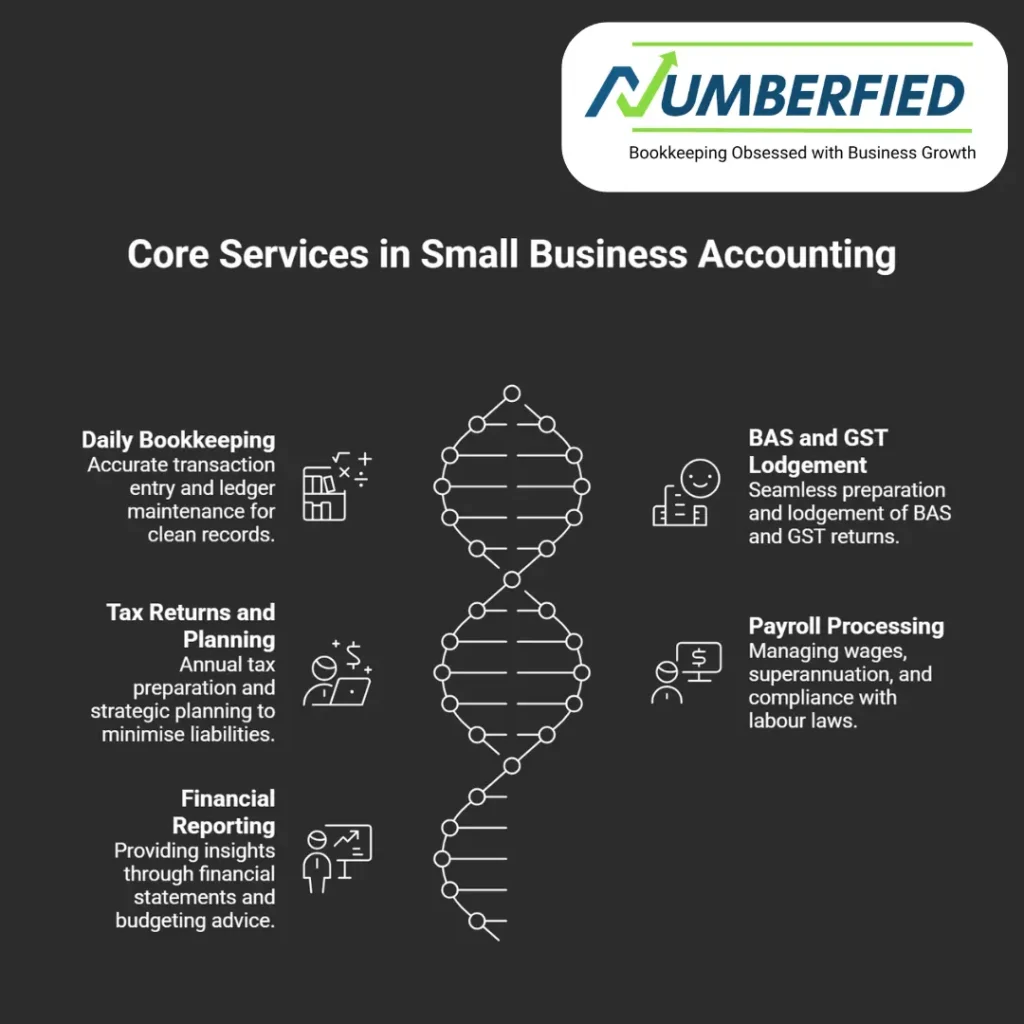
The best small business accounting service covers a core set of tasks to keep your finances in order.
Daily Bookkeeping and Record-Keeping
This includes transaction entry, bank reconciliations, expense categorisation, and ledger maintenance. Accurate daily work ensures clean records for ATO audits and tax time.
BAS and GST Lodgement
Professionals prepare and lodge quarterly or monthly BAS, handling GST credits and PAYG instalments. Small business accounting Australia makes this process seamless, preventing late fees.
Tax Returns and Planning
Annual tax return preparation and filing, with strategies to minimise liabilities through deductions like R&D incentives. Outsourced bookkeeping Australia offers year-round planning for better outcomes.
Payroll Processing
Managing wages, superannuation, PAYG withholding, and Single Touch Payroll reporting. A virtual accountant for a small business ensures compliance with Fair Work and ATO rules.
Financial Reporting and Advisory
Monthly profit and loss statements, balance sheets, cash flow forecasts, and budgeting advice. BAS and tax services in Australia provide insights to guide business decisions.
Common Mistakes to Avoid with Small Business Accounting Service
Even with professional help, pitfalls can occur. Here’s how to steer clear.
Mixing Personal and Business Expenses
Blending accounts complicates deductions and raises ATO flags. Use separate business accounts from the start to keep the small business accounting service efficient.
Delaying Engagement
Many wait until tax chaos, missing proactive savings. Engage a small business accounting service early to build accurate records from day one.
Ignoring Technology Integration
Choosing providers without cloud tools leads to manual work. Ensure compatibility with Xero or MYOB for streamlined small business accounting in Australia.
Overlooking Regular Reviews
Assuming “set and forget” misses errors. Schedule monthly check-ins with your outsourced bookkeeping Australia provider to review reports and adjust.
Focusing Solely on Cost
Cheap options may lack ATO expertise, leading to mistakes. Prioritise value in BAS and tax services Australia – quality saves more long-term.
Step-by-Step Guide to Choosing a Small Business Accounting Service in Australia
Follow this guide to find the right provider.
Step 1: Assess Your Business Requirements
Identify needs: bookkeeping only, full tax services, or advisory? Consider transaction volume, industry, and ATO obligations for a tailored small business accounting service.
Step 2: Research ATO-Registered Providers
Look for Tax Practitioners Board-registered agents with positive reviews. Check specialisations in small business accounting in Australia and cloud tools.
Step 3: Evaluate Qualifications
Confirm tax agent registration and experience with your entity (sole trader, company). Ask for case studies in outsourced bookkeeping in Australia.
Step 4: Check Technology and Features
Ensure use of ATO-approved software with bank feeds and portals. A virtual accountant for a small business should offer mobile access and secure data.
Step 5: Compare Quotes
Request detailed proposals outlining services and fees. Compare inclusions like BAS and tax services in Australia.
Step 6: Meet the Team
Schedule calls to assess communication. Discuss how they handle ATO audits or queries.
Step 7: Start with a Trial
Many offer trial periods. Monitor quality before committing.
Conclusion
A small business accounting service is vital for ATO compliance, tax savings, time freedom, and financial clarity. By selecting the right provider, you gain a partner that supports your success. Whether starting out or scaling up, these services provide the foundation you need. Ready to simplify your finances? Request a free consultation today and discover how a small business accounting service can elevate your operation.
FAQ
What is a small business accounting service?
A small business accounting service provides professional support for daily bookkeeping, BAS lodgements, tax returns, payroll, and financial reporting, tailored to sole traders, startups, and small companies. It ensures ATO compliance, maximises deductions, and gives you clear insights into your finances so you can focus on running your business.
How much does a small business accounting service cost in Australia?
Small business accounting service in Australia typically costs $300–$2,000 per month in 2026, depending on transaction volume and scope. Basic bookkeeping starts around $400–$800, while full-service packages (including BAS, tax returns, payroll, and advisory) usually range from $1,200–$2,000+ monthly.
Is a small business accounting service worth it for sole traders and startups?
Yes, it’s worth it for most sole traders and startups. The service saves time, reduces errors, uncovers deductions (often thousands in savings), and prevents ATO penalties, frequently paying for itself through better compliance and tax benefits.
What services are usually included in a small business accounting service?
Typical packages include daily bookkeeping, bank reconciliations, BAS/GST lodgement, payroll processing, monthly financial reports (profit & loss, balance sheet), annual tax return preparation, and basic advisory support. Many also cover superannuation compliance and cash flow forecasting.
Should I choose an in-house or outsourced small business accounting service?
An outsourced small business accounting service is usually better for most small businesses due to lower costs (no salary/super), access to ATO-registered experts, scalability, and cloud tools. In-house suits larger operations needing constant on-site control and oversight.
Do I need a CPA for small business accounting service?
Not necessarily for basic bookkeeping and BAS lodgement, but a CPA is highly recommended for complex tax returns, business structuring, audits, or advanced planning. Many small businesses use a bookkeeper for daily tasks and a CPA for tax season and strategic advice.
How do I choose the best small business accounting service in Australia?
Look for ATO-registered providers with strong reviews, cloud software (Xero, MYOB), transparent pricing, and good communication. Request a trial or consultation to test accuracy, responsiveness, and fit for your industry and business size.
What are the common mistakes with small business accounting service?
Common mistakes include mixing personal/business expenses, delaying engagement, ignoring cloud integration, underclaiming deductions, and choosing providers based only on low price. Proper setup, regular reviews, and focusing on value prevent most issues.
What are the latest trends in small business accounting services for 2026?
Trends in 2026 include AI automation for transaction categorisation, mandatory e-invoicing rollout, expanded Single Touch Payroll reporting, and ESG/sustainability tracking. Providers are focusing on real-time dashboards, predictive cash flow tools, and stronger cybersecurity to meet ATO demands.
How can I get started with a small business accounting service?
Start by assessing your needs (transaction volume, tax complexity), researching ATO-registered providers, comparing quotes, and checking software compatibility. Many offer free consultations or a trial period. Book one today to simplify your finances and focus on growing your business.
Also Read: Save Hours and Cash When You Outsource Bookkeeping Services for Your Small Business in Australia!