
Introduction
As a small business owner in Australia, managing finances can be overwhelming, but tax and accounting services for small businesses offer essential support to navigate ATO requirements and drive growth. These services go beyond basic number-crunching, providing the tools to maintain accurate records, optimise tax returns, and make informed decisions. Whether you’re a sole trader in Melbourne or a startup in Sydney, understanding tax and accounting services for small businesses is key to avoiding penalties and building a solid foundation. In this guide, we explore how these services can benefit your operations, from compliance to strategic advice.
Benefits of Tax and Accounting Services for Small Businesses
Tax and accounting services for small businesses deliver significant advantages that help entrepreneurs focus on what they do best. From ensuring ATO compliance to uncovering tax savings, these services provide peace of mind and financial efficiency.
Compliance with ATO Regulations
One of the primary benefits of tax and accounting services for small businesses is staying compliant with Australian Taxation Office rules. Professionals handle BAS lodgements, GST reporting, and superannuation obligations, reducing the risk of audits or fines. For instance, small business accounting Australia experts ensure your records align with current legislation, preventing costly errors.
Maximising Tax Savings
Tax services for small businesses can identify deductions and credits you might miss, such as home office expenses or vehicle allowances. Outsourced accounting in Australia allows for strategic planning, like timing asset purchases to optimise tax outcomes. This can result in substantial savings, freeing up capital for reinvestment.
Time Freedom for Business Growth
By delegating bookkeeping and tax preparation, you gain time to grow your enterprise. Virtual accountant Australia options mean you don’t need to spend hours on spreadsheets, allowing you to focus on sales and customer service. The efficiency of tax and accounting services for small businesses streamlines operations, boosting productivity.
Financial Clarity and Decision-Making
Regular financial reports from BAS and tax preparation services offer insights into cash flow and profitability. Small business accounting Australia professionals provide dashboards that highlight trends, helping you make data-driven decisions. This clarity is crucial for budgeting and forecasting in a competitive market.
In-House vs. Outsourced Accounting Comparison
Choosing between in-house and outsourced tax and accounting services for a small business depends on your scale and resources. Here’s a balanced look at both approaches.
Cost Implications
In-house accounting involves salaries, training, and software costs, often exceeding $60,000 annually for a full-time role. Outsourced accounting in Australia can start at $300–$1,500 per month, offering flexibility without fixed overheads. For startups, outsourcing is more cost-effective, avoiding recruitment expenses.
Expertise and Compliance
In-house staff may lack specialised knowledge in ATO changes, leading to errors. Tax services for small businesses via outsourced providers bring certified experts familiar with industry-specific deductions. Virtual accountant Australia ensures up-to-date compliance, reducing risks that an in-house team might overlook.
Scalability and Flexibility
In-house accounting is fixed, making it hard to scale during peak periods like tax season. Outsourced accounting Australia allows you to adjust services as your business grows, adding payroll or advisory services without hiring. This flexibility suits seasonal businesses or those expanding rapidly.
Control and Communication
In-house provides immediate access, but outsourced uses cloud tools for real-time visibility. Small business accounting Australia firms often offer dedicated portals and regular check-ins, maintaining control while outsourcing routine tasks. Communication is key-choose providers with clear reporting protocols.
Essential Services Included in Tax and Accounting
Tax and accounting services for small businesses encompass a range of offerings to keep your finances in order. Understanding these helps you select the right package.
Bookkeeping and Record-Keeping
Core to tax and accounting services for small businesses is accurate bookkeeping, including transaction tracking, bank reconciliations, and ledger maintenance. This ensures clean records for BAS and tax preparation, preventing discrepancies during ATO reviews.
BAS and GST Lodgement
Professional BAS and tax preparation services handle quarterly or monthly lodgements, calculating GST credits and liabilities. For small business accounting in Australia, this service is vital to avoid penalties and claim refunds promptly.
Tax Returns and Planning
Tax services for small businesses prepare and file your annual returns, maximising deductions like depreciation or R&D incentives. Forward planning minimises tax burdens, with outsourced accounting Australia offering year-round strategies.
Payroll Processing
Many tax and accounting services for small businesses include payroll, managing superannuation, PAYG withholding, and employee payments. This ensures compliance with Fair Work Australia rules and accurate reporting.
Financial Advisory and Reporting
Beyond basics, a virtual accountant in Australia provides monthly reports, cash flow forecasts, and business advice. This helps identify growth opportunities and financial risks early.
Common Mistakes to Avoid in Tax and Accounting
Even with tax and accounting services for small businesses, mistakes can occur. Awareness helps you partner effectively with providers.
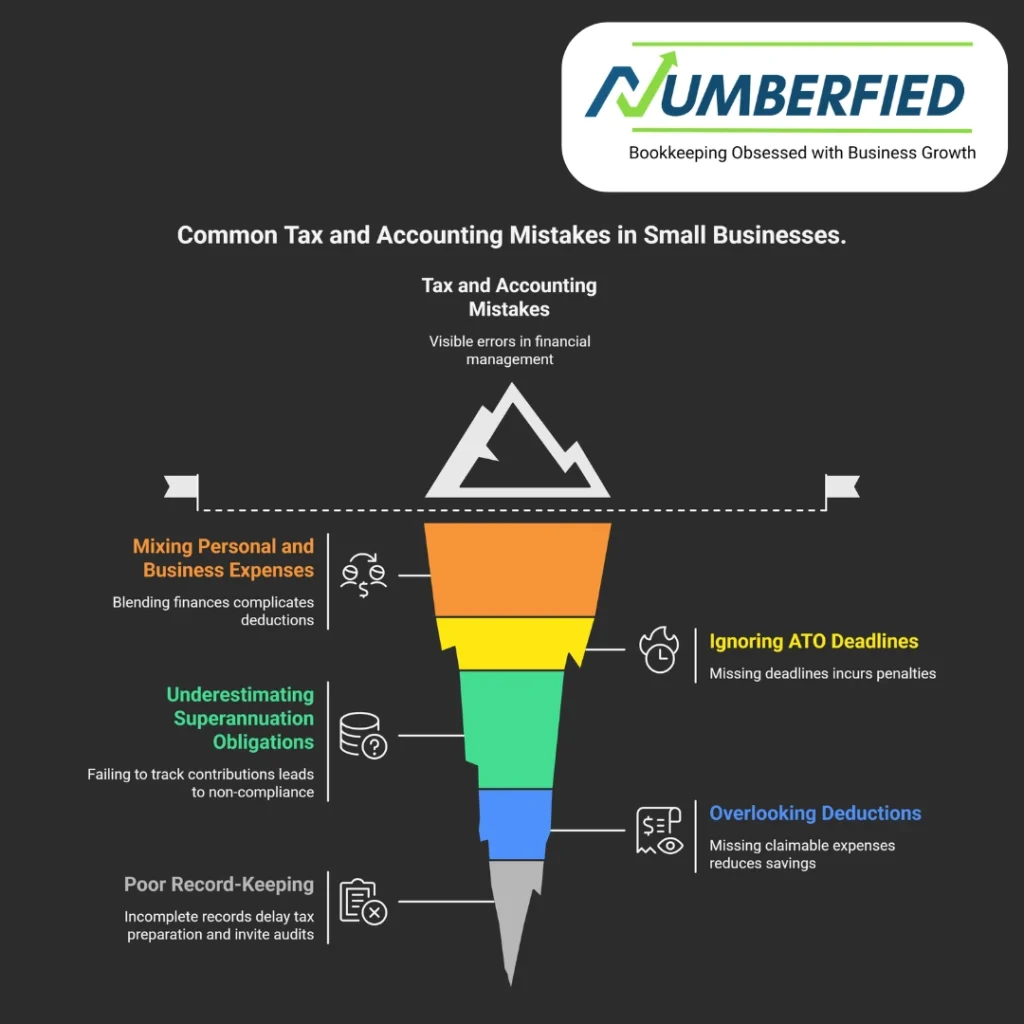
Mixing Personal and Business Expenses
A frequent error is blending personal and business finances, complicating deductions and raising ATO red flags. Small business accounting Australia experts recommend separate accounts to maintain clear records.
Ignoring ATO Deadlines
Missing BAS or tax return deadlines incurs penalties. Outsourced accounting Australia can set reminders and automate lodgements, but always review dates yourself.
Underestimating Superannuation Obligations
Failing to track super contributions leads to non-compliance. Tax services for small businesses include super management to avoid fines and ensure employee entitlements.
Overlooking Deductions
Many missclaimable expenses, like home office setup. Virtual accountant Australia professionals can audit records to uncover overlooked savings.
Poor Record-Keeping
Incomplete records delay tax preparation and invite audits. Use BAS and tax preparation services with digital tools for organised, accessible documentation.
Step-by-Step Guide to Choosing Tax and Accounting Services in Australia
Selecting tax and accounting services for a small business requires careful consideration. Follow this guide for a smooth process.
Step 1: Assess Your Needs
Determine your requirements-bookkeeping only, full tax services, or advisory? For small business accounting Australia, list transaction volume, entity type (sole trader, company), and any industry specifics.
Step 2: Research Providers
Look for ATO-registered agents with positive reviews. Outsourced accounting Australia options, like Xero-certified firms, ensure compatibility. Compare fees, services, and client testimonials.
Step 3: Check Qualifications
Ensure the provider has qualified accountants or BAS agents. Tax services for small businesses must comply with TPB standards. Ask for certifications and experience with similar clients.
Step 4: Evaluate Technology
Choose services using cloud tools for real-time access. Virtual accountant Australia with QuickBooks or Xero integration streamlines collaboration and reporting.
Step 5: Get Quotes and Contracts
Request detailed quotes outlining services and fees. Review contracts for confidentiality, turnaround times, and exit clauses. Start with a trial period if possible.
Step 6: Onboard and Monitor
Share access to your systems during onboarding. Regularly review reports and communicate needs. Adjust services as your business evolves.
Top Providers and ATO Compliance Trends in 2026
In 2026, tax and accounting services for small businesses in Australia are evolving with technology and ATO changes. Leading providers include H&R Block for affordable tax prep, KPMG for larger entities, and Bench or Pilot for virtual options. Local firms like My Accountant or TaxStore offer personalised small business accounting in Australia.
Trends focus on AI-driven automation for faster BAS processing and real-time ATO reporting. The ATO’s push for digital lodgements means services must integrate with Single Touch Payroll (STP) and e-invoicing. Virtual accountant Australia is booming, with 70% of small businesses opting for remote support for cost efficiency. Sustainability reporting is emerging, with providers adding ESG metrics to financial advice.
Look for providers compliant with the ATO’s latest super guarantee rules and tax avoidance crackdowns. Outsourced accounting in Australia with data security certifications (e.g., ISO 27001) is crucial amid rising cyber threats.
Conclusion
Tax and accounting services for small businesses are indispensable for compliance, savings, and growth in Australia. By partnering with experts, you gain financial clarity and time to focus on your passion. Whether it’s BAS preparation or strategic planning, these services safeguard your future. Ready to elevate your finances? Request a free consultation with a trusted provider today to discuss your needs.
FAQ
What is the meaning of tax and accounting services?
Tax and accounting services refer to professional assistance provided by accountants or tax agents to manage a business or individual’s financial records, ensure compliance with tax laws, and optimise tax outcomes. These services include bookkeeping, preparing financial statements, lodging tax returns, BAS statements, and offering tax planning advice to minimise liabilities legally.
What do you mean by tax accounting?
Tax accounting is the specialised area of accounting focused on preparing and filing tax returns, calculating taxable income, identifying allowable deductions, and ensuring compliance with ATO regulations. It differs from financial accounting by prioritising tax laws and rules over general reporting standards, helping individuals and businesses reduce tax burdens legally.
What is the meaning of accounting services?
Accounting services encompass a broad range of financial tasks, including bookkeeping, financial statement preparation, payroll processing, budgeting, and advisory work. They help businesses maintain accurate records, understand their financial position, meet regulatory requirements, and make informed decisions, often delivered by accountants or firms on an ongoing or project basis.
What is the meaning of service tax?
Service tax is a term not currently used in Australia; it was replaced by the Goods and Services Tax (GST) in 2000. GST is a 10% value-added tax applied to most goods and services sold in Australia. Businesses registered for GST collect it on taxable sales and claim credits for GST paid on purchases.
What falls under accounting services?
Accounting services include bookkeeping (recording transactions), financial reporting (preparing balance sheets, profit & loss statements), payroll management, BAS/GST lodgement, tax return preparation, auditing, budgeting, and financial advisory. They cover compliance, record-keeping, and strategic support to help businesses operate efficiently and meet ATO obligations.
What are the 4 types of accounting?
The four main types of accounting are financial accounting (preparing external reports like balance sheets), management accounting (internal reports for decision-making), tax accounting (focusing on tax compliance and planning), and cost accounting (analysing production costs). Each serves different purposes, with financial and tax accounting being most relevant for compliance.
What is the difference between accounting and tax accounting?
Accounting involves recording, classifying, and reporting financial transactions for overall business health, following GAAP or AASB standards. Tax accounting focuses specifically on calculating taxable income, applying tax laws, and preparing tax returns to minimise liabilities legally. While accounting provides a complete financial picture, tax accounting prioritises ATO rules and deductions.
How much is $100,000 salary after tax in Australia?
For the 2025–26 financial year, a $100,000 salary in Australia (resident individual) incurs approximately $22,967 in income tax and Medicare levy, leaving around $77,033 after tax. This assumes no other deductions or offsets; actual take-home pay varies with superannuation, HECS debt, or tax offsets.
How much does a tax adviser charge?
Tax advisers in Australia typically charge $150–$400 per hour in 2026, depending on experience and location. For small businesses or individuals, annual tax return preparation often costs $800–$3,000, while ongoing advisory retainers range from $300–$1,500 per month for regular clients.
How much is a tax accountant fee?
Tax accountant fees vary widely: individual tax returns average $300–$1,200, small business returns $800–$3,500, and monthly accounting retainers $500–$2,500. Hourly rates are usually $180–$350. Fees depend on complexity, entity type (sole trader vs. company), and whether BAS, payroll, or advisory work is included.
Also Read: How Accounting Services Bookkeeping Can Transform Your Australian Business