

Introduction
Most founders are control freaks. It is a necessary survival trait in the early days. You wear every hat. You sweep the floors. You close the deals. You manage the books. But there is a dangerous lie that permeates the startup world. We tell ourselves that because we can do the math, we should manage the finances. This mindset is a silent revenue killer.
You likely started with a subscription to QuickBooks or Xero. It felt responsible. It was cheap. But as your revenue grows, that software stops being a solution and starts becoming a liability. Software is a tool. It is not a strategy. It cannot interpret tax law. It cannot spot a cash flow crisis three months out. Identifying the best accounting services for small business isn’t about offloading a chore. It is about stopping the financial bleeding you don’t even know is happening.
Key Takeaways
- The Tipping Point: Recognizing the revenue milestones where DIY accounting becomes negligent.
- The Phantom Tax: How “saving money” on bookkeeping often triggers expensive audits and tax overpayments.
- Software Limitations: Why tools like Xero and FreshBooks require human oversight to function correctly.
- CEO ROI: Calculating the actual cost of your time when you spend it on data entry instead of growth.
- Hybrid Solutions: Combining automation with expert strategy.
The Illusion of Automation: Why Software Is Not Enough
We live in an era where we expect technology to solve everything. The marketing campaigns for major accounting platforms are brilliant. They promise that with a few clicks, your bank feeds will reconcile themselves. They promise that tax season will be a breeze.
This is a half-truth.
Accounting software is excellent at aggregation. It pulls data from your bank accounts and credit cards into one central hub. That is where the automation ends and the interpretation begins. Software does not know what a transaction is. It only knows that money moved.
The Categorization Trap
Artificial intelligence in these platforms is getting smarter. However, it is still prone to massive errors. The software might see a purchase at a steakhouse. It defaults to “Meals and Entertainment.”
Perhaps that dinner was actually a client acquisition meeting. Perhaps it was a staff holiday party. Perhaps it was a personal expense you accidentally put on the corporate card.
The tax implications for these three scenarios are radically different. Some are 50% deductible. Some are 100% deductible. Some are not deductible at all. If you accept the software’s default categorization, you are either triggering an audit risk or throwing away a valid tax shield. A human bookkeeper asks the context. Software just guesses.
Garbage In, Garbage Out
Your financial reports are only as good as the data entered. If you misclassify a capital asset as an immediate expense, your Profit and Loss statement is wrong. Your Balance Sheet is wrong.
When you go to apply for a line of credit or bring on an investor, they will look at these reports. If they see amateur errors, your valuation drops. You look risky. The software did its job by recording the numbers. You failed yours by not understanding where they go.
The Tipping Point: Signs You Have Outgrown DIY
There is a phase where DIY makes sense. If you are a freelancer making $50,000 a year with three monthly expenses, hire a CPA for taxes and do the rest yourself. But businesses grow. Complexity compounds.
There is a specific moment where the cost of mistakes exceeds the cost of hiring help. We call this the Tipping Point. It usually happens long before founders realize it.
The Revenue Ceiling
Typically, once a business hits $250,000 to $500,000 in annual revenue, DIY accounting becomes dangerous. At this volume, the transaction count is too high for a “quick check” on weekends.
The volume of data creates a fog. You stop seeing individual transactions and start looking at aggregate balances. You assume the bank balance is accurate. You stop reconciling. This is when fraud happens. This is when subscriptions you cancelled six months ago keep charging you. You are too busy making money to notice you are leaking it.
Inventory and COGS Complexity
Service businesses have it easier. E-commerce and retail businesses face a brutal reality. Cost of Goods Sold (COGS) is not just what you paid for the product. It involves shipping, customs, packaging, and storage.
Software like FreshBooks struggles with complex inventory management without heavy configuration. If you are expensing inventory the moment you buy it rather than when you sell it, your margins are fiction. You might think you are profitable because you have cash in the bank. In reality, you might be selling at a loss once true COGS are calculated. A professional accountant sets up accrual accounting to match revenue with expenses properly.
The “Saturday Morning” Test
Here is the ultimate litmus test. What are you doing on Saturday morning?
If you are logging into your bank account to categorize expenses, you are failing as a CEO. Your energy is a finite resource. Every hour you spend fighting with a spreadsheet is an hour you are not training your sales team. It is an hour you are not refining your product.
If you resent looking at your books, you will rush them. Rushed accounting is inaccurate accounting.
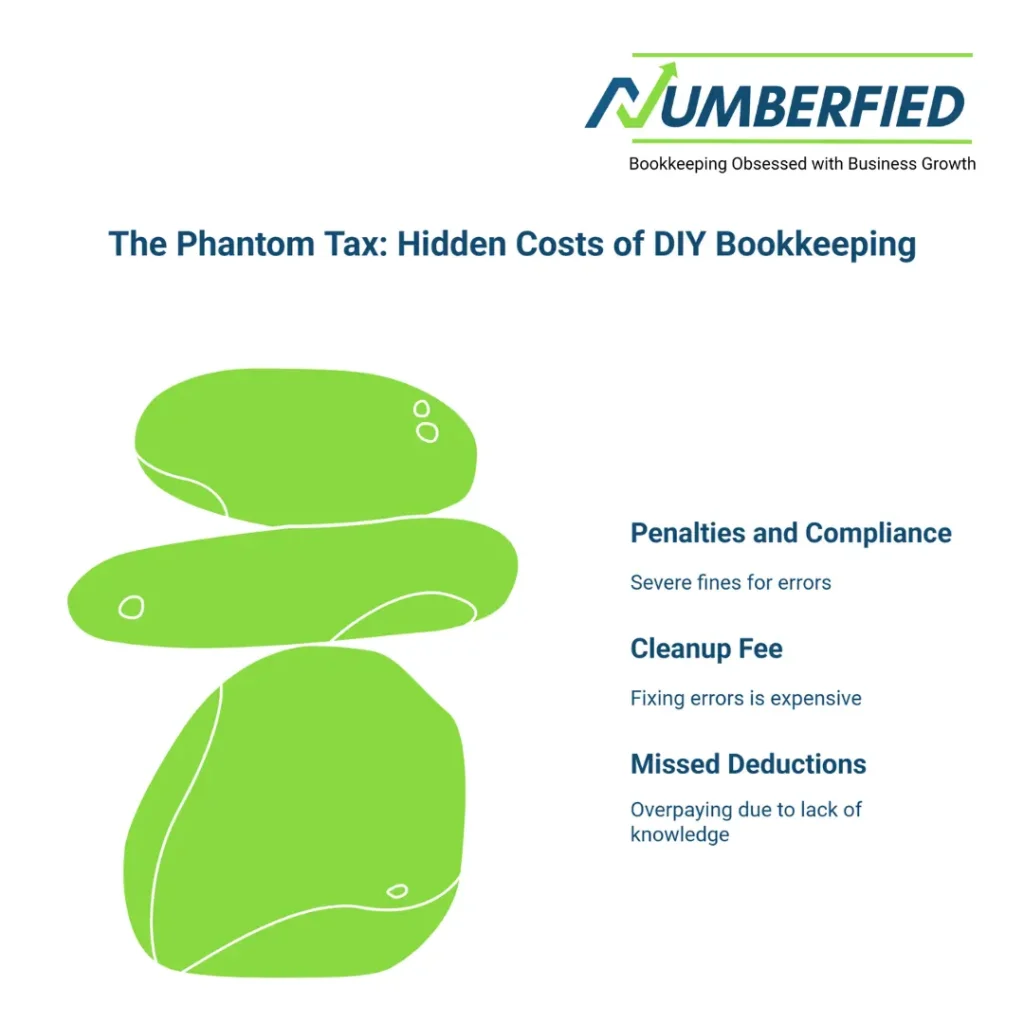
The Phantom Tax: Hidden Costs of Amateur Errors
Entrepreneurs often balk at the monthly retainer of a professional service. They see a $500 or $1,000 monthly expense and think, “I can save that.”
This is false economy. You are not saving money. You are deferring pain. There is a “Phantom Tax” associated with DIY bookkeeping that shows up in three distinct ways.
Missed Deductions
The tax code is dense. It changes annually. Professionals spend their entire careers studying these changes. You spend five minutes Googling them.
You will miss things. You might miss the Qualified Business Income (QBI) deduction nuances. You might fail to depreciate your assets correctly. You might not realize that your home office renovation could have been partially expensed. These missed opportunities compound over years. You could easily overpay the IRS by $5,000 to $10,000 simply because you didn’t know what to claim. That “savings” on the bookkeeper just evaporated.
The Cleanup Fee
This is the most common scenario we see at Numberfied. A founder runs their own books for two years. They finally hire us because they are being audited or looking to sell.
We open the file. It is a disaster. Negative cash balances. Unreconciled accounts from 2022. Duplicate income entries.
We have to fix it. Forensic accounting is expensive. Most of the time, the cost of fixing wrong data for two years is as much as three times the money that was needed to be done correctly the first time. You pay for the cleanup. Then you pay to amend your tax returns. Then you pay the penalties and interest on the incorrect filings.
Penalties and Compliance
Payroll tax is not something to mess with. The government does not have a sense of humor regarding payroll compliance. If you miss a deadline or miscalculate a withholding, the fines are automatic and severe.
Software automates the filing, but you must feed it the right inputs. If you misclassify an employee as a contractor, the software won’t stop you. The Department of Labor, however, will destroy you.
The ROI of Professional Oversight: Reframing the Expense
Stop looking at accounting as overhead. It is data intelligence.
When you hire a professional service, you are buying clarity. You are purchasing a dashboard that tells you exactly which levers to pull to increase profitability.
Cash Flow Forecasting
Most DIY founders run their business on “Bank Balance Accounting.” If there is money in the bank, they spend.
This leads to cash crunches. A professional looks at your Accounts Payable and Accounts Receivable. They tell you, “Yes, you have $50,000 in the bank, but you have $40,000 in bills due next week and payroll in ten days. Do not buy that new equipment.”
Forecasting allows you to make decisions with confidence. You know exactly when you can afford to hire. You know when you need to draw on a line of credit. This strategic insight prevents bankruptcy.
Profit Margin Analysis
Is your main product actually generating you money? You could be having a high revenue, but your margins might be very low after you have taken into account the labor, ads and overhead.
A bookkeeper separates your revenue streams and allocates costs accordingly. You might discover that your “best” client is actually costing you money. You might find that a neglected service line has an 80% margin and deserves more focus. This analysis shifts your entire business strategy.
How to Identify the Best Accounting Services for Small Business
Not all firms are created equal. The market is flooded with data entry clerks posing as accountants. You do not need someone to just type numbers. You need a partner. While assessing providers, it is necessary that you identify certain characteristics which not only indicate their efficiency but also their compatibility with ambitious growth objectives.
Industry Specificity
Generalists are fine for general businesses. If you are a specialized entity, you need a specialist. A SaaS company has different revenue recognition rules (ASC 606) than a construction company (percentage of completion).
Ask potential providers about their current client roster. If they don’t understand your unit economics, they cannot advise you. They will just record history. You need someone who can predict the future based on industry benchmarks.
Tech Stack Agnosticism
Be wary of firms that force you into a specific software because it is “what they use.” The best firms adapt to your needs or recommend the best stack for your specific workflow.
They should be experts in the ecosystem. They should know which inventory app integrates best with Shopify. They should know which payroll provider handles multi-state compliance best. They act as a CIO for your finance department.
Communication Cadence
How often will you hear from them? If the answer is “once a year at tax time,” run.
Modern accounting services are proactive. You should receive monthly reports. You should have quarterly strategy calls. They should be pinging you on Slack or email when they see a transaction that looks odd. The relationship must be continuous. Financial visibility is not a once-a-year event.
The Hybrid Model: The Future of Finance
We are not advocating for a return to paper ledgers. The ideal setup is a hybrid model. This combines the efficiency of cloud-based software with the discernment of human expertise.
You Own the Data
You should always maintain admin access to your Xero or QuickBooks file. The bookkeeper works inside it. This ensures transparency. You can see what they are doing. You are not held hostage.
The Human Pilot
Think of the software as the autopilot on a plane. It handles the steady cruising. But you need a pilot for takeoff, landing, and turbulence.
Your bookkeeper monitors the feeds. They manage the reconciliations. They handle the accruals. Then, they translate that technical work into plain English for you. They convert “Deferred Revenue” into “Cash we have collected but haven’t earned yet.”
This partnership allows you to remain the visionary. You set the course. They ensure the plane has enough fuel to get there.
Conclusion
The transition from DIY to professional accounting is a rite of passage. It signals that your business has moved from a hustle to an organization.
Clinging to the ledger is not a badge of honor. It is a chokehold on your potential. The hidden costs of errors, the wasted time, and the lack of strategic data are far more expensive than a monthly fee. You built your business to solve a problem for your customers. You did not build it to categorize receipts at midnight.
Invest in the best accounting services for small business you can find. Reclaim your time. Protect your margins. Let the pros handle the math so you can handle the growth.
Frequently Asked Questions
1. Can’t I just ask my CPA to do my bookkeeping?
Most CPAs focus on tax filing, not day-to-day bookkeeping. Their hourly rates are too high for monthly reconciliation. You need a dedicated bookkeeper for the monthly work and a CPA for the year-end strategy.
2. How much should I budget for accounting services?
Expect to pay between $300 and $800 per month for quality bookkeeping for a growing small business. If you are paying less, you are likely getting automated junk.
3. What is the difference between cash and accrual accounting?
Cash accounting records revenue when money hits the bank. Accrual records revenue when it is earned, regardless of payment. Accrual is essential for understanding true profitability.
4. Will I lose control of my money if I hire someone?
No. A bookkeeper should have “view only” or “data entry” access to your bank. They should never have authority to sign checks or move funds without your approval.
5. When is the right time to switch?
The moment you can’t answer “What is my profit this month?” instantly. Or when your annual revenue exceeds $250,000. Whichever comes first.
Ready to stop guessing?
Book a FREE Strategy Call with Numberfied today. Let’s clean up your books and build a roadmap for profit.
Also See: Why Bookkeeping Services for Small Businesses Are Your Secret Weapon for Stress-Free Success