
Introduction
For many small business owners and startups, managing accounting and bookkeeping in-house drains time and distracts from growth. Outsourcing accounting services for small business delivers expert bookkeeping, real-time financial reporting, and advisory support so you can focus on customers and scaling your business.
Why Small Businesses Outsource Accounting
Outsourced accounting provides access to accounting professionals, advanced accounting software, and consistent financial systems without the overhead of hiring a full-time internal accounting team. Whether you need simple bookkeeping, monthly financials, tax filing, or outsourced CFO services, outsourcing accounting for small businesses brings predictable costs, better financial oversight, and peace of mind.
Core benefits of outsourcing accounting services
- Cost savings: Reduce payroll, benefits, and training expenses compared to hiring full-time staff.
- Real-time financial visibility: Cloud-based accounting gives you up-to-date financial data and cash flow insights.
- Scalable support: Add bookkeeping services, accounting support, or outsourced CFO services as your business grows.
- Expert financial reporting: Accurate financial statements and advice that support better business decisions.
- Improved compliance: Professionals handle tax filing, preparation services, and regulatory reporting.
Common Services Offered by Outsourced Accounting Firms
Outsourced accounting firms and virtual accounting services typically provide a mix of these services tailored to the needs for small businesses and startups:
- Bookkeeping and expert bookkeeping using bookkeeping software and cloud-based accounting platforms.
- Monthly financials and financial statements preparation for owners and lenders.
- Tax services and tax filing preparation are often coordinated with your CPA.
- Outsourced CFO and advisory services for strategic financial planning, cash flow forecasting, and budgeting.
- Accounts payable/receivable management, payroll coordination, and bill pay.
- Implementation of accounting systems and bookkeeping software, with training for your team.
Related Terms You May See
When researching options for outsourcing accounting services for small business, you’ll encounter related terms like outsourced bookkeeping, virtual accounting services, small business financial outsourcing, remote accountant, and cloud-based accounting. These describe different delivery models but often overlap in services and outcomes.
DIY vs. Outsourced: A Practical Comparison
Choosing between doing accounting in-house and hiring an outsourced accounting service depends on cost, control, and complexity. Here’s an objective comparison to help a business owner decide.
DIY / In-house Accounting
- Pros: Direct control, immediate access to physical documents, and potential cultural fit with the internal team.
- Cons: High fixed costs (hiring, benefits), limited access to advanced accounting software or advisory, reliance on one or two employees for critical financial processes, and risk during staff turnover.
Outsourced Accounting
- Pros: Access to accounting professionals and outsourced accounting firms with specialized expertise, scalable services, better financial reporting and oversight, predictable monthly costs, faster implementation of advanced accounting software, and fewer compliance risks.
- Cons: Requires careful vendor selection, some control is delegated, and there is potential onboarding time.
For many growing businesses and startups, the advantages of outsourcing accounting, especially access to an outsourced CFO and real-time financial insights, outweigh the downsides of losing some direct control.
Top Providers and What to Look For
There are many outsourced accounting firms and remote accounting services servicing U.S. small businesses. When evaluating providers, prioritize these features:
- Expertise in small business accounting and tax services, looking for experience with businesses that need bookkeeping, payroll, and advisory services.
- Cloud-based accounting and bookkeeping software proficiency (QuickBooks Online, Xero, or similar).
- Clear, secure processes for financial data handling and real-time reporting capabilities.
- Range of services: bookkeeping services, outsourced CFO, bookkeeping software support, tax filing, and advisory services.
- Transparent pricing and defined service levels avoid companies that over-promise with low-cost, low-quality deliverables.
- Client references and case studies demonstrating measurable benefits, such as improved cash flow or reduced month-end close time.
Examples of well-known types of providers
- Virtual accounting platforms that combine software and bookkeeping teams for startups and small business owners.
- Specialized outsourced accounting firms that provide outsourced accounting services and outsourced CFO support.
- Local accounting firms offering hybrid services, remote bookkeeping with occasional on-site advisory.
Common Mistakes Small Business Owners Make
Avoid these frequent errors when selecting outsourced accounting services:
- Choosing low cost over quality: Low prices often mean undertrained staff, manual processes, and data errors that increase long-term costs.
- Lack of clarity about scope: Not defining monthly deliverables, timelines, and ownership of financial reporting leads to confusion and missed deadlines.
- Ignoring security: Failing to vet data protection practices puts financial data at risk.
- Not planning transition: Attempting to switch providers without a step-by-step plan causes disruptions to payroll, tax filings, and cash flow visibility.
- Overlooking integration: Selecting vendors that don’t integrate with your accounting software, bank feeds, or payroll systems increases manual work.
Step-by-Step Guide to Selecting an Outsourced Accounting Partner
Follow this process to evaluate and onboard an outsourced accounting provider with minimal disruption:
1. Define your accounting needs and priorities
List must-have services (bookkeeping, monthly financials, tax filing), desired advisory (outsourced CFO, cash flow forecasting), and frequency of reporting. Include the accounting software you use or prefer and any special requirements for startups or industry-specific compliance.
2. Set a budget and decide on a pricing model
Determine whether you prefer fixed monthly pricing, hourly rates, or bundled packages. Compare the advantages of predictable costs versus pay-for-what-you-use models.
3. Shortlist providers and check credentials
Ask for references, case studies, and security certifications. Confirm the provider’s experience with small business accounting, bookkeeping services, and advisory services for businesses that need growth support.
4. Request a sample engagement and scope document
Require a detailed statement of work describing deliverables, timelines for monthly financials, responsibilities (who handles bank reconciliations, payroll coordination, tax filing), and escalation paths for disputes.
5. Plan the transition
Create a timeline for onboarding: migrating accounting data, connecting bank and credit card feeds, setting up bookkeeping software, and assigning an internal point of contact. Include overlap time where both the outgoing and incoming teams work together to reconcile accounts and verify financial statements.
6. Implement safeguards and KPIs
Define key performance indicators: days to close monthly financials, error rates, cash forecast accuracy, and response times. Confirm data access, backups, and security protocols.
7. Maintain communication and review cadence
Schedule regular financial reviews, quarterly strategy sessions with an outsourced CFO (if included), and an annual performance review to ensure the service continues to meet business needs.
Transition Checklist: Moving from In-house to Outsourced Accounting
- Inventory current accounting processes and documentation.
- Export and securely transfer historical financial data and tax records.
- Set up user access for cloud-based accounting and bookkeeping software.
- Reconcile open items and ensure payroll and taxes are current before cutover.
- Communicate changes to vendors, lenders, and stakeholders to avoid payment disruptions.
- Schedule overlap and knowledge transfer sessions between teams.
- Establish reporting templates and approval workflows for financial statements and invoices.
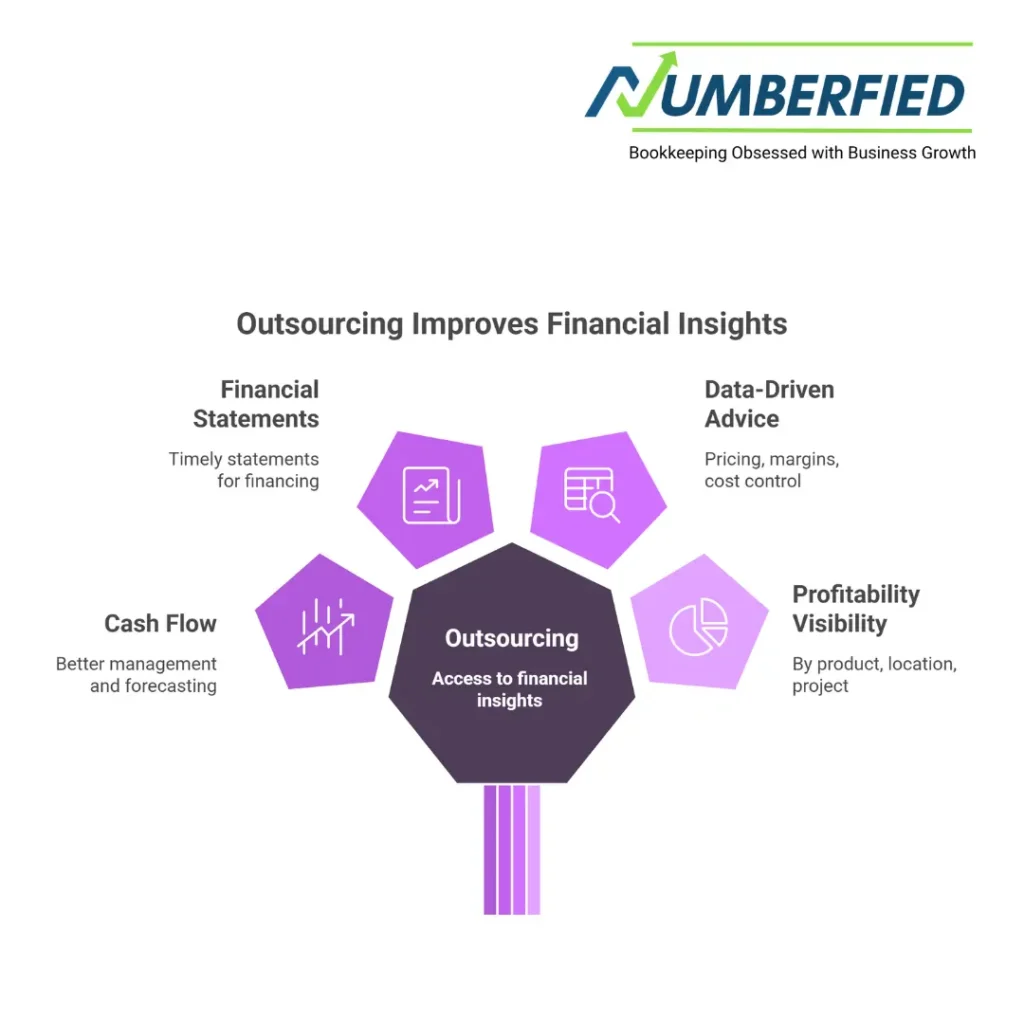
How Outsourcing Improves Financial Insights and Business Decisions
Outsourced accounting gives small business owners access to financial insights they often can’t get from an internal part-time bookkeeper. With regular financial reporting and advisory services, you gain:
- Better cash flow management and forecasting to prevent surprises and support growth.
- Timely financial statements that help secure financing or investor confidence.
- Data-driven advisory for pricing, margins, and cost control.
- Visibility into profitability by product line, location, or project.
These improvements turn accounting from a compliance task into a strategic tool that helps your business grow.
Pricing Expectations and ROI
Costs for outsourced accounting services vary depending on complexity and services. Expect basic bookkeeping and monthly financials to start at modest monthly rates for many small businesses, while outsourced CFO services or full-service accounting and bookkeeping packages will cost more. The ROI often shows up as time savings for the business owner, fewer accounting errors, improved cash flow, and better decisions that drive revenue growth.
Top Features to Prioritize
When evaluating accounting outsourcing services, prioritize these features:
- Real-time financial reporting and dashboard access.
- Experienced accountants and bookkeepers, including access to outsourced CFO or advisory services.
- Strong integration with bookkeeping software and payroll systems.
- Clear deliverables include reconciliations, monthly financial statements, and cash flow forecasting.
- Secure handling of financial data and a detailed SLA.
How Outsourcing Helped a Growing Startup
A startup with 20 employees struggled to keep monthly financials current while hiring a head of sales. After outsourcing accounting, the business gained a reliable bookkeeping services partner that automated bank feeds, delivered timely financial statements, improved cash flow visibility, and provided part-time outsourced CFO services for strategic planning. The startup reduced the month-end close time from two weeks to three days and used accurate financials to secure a line of credit for expansion.
Conclusion
Outsourcing accounting services for small businesses delivers immediate operational benefits and long-term strategic value. By choosing the right provider and following a structured transition plan, you reduce overhead, gain reliable financial reporting, and get the advisory support necessary as your business grows.
Ready to take control of your financials?
Schedule a free consultation to explore outsourced accounting solutions customized for your business needs, including bookkeeping services, outsourced CFO support, and tax preparation services. Get expert bookkeeping, real-time financial visibility, and the advisory insights you need to make confident business decisions.
FAQ
How much do accountants charge for monthly bookkeeping?
Accountants or professional bookkeeping services typically charge $500–$2,500 per month for small businesses, depending on transaction volume, complexity, and additional services like payroll or reporting. Basic plans start lower, while comprehensive monthly retainers reach the higher end.
Is it a good idea to outsource bookkeeping?
Yes, outsourcing bookkeeping is often a great idea for small businesses because it saves time, reduces costs compared to in-house hiring, provides access to expert knowledge, minimizes errors, and allows owners to focus on core operations rather than administrative tasks.
Should I outsource my bookkeeping?
You should consider outsourcing if you’re spending too much time on books, facing compliance issues, dealing with growing transaction volume, or lacking in-house expertise. It’s especially beneficial for accuracy, scalability, and freeing up resources without the overhead of a full-time employee.
What is the golden rule of bookkeeping?
The three golden rules of bookkeeping (foundation of double-entry accounting) are: debit the receiver and credit the giver (personal accounts); debit what comes in and credit what goes out (real accounts); debit all expenses and losses and credit all incomes and gains (nominal accounts). These ensure every transaction balances.
How much do outsourced bookkeepers charge?
Outsourced bookkeepers typically charge $500–$2,500 per month for small businesses, based on needs like transaction count and services. Simpler setups start around $300–$1,000, with more complex or full-service options higher.
What should you not outsource?
Do not outsource core strategic decisions like high-level financial planning, sensitive compliance oversight, fraud prevention, or tasks requiring deep internal knowledge of your business. Repetitive operational tasks like daily transaction recording are ideal for outsourcing.
How much should you pay a bookkeeper per month?
For small businesses, expect to pay between $500 and $2,500 per month for outsourced or professional bookkeeping services. Factors include business size, transaction volume, and extras such as reconciliations or reporting, which are on the lower end.
Why are bookkeepers declining?
Bookkeeper roles are declining due to automation handling routine tasks, an aging workforce nearing retirement, a shortage of new entrants (fewer accounting graduates), offshoring to lower-cost regions, and overall talent pipeline issues in the profession.
How much does it cost to hire an accountant for your small business?
Hiring an accountant for a small business typically costs $150–$400 per hour, or $1,000–$5,000 annually for ongoing services such as tax preparation and advisory support. Monthly retainers or packages typically range from $500 to $2,000, depending on the scope.
How much does it cost to outsource an accountant?
Outsourcing an accountant or full accounting services for small businesses typically costs $500–$ 5,000 per month, varying by complexity and the services provided (bookkeeping, tax, advisory). Basic outsourced packages start lower, with comprehensive support higher.
Also Read: The “Found Money” Effect: Outsourcing Accounting Services for Small Business as a Revenue Strategy