

Introduction
For small to medium business owners, CFOs, finance managers, startups, and entrepreneurs, financial decisions directly shape success or setbacks. Consulting services in accounting offer specialized expertise that goes far beyond routine compliance or data entry. These services provide strategic insight, risk mitigation, and actionable plans that help businesses navigate complex financial landscapes with confidence. Whether you’re optimizing cash flow, preparing for funding rounds, or ensuring regulatory alignment, consulting services in accounting act as a trusted partner in turning numbers into growth opportunities.
In this comprehensive guide, we explore the real-world benefits, compare in-house and outsourced models, detail essential offerings, highlight pitfalls to avoid, walk through the selection process, and examine leading firms and key trends shaping the industry in 2026.
Key Benefits of Consulting Services in Accounting
Consulting services in accounting deliver high-impact advantages that directly support business stability and expansion.
Expert Guidance for Strategic Decisions
Accounting consulting services bring deep knowledge of financial structures, industry benchmarks, and best practices. Advisors help translate complex data into clear strategies for pricing, capital allocation, cost control, and investment decisions. This expert guidance enables leaders to pursue opportunities with greater certainty and avoid common financial missteps.
Risk Reduction and Compliance Assurance
One of the strongest advantages of consulting services in accounting is proactive risk identification and mitigation. Advisors assess internal controls, regulatory exposure, fraud vulnerabilities, and financial reporting risks, helping prevent costly penalties or reputational damage. They also ensure alignment with GAAP, IFRS, or industry-specific standards, providing assurance that financial statements are accurate and defensible.
Growth Strategies and Scalability Planning
Financial consulting for small businesses focuses on building scalable financial foundations. Advisors develop growth roadmaps, evaluate funding options, model expansion scenarios, and optimize capital structure. Strategic accounting consulting identifies levers for profitability, supports M&A readiness, and prepares businesses for future financing rounds or exits.
Operational Efficiency and Process Improvement
Consulting services in accounting often include process optimization, technology implementation, and workflow redesign. Outsourced accounting consultants help automate manual tasks, integrate systems, and establish stronger controls, freeing internal teams for higher-value work while reducing errors and costs.
In-House vs. Outsourced Consulting Services in Accounting
The choice between in-house and outsourced consulting services in accounting depends on scale, budget, and strategic needs.
Cost Structure and Flexibility
In-house advisory roles require salaries, benefits, training, and overhead, often exceeding $150,000 annually for a senior advisor. Outsourced accounting consultants typically charge $150–$400 per hour or project-based fees, allowing businesses to access expertise only when needed. This flexibility makes outsourced models far more cost-effective for most SMBs.
Depth of Expertise and Fresh Perspective
In-house advisors build deep company knowledge but may lack exposure to diverse industries or emerging practices. Outsourced accounting consultants bring broad experience from multiple clients, offering fresh perspectives, benchmark comparisons, and best-practice insights. Business accounting advisory from external providers often uncovers blind spots that internal teams miss.
Scalability and Access to Specialists
In-house advisory is fixed in capacity, limiting responsiveness during growth phases or special projects. Consulting services in accounting scale on demand engage specialists for M&A due diligence, system implementation, or crisis response without long-term commitments. This scalability suits startups and businesses with variable needs.
Objectivity and Independence
Internal advisors may face pressure to align with management views. Outsourced consultants maintain independence, delivering candid assessments of risks, controls, or performance. Strategic accounting consulting benefits from this objectivity, especially in high-stakes decisions.
Essential Services in Consulting Services in Accounting
Top-tier consulting services in accounting cover a wide range of high-value offerings tailored to business needs.
Financial Planning and Forecasting
Advisors build detailed financial models, create rolling forecasts, and develop scenario analyses to support budgeting and strategic planning. Financial consulting for small businesses helps align resources with goals, anticipate cash needs, and evaluate investment decisions.
Tax Strategy and Optimization
Consulting services in accounting include proactive tax planning, entity structuring, deduction maximization, and credit identification (R&D, energy, hiring). Advisors help minimize liabilities legally while ensuring compliance with federal, state, and local requirements.
Internal Controls and Risk Management
Advisors assess control environments, identify weaknesses, and implement safeguards against fraud, errors, or inefficiencies. Accounting consulting services strengthen governance, improve segregation of duties, and reduce exposure to financial and operational risks.
Forecasting, Budgeting, and Performance Analysis
These services develop robust budgeting processes, variance analysis, and KPI tracking. Strategic accounting consulting uses data to highlight performance drivers, cost-saving opportunities, and areas for reinvestment.
M&A Support and Transaction Advisory
Consulting services in accounting provide due diligence, valuation support, deal structuring, and post-merger integration planning. Advisors help evaluate targets, negotiate terms, and ensure financial alignment during acquisitions or sales.
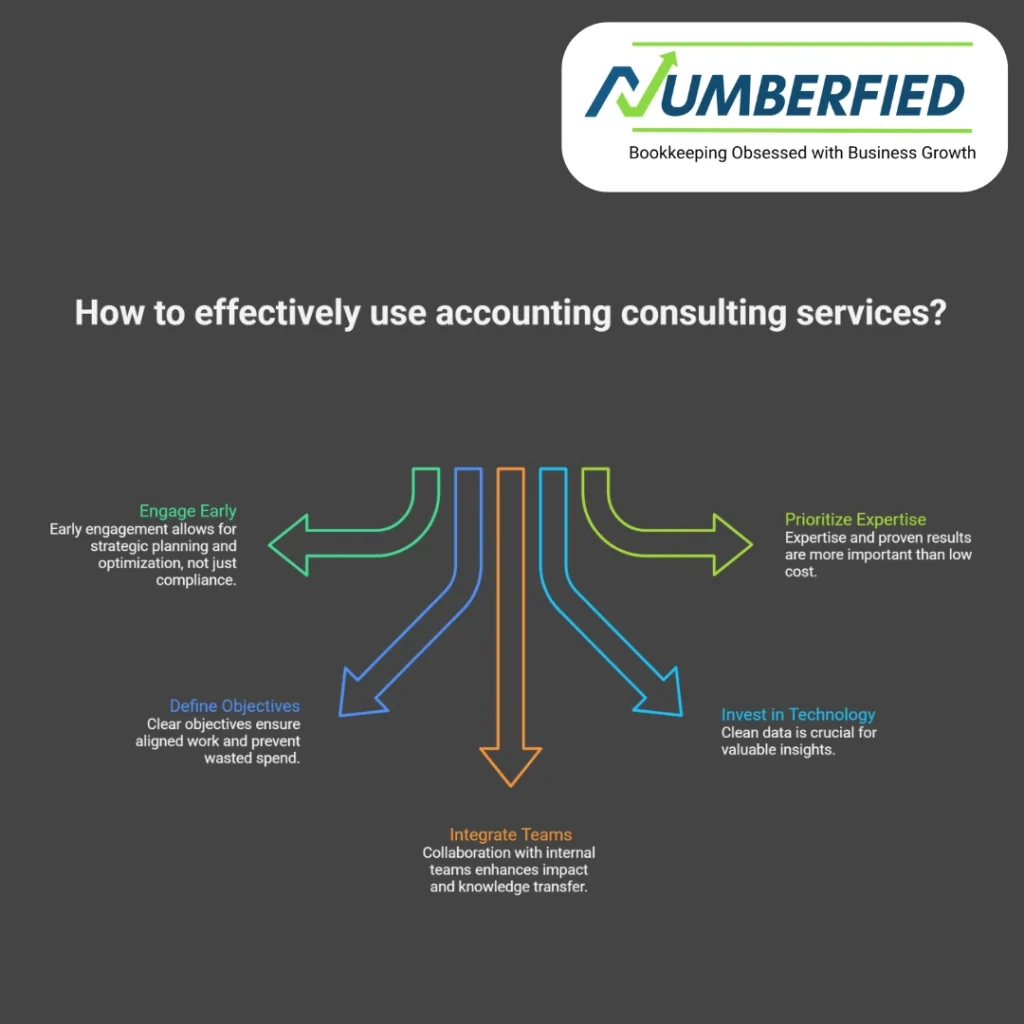
Common Mistakes to Avoid When Using Consulting Services in Accounting
Even with expert help, businesses can fall into avoidable traps.
Treating Consultants as Temporary Bookkeepers
Many hire consultants only for compliance or crisis response, missing strategic value. Engage consulting services in accounting early for planning and optimization, not just firefighting.
Failing to Define Clear Objectives
Vague scopes lead to misaligned work and wasted spend. Establish specific goals, deliverables, and success metrics before starting any engagement with accounting consulting services.
Overlooking Integration with Internal Teams
Siloed consulting efforts reduce impact. Ensure outsourced accounting consultants collaborate with your team, transfer knowledge, and align recommendations with company culture.
Ignoring Technology and Data Quality
Advisors need clean, integrated data to deliver value. Invest in proper systems and data hygiene before engaging financial consulting for a small business to maximize insights.
Choosing Based Solely on Price
Low-cost consultants may lack depth or industry knowledge. Prioritize expertise, references, and proven results over the lowest fee when selecting consulting services in accounting.
Step-by-Step Guide to Selecting Consulting Services in Accounting
Follow this structured approach to find the right partner.
Step 1: Define Your Objectives and Scope
Identify specific needs: compliance support, growth planning, system implementation, or risk assessment. Outline desired outcomes, timeline, and budget to guide the search for consulting services in accounting.
Step 2: Research Qualified Providers
Look for firms or independents with relevant industry experience, strong references, and certifications (CPA, CMA, CGMA). Review case studies and client testimonials to assess fit for business accounting advisory.
Step 3: Evaluate Expertise and Approach
During initial discussions, assess the depth of knowledge in your sector and their methodology. Ask how they approach financial consulting for small businesses and how they measure success.
Step 4: Compare Proposals and Pricing
Request detailed proposals outlining scope, deliverables, timeline, fees, and team members. Compare value, not just cost, and ensure transparency in billing (hourly, fixed-fee, or retainer).
Step 5: Check References and Past Results
Contact previous clients to verify quality, communication, and outcomes. Ask about challenges overcome and measurable improvements delivered by strategic accounting consulting.
Step 6: Assess Cultural and Communication Fit
Ensure the consultant understands your business culture and communicates clearly. Schedule working sessions to test collaboration before committing to consulting services in accounting.
Step 7: Start with a Defined Pilot or Phase
Begin with a limited-scope engagement to test quality and fit. Use this phase to refine expectations and confirm value before expanding to broader outsourced accounting consultants’ work.
Conclusion
Consulting services in accounting provide small to medium businesses with expert guidance, risk reduction, growth strategies, and compliance assurance that internal teams alone often cannot match. By choosing the right partner, you gain a powerful ally in building financial strength and long-term success. Whether you’re optimizing operations, preparing for expansion, or strengthening controls, these services deliver measurable value. Ready to elevate your financial strategy? Request a free consultation today and see how consulting services in accounting can drive your business forward.
FAQ
What are the Big 4 accounting firms consulting services?
The Big 4 accounting firms (Deloitte, PwC, EY, KPMG) offer consulting services in accounting that include financial reporting advisory, technical accounting guidance, transaction support, internal controls review, and implementation of new standards like revenue recognition or leases. They help clients with complex accounting issues, IPO readiness, restatements, and M&A due diligence. These services focus on compliance, risk management, and strategic financial decision-making for large and mid-sized companies.
Are consulting services capitalized or expensed?
Consulting services are generally expensed as incurred under U.S. GAAP and IFRS because they are considered period costs that benefit the current period. Costs for routine advisory, compliance reviews, or operational improvements are expensed immediately on the income statement. Only specific consulting fees directly related to creating an asset (e.g., software development or certain M&A transaction costs) may be capitalized under strict criteria.
How much does a CPA charge for consulting?
A CPA typically charges $150–$400 per hour for consulting services in 2026, depending on experience, location, and project complexity. For small to medium businesses, fixed-fee consulting projects often range from $2,000 to $15,000+, while ongoing advisory retainers can cost $1,000–$5,000 per month. Rates are higher for specialized work such as forensic accounting, valuations, or litigation support.
What are financial accounting and advisory services?
Financial accounting and advisory services combine preparation of compliant financial statements with strategic guidance on financial planning, risk management, forecasting, and performance improvement. They help businesses interpret financial data, optimize capital structure, and make informed decisions to support growth and stability. These services often include budgeting, cash flow analysis, and internal control assessments.
What are accounting advisory services?
Accounting advisory services provide expert recommendations on accounting policies, financial reporting improvements, system implementations, transaction structuring, and compliance with GAAP or IFRS. They assist with complex technical issues, new standard adoptions, restatements, and process optimization. The focus is on enhancing accuracy, transparency, and strategic use of financial information.
What are examples of advisory services?
Examples of advisory services include financial forecasting and budgeting, cash flow optimization, cost reduction analysis, internal control reviews, ERP system implementation support, valuation services, and merger and acquisition due diligence. Other common examples are risk assessment, performance benchmarking, capital structure advice, and sustainability reporting guidance.
What is FAAS in the Big 4?
FAAS stands for Financial Accounting Advisory Services in the Big 4 firms (Deloitte, PwC, EY, KPMG). It is a specialized practice that provides technical accounting advice, financial reporting support, transaction advisory, and assistance with complex accounting standards implementation. FAAS teams help clients with IFRS/US GAAP compliance, restatements, IPO readiness, and other high-level financial reporting challenges.
Is FAAS better than audit?
FAAS and audit serve different purposes, so one is not inherently better than the other. Audit provides independent assurance on historical financial statements for compliance and stakeholder trust. FAAS offers proactive advisory on accounting treatments, process improvements, and strategic finance, making it complementary to audit rather than a replacement.
What is a financial advisory service?
A financial advisory service provides expert guidance on managing finances, investments, financial planning, risk management, and business strategy. It includes wealth management, retirement planning, investment portfolio advice, debt structuring, and business valuation for individuals and companies. The focus is on helping clients achieve financial goals through informed, personalized decisions.
Why am I getting calls from financial advisors?
You are likely receiving calls from financial advisors because your contact information was obtained through lead generation sources such as purchased lists, public business directories, online inquiries, networking events, or referrals. Many advisors use cold calling, social media outreach, or marketing campaigns to find potential clients. If you recently searched for financial products, attended events, or appeared in business listings, your details may have been shared or sold to advisory firms.
Read Also: 7 Insider Tips to Simplify Your Finances with QuickBooks Bookkeeping Services for Small Businesses