

Introduction
Running a small to medium business, a startup, a freelance gig, or a sole proprietorship means your time and cash are always in short supply. Accounting and bookkeeping outsourcing lets you hand off the daily grind of receipts, reconciliations, bill payments, payroll, and reporting to skilled remote teams so you can focus on winning clients, delivering work, or simply enjoying the independence you started your business for. These professional services deliver clean, compliant books, real-time visibility, and often thousands in tax savings, all without the fixed salaries, benefits, hiring headaches, or office overhead of an in-house hire.
In 2026, with IRS data-matching at an all-time high, 1099-K reporting fully enforced at $600, AI-assisted audits targeting deductions, and labor costs continuing to climb, accounting and bookkeeping outsourcing has become one of the highest-ROI moves most growing businesses can make. This comprehensive guide covers the proven benefits, compares in-house vs. outsourced models, details the core services you should expect, identifies common mistakes that waste money, provides a practical step-by-step selection and onboarding process, reviews leading specialized providers, examines key outsourcing industry trends, and shows you exactly how to choose and start with confidence.
Key outsourcing industry trends in 2026:
- AI-enhanced automation & accuracy: categorization and anomaly detection are now 70–85% automated, reducing costs by 20–30%.
- Advanced cybersecurity standards: SOC 2 Type II mandatory, zero-knowledge encryption options, regular penetration testing.
- Fractional & scalable models: 10–30 hours/month per client are becoming mainstream for advisory handoff.
- ESG/sustainability reporting integration: increasing demand as sustainability affects grants, loans, and investor requirements.
- Deeper practice management software compatibility (Karbon, Canopy, Jetpack Workflow) for seamless workflow.
Key Benefits of Accounting and Bookkeeping Outsourcing
Accounting and bookkeeping outsourcing delivers advantages that directly improve profitability, reduce risk, and free your time.
Significant Cost Savings vs In-House Staffing
A full-time U.S. bookkeeper costs $50,000–$80,000 per year in salary + 25–40% in payroll taxes, benefits, software, training, and office overhead. Accounting and bookkeeping outsourcing typically runs $500–$2,500 per month ($6,000–$30,000/year), with no employment liabilities. Most small businesses save 50–75% net while receiving higher consistency and expertise than a single in-house person can usually provide.
Access to Specialized Expertise & Scalability
In-house hires often start at a general level and learn on the job. Outsourced accounting and bookkeeping services bring certified professionals (QuickBooks ProAdvisors, Xero Certified Advisors, CPAs, EAs) who specialize in small business, e-commerce, professional services, contractors, or SaaS. They know current IRS/state rules, deduction nuances, and compliance traps, delivering cleaner books and more tax savings. Scalability is instant: increase hours during launch or peak seasons, reduce them during slow periods, all without HR friction or long-term commitments.
IRS/State Compliance Assurance & Penalty Reduction
The IRS continues aggressive data-matching on 1099-K forms, home office claims, vehicle expenses, and self-employment income in 2026. Accounting and bookkeeping outsourcing maintains audit-ready records with digital receipts, mileage logs, and supporting documentation, while ensuring accurate quarterly estimates and 1099 issuance. Many top providers include audit coordination or representation support, significantly lowering penalty risk.
Time Freedom for Core Business Activities
Manual bookkeeping or managing an employee can consume 10–25 hours monthly. Accounting and bookkeeping outsourcing eliminates that burden, giving you back time for sales calls, client delivery, marketing, product creation, or personal life. Owners frequently report reclaiming an entire workday per week once the service is fully implemented.
Real-Time Financial Visibility & Strategic Insights
Cloud-based accounting and bookkeeping outsourcing provides live access to current cash balance, P&L, balance sheet, aged A/R & A/P, and custom KPIs via mobile apps and client portals. Monthly reports include variance analysis and actionable insights helping you spot cash flow issues early, set better rates, control spending, and time investments for maximum return.
In-House vs Outsourced Accounting and Bookkeeping Comparison
The choice between in-house and accounting and bookkeeping outsourcing comes down to cost, control, expertise, and scalability.
Cost Structure & Total Ownership Cost
In-house: $50,000–$80,000 base salary + 25–40% taxes/benefits + software ($1,200–$3,600/year) + training + management time = $70,000–$120,000+ true annual cost. Outsourced accounting and bookkeeping averages $500–$2,500/month ($6,000–$30,000/year) with no hidden employment costs. Most small businesses save 50–75% net after switching.
Expertise Depth & Consistency
In-house quality varies with turnover, skill gaps, or workload, leading to inconsistency. Outsourced accounting and bookkeeping services use standardized workflows, checklists, peer review, and specialized teams to deliver greater consistency. Many providers focus exclusively on small businesses or specific industries, bringing deeper knowledge than a single in-house person can maintain.
Flexibility & Scalability
In-house headcount is fixed. January–April overload requires overtime or temps; summer lulls mean idle payroll. Accounting and bookkeeping outsourcing scales hours up/down instantly, matching client workload without HR issues. Surge capacity during tax season is often included at pre-agreed rates.
Control, Oversight & Technology Access
Some owners fear losing visibility. Modern outsourced solutions include shared real-time dashboards (QuickBooks Online Accountant view, Xero Practice), weekly status reports, and direct Slack/email channels. You retain full oversight while the provider handles volume.
Transition & Onboarding Effort
In-house hiring takes 4–12 weeks (posting, interviewing, onboarding). Outsourced onboarding usually takes 2–6 weeks and can be phased (5–10 clients/month). Good providers supply standardized handover templates and run parallel processing during transition.
Essential Services Included in Accounting and Bookkeeping Outsourcing
High-quality accounting and bookkeeping outsourcing covers these core areas with precision and proactivity.
Transaction Processing & Categorization
Daily/weekly import of bank, credit card, and payment processor feeds. The team applies your chart of accounts, custom rules, and naming conventions, ensuring consistent coding across all clients.
Bank, Credit Card & Payment Processor Reconciliations
Full monthly reconciliations for every account, including investigation of discrepancies, duplicate detection, and clearing reconciled items. This keeps books accurate and catches bank errors early.
Accounts Payable & Vendor Bill Management
Entry of vendor bills, matching to purchase orders (if used), coding correctly, scheduling payments, and executing bill pay. This reduces late fees and captures early-payment discounts.
Accounts Receivable & Invoicing Support
Creating/sending invoices (recurring or one-off), tracking open receivables, sending polite follow-up reminders, and recording payments. Many providers integrate with invoicing tools to automate processes.
Monthly Financial Statements & Reporting
Compilation of clean monthly trial balances, profit & loss statements, balance sheets, and cash flow reports for each client. Packages often include variance analysis, key ratio tracking, and custom dashboards.
Sales Tax, 1099 & Basic Compliance Support
Tracking sales tax liability by jurisdiction, preparing 1099 information for vendors/contractors, and flagging compliance deadlines. While the service does not prepare or sign tax returns, it delivers organized books that help your CPA/EA complete tax season faster.
Common Mistakes to Avoid with Accounting and Bookkeeping Outsourcing
These errors can reduce ROI or create frustration.
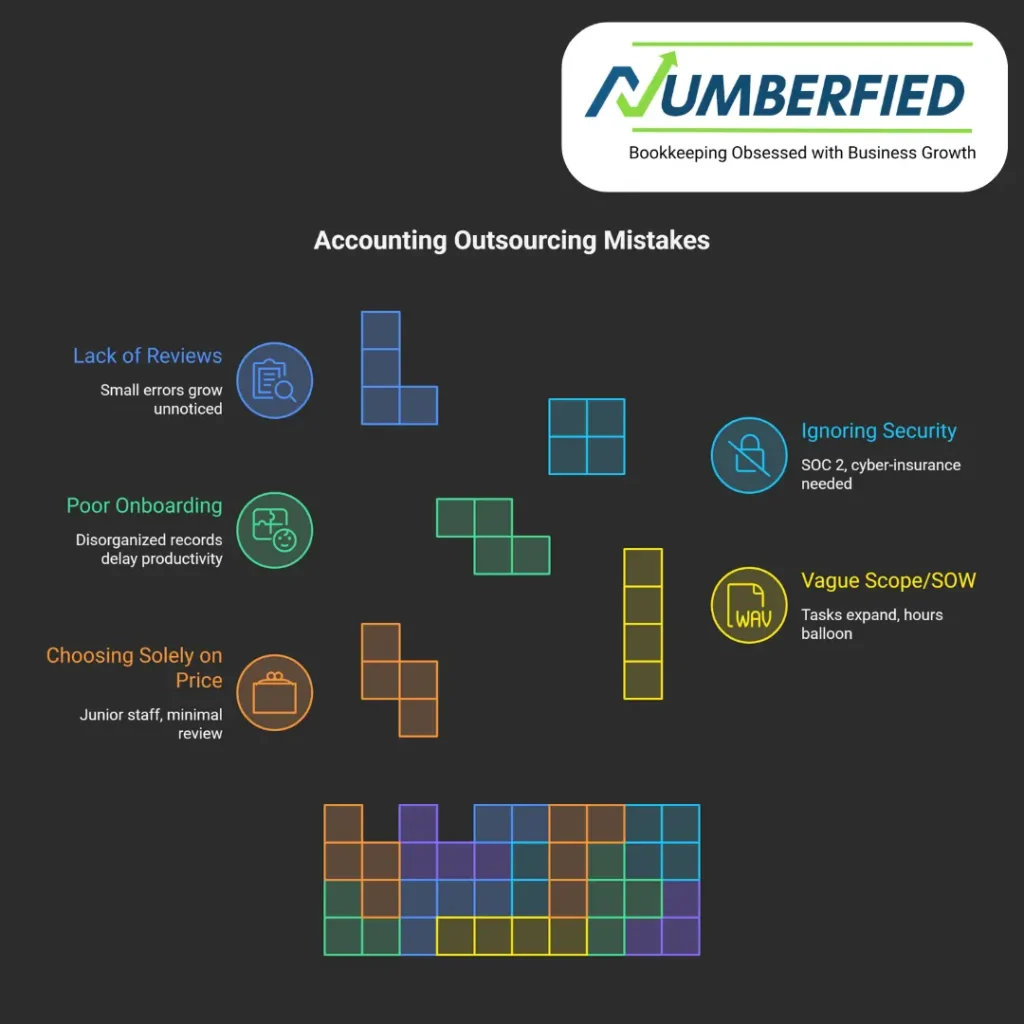
Choosing Solely on Price
Very low rates often mean junior staff, minimal review, or outdated tools. The best accounting and bookkeeping outsourcing balances cost with certifications, references, and technology, focusing on value rather than the lowest bid.
Vague Scope/SOW & No Clear Deliverables
Without a detailed statement of work, tasks expand and hours balloon. Define exact responsibilities, monthly hour caps, and the change-order process in the contract before starting.
Poor Onboarding & Data Handover
Sending disorganized records delays productivity. Use a standardized handover checklist (chart of accounts, prior year financials, recurring bills, login instructions, key processes) to ensure a smooth start.
Ignoring Security & Compliance
Always verify SOC 2 compliance, cyber-insurance, and confidentiality agreements. Never share full bank logins; use accountant-specific read-only access or bank feeds.
Lack of Regular Reviews
Assuming “it’s handled” and skipping monthly reviews allows small errors to grow. Schedule recurring check-ins and use shared dashboards to stay on top of quality.
Step-by-Step Guide to Selecting & Onboarding Accounting and Bookkeeping Outsourcing Providers
Follow this process to choose and integrate successfully.
Step 1: Define Needs & Capacity Gaps
List must-have tasks (categorization, reconciliations, bill pay, invoicing, reporting), monthly hour estimate, and compliance concerns (sales tax, 1099s, quarterly estimates). Calculate hours currently spent on bookkeeping to quantify ROI potential.
Step 2: Set Budget & Success Metrics
Budget $500–$2,500/month. Define KPIs: hours saved, deduction increase, compliance error reduction, advisory billing growth, and net profit margin improvement.
Step 3: Research Specialized Providers
Search “accounting and bookkeeping outsourcing” or “outsourced bookkeeping for small business.” Focus on providers with strong small-business reviews, QuickBooks/Xero certifications, and client testimonials from similar companies.
Step 4: Evaluate Technology & Security
Confirm deep integration with your tools (QuickBooks Online, Xero, Stripe, Shopify) and bank-level security (SOC 2 Type II, encryption, 2FA). Ask about AI usage and data breach protocols.
Step 5: Request Detailed Proposals & References
Ask for:
- sample financial statements & dashboards
- monthly hour estimates per business type
- pricing tiers & change-order process
- 3–5 client references (call them)
Step 6: Run a Pilot with Limited Scope
Start with 1–3 months on a small set of tasks or clients. Monitor quality, turnaround, communication, and client feedback before expanding.
Step 7: Onboard Systematically & Optimize
Create a handover template for each client. Hold weekly alignment calls for the first 60–90 days. Provide constructive feedback early and refine processes as you scale.
Conclusion
Accounting and bookkeeping outsourcing delivers significant cost savings, specialized expertise, scalability, IRS/state compliance assurance, time freedom, and real-time financial visibility, transforming how small- to medium-sized businesses, startups, entrepreneurs, sole proprietors, freelancers, and self-employed professionals manage finances. By avoiding common mistakes and following a structured selection process, you can find a partner that becomes one of your most valuable assets. As AI accuracy, cybersecurity standards, and compliance demands advance in 2026, outsourcing becomes even more powerful.
Ready to reclaim your time and keep more of what you earn? Request a free consultation or quote today from a trusted accounting and bookkeeping outsourcing provider and take the first step toward cleaner books and stronger growth.
FAQ
How much does accounting and bookkeeping outsourcing cost for small businesses?
Accounting and bookkeeping outsourcing typically costs $500–$2,500 per month in 2026, depending on transaction volume and scope. Basic plans start around $500–$1,000, while full-service packages (reconciliations, reporting, advisory) range from $1,200–$2,500+.
Is accounting and bookkeeping outsourcing worth it for small businesses and freelancers?
Yes, it’s worth it for most businesses earning $50,000+ annually. Accounting and bookkeeping outsourcing saves time, uncovers thousands in deductions, prevents penalties, and provides audit-ready books, usually delivering more tax savings and clarity than the fee costs.
What services are included in accounting and bookkeeping outsourcing?
Typical packages include transaction processing & categorization, bank/credit card reconciliations, accounts payable & receivable management, payroll & 1099 support, monthly financial statements, sales tax compliance, and basic tax prep coordination. Many also handle bill pay, invoicing, and advisory services.
How do I choose the best accounting and bookkeeping outsourcing provider?
Look for QuickBooks ProAdvisors, Xero Certified Advisors, or CPAs with strong reviews, cloud software proficiency, transparent fixed-fee pricing, and audit support. Request a consultation, sample reports, and references to ensure fit for your business.
How does accounting and bookkeeping outsourcing differ from in-house or DIY?
Outsourced accounting and bookkeeping offer lower fixed costs, instant scalability, access to specialized expertise, and advanced cloud tools without employment overhead. In-house/DIY provides company-specific knowledge but comes with higher costs, limited flexibility, and higher error risk.
Is my data secure with accounting and bookkeeping outsourcing?
Yes, reputable accounting and bookkeeping outsourcing uses bank-level encryption, two-factor authentication, secure client portals, and regular backups. Look for SOC 2 compliance or similar certifications, and use accountant-specific read-only access instead of full bank logins.
What are the latest trends in accounting and bookkeeping outsourcing for 2026?
Trends include AI-enhanced automation & accuracy (categorization and anomaly detection 70–85% automated), advanced cybersecurity standards (SOC 2 Type II, zero-knowledge encryption), fractional & scalable models, ESG/sustainability reporting integration, and deeper integration with practice management software.
What are red flags when evaluating accounting and bookkeeping outsourcing providers?
Red flags include very low prices, vague scope descriptions, no certifications or references, reluctance to do a paid test task, poor communication during consultation, hidden fees, and lack of audit support or security certifications.
How can I get started with accounting and bookkeeping outsourcing?
Define your must-have tasks and monthly budget, research providers with strong reviews and certifications, request detailed proposals, and assign a small paid test task. Many offer free consultations or discounted first months. Schedule one today to simplify your books.
Is accounting and bookkeeping outsourcing suitable for different business sizes and types?
Yes, it works well for freelancers (10–20 hours/month, basic categorization & reporting), small teams (20–40 hours, full AP/AR), and growing SMBs (40+ hours, inventory/COGS, advisory). Accounting and bookkeeping outsourcing scales to match your size, industry, and complexity.
Read Also: 9 Surprising Ways a Bookkeeping Service for Small Business Can Boost Your Success