

Introduction
If you’re a CPA, accounting firm owner, tax professional, enrolled agent, or practice manager, you already know the math: your highest-margin work is advisory, complex tax planning, business consulting, financial modeling, and strategic client conversations, not daily transaction entry, bank reconciliations, bill coding, or 1099 preparation. Yet many firms still tie up senior talent (or burn out junior staff) on routine compliance tasks that bill at $50–$120/hour, rather than advisory rates of $250–$600+/hour.
Bookkeeping services for CPAs solve this by outsourcing the back-office volume to specialized remote teams that work under your brand standards, using your preferred practice software and workflows. The result: you reclaim thousands of billable hours annually for premium advisory work, scale client capacity without proportional hiring, improve consistency across client files, reduce fixed overhead, and often see better client retention because books are cleaner and reports are more timely. In 2026, with client demand for real-time dashboards, tighter IRS scrutiny on gig-economy income and deductions, and talent costs still climbing, the best bookkeeping services for CPAs are no longer a convenience; they’re a competitive edge and a profitability lever.
This guide covers the tangible benefits, compares in-house vs. outsourced models for accounting practices, details the essential services these providers deliver, addresses common pitfalls, provides a step-by-step selection and onboarding roadmap, reviews leading specialized providers, and highlights key industry trends shaping CPA firm outsourcing in 2026 so you can make a clear, confident decision that accelerates firm growth.
Key Benefits of Bookkeeping Services for CPAs
Outsourcing routine bookkeeping to specialized providers creates a powerful flywheel of benefits that compound over time.
Free Up Advisory & Tax-Planning Time
CPAs frequently spend 30–50% of their working hours on compliance-level tasks that bill far below advisory rates. Bookkeeping services for CPAs offload transaction processing, reconciliations, bill pay, A/R follow-up, and basic compliance work, allowing you to redirect that time to high-value activities: tax planning, financial consulting, business valuations, succession planning, cash-flow strategy, and client advisory sessions. Firms typically report 500–1,500+ additional advisory hours per year after outsourcing, often translating to $100,000–$500,000+ in incremental revenue at premium rates.
Increase Firm Capacity & Billable Hours
Adding clients usually means adding headcount, which brings fixed salary costs, benefits, training time, turnover risk, and management overhead. Outsourced bookkeeping for CPAs is available on a pay-as-you-go or fixed-monthly basis, scaling instantly with client additions or seasonal workload spikes (January–April). You can grow from 50 to 150 clients without a proportional increase in internal staff, dramatically improving revenue per employee (RPE), profit margins, and firm valuation multiples.
Consistent Accuracy & Reduced Review Time
In-house bookkeeping quality varies by staff member, training level, workload, or tenure. CPA firm bookkeeping services enforce standardized workflows, checklists, peer review, and technology (AI categorization, duplicate detection, automated reconciliations) to achieve near-100% accuracy. Cleaner books mean less time spent by CPAs and EAs reviewing and correcting entries, often cutting review time by 50–80% and reducing costly rework.
Lower Fixed Overhead & Hiring Risk
In-house bookkeeping carries payroll taxes (~10–15%), benefits (health, 401(k) match), software licenses, workstation costs, and HR overhead. Outsourced solutions eliminate these variables, pay only for productive hours, or charge a predictable monthly fee. Many CPA firms report 40–65% net savings after switching to scalable bookkeeping solutions for CPAs, freeing capital for marketing, technology, partner distributions, or hiring more advisory talent.
Better Client Retention Through Cleaner Books
Clients stay longer with firms that deliver timely, accurate financial statements, clear dashboards, and proactive insights. Bookkeeping services for CPAs produce consistently clean books, real-time reporting, and advisory handoff notes that highlight planning opportunities, making your firm appear more professional and strategic. Firms using specialized back-office support frequently report higher client retention rates and more referrals.
In-House vs. Outsourced Bookkeeping for CPA Firms
Most growing practices eventually face the in-house vs. outsourced decision. Here’s how the models compare in 2026.
Cost Structure & Total Ownership Cost
In-house: $50,000–$85,000 annual base salary for a full-time bookkeeper + 25–40% in taxes/benefits + software ($1,200–$3,600/year) + training + management time = $70,000–$120,000+ true cost per year. Outsourced bookkeeping for CPAs averages $1,200–$4,500/month ($14,400–$54,000/year) with no hidden employment costs. Most firms save 35–60% net after transition.
Quality, Consistency & Specialization
In-house quality depends on individual turnover, sick days, and skill gaps, which create inconsistency. CPA firm bookkeeping services use standardized processes, checklists, peer review, and technology (AI categorization, duplicate detection, automated reconciliations) to achieve higher consistency. Many providers specialize in serving accounting firms exclusively, understanding your exact workflow and deliverable expectations.
Scalability & Seasonality Handling
Adding clients often means adding headcount, which takes weeks/months and carries fixed costs. Virtual bookkeeping for accounting firms scales hours up/down instantly, matching your client workload without HR friction. Surge capacity for tax season at pre-agreed rates is standard among top providers.
Control, Oversight & Integration with Practice Software
Some partners worry about losing visibility. Modern back-office bookkeeping support for CPAs includes shared real-time dashboards (QuickBooks Online Accountant view, Xero Practice), weekly status reports, and direct Slack/email channels. You retain full oversight while the provider handles volume. Deep integration with Karbon, Canopy, Jetpack Workflow, and Practice Ignition ensures seamless handoff.
Transition & Onboarding Effort
In-house hiring takes 4–12 weeks (posting, interviewing, onboarding). Outsourced onboarding usually takes 2–6 weeks and can be phased (5–10 clients/month). Good providers supply standardized handover templates and run parallel processing during transition.
Essential Services Provided by Bookkeeping Services for CPAs
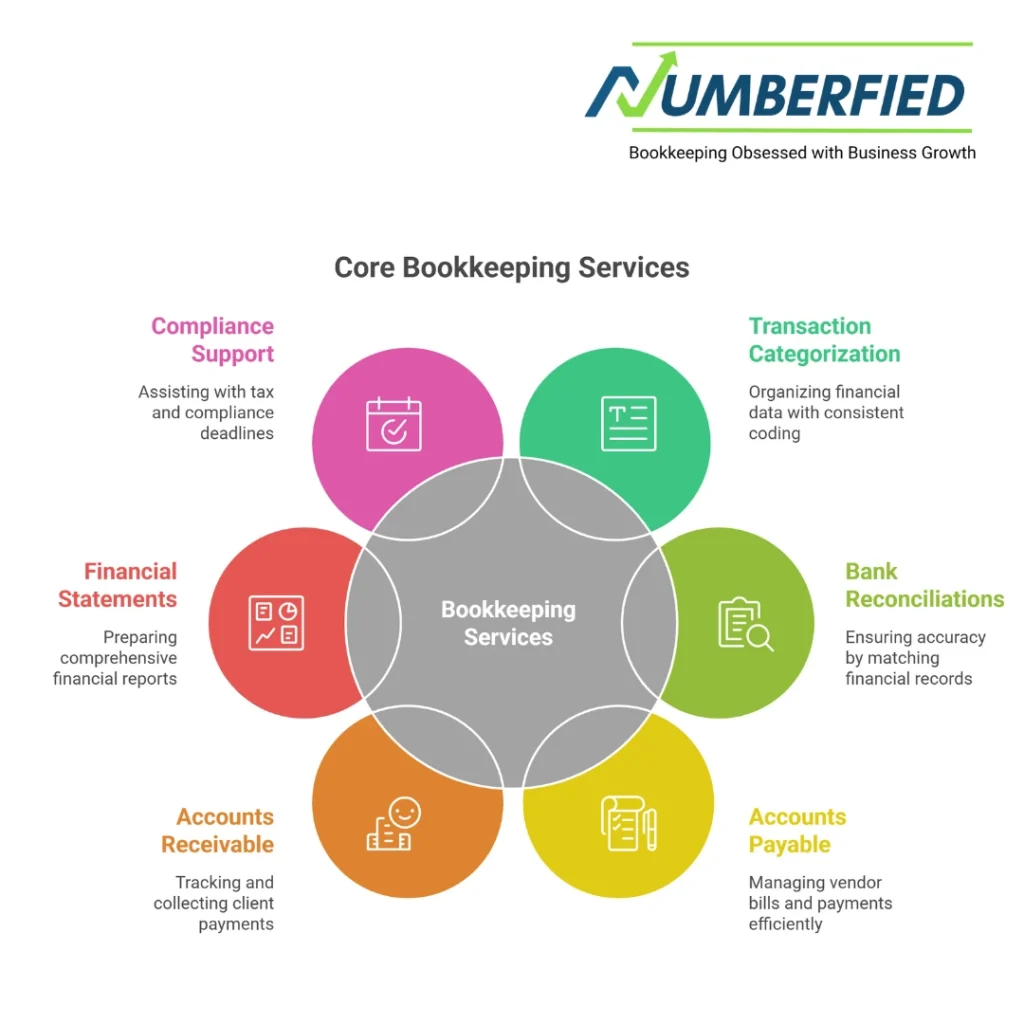
High-quality providers deliver these core services, customized to the needs of accounting practices.
Client Transaction Categorization & Coding
Daily/weekly import of client bank, credit card, and payment processor feeds. The team applies your firm’s standard chart of accounts, custom rules, and naming conventions, ensuring consistent coding across all clients.
Bank, Credit Card & Payment Processor Reconciliations
Full monthly reconciliations for every client account, including investigation of discrepancies, duplicate detection, and clearing reconciled items. This keeps client books accurate and minimizes your CPAs’ review time.
Accounts Payable & Vendor Bill Management
Entry of vendor bills, matching to purchase orders (if used), coding to correct GL accounts, scheduling payments, and executing bill pay (via client bank or bill-pay platform). Reduces client late fees and captures early-payment discounts.
Accounts Receivable & Invoicing Support
Creating/sending client invoices (recurring or one-off), tracking open receivables, sending polite follow-up reminders, recording payments, and reporting aged A/R. Many providers integrate with Practice Ignition, Karbon, or Jetpack Workflow for seamless workflow.
Monthly Financial Statement Preparation
Compilation of clean monthly trial balances, profit & loss statements, balance sheets, and cash flow reports for each client. Packages often include variance analysis, key ratio tracking, and custom dashboards shared via the QBO Accountant view or the Xero Practice.
Sales Tax, 1099 & Basic Compliance Support
Tracking sales tax liability by jurisdiction, preparing 1099-NEC/MISC information, and flagging compliance deadlines. While the provider does not prepare or sign tax returns, they deliver organized trial balances and supporting schedules that make your firm’s tax prep faster and more accurate.
Common Challenges & Mistakes When Using Bookkeeping Services for CPAs
Even with strong providers, these pitfalls can reduce ROI if not managed.
Poor Client Data Handover
Sending disorganized client files or incomplete access information causes weeks of cleanup. Create standardized onboarding checklists and require clients to provide clean data before handover.
Scope Creep Without Change Orders
Without a detailed SOW, clients request “just one more thing” (payroll setup, complex fixed-asset entries), and hours balloon. Define exact tasks, hour caps, and the change-order process in the master services agreement.
Quality Inconsistency Across Clients
Some providers assign junior staff to smaller clients, leading to variable quality. Choose bookkeeping services for CPAs that use peer review, checklists, and senior oversight on every file.
Security & Confidentiality Risks
Sharing client logins raises liability questions. Insist on read-only bank feeds, accountant-specific user roles, SOC 2 Type II compliance, and cyber-insurance from your provider.
Underestimating Transition Time
Firms expect instant results, but onboarding 20–50 clients takes 2–6 months. Plan a phased rollout (5–10 clients per month) and keep parallel in-house processing during transition.
Step-by-Step Guide to Selecting & Onboarding Bookkeeping Services for CPAs
Follow this structured process to choose and integrate successfully.
Step 1: Assess Firm Needs & Capacity Gaps
Calculate current non-billable hours spent on compliance work, the number of clients needing routine bookkeeping, desired turnaround times, and the target advisory utilization rate. This quantifies the ROI potential of bookkeeping services for CPAs.
Step 2: Set Budget & Success Metrics
Budget $1,200–$4,500/month initially. Define KPIs: hours saved per CPA, reduction in compliance rework, increase in advisory billings, client retention rate, and net profit margin improvement.
Step 3: Research Specialized Providers
Search for “outsourced bookkeeping for CPAs” or “virtual bookkeeping for accounting firms.” Focus on providers that exclusively or primarily serve CPA firms (they understand your workflow, deliverables, and liability concerns).
Step 4: Evaluate Technology Stack & Integration
Confirm deep integration with QuickBooks Online Accountant, Xero Practice, Practice Ignition, Karbon, Canopy, or Jetpack Workflow. Ask about API access, custom mapping, and how they handle multi-client environments.
Step 5: Check Security, Compliance & Insurance
Verify SOC 2 Type II, cyber-insurance ($1M+), confidentiality agreements, background checks, and data destruction policies. Ask how they handle client data breaches and IRS inquiries.
Step 6: Request Detailed Proposals & References
Ask for:
- sample client trial balance & financial statements
- monthly hour estimates per client type
- pricing tiers & change-order process
- 3–5 CPA firm references (call them)
Step 7: Run a Pilot with 5–10 Clients
Start with a small pilot group. Monitor quality, turnaround time, communication, and client feedback for 60–90 days before expanding.
Step 8: Onboard Systematically & Train Staff
Create a standardized handover template for each client. Train your team on the provider’s portal, escalation process, and quality checkpoints. Hold monthly firm/provider alignment calls.
Key trends in 2026:
- AI-assisted categorization and anomaly detection reduce manual review by 60–80%.
- SOC 2 Type II & cybersecurity maturity becoming table stakes for CPA-focused providers.
- Fractional senior bookkeeper models (senior oversight 5–15 hours/month + junior execution).
- Deeper integration with QuickBooks Online Accountant, Xero Practice, Karbon, Canopy & Jetpack Workflow.
- Advisory handoff packages that deliver clean books with notes highlighting planning opportunities for the CPA.
Conclusion
Bookkeeping services for CPAs are a strategic lever that frees advisory time, increases firm capacity, improves consistency, lowers fixed overhead, and enhances client retention through cleaner, timelier books. By outsourcing routine compliance work to specialized providers, you create more space for high-margin advisory, tax planning, and client strategy, the activities that drive firm value and partner income. As AI automation, cybersecurity standards, and practice software integration continue to advance in 2026, the advantages of outsourcing become even more pronounced.
Ready to reclaim your time, scale your practice, and focus on the work that matters most? Request a free demo or pilot consultation today from a CPA-focused bookkeeping provider and see how much capacity you can unlock.
FAQ
How much do bookkeeping services for CPAs cost?
Bookkeeping services for CPAs typically cost $1,200–$4,500 per month in 2026 for 20–80 client accounts, depending on volume and complexity. Pricing is usually per-client or per-hour, with most firms achieving 40–65% net savings compared to in-house staffing.
Are bookkeeping services for CPAs worth the investment for accounting firms?
Yes, most growing firms find them highly worthwhile. They free 30–50% of CPA time for advisory work (which bills 2–5× higher), improve consistency, reduce compliance risk, and allow the firm to take on 30–100% more clients without proportional headcount growth.
What services are usually included in bookkeeping services for CPAs?
Typical services include client transaction categorization, bank/credit card reconciliations, accounts payable & receivable management, monthly financial statement preparation (trial balance, P&L, balance sheet), sales tax & 1099 tracking, and compliance reminders & audit-ready files. Deliverables are tailored to your firm’s workflow and practice management software.
How do I choose the best bookkeeping services for CPAs?
Look for providers that exclusively or primarily serve CPA firms, have SOC 2 compliance, deep integration with QBO Accountant/Xero Practice, strong references from other practices, and clear SLAs for turnaround and quality. Request a pilot with 5–10 clients and evaluate accuracy, communication, and advisory handoff quality.
How do bookkeeping services for CPAs differ from hiring in-house staff?
Outsourced services offer scalability (add/reduce capacity instantly), no employment overhead, consistent quality through standardized processes, and specialization in high-volume compliance work. In-house staff provide deep firm-specific knowledge but come with fixed costs, hiring risk, and limited scalability.
Is client data secure with bookkeeping services for CPAs?
Yes, reputable providers use bank-level encryption, two-factor authentication, secure client portals, role-based access, regular penetration testing, and SOC 2 Type II compliance. They also carry cyber-insurance ($1M–$5M) and sign firm-specific confidentiality/BAA agreements.
What are the latest trends in bookkeeping services for CPAs in 2026?
Trends include AI-assisted categorization and anomaly detection, reducing manual review by 60–80%, deeper integration with practice management tools (Karbon, Canopy, Jetpack Workflow), fractional senior bookkeeper models, enhanced cybersecurity requirements, and advisory handoff packages that highlight planning opportunities for the CPA.
What are red flags when evaluating bookkeeping services for CPAs?
Red flags include very low per-client pricing, no SOC 2 or equivalent security certification, reluctance to provide CPA firm references, vague SLAs, poor communication during the sales process, and lack of experience serving accounting practices specifically.
How do I onboard bookkeeping services for CPAs smoothly?
Create a standardized client handover template, phase onboarding (5–10 clients per month), run parallel processing during transition, train your team on the provider’s portal, and hold weekly alignment calls for the first 60–90 days. Clear scope, escalation paths, and quality checkpoints prevent most issues.
How scalable are bookkeeping services for CPAs as the practice grows?
Highly scalable, most providers can add capacity within days or weeks, with no hiring delays or fixed costs. Firms commonly grow from 50 to 150+ clients by outsourcing routine compliance work, maintaining or improving revenue per employee while increasing advisory billings.
Read Also: Why Numberfied’s Accounting Bookkeeping Service Saves Small Businesses Time and Money