
Introduction
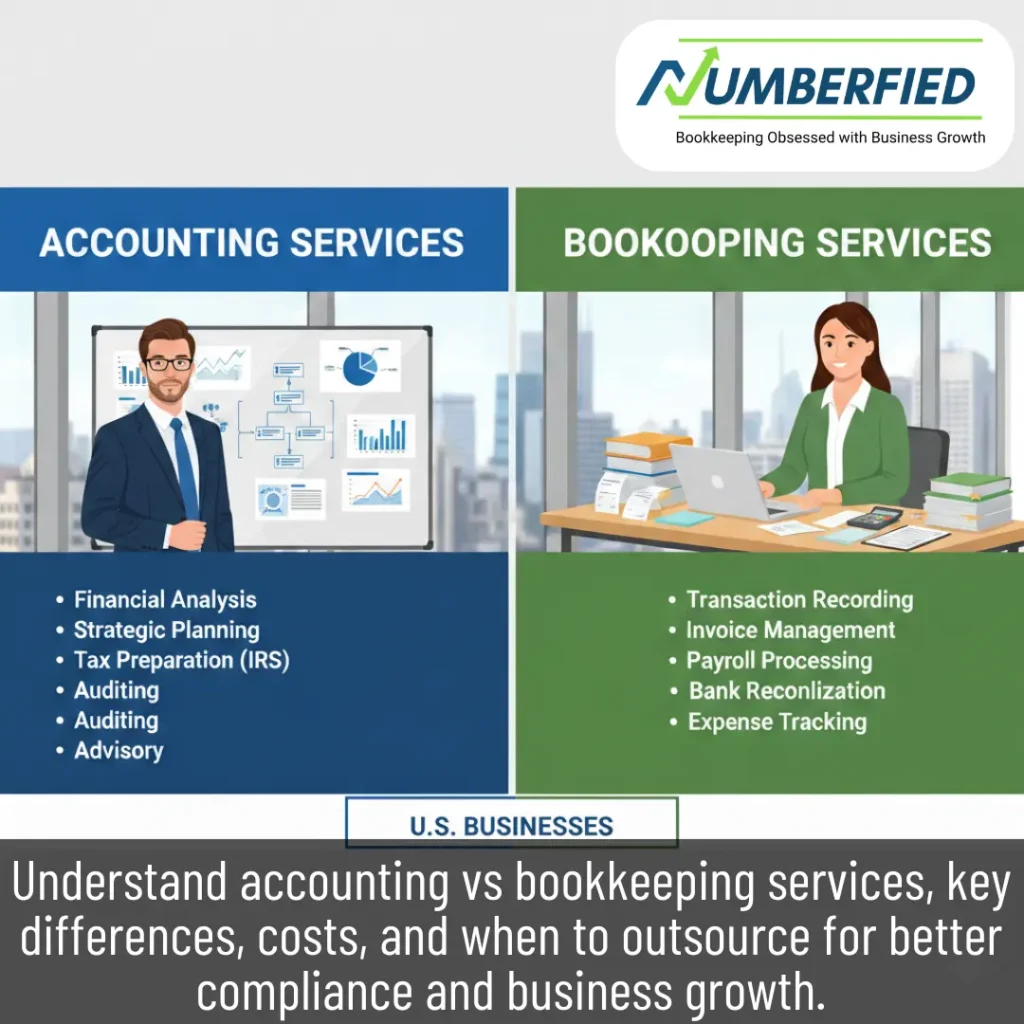
Accounting vs bookkeeping services matter for every business owner deciding how to manage finances effectively. We explain the differences, illustrate practical scenarios, and show how we at Numberfied can help you implement the right solution. This guide provides clear distinctions, actionable steps, and solutions to common challenges facing small and growing companies across the USA.
Why this matters: Choosing between bookkeeping and accounting affects compliance, tax readiness, financial insight, and business growth. We present usable guidance so you can decide confidently and save time and money.
Key Takeaways
- Roles clarified: Bookkeeping records transactions; accounting analyzes them.
- Cost vs value: Bookkeeping is foundational; accounting provides strategy and decision support.
- When to outsource: Consider outsourcing to Numberfied for efficiency, accuracy, and scalable advice.
Understanding the Basics of accounting vs bookkeeping services
Definition of bookkeeping
Bookkeeping is the systematic recording of daily financial transactions. It organizes receipts, invoices, payroll entries, and bank reconciliations to ensure accurate ledgers. Reliable bookkeeping is essential for accurate accounting and tax compliance.
Definition of accounting
Accounting interprets, classifies, analyzes, and reports financial data produced by bookkeeping. Accountants prepare financial statements, advise on tax strategy, and help with budgeting and forecasting. Accounting converts transaction data into insights for decision-makers.
How bookkeeping supports accounting
Bookkeeping provides the raw data accountants need to create meaningful reports. Without consistent bookkeeping, accounting becomes error-prone and time-consuming. We ensure bookkeeping processes align with accounting goals to reduce discrepancies.
Core Tasks Compared: accounting vs bookkeeping services
Daily bookkeeping activities
Bookkeepers manage accounts payable and accounts receivable, record sales, reconcile bank statements, and track expenses. They maintain ledgers and ensure every transaction is categorized correctly. Accurate daily work prevents issues at month-end.
Accounting analysis and reporting
Accountants prepare profit and loss statements, balance sheets, and cash flow analyses. They interpret results to inform pricing, cost control, and investment decisions. Accountants also ensure financials comply with industry standards and tax laws.
Overlap and coordination
Some tasks overlap, such as payroll and tax filing, where both bookkeepers and accountants contribute. Clear communication between the two functions improves efficiency. We coordinate bookkeeping and accounting workflows to streamline month-end and tax-season activities.
When to Hire Bookkeeping Services
Early-stage business needs
Startups and small businesses often need bookkeeping first to establish consistent records. Reliable bookkeeping supports investor reporting, loan applications, and initial tax filings. We assist early-stage teams with setup and training.
Volume and complexity triggers
If transaction volume grows or operations include inventory and multiple revenue streams, outsourcing bookkeeping becomes cost-effective. Complex payment methods and high transaction frequency increase the likelihood of errors. Numberfied scales bookkeeping to match transactional complexity.
Cost considerations for bookkeeping
Bookkeeping typically incurs lower fees than accounting but requires disciplined processes. Costs vary by transaction volume, software integration, and whether payroll is included. We provide transparent pricing and flexible plans based on needs.
When to Hire Accounting Services
Strategic financial planning
Engage accounting services when you need strategic financial planning, tax optimization, or investment analysis. Accountants translate records into business strategy and forecasts. We support growth planning with scenario modeling and KPI tracking.
Compliance and tax requirements
Accountants ensure financial statements meet regulatory and tax requirements. They prepare tax returns, manage sales tax compliance, and handle audits. For regulated industries, accounting expertise reduces compliance risk.
Funding, mergers, and exits
When pursuing funding, an acquisition, or an exit, rigorous accounting is essential. Lenders and investors expect clear financial reporting and audited numbers. We prepare clean, investor-ready financials that support negotiations and valuations.
Technology and Tools in accounting vs bookkeeping services
Modern bookkeeping software
Cloud accounting platforms automate transaction entry, bank feeds, and reconciliations. Bookkeepers use tools like QuickBooks, Xero, or specialized apps to maintain ledgers. Automation reduces manual errors and accelerates month-end closes.
Accounting tools and dashboards
Accountants utilize financial modeling tools, consolidation software, and dashboards for KPIs and forecasting. Integrations with ERP systems and payroll software are common. We implement tools that deliver timely insights and streamline reporting.
Security and data integrity
Both bookkeeping and accounting require secure data practices: encrypted backups, role-based access, and audit trails. Protecting financial data prevents fraud and ensures business continuity. We enforce security standards across service offerings.
Cost, Pricing Models, and ROI
Common pricing structures
Providers charge by hour, monthly package, or per-transaction for bookkeeping and by project or retainer for accounting. Transparent pricing aligns expectations and budget. We offer clear plans that scale with your business and transaction volume.
Estimating ROI
Outsourcing bookkeeping reduces internal labor costs and errors, and engaging accountants drives tax savings and strategic decisions. The ROI is measured in saved time, improved cash flow, and better decisions. We quantify expected savings and efficiency gains for prospective clients.
Making a budgeting decision
Decide based on business stage, transaction complexity, and growth plans. Upfront bookkeeping investment pays off by enabling high-quality accounting. We help you model costs and benefits to choose the optimal service mix.
Industry-Specific Considerations
Retail and inventory-heavy businesses
Inventory management requires integrated bookkeeping for cost of goods sold and accurate inventory valuation. Accounting supports margin analysis and seasonal forecasting. We implement integrations that track inventory in real time.
Service-based businesses
Service firms focus on project accounting, time tracking, and revenue recognition. Accurate bookkeeping captures billable hours; accounting allocates revenue and evaluates profitability by client. We customize workflows for professional services.
Nonprofits and fund accounting
Nonprofits need fund accounting and donor reporting, which requires specialized bookkeeping and accounting practices. Compliance with grant restrictions and transparent reporting are essential. We support nonprofit reporting requirements and grant reconciliation.
Transitioning Between Services
From in-house to outsourced bookkeeping
Transitioning involves migrating records, standardizing categories, and training staff on new processes. Clear documentation minimizes disruption. We manage transitions with step-by-step plans and data validation checks.
Upgrading from bookkeeping to full accounting
When strategic needs increase, upgrade to integrated accounting services for forecasting, tax planning, and financial analysis. The upgrade requires a chart of accounts refinement and historical adjustments. We coordinate upgrades without interrupting operations.
Working with combined teams
Hybrid models combine remote bookkeeping with periodic accounting reviews. This approach balances cost and expertise and ensures reports are analysis-ready. We provide combined service packages with regular review cycles.
How Numberfied Helps with accounting vs bookkeeping services
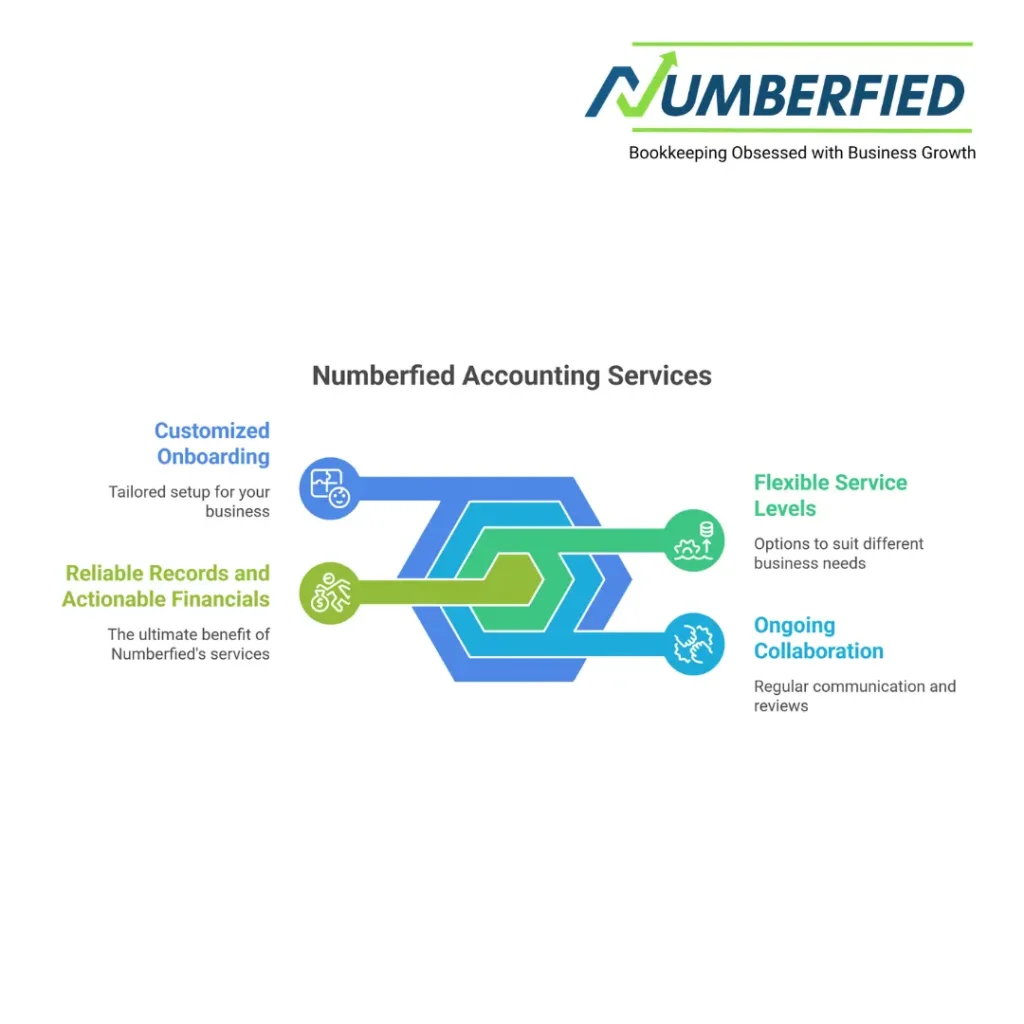
Customized onboarding
We tailor onboarding to your industry, systems, and growth trajectory. Our process includes initial health checks, cleanup, and integration with your tools. The result is reliable records and actionable financials.
Ongoing collaboration
We provide monthly closes, financial reviews, and proactive recommendations. Our team communicates clearly to keep leadership informed and aligned. You receive timely insights that support daily operations and long-term planning.
Flexible service levels
Choose bookkeeping-only support, full accounting, or a hybrid plan. We scale services as your needs evolve and provide predictable pricing. Contact us for a tailored quote and service roadmap.
Practical Steps to Decide for Your Business
Assess your current needs
Review transaction volume, regulatory complexity, and decision-making requirements. Determine whether you need routine record keeping or strategic financial guidance. We offer assessments to identify gaps and opportunities.
Create a phased plan
Start with bookkeeping to get clean data, then add accounting services as strategic needs grow. A phased plan reduces upfront costs and builds capacity. We help create a roadmap aligned with milestones and cash flow.
Measure and refine
Track KPIs such as days to close, tax liabilities, and cash runway to evaluate effectiveness. Use these metrics to adjust service levels and processes. Our team provides regular reviews and optimization recommendations.
Common Mistakes and How to Avoid Them
Ignoring bookkeeping quality
Poor bookkeeping leads to inaccurate financials and unexpected tax liabilities. Invest in consistent processes and quality checks. We perform reconciliations and regularly validate accounts to prevent costly errors.
Underutilizing accounting insight
Some businesses treat accounting only as compliance rather than a strategic resource. Use accounting to plan, forecast, and optimize tax strategy. We provide actionable analysis that supports growth and profitability.
Delaying professional help
Waiting too long to hire professionals increases cleanup time and costs. Early engagement reduces risk and supports faster growth. Contact Numberfied early to set up systems that scale with your business.
Real-World Examples and Case Studies
Small retailer scaling up
A retail client moved from manual ledgers to outsourced bookkeeping and then added accounting for inventory forecasting. The transition improved margin analysis and reduced stockouts. Our team guided the system selection and implementation.
Professional services firm optimizing billing
A consulting firm needed time tracking and revenue recognition improvements; bookkeeping captured billable hours accurately, while accounting restructured client profitability reporting. We streamlined billing and improved cash collection cycles.
Nonprofit improving donor reporting
A nonprofit required fund accounting and transparent reporting to satisfy grantors; bookkeeping organized donation tracking, and accounting prepared restricted fund statements. We helped secure ongoing grant funding through improved financial transparency.
Conclusion
Understanding accounting vs bookkeeping services is essential for making informed decisions that impact compliance, financial clarity, and business growth. Bookkeeping records the transactions that accounting interprets and uses to advise strategic choices. We recommend starting with reliable bookkeeping and layering in accounting as your strategic needs expand. For U.S. businesses seeking a partner to streamline finances, minimize risk, and support growth, contact us at Numberfied for a tailored consultation and clear next steps.
Ready to clarify your needs and build a financial plan that scales? Contact Numberfied today to discuss bookkeeping and accounting options tailored to your business
Frequently Asked Questions
What are the primary differences between bookkeeping and accounting?
Bookkeeping focuses on accurate recording and categorization of financial transactions, ensuring ledgers and records are up to date. Accounting takes that recorded data and analyzes it to produce financial statements, forecasts, and tax filings. Together, they form a complete financial management system for decision-making and compliance.
When should a small business hire bookkeeping services?
Hire bookkeeping services when transaction volume grows beyond what an owner can manage or when accuracy and timely records become critical for tax compliance. Outsourcing reduces errors and frees leadership to focus on operations and growth. We help evaluate transaction volume and recommend appropriate bookkeeping plans.
When is accounting necessary for a business?
Accounting becomes necessary for financial analysis, tax planning, investor reporting, and strategic decision-making as a business scales. It provides insights like cash flow forecasting and profitability by segment. Numberfied offers accounting services that turn records into an actionable strategy.
Can bookkeeping and accounting be outsourced together?
Yes, many businesses outsource bookkeeping and accounting as a combined service for continuity and efficiency. A unified provider streamlines workflows and reduces reconciliation issues between teams. We provide integrated bookkeeping and accounting packages to ensure alignment and timely reporting.
How much do bookkeeping and accounting services typically cost?
Costs vary by transaction volume, complexity, and service level; bookkeeping is generally priced monthly or per transaction while accounting may be billed hourly or as a retainer. Industry specifics, payroll, and tax needs affect pricing. We offer transparent quotes based on an initial assessment of your needs.
What technology should businesses use for bookkeeping and accounting?
Cloud accounting platforms like QuickBooks and Xero, integrated payroll systems, and expense management apps provide automation and accuracy. The right tech stack depends on business needs, industry, and scale. We help select and implement tools that improve efficiency and reporting.
How long does it take to transition to outsourced bookkeeping?
Transition time depends on the cleanliness of existing records, transaction volume, and system integrations; typical transitions range from two to eight weeks. Thorough cleanup and validation steps ensure accurate opening balances and continuity. Our onboarding process includes data migration and reconciliation to minimize disruption.
Will outsourcing bookkeeping reduce tax liabilities?
Outsourcing bookkeeping alone improves accuracy and timeliness of records, which reduces the risk of missed deductions and penalties. Accounting expertise is required to identify tax optimization strategies and implement proactive planning. We integrate bookkeeping and accounting to improve tax outcomes and compliance.
How do we measure the effectiveness of accounting vs bookkeeping services?
Measure effectiveness with metrics like month-end close time, accuracy of forecasts, tax compliance, and improvements in cash flow or profitability. Regular reviews and KPIs reveal process improvements and ROI. We provide periodic performance reports and actionable recommendations to drive improvements.
How can Numberfied support my transition to professional financial services?
Numberfied offers tailored onboarding, cleanup, and scalable service plans for bookkeeping and accounting to match your business stage and goals. We provide technology integration, monthly closes, and strategic financial advice. Contact us for a consultation and a customized plan aligned with your objectives.
Read Also: 7 Stunning Ways Private Bookkeeping Services Can Elevate Your Business