

Introduction
Finding the best bookkeeping service for startups is a pivotal step for any new business. We open with a practical hook: accurate books reduce stress, improve decision-making, and position you for growth and funding. In this guide, we explain why the right bookkeeping matters, evaluate common solutions, and show how to choose services that scale with your startup.
Key takeaway
- Accurate bookkeeping drives better decisions and investor confidence.
- Cloud tools and virtual services offer cost-effective, scalable bookkeeping.
- We recommend an evaluation checklist to select the best bookkeeping service for startups.
Why bookkeeping matters for startups
Financial clarity from day one
Early bookkeeping ensures founders understand cash flow, profitability, and runway. We emphasize clarity because it prevents surprises and supports strategic planning.
Compliance and tax readiness
Proper bookkeeping keeps records audit-ready and simplifies tax filing. The best bookkeeping service for startups helps maintain organized records and avoid penalties.
Investor and lender confidence
Investors and lenders review historical financials; accurate books demonstrate discipline. The best bookkeeping service for startups provides clean books that support funding conversations.
Core bookkeeping services startups need
Transaction recording and categorization
Daily transaction capture and consistent categorization form a reliable general ledger. We recommend automated feeds to reduce manual errors.
Bank and credit reconciliation
Reconciliation validates account balances and detects discrepancies. The best bookkeeping service for startups reconciles accounts regularly and documents adjustments.
Financial reporting and dashboards
Monthly P&L, balance sheet, and cash flow reports inform strategy. We favor services that deliver timely, insightful reports aligned with startup KPIs.
How to evaluate the best bookkeeping service for startups
Expertise with startups
Look for providers experienced with funding rounds, equity transactions, and subscription models. The best bookkeeping service for startups understands startup-specific nuances.
Technology stack and integrations
Ensure the service integrates with your payment processors, payroll, and bank accounts. We prioritize cloud-based platforms for real-time visibility.
Pricing and scalability
Select a provider offering transparent pricing and the ability to scale as your team and transaction volume grow. The best bookkeeping service for startups balances cost with capability.
Comparing DIY, freelancers, and firms
DIY bookkeeping pros and cons
DIY keeps costs low but consumes founder time and carries risk from inexperience. We recommend DIY only in the earliest phase with low transaction volume.
Freelancers and contractors
Freelancers can be flexible and affordable but vary in reliability and scope. The best bookkeeping service for startups may combine freelance support with firm oversight.
Outsourced bookkeeping firms
Firms offer process controls, multiple experts, and continuity. For many startups, the best bookkeeping service for startups is a specialized firm offering technology-enabled services.
Technology considerations for startups
Cloud accounting platforms
Platforms like QuickBooks Online and Xero enable collaboration and automation. The best bookkeeping service for startups leverages cloud tools for accuracy and speed.
Automation and bank feeds
Automated bank feeds and receipt capture reduce manual entry. We recommend services that minimize repetitive tasks to lower costs and errors.
Security and access controls
Verify encryption, backups, and role-based access before sharing financial data. The best bookkeeping service for startups enforces strict security practices.
Cost structures and budgeting
Monthly subscription models
Many providers charge a predictable monthly fee based on transaction volume and services. We encourage budgeting for bookkeeping as an investment in financial health.
Fixed-fee project pricing
Some tasks, such as initial cleanups or chart of accounts setup, are billed as fixed projects. The best bookkeeping service for startups outlines one-time and recurring fees transparently.
Hourly consulting rates
Accountant consultations and bespoke advisory are often hourly. We suggest combining monthly bookkeeping with occasional advisory to control costs.
Onboarding and cleanup for new startups
Initial assessment and setup
Onboarding begins with a financial assessment and a chart of accounts setup. The best bookkeeping service for startups performs a comprehensive initial setup to prevent future rework.
Historical cleanup and reconciliations
If you have prior transactions, an organized cleanup brings the books current. We recommend addressing reconciliations, missing receipts, and tax classifications early.
Setting processes and controls
Define approval workflows, expense policies, and reporting cadences. The best bookkeeping service for startups helps implement repeatable processes to sustain accuracy.
Choosing a provider: checklist and red flags
Checklist for selection
- Startup experience and references
- Clear service scope and SLAs
- Technology and integrations supported
- Pricing transparency and billing cycles
- Security and data protection
Red flags to avoid
Watch for vague deliverables, poor communication, and a lack of documented processes. Avoid providers who promise unrealistic turnaround without documented workflows.
Questions to ask potential providers
Ask about team qualifications, sample reports, onboarding timelines, and how they handle payroll and tax coordination. The best bookkeeping service for startups provides clear answers and examples.
Integration with accounting, taxes, and payroll
Coordinating with accountants
Good bookkeeping prepares the way for efficient tax preparation and advisory services. We encourage collaboration between bookkeepers and tax accountants to minimize surprises.
Payroll and benefits coordination
Payroll data must flow into bookkeeping for accurate liabilities and tax reporting. The best bookkeeping service for startups coordinates payroll and benefits reconciliation.
Preparing for audits and due diligence
Well-maintained books simplify audits and due diligence during fundraising. We emphasize documentation and consistent controls as part of preparation.
Case studies and common startup scenarios
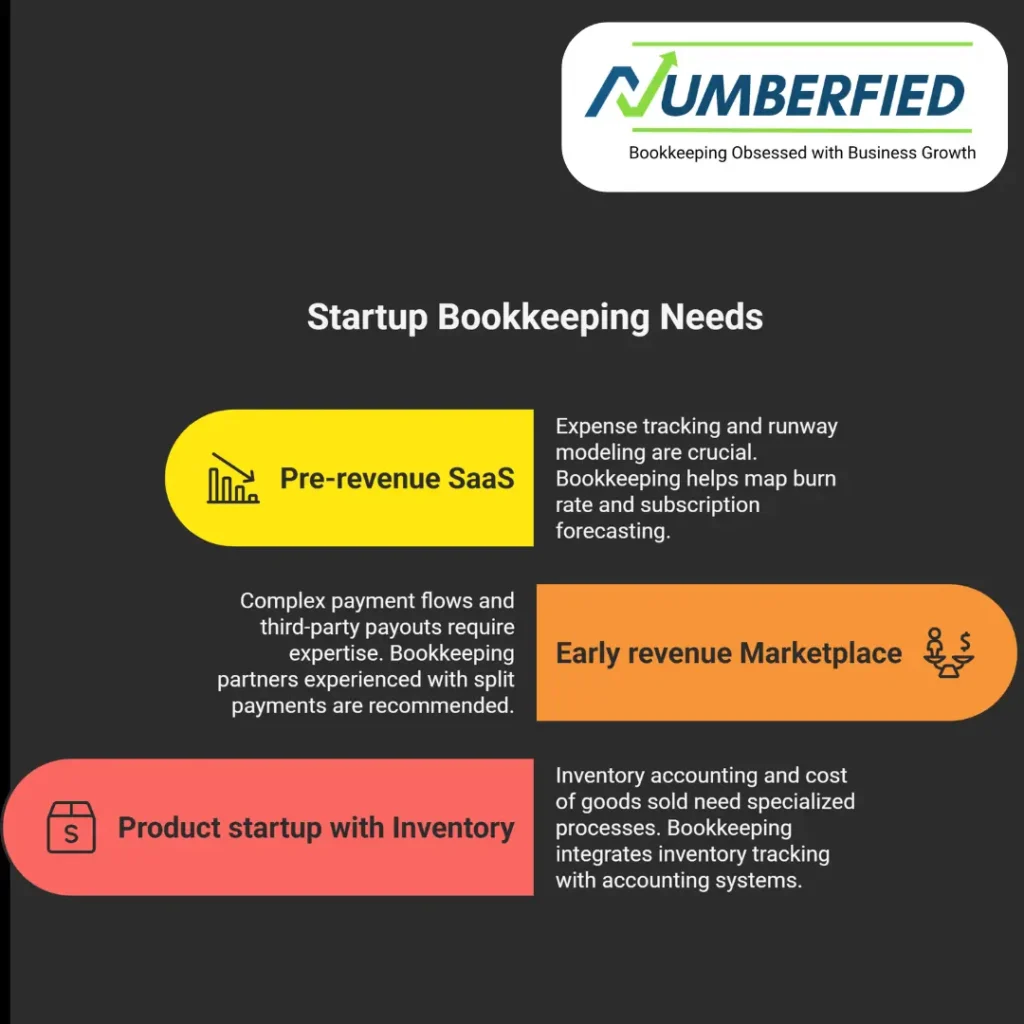
Pre-revenue SaaS startup
A pre-revenue SaaS startup needs expense tracking and runway modeling. The best bookkeeping service for startups helps map burn rate and subscription forecasting.
Early revenue marketplace
Marketplaces involve complex payment flows and third-party payouts. We recommend a bookkeeping partner experienced with split payments and fee structures.
Product startup with inventory
Inventory accounting and cost of goods sold require specialized processes. The best bookkeeping service for startups integrates inventory tracking with accounting systems.
Measuring performance and ROI
Key performance indicators
Track gross margin, burn rate, cash runway, and monthly recurring revenue. The best bookkeeping service for startups includes KPI reporting tailored to your business model.
Monthly close and reporting cadence
Establish a consistent monthly close to maintain timely insights. We advise regular reviews with founders to translate numbers into action.
Using reports for decisions
Financial reports guide hiring, pricing, and investment decisions. The best bookkeeping service for startups presents data clearly to inform strategic choices.
Why do many startups choose Numberfied
Specialization and startup focus
Numberfied specializes in startup bookkeeping and financial operations. Our team understands funding timelines, founder constraints, and growth requirements.
Technology-first approach
We use modern cloud accounting platforms and automation to deliver timely results. Numberfied ensures integrations and workflows are optimized for scalability.
Transparent pricing and partnership
Numberfied offers clear pricing and a partnership mindset to support evolving needs. We work collaboratively to align bookkeeping with strategic goals.
Implementation roadmap for startups
Phase 1: Evaluate needs and select provider
Assess transaction volume, key integrations, and reporting needs. The best bookkeeping service for startups fits your current stage and growth plan.
Phase 2: Onboard and clean up
Complete chart of accounts setup, historical reconciliation, and automation. We recommend a documented onboarding plan with milestones.
Phase 3: Ongoing operations and advisory
Move to regular reporting, KPI reviews, and strategic advisory as required. The best bookkeeping service for startups evolves into a trusted financial partner.
Common pitfalls and how to avoid them
Neglecting bookkeeping until tax season
Delaying bookkeeping creates a backlog, inaccuracies, and stress. We advise continuous bookkeeping and periodic reconciliations to prevent urgent cleanups.
Poor categorization of expenses
Inconsistent categorization leads to misleading reports and tax errors. The best bookkeeping service for startups enforces a consistent chart of accounts and documentation standards.
Overlooking security and access
Sharing credentials insecurely increases risk. We require role-based access, secure connections, and regular reviews of permissions.
Summary and next steps
Choosing the best bookkeeping service for startups means prioritizing startup experience, cloud technology, transparent pricing, and strong communication. We have outlined evaluation criteria, onboarding steps, common scenarios, and why Numberfied is a practical partner for many startups. For proactive financial control and scalable operations, engage with a trusted provider early and set clear expectations.
Ready to simplify your books? Contact us at Numberfied to discuss your needs, review our services, and get a tailored proposal. We will help you implement the right bookkeeping solution to support growth and funding readiness.
Frequently Asked Questions
What makes a bookkeeping service the best for startups?
Startup specialization, cloud tools, and clear communication are essential. We look for providers who handle equity, funding, and complex revenue models. The best bookkeeping service for startups combines technology with experienced professionals.
How much should a startup budget for bookkeeping?
Budget depends on transaction volume and services required, typically a monthly subscription or bundled package. Expect higher costs for cleanup and advisory work. We recommend prioritizing consistent, quality bookkeeping over minimal cost.
Can bookkeeping scale with my startup?
Yes, cloud-based services and modular pricing enable scalability as transactions grow. Providers should offer clear upgrade paths for added services. The best bookkeeping service for startups plans for increasing complexity.
How long does onboarding typically take?
Onboarding ranges from a few days for simple setups to several weeks for historical cleanup. Time depends on data quality and integrations required. We provide an onboarding timeline with milestones and deliverables.
Do startups need full-time bookkeepers?
Not always; many startups use outsourced teams with structured SLAs to cover needs efficiently. As complexity grows, consider moving to a larger package or in-house finance lead. The best bookkeeping service for startups offers flexible support models.
How does bookkeeping help with fundraising?
Clean, accurate financials build credibility and simplify due diligence for investors. Bookkeeping provides historical trends, cash runway, and KPI reports that investors expect. We prepare concise, investor-ready financial documentation.
What security measures should I expect?
Expect encrypted connections, role-based access, and regular backups as standard safeguards. Providers should share security policies and compliance details. The best bookkeeping service for startups prioritizes data protection and access controls.
Can bookkeeping firms handle payroll and taxes?
Many firms coordinate payroll and tax filings through integrations or partnerships with specialist providers. Clarify responsibilities and handoffs during selection to avoid gaps. We ensure payroll data flows into bookkeeping for accurate reporting.
How often should startups review financial reports?
Monthly reviews are standard for early-stage startups to maintain visibility and adjust plans. More frequent checks may be necessary during rapid growth or fundraising. The best bookkeeping service for startups establishes a reporting cadence aligned with decision cycles.
Why choose Numberfied over other providers?
Numberfied focuses on startups with technology-driven bookkeeping and transparent pricing. We combine bookkeeping accuracy with strategic insights for founders. Contact Numberfied to explore a tailored bookkeeping plan that supports growth.
Read Also: Why Do Accountants Charge So Much? Exploring Accounting Firm CFO Services