

Introduction
At Numberfied, we understand that clarity around bookkeeping charges is critical for making confident financial decisions and planning for sustainable growth. Bookkeeping costs can vary widely depending on factors such as business size, transaction volume, service complexity, and the level of expertise required, making it challenging to compare options or predict expenses accurately.
In this guide, we break down how bookkeeping pricing is structured, the key services that influence costs from basic transaction recording to full-service financial reporting, and how to assess true value beyond just the price. Our goal is to equip businesses across the USA with transparent, practical insights so they can choose bookkeeping solutions that deliver accuracy, efficiency, and long-term financial confidence at predictable rates. Understanding bookkeeping charges helps you budget, compare providers, and assess return on investment. Clear expectations for bookkeeping charges lead to better cash flow management, stronger compliance, and more effective strategic planning. As the Numberfied team, we explain key drivers, practical steps to reduce costs, and how our services align with your business goals.
Key Takeaways
- Bookkeeping charges depend on transaction volume, complexity, and frequency of reporting.
- Transparent packages and regular communication reduce surprises in bookkeeping charges.
- Automation and clean records can lower ongoing charges over time.
- Choose a provider that offers scalable services and clear deliverables to control bookkeeping costs.
What Drives Bookkeeping Charges?
Transaction Volume
The number of transactions is a primary driver of bookkeeping charges. Daily sales, payroll items, vendor bills, and expense receipts all contribute to the workload. Higher volumes require more time and systems, which typically raise charges.
Transaction Complexity
Complex transactions, such as multi-entity consolidations, inventory adjustments, or industry-specific accounts, increase the time spent per item. Complexity raises bookkeeping charges because more expertise and review are required to ensure accuracy.
Frequency and Reporting Needs
The cadence of reporting weekly, monthly, or quarterly affects charges. Frequent reporting and customised management reports require additional attention and reconciliation, which can affect the final bookkeeping charges.
How Pricing Models Affect Bookkeeping Charges
Hourly Pricing
Hourly billing is based on time spent. This model makes charges variable, tied to actual effort. It can work well for irregular projects, but may lead to unpredictable charges month to month.
Fixed-Monthly Pricing
Fixed-monthly pricing provides predictable charges by bundling services into a set fee. This model helps businesses plan cash flow and consistently evaluate value, reducing surprise increases in charges.
Tiered or Per-Transaction Pricing
Tiered or per-transaction pricing links charges to volume or service levels. It scales with business needs and can be efficient for growing companies when tiers are well-structured to reflect the actual work involved.
Common Services Included in Bookkeeping Charges
Bank Reconciliation
Reconciling bank and credit card accounts is a foundational task. Consistent reconciliation reduces errors and is usually included in charges because it ensures financial accuracy.
Accounts Payable and Receivable Management
Processing invoices, paying vendors, and managing customer invoices are core services. These tasks often influence charges because they require tracking, follow-up, and accurate coding to financial statements.
Payroll Support and Employer Filings
Payroll processing and related filings add complexity. Whether handled in-house or by a partner, payroll tasks can increase bookkeeping costs due to regulatory compliance requirements and recurring cycles.
How to Evaluate Bookkeeping Charges When Comparing Providers
Ask for a Clear Scope of Work
Request a written scope that outlines deliverables, frequency, and responsibilities. A well-defined scope helps you compare charges apples-to-apples and avoid hidden fees.
Request Sample Reports
Review sample financial reports and reconciliations. The quality of deliverables influences perceived value and justifies charges when reports are actionable, accurate, and timely.
Check Communication and Support Policies
Understand how often you’ll meet, response times, and who handles your account. Strong communication reduces surprises and can lower effective charges by preventing rework.
Practical Steps to Reduce Your Bookkeeping Charges
Keep Records Organized
Streamlining receipts, invoices, and bank statements reduces cleanup time. Organized records directly lower charges over time by reducing manual reconciliation work.
Automate Repetitive Tasks
Use bank feeds, receipt scanning, and integrated invoicing to minimize manual entry. Automation reduces the hours required for bookkeeping, which can lower charges in hourly models and improve efficiency under fixed pricing.
Consolidate Services with One Provider
Bundling bookkeeping, payroll, and tax prep with a single partner often reduces duplication of effort and overall bookkeeping costs. Consolidation creates consistency and a single point of responsibility for accurate books.
How Numberfied Approaches Bookkeeping Charges
Transparent Pricing Structure
We provide clear tiers and a defined scope so you understand what contributes to charges. Our approach minimizes surprises and helps you budget more effectively.
Scalable Services
As your business grows, our services scale with it. We tailor packages so charges evolve predictably with your needs rather than spike unexpectedly.
Technology and Expertise Combined
We use modern tools and seasoned professionals to reduce time on routine tasks. This mix helps manage charges while maintaining high accuracy and timely reporting.
Industry-Specific Considerations for Bookkeeping Charges
Retail and E-commerce
Retail and e-commerce often involve high transaction volumes and inventory tracking, which affect bookkeeping costs. Proper integration and automation are essential to control ongoing charges in these industries.
Service-Based Businesses
Service businesses focus on time tracking, client billing, and project accounting. These elements shape charges differently than inventory-driven models, often requiring accurate job costing and billing support.
Professional Practices
Professional services need detailed financials for partner compensation, billing cycles, and compliance. These requirements can increase bookkeeping costs due to the complexity of reporting and analysis needs.
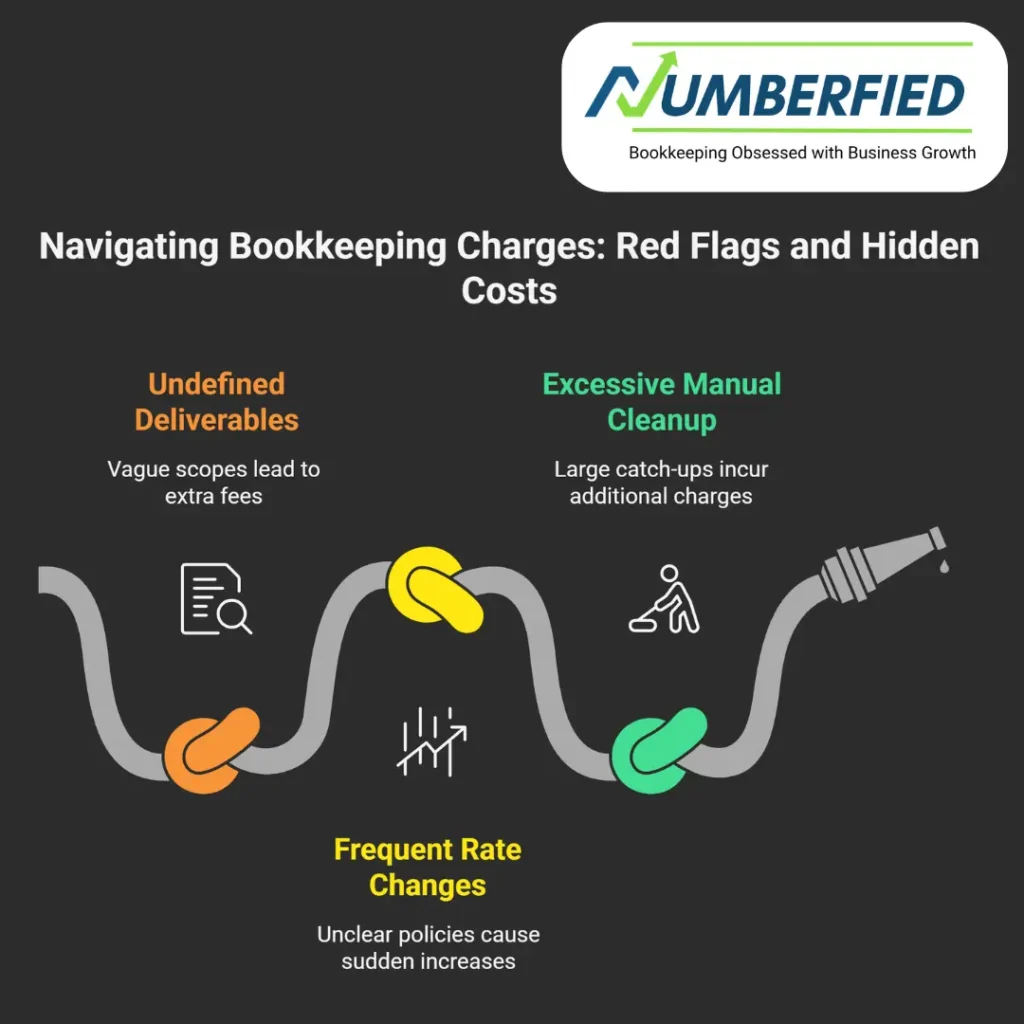
Red Flags and Hidden Costs in Bookkeeping Charges
Undefined Deliverables
Vague scopes create room for extra fees. If a provider cannot clearly list what is included, ask how they will handle tasks outside the scope to prevent unexpected charges.
Frequent Rate Changes
Watch for unclear policies on rate increases. Providers should communicate changes and provide a rationale to avoid sudden increases in bookkeeping charges.
Excessive Manual Cleanup Fees
Large catch-up cleanups often come with additional charges. Avoid this by maintaining regular, organized records to keep charges predictable.
Choosing the Right Plan to Match Your Bookkeeping Charges
Start with a Needs Assessment
Assess transaction volume, industry needs, and reporting frequency. A clear assessment helps choose a plan that effectively balances services and charges.
Prefer Predictability for Budgeting
If budgeting is critical, favor fixed monthly plans. Predictable charges simplify cash flow planning and align expectations across stakeholders.
Allow for Quarterly Reviews
Schedule regular reviews to adjust the scope as your business changes. Revisiting needs prevents mismatches that could unexpectedly inflate bookkeeping charges.
Actionable Checklist to Manage Bookkeeping Charges
Monthly Reconciliation Routine
Establish a monthly checklist to reconcile accounts. Consistent routines reduce errors and long-term charges by preventing backlog and rework.
Adopt Two-Way Communication
Keep a direct line to your bookkeeper for clarifications. Timely answers prevent delays and extra time, which keeps charges under control.
Measure Value, Not Just Cost
Compare charges against the value of accurate financials, compliance avoidance, and strategic insight. The right provider often offsets bookkeeping charges with better decisions and time savings.
How to Request a Quote and What to Include
Provide Transaction Samples
Share representative months of transactions. Sample data allows providers to estimate efforts accurately and present realistic charges.
List Required Deliverables
Detail the reports, frequency, and any special tasks required. Clear deliverable lists help avoid scope creep and unexpected charges.
Ask About Onboarding and Cleanup
Clarify what initial cleanup entails and whether onboarding fees apply. Knowing this upfront prevents surprises in your charges during the first months.
Conclusion
Bookkeeping charges should reflect the value of accurate, timely financial information. By understanding cost drivers, selecting the right pricing model, and maintaining organised records, you can control bookkeeping costs while generating reliable reports that inform decisions. At Numberfied, we combine transparent pricing, scalable services, and modern tools to keep charges predictable and aligned with your business goals. Visit https://numberfied.com/ to request a customised quote and discover how we can efficiently and affordably manage your books.
Frequently Asked Questions
What exactly are bookkeeping charges, and why do they vary?
Bookkeeping charges are fees a business pays for maintaining and recording financial transactions and producing financial reports. They vary because different businesses require different levels of effort, transaction volume, complexity, frequency of reporting, and industry requirements, all of which affect the time and expertise needed, which in turn affects bookkeeping charges. Transparent scopes and sample transactions help providers estimate these charges accurately.
How can I lower my bookkeeping charges without sacrificing quality?
You can lower bookkeeping charges by organizing records, automating repetitive tasks, and cleaning up accounts before onboarding a provider. Reducing manual entry and ensuring bank feeds are connected cuts the time required to process transactions. Choosing a fixed monthly plan with a clear scope can also stabilize bookkeeping charges while maintaining service quality.
Should I choose hourly or fixed pricing to control bookkeeping charges?
Hourly pricing offers flexibility for irregular needs but can create variable bookkeeping charges. Fixed pricing provides predictability and easier budgeting. Choose hourly for occasional, unpredictable work and fixed pricing for steady, ongoing bookkeeping to manage bookkeeping charges effectively.
Are there hidden costs that increase bookkeeping charges later?
Hidden costs can appear if the provider has vague scopes, charges for catch-up cleanups, or applies extra fees for additional report requests. To prevent surprises, ask for a detailed scope, onboarding terms, and policies on rate changes and extra services that could raise your bookkeeping charges.
How often should I review my bookkeeping charges and service scope?
Review bookkeeping charges and service scope at least quarterly or during significant business changes. Regular reviews ensure the plan aligns with current transaction volume and complexity, helping you avoid under- or overpaying for bookkeeping services relative to your actual needs.
Can automation significantly reduce bookkeeping charges?
Yes, automation can reduce manual data entry and reconciliation time, decreasing the labor component of bookkeeping charges. Tools such as bank feeds, receipt capture, and integrated billing systems streamline workflows, enabling providers to reduce bookkeeping costs while maintaining accuracy and improving timeliness.
How do industry specifics affect bookkeeping charges?
Different industries have distinct accounting needs, including inventory for retail, job costing for services, and compliance for regulated sectors. These needs change the amount of work and expertise required, so bookkeeping charges reflect specialized tasks and reporting frequency necessary for accurate financials in each industry.
What should I expect during onboarding, and how does it affect bookkeeping charges?
Onboarding typically involves cleaning up prior records, setting up the system, and migrating historical data. Depending on the condition of your books, onboarding can increase initial bookkeeping charges. A clear agreement on cleanup scope and costs helps set expectations and prevents unexpected bookkeeping charges early in the relationship.
How transparent should a provider be about bookkeeping charges?
Providers should be fully transparent about how they price services, what’s included in each tier, and how additional work is billed. Transparent communication prevents surprises and ensures bookkeeping charges are justified by clear deliverables and expected outcomes.
When is it worth paying higher bookkeeping charges for a premium provider?
Higher bookkeeping charges can be justified when a provider offers deeper expertise, faster turnaround, proactive insights, and integrated services like payroll and tax coordination. Paying more may deliver significant downstream savings through compliance avoidance, better financial decisions, and time recovered for core business activities.
Read Also: Why Numberfied’s Bookkeeping Accounting Service Is Your Small Business’s Secret Weapon