

Introduction
At Numberfied, we recognize how critical it is for brokerages operating in fast-paced, transaction-driven environments to have clear, accurate financial processes. Whether you manage a growing team of agents or run a specialized brokerage, choosing the right bookkeeping packages for brokers is essential to maintaining compliance, tracking commissions, and ensuring reliable financial reporting. This guide outlines practical steps to help you evaluate your options, understand which features matter most, and select a solution that aligns with your business goals. We also highlight how Numberfied’s tailored bookkeeping packages for brokers are designed to simplify financial management, improve visibility, and support your growth with a professional yet approachable experience.
Key takeaways:
- Bookkeeping packages for brokers should be tailored to transaction volume, trust account requirements, and reporting needs.
- Choosing the right package saves time, reduces compliance risk, and improves decision-making.
- Numberfied offers packages that blend cloud bookkeeping, dedicated specialists, and streamlined reporting for brokerages.
- Implementation involves setup, clean-up, ongoing reconciliation, and periodic advisory to scale with your firm.
Why Brokers Need Specialized Bookkeeping Packages for Brokers
Regulatory and trust account complexity
Brokerage firms face specific regulatory requirements and trust account rules that general small business bookkeeping often does not address. Bookkeeping packages for brokers ensure transactions tied to clients and escrow accounts are recorded precisely, reducing audit risk and protecting reputations.
High transaction volume and commission structures
Commission calculations, split tables, and large transaction volumes require bookkeeping processes tuned for brokers. Tailored bookkeeping streamlines commission workflows and automates routine calculations so agents and managers can focus on sales and service.
Need for timely, actionable reporting
Brokers need timely reports on cash flow, agent performance, and profitability by office or property. The right bookkeeping packages for brokers deliver recurring financial statements and dashboards designed for brokerage decision-making.
Core Components of Effective Bookkeeping Packages for Brokers
Initial setup and chart of accounts design
Effective bookkeeping packages for brokers begin with a chart of accounts aligned to the brokerage’s operations. Proper setup maps trust liabilities, commission lines, and expense categories so reporting is accurate from day one.
Ongoing transaction processing and reconciliation
Daily and weekly transaction processing, bank and trust reconciliations, and commission postings form the backbone of bookkeeping packages for brokers. Consistent cycles prevent backlogs and limit errors.
Monthly close, financial statements, and management reports
Monthly close procedures and customized management reports convert raw bookkeeping into insights. Bookkeeping packages for brokers should deliver profit-and-loss, balance sheet, and cash summaries tailored to brokerage metrics.
How to Choose the Right Bookkeeping Packages for Brokers
Assess transaction volume and complexity
Start by quantifying listings, closings, and payment flows. Bookkeeping packages for brokers should be tailored to your volume to keep processing times and costs predictable.
Consider trust accounting and compliance support
Evaluate whether your package includes trust account reconciliation and compliance documentation. Bookkeeping packages for brokers often include audit-ready records to simplify regulatory reviews and internal controls.
Look for automation and integrations
Modern bookkeeping packages for brokers integrate with CRM, property management, and transaction management systems. Automation reduces manual entry and improves data accuracy.
Comparing Typical Bookkeeping Packages for Brokers
Basic bookkeeping package features
Entry-level bookkeeping packages handle general ledger maintenance, monthly reconciliations, and basic reporting. These packages are suited for smaller brokerages with simpler transaction patterns.
Standard bookkeeping package features
Mid-tier bookkeeping packages for brokers include commission processing, regular trust reconciliations, and more detailed reporting, often with a fractional controller option for insights and planning.
Premium bookkeeping package features
Top-tier bookkeeping packages provide a dedicated bookkeeping team, advanced integrations, enhanced advisory services, and custom KPI dashboards for larger or multi-office brokerages.
Implementation Steps for Bookkeeping Packages for Brokers
Discovery and requirements analysis
The first step in any bookkeeping package for broker engagement is a discovery phase. We map workflows, systems, and compliance obligations to design a package that fits your firm.
Data migration and clean-up
Transitioning to a new package includes migrating historical data and resolving legacy inconsistencies. Thorough clean-up is essential so that ongoing bookkeeping packages for brokers produce reliable reports.
Training, testing, and go-live
Training staff on new processes and running a parallel testing period ensures the bookkeeping packages operate smoothly from day one.
How Numberfied Structures Its Bookkeeping Packages
Dedicated bookkeeping teams
Numberfied assigns experienced bookkeepers who understand brokerage workflows. Our bookkeeping packages pair bookkeeping expertise with industry-specific process knowledge to reduce errors and speed up reconciliations.
Cloud-first tools and secure access
We use cloud accounting and secure portals, so broker bookkeeping packages are accessible, auditable, and protected. Clients see real-time updates and receive automated reports tailored to brokerage needs.
Ongoing advisory and performance reviews
Beyond routine bookkeeping packages for brokers, Numberfied offers periodic advisory sessions. We review trends, suggest efficiencies, and adjust package scope as your brokerage grows.
Operational Best Practices Included in Bookkeeping Packages
Standardizing data entry and transaction categories
Consistent transaction coding prevents misclassification. Bookkeeping packages include standard charts of accounts, templates,s and naming conventions to simplify report interpretation.
Monthly close checklists and controls
Rigid monthly close procedures reduce risk. Bookkeeping packages often include reconciliation checklists and documentation guidelines to demonstrate control over trust and operating accounts.
Regular audit readiness and documentation
Preparation for audits is part of quality bookkeeping packages. Numberfied helps maintain supporting schedules and electronic records so audits run smoothly and quickly.
Common Questions Brokers Ask About Bookkeeping Packages
What level of detail should a brokerage track?
Brokers should track transactions by agent, property, and commission type. Bookkeeping packages for brokers that provide granular detail enable more accurate commission calculations and profitability analysis at multiple levels.
How often should reconciliations occur?
Trust accounts should be reconciled at least monthly and often more frequently,y depending on transaction volume. Bookkeeping packages for brokers typically schedule reconciliations weekly for active trust accounts.
Can bookkeeping packages for brokers support multiple offices?
Yes, properly structured bookkeeping packages for brokers accommodate multi-office operations, allowing roll-up reporting and office-level performance analysis while centralizing controls.
Cost Considerations and ROI of Bookkeeping Packages
Understanding pricing models
Bookkeeping packages for brokers may be priced by transaction volume, number of accounts, or as a flat monthly retainer. Transparent pricing helps brokers budget and measure value over time.
Measuring return on investment
ROI is measured through time savings, reduced compliance risk, and improved decision-making. Quality bookkeeping packages often enable better cash management and help identify profitable service lines.
Reducing overhead with automation
Automation in bookkeeping packages reduces manual labor and error rates. Integrations with listing and transaction systems streamline data flow and free staff for value-added activities.
Transitioning From In-House to Outsourced Bookkeeping
When to consider outsourcing
Brokers often consider outsourcing bookkeeping when transaction volume exceeds internal capacity or regulatory complexity increases. Outsourcing provides access to expertise and scalable processes.
Managing the transition and maintaining control
Outsourcing does not mean losing control. Bookkeeping packages should include dashboards, approvals, and scheduled reviews so leadership retains oversight.
Benefits of partnering with an industry-aware provider
Working with a provider experienced in real estate and brokerage operations ensures that best practices and compliance knowledge inform bookkeeping packages for brokers.
Case Studies: How Bookkeeping Packages for Brokers Deliver Value
Small brokerage streamlines commission processing
A small brokerage consolidated agent payments and automated commission splits using bookkeeping packages for brokers, reducing processing time and improving payout accuracy. Regular reporting gave managers a clearer view of profits.
Mid-size firm improves trust account controls
A mid-size firm adopted dedicated trust reconciliations in its bookkeeping packages, resolving long-standing discrepancies and reducing audit friction. The result was cleaner records and lower stress during reviews.
Large multi-office firm centralizes financial reporting
A large firm moved to centralized bookkeeping packages, enabling consolidated P&L and office-level reporting. Leadership gained real-time insights to guide expansion and resource allocation.
Integrations and Technology That Enhance Bookkeeping Packages
Linking CRM and transaction management platforms
Integrations between CRM systems, transaction platforms, and accounting software reduce duplicate entry. Bookkeeping packages with these connections improve accuracy and save staff time.
Using dashboards and KPIs for quick decisions
Dashboards included in bookkeeping packages surface KPIs such as agent productivity, gross commission income trends, and cash position so that leaders can make informed decisions quickly.
Security and backups
Security is central to credible bookkeeping packages for brokers. Numberfied uses encrypted storage, role-based access, and regular backups to protect financial information and maintain business continuity.
Customizing Bookkeeping Packages for Brokers to Your Business
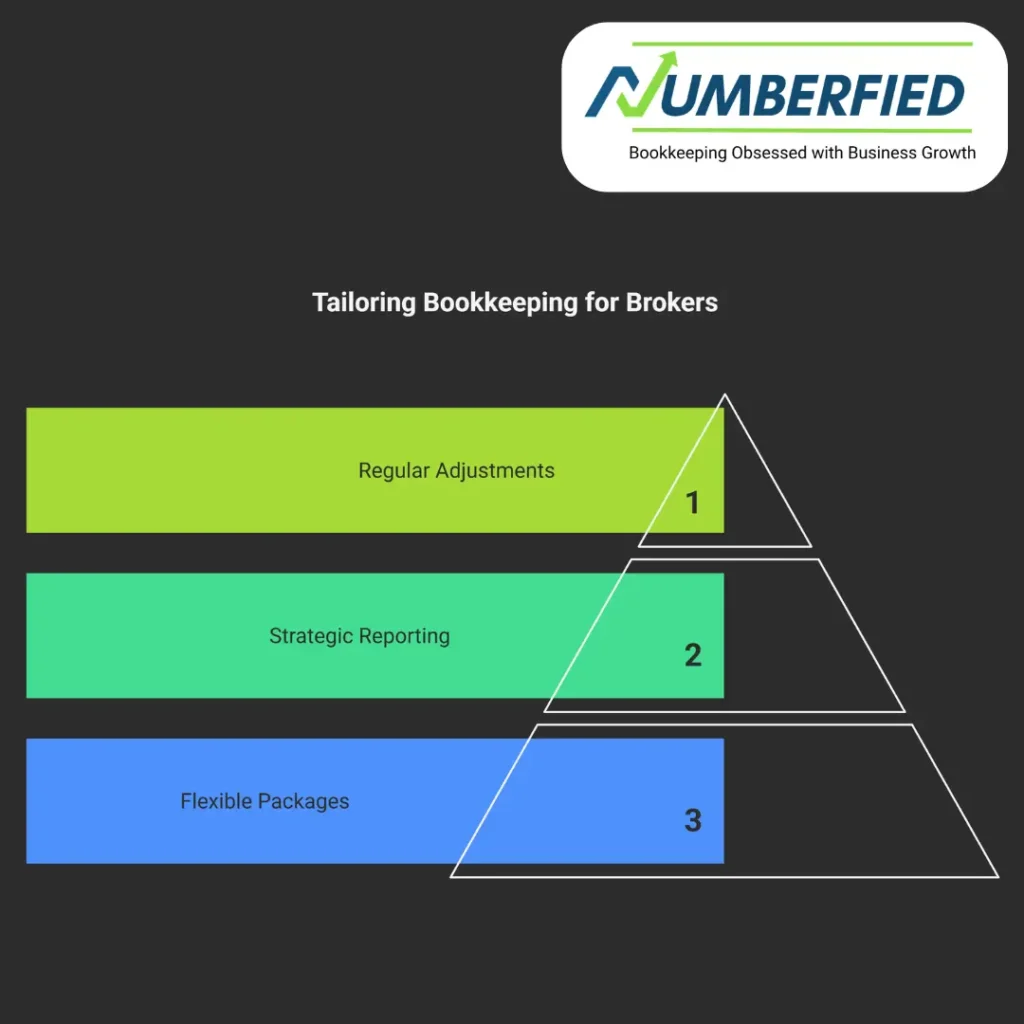
Flexible service tiers and add-ons
Bookkeeping packages for brokers should be modular so firms can add payroll, tax preparation, or CFO advisory as needed. Flexibility keeps costs aligned with growth and complexity.
Building reporting templates that matter
Templates for profitability by agent, office, or property type transform bookkeeping packages from record-keeping tools into strategic tools. Custom reports surface the metrics most relevant to leadership.
Periodic review and package adjustments
As your brokerage evolves, bookkeeping packages should be reviewed and adjusted. Numberfied schedules regular check-ins to ensure service levels match business needs.
Working with Numberfied: What to Expect From Our Bookkeeping Packages
Onboarding with clear milestones
Numberfied’s onboarding for bookkeeping packages includes a project plan, data migration, and training sessions. We aim for a smooth transition and immediate improvements in record quality.
Dedicated point of contact and responsive support
Clients receive a dedicated contact who understands brokerage accounting. Our bookkeeping packages include support for questions, escalations, and ongoing process improvements.
Transparent reporting and predictable pricing
We provide clear invoices and regular reports so you always know what you’re receiving. Bookkeeping packages from Numberfied are designed for predictable value and measurable results.
Next Steps: How to Get Started With Bookkeeping Packages for Brokers
Schedule a discovery call
The easiest next step is a short discovery call to assess needs and outline a customized bookkeeping package for the broker’s plan. We’ll map your current state and recommend the right scope.
Request a sample report
Ask for example reports that match your brokerage metrics so you can evaluate whether the bookkeeping packages for brokers will deliver the insights you need.
Begin a phased rollout
Many firms start with a phased rollout: initial setup, clean-up, then ongoing processing. Phased implementation makes bookkeeping packages for brokers manageable and measurable.
Conclusion
Bookkeeping packages for brokers are an essential foundation for a healthy, growing brokerage. With tailored setup, ongoing reconciliation, and advisory support, brokerages gain clarity, reduce risk, and free time to focus on clients. Numberfied designs bookkeeping packages that scale with your business and deliver actionable financial insights. Ready to talk about a package that fits your brokerage? Visit https://numberfied.com/ to schedule a discovery call and learn how our bookkeeping packages can help you thrive.
Frequently Asked Questions
What do bookkeeping packages for brokers typically include?
Bookkeeping packages for brokers typically include a chart of accounts setup, transaction entry, bank and trust reconciliations, commission processing, and monthly financial statements. Many packages also offer integrations with transaction management systems to reduce manual entry and improve accuracy.
How long does it take to implement bookkeeping packages for brokers?
Implementation time depends on the size of the firm and the condition of historical records. Onboarding for bookkeeping packages for brokers often follows a phased approach with discovery, data migration, and a testing period to ensure accuracy before full go-live.
Can bookkeeping packages for brokers handle trust accounting?
Yes, quality bookkeeping packages for brokers include trust account management and reconciliation processes. These packages ensure trust funds are recorded correctly, maintain separate ledgers for client funds, and prepare audit-ready documentation for regulators.
Are bookkeeping packages for brokers compliant with industry regulations?
Bookkeeping packages for brokers designed for the brokerage market incorporate compliance controls and documentation practices. Providers with real estate experience include protocols to support regulatory reviews and internal controls around trust funds and commission payouts.
What technology do bookkeeping packages for brokers use?
Most modern bookkeeping packages for brokers use cloud accounting platforms, secure portals, and integrations with CRM and transaction management systems. This technology stack supports automation, remote access, and real-time reporting, which are essential for brokerages.
How do bookkeeping packages for brokers handle commissions?
Bookkeeping packages for brokers handle commission calculations, split processing, and agent payouts. They track earned versus paid commissions, manage deductions, and produce reports that reconcile commission expenses with revenue received.
Can bookkeeping packages for brokers scale as a firm grows?
Yes, scalable bookkeeping packages for brokers offer tiered services and flexible add-ons. As your firm grows, you can expand services to include payroll, tax preparation, and higher-touch advisory without disrupting bookkeeping continuity.
What are the benefits of outsourcing bookkeeping packages for brokers?
Outsourcing bookkeeping packages for brokers reduces administrative burden, provides access to specialized expertise, and improves control and reporting. Firms gain predictable costs and can reallocate internal resources to revenue-generating activities.
How does Numberfied ensure data security in bookkeeping packages for brokers?
Numberfied employs encrypted data storage, secure access controls, role-based permissions, and regular backups as part of our bookkeeping packages for brokers. These measures protect sensitive financial information and maintain business continuity.
How do I evaluate whether bookkeeping packages for brokers deliver value?
Measure value by tracking time saved, reduced errors, faster close cycles, and improved decision-making from better reporting. Bookkeeping packages for brokers that provide clear KPIs and regular advisory reviews make it easy to demonstrate ROI and adjust scope as needed.
Read Also: Why Numberfied’s Bookkeeping Accounting Service Is Your Small Business’s Secret Weapon