

Introduction
Managing finances as an Australian resident or sole trader can be time-consuming and complex. Personal bookkeeping services offer focused, professional help that keeps records organised, ensures ATO compliance, and frees time for your core activities. This guide explains the benefits, challenges, compliance requirements, tools, onboarding steps, and expected return on investment so you can make a confident decision.
Quick takeaways
- Personal bookkeeping services deliver accuracy, time freedom, and tax readiness.
- Expect cost savings through reduced penalties, organised records, and better decisions.
- Select services that use Xero or MYOB and follow ATO guidelines.
Why personal bookkeeping services matter
Clarity for personal and small-business finances
Accurate records separate personal and business transactions, simplify BAS and tax returns, and reduce mistakes when lodging with the ATO. A qualified provider structures accounts, so you always know where you stand.
Reducing administrative burden
Outsourcing routine data entry, reconciliations, and reporting lets you focus on earning and living. Regular bookkeeping avoids last-minute rushes at tax time.
Supporting decision-making
Reliable financial reports from personal bookkeeping services help with budgeting, forecasting, and cash flow planning for sole traders and households with variable income.
Key benefits explained
Cost savings and fiscal discipline
Good bookkeeping minimises ATO penalties and prevents double-spending. Personal bookkeeping services can identify deductible expenses and prevent missed claims, often paying for themselves.
Expertise and tailored advice
Specialist bookkeepers understand Australian tax rules and reporting cycles. They tailor processes for sole traders, contractors, and individuals with rental or investment income.
Time freedom and productivity
Delegating record-keeping frees time for revenue-generating work, family, and rest. Ongoing services reduce the hours spent on retroactive reconciliation before tax deadlines.
Common challenges and how to manage them
Privacy concerns and data handling
Personal bookkeeping services require access to bank statements and receipts. Choose providers with clear privacy policies and restricted access controls to protect sensitive information.
Security and technology risks
Confirm secure cloud platforms, two-factor authentication, and encrypted communication. Regular backups and software updates reduce exposure to cyber threats.
Maintaining oversight and control
Even with outsourced services, retain oversight by reviewing monthly reports, approving reconciliations, and keeping copies of critical documents. Set defined approval limits for transactions.
Australian compliance: ATO rules and reporting
Understanding ATO obligations
Personal bookkeeping services must align with ATO requirements for record retention, GST reporting, and PAYG obligations. Bookkeepers often prepare BAS and liaise with tax agents to ensure proper lodgement.
Record-keeping timeframes
The ATO requires records to be kept for five years in most cases. Ensure your chosen service stores documents in accessible formats and can retrieve files for audits or reviews.
GST, BAS, and fringe benefits
If you are registered for GST, personal bookkeeping services prepare BAS, reconcile GST accounts, and ensure timely payments. They also track fringe benefits and other tax-sensitive items for accurate reporting.
How to select the right provider
Qualifications and industry experience
Look for providers with formal bookkeeping qualifications, memberships in recognised industry bodies, and experience serving Australian residents and sole traders.
Service scope and pricing
Clarify deliverables: reconciliation frequency, BAS preparation, payroll, tax prep support, and software subscriptions. Compared to transparent pricing models, fixed monthly fees are typically easier to budget for.
References, reviews, and sample reports
Ask for client references and examples of monthly reports. Quality providers will show how they present cash flow, profit and loss, and reconciliations in a clear, actionable format.
Tools and platforms commonly used
Xero: cloud-native bookkeeping
Xero is widely used by Australian sole traders and personal bookkeeping services for bank feeds, reconciliations, and BAS workflows. Its ecosystem supports payroll, expense capture, and integrations with tax agents.
MYOB: established local option
MYOB remains popular for businesses and individuals who prefer a locally focused solution. Certified bookkeepers can manage compliance features, payroll, and BAS in MYOB with direct ATO links.
Receipt capture and automation tools
Tools like Receipt Bank (Dext) and Hubdoc automate receipt capture and invoice extraction. Personal bookkeeping services that use automation reduce manual entry and speed up month-end processes.
Tax preparation and lodgement support
Preparing tax-ready records
Personal bookkeeping services gather income, deductible expenses, and supporting documents so tax agents or accountants can prepare accurate returns. Regular reconciliations reduce surprises at lodgement time.
Coordination with registered tax agents
Bookkeepers frequently collaborate with registered tax agents for lodgement. Confirm whether your chosen provider coordinates directly or gives you files to pass to your accountant.
Minimising audit risk
Well-documented transactions and consistent reporting reduce the likelihood of ATO queries. Bookkeepers can prepare audit packs and explain entries during reviews.
Onboarding process: practical steps
Initial assessment and setup
Onboarding for personal bookkeeping services begins with a financial health check: a review of current records, bank feeds setup, and a plan for categorisation consistent with tax rules.
Data migration and chart of accounts
Effective onboarding includes migrating historical transactions into Xero or MYOB and creating a chart of accounts tailored to your income streams and expenses for accurate reporting.
Training and communication cadence
Agree on reporting frequency, preferred communication channels, and how to send receipts. Good providers offer short training sessions so clients can capture expenses correctly going forward.
Measuring return on investment (ROI)
Direct cost savings
Calculate savings from reduced ATO penalties, fewer accounting adjustments, and reclaimed deductible expenses. Personal bookkeeping services often identify missed deductions that increase net returns.
Time value and productivity gains
Estimate the hours reclaimed by outsourcing bookkeeping and multiply by your hourly rate to quantify time-based ROI. Include the value of improved decision-making enabled by timely reports.
Long-term financial health
Regular reconciliations and accurate records show trends early, help avoid cashflow crises, and support better borrowing or investment choices, and tangible long-term returns from quality bookkeeping.
Pricing models and expected fees
Fixed monthly plans
Many providers offer fixed monthly pricing based on transaction volume and services. This eases budgeting and encourages regular maintenance rather than ad hoc fixes.
Hourly or ad hoc rates
For occasional catch-ups, hourly billing works well. Ensure the provider supplies time estimates and clear invoicing practices to avoid unexpected costs.
Bundled services
Some offerings bundle bookkeeping, payroll, and BAS preparation. Compare whether bundled pricing is more economical than paying separately for each service.
Practical tips to maximise value
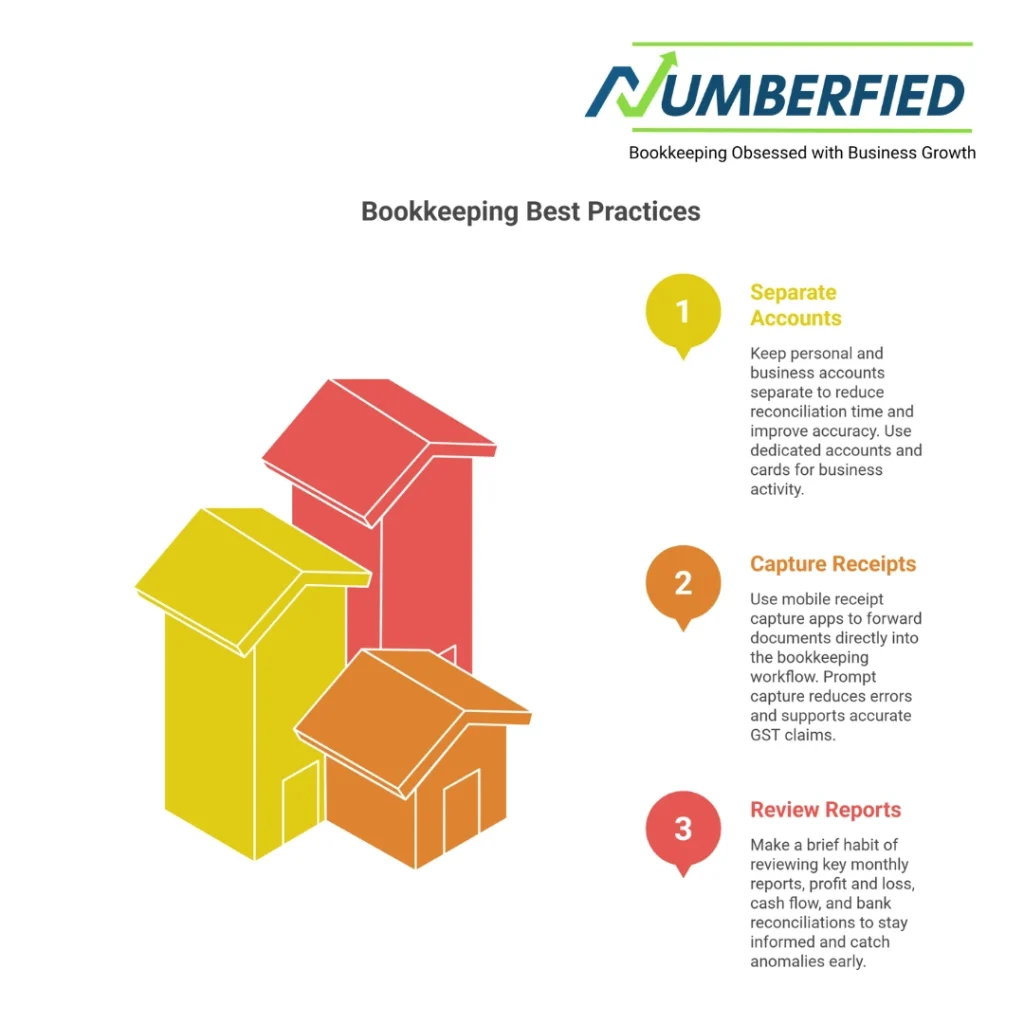
Keep personal and business accounts separate
Separation reduces reconciliation time and improves the accuracy of reports prepared by personal bookkeeping services. Use dedicated accounts and cards for business activity.
Capture receipts promptly
Use mobile receipt capture apps to forward documents directly into the bookkeeping workflow. Prompt capture reduces errors and supports accurate GST claims.
Review monthly reports
Make a brief habit of reviewing key monthly reports, profit and loss, cash flow, and bank reconciliations to stay informed and catch anomalies early.
Case study: sole trader turnaround (illustrative)
Situation
A sole trader with inconsistent records faced BAS penalties and cashflow uncertainty. The lack of reconciled accounts made tax preparation costly and stressful.
Action
Engaging personal bookkeeping services introduced regular reconciliations, automated receipt capture, and a simplified chart of accounts. Monthly reports and BAS were prepared on schedule.
Outcome
Over 12 months, the sole trader reduced BAS penalties, claimed missed deductions, and regained hours previously spent on admin, delivering measurable financial and time ROI.
Common mistakes to avoid
Delaying bookkeeping until tax time
Waiting until the end of the year increases errors and costs. Regular monthly bookkeeping keeps records clean and avoids rushed corrections.
Choosing the cheapest rather than the fit-for-purpose
Lowest-cost options may lack ATO knowledge or secure systems. Prioritise expertise, security, and clear deliverables when choosing personal bookkeeping services.
Poor communication and unclear expectations
Set clear responsibilities, report format, and response times from the start to avoid friction and missed deadlines.
How Numberfied supports Australian clients
Compliance-focused workflows
Numberfied aligns bookkeeping processes with Australian tax rules and BAS cycles, keeping records ready for lodgement and audit requests.
Cloud tools and automation
We implement and manage platforms such as Xero and MYOB, plus receipt capture and bank feeds, to streamline reconciliation and reporting.
Flexible engagement options
Numberfied offers fixed monthly plans and ad hoc catch-ups so sole traders and individuals can choose a model that suits their workload and budget. Contact Numberfied for a tailored quote and onboarding plan.
Conclusion
Personal bookkeeping services deliver clarity, compliance, and time savings for Australian residents and sole traders. By selecting a qualified, secure provider that uses Xero or MYOB and follows ATO guidelines, you can reduce costs, avoid penalties, and gain better control of your finances. If you want a compliant, reliable, and efficient approach to your records, contact Numberfied to discuss how our services can fit your needs.
Frequently asked questions
What are personal bookkeeping services, and who needs them?
Personal bookkeeping services are tailored record-keeping and reporting solutions for individuals and sole traders. They suit anyone who needs organised accounts, tax readiness, and professional reporting without managing daily bookkeeping themselves.
How secure is my financial data with an outsourced bookkeeper?
Reputable providers use encrypted cloud platforms, secure access control, and two-factor authentication. Confirm their security policies, data centre location, and backup procedures before engagement.
Which software is best: Xero or MYOB?
Xero is popular for cloud-native workflows and large integration ecosystems, while MYOB remains strong for local business preferences. The best choice depends on your workflow and the bookkeeper’s expertise.
How often should I reconcile my accounts?
Monthly reconciliations are standard for ongoing bookkeeping, but higher-volume businesses may prefer fortnightly or weekly checks. Regular reconciliation prevents errors and improves cash flow visibility.
Can bookkeepers help with BAS and GST?
Yes. Personal bookkeeping services often prepare BAS, reconcile GST accounts, and ensure timely lodgement, or prepare files for your registered tax agent to lodge.
Will outsourcing bookkeeping save me money?
Outsourcing can save money by reducing penalties, improving deductions, and freeing time for income-generating activities. Compare expected savings against service costs to estimate ROI.
How long does onboarding usually take?
Onboarding typically takes one to four weeks, depending on historical data volume and software migration needs. A clear scope and prompt provision of documents speed the process.
What documents will my bookkeeper need?
Your bookkeeper will need bank statements, invoices, receipts, payroll records (if any), and previous tax returns. Digital copies and access to bank feeds simplify the workflow.
Can bookkeepers represent me with the ATO?
Bookkeepers can prepare records and liaise with registered tax agents. Only a registered tax agent or authorised representative can formally represent you in ATO matters unless you grant specific authority.
How do I measure whether bookkeeping is delivering value?
Measure value by reduced time spent on admin, fewer ATO adjustments or penalties, improved cashflow reports, and identified tax savings. Regular review of KPIs and financial reports shows ongoing benefits.
Also Read: Why Accounting Services for Ecommerce Are Your Australia Online Store’s Secret Sauce