
Introduction
The financial services industry is currently standing at a technological crossroads. On one side, Artificial Intelligence (AI) offers an unprecedented opportunity to automate the tedious, manual tasks associated with bookkeeping and accounting – from data entry to anomaly detection. On the other side, a new report from global cybersecurity leader Trend Micro reveals that this same innovation is rapidly expanding the “attack surface” for hackers, putting sensitive financial data at risk.
As a firm dedicated to modern financial operations, Numberfied understands that you cannot separate number-crunching from security. While platforms like Numberfied help streamline bookkeeping and accounting processes for growth, the underlying data must be fortified against evolving digital threats. According to a recent study published on July 2, 2025, Australian firms are embracing AI but bracing for a surge in cyber risk. Here is how that global trend directly impacts your bookkeeping and accounting practice and what you can do about it.
The AI Paradox: Efficiency vs. Exposure in Financial Services
The integration of AI into financial workflows is no longer a luxury; it is a necessity. However, the Trend Micro research highlights a critical paradox: the same tools that protect data can also expose it.
Why Bookkeeping is a Prime Target for AI-Driven Cyber Attacks
Bookkeeping and accounting firms are treasure troves of personally identifiable information (PII), bank details, tax file numbers, and corporate secrets. Trend Micro’s research indicates that 87% of businesses believe AI will negatively impact their cyber risk exposure within the next three to five years.
The Rise of Automated Anomaly Exploitation
Traditionally, bookkeepers relied on manual checks to spot fraud. Today, criminals use AI to learn your bookkeeping and accounting software patterns. They deploy AI to write undetectable code or craft phishing emails that mimic a CEO’s tone perfectly (voice and text cloning). If a firm adopts AI for efficiency without a security-first mindset, they are essentially handing cybercriminals a roadmap to their general ledger.
Data Poisoning and Financial Records
One specific threat to bookkeeping and accounting is “data poisoning.” If an attacker compromises the AI model your firm uses to categorize expenses or reconcile bank feeds, they can subtly alter data over time. Because AI processes millions of data points, a human bookkeeper might not notice a $5 diversion on hundreds of transactions, but the AI sees it as normal. This creates a ticking time bomb in your financial statements.
The “Shadow IT” Risk in Modern Accounting Firms
The Trend Micro study also points to a proliferation of new endpoints, APIs, and “shadow IT” as a major concern. In the context of bookkeeping and accounting, this is extremely relevant.
The Danger of Unapproved AI Tools
An accountant wants to save time. They download a ChatGPT-powered plugin to write emails or a third-party AI tool to summarize receipts. This is “Shadow IT” – software used without the central IT department’s approval.
For bookkeeping and accounting, this is catastrophic. These unvetted tools may store your client’s financial data on unsecured servers in foreign countries. Trend Micro notes that uncertainty around how data is processed and stored by AI systems is a top concern. Numberfied advocates for using centralized, secure platforms rather than fragmented, risky third-party add-ons.
Building a Secure Framework for AI-Powered Bookkeeping
How do we reconcile the need for speed with the need for safety? The answer is not to abandon AI, but to adopt rigorous security practices alongside your bookkeeping and accounting automation.
Strategies to Protect Financial Data in the AI Era
To protect your firm from the threats outlined in the Trend Micro report, you must embed security into every stage of AI adoption.
Implement “Secure by Design” Bookkeeping
As Andrew Philp, ANZ Field CISO at Trend Micro, stated, security cannot be an afterthought. When choosing a bookkeeping and accounting solution (or using one like Numberfied), ensure that the AI models are transparent.
- Ask Vendors: Where is the data processed? Is it used to train public models?
- Access Control: Ensure that AI-driven anomaly detection does not override human control. The system should flag, not act.
Continuous Monitoring for Anomalies
The report highlights that 45% of firms rely on AI for automated asset discovery and anomaly detection. In bookkeeping and accounting, this means using AI to watch for AI attacks.
- Behavioral Analysis: Use software that learns the typical behavior of your bookkeepers. If an AI logs in at 3 AM from a strange IP address and attempts to export the entire chart of accounts, the system should lock down instantly.
Vendor Risk Management and Compliance
The Trend Micro study mentions increased compliance pressures. For bookkeeping and accounting firms, compliance with frameworks like SOC 2 or ISO 27001 is non-negotiable.
- API Security: Many AI tools connect via APIs. Ensure that your bookkeeping and accounting software uses tokenized authentication rather than passwords.
- Patching Cycles: The Pwn2Own event in Berlin uncovered seven zero-day vulnerabilities in AI frameworks. Your accounting tech stack must have a rapid patching cycle – most cloud-based bookkeeping and accounting platforms handle this, but on-premise solutions often fail here.
Conclusion
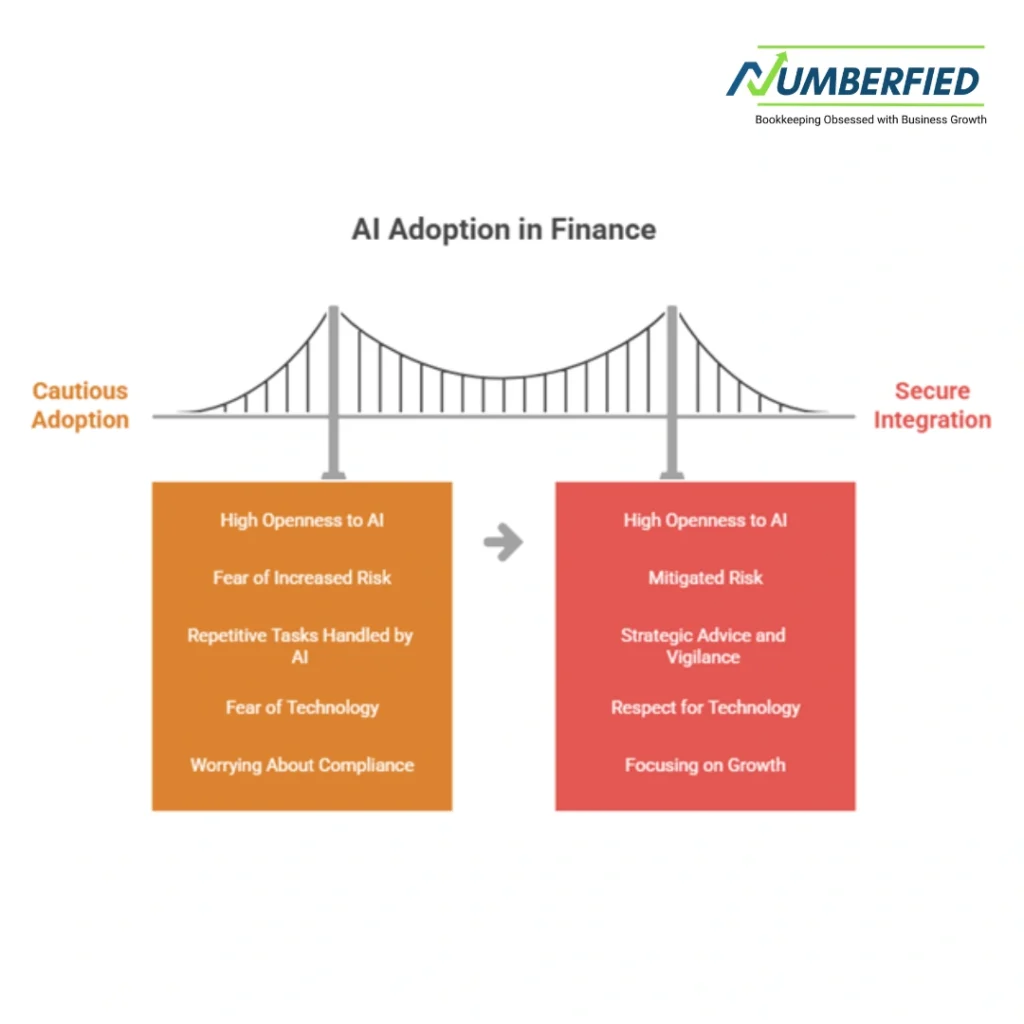
The future of finance is intelligent, automated, and digital. As the Trend Micro research clearly shows, Australian firms (and by extension, global markets) are barreling toward AI adoption, with 93% open to using AI in their security strategies. However, the 87% who fear increased risk exposure are right to be cautious.
For the bookkeeping and accounting industry, this is a watershed moment. AI can handle the repetitive tasks of reconciliation and reporting, freeing humans to offer strategic advice – the kind of growth-driven insights that Numberfied specializes in. But that freedom comes with the responsibility of vigilance.
The solution is not to fear technology but to respect it. By demanding secure AI models, eliminating shadow IT, and continuously monitoring financial ecosystems, accountants and bookkeepers can protect their clients’ assets. The goal is to stop worrying about compliance and start focusing on growth, knowing that your digital fortress is secure.
Also Read: Why the Best Bookkeeping Services for Small Business Are Your Australian Success Key
Frequently Asked Questions (FAQs)
How does AI specifically increase risk in bookkeeping and accounting?
AI increases risk by expanding the “attack surface.” It adds new APIs, data endpoints, and automated processes that hackers can exploit. Criminals also use AI to create more convincing phishing scams aimed at stealing login credentials for accounting software.
What is “Shadow IT” and why is it bad for my accounting firm?
Shadow IT refers to software or AI tools used without the IT department’s approval. In accounting, downloading an unapproved receipt-scanning AI could lead to client financial data being leaked onto public AI servers.
Can AI help defend against cyber attacks in accounting?
Yes. Over half of businesses use AI for anomaly detection. In bookkeeping and accounting, AI can spot irregular payment patterns or login attempts that a human might miss, stopping fraud in real-time.
What should I ask my bookkeeping software vendor about AI security?
Ask: “Do you use my data to train your public AI models?” “Is data encrypted at rest and in transit?” and “Do you conduct third-party penetration testing on your AI features?”
Are small bookkeeping firms at risk, or just big corporations?
Small firms are at higher risk. Cybercriminals know small bookkeeping and accounting firms often lack dedicated IT security, making them easier targets for automated AI-driven ransomware attacks.
What is “data poisoning” in financial contexts?
Data poisoning is when a hacker subtly alters the training data of an AI. In bookkeeping and accounting, this could adjust tax calculations by fractions of a percent, leading to massive cumulative errors over time.
How does Numberfied address these cybersecurity concerns?
Numberfied focuses on secure, growth-driven bookkeeping and accounting by using reputable cloud platforms, emphasizing access controls, and ensuring that business owners retain oversight over their financial data.
What is the biggest red flag that my AI bookkeeping tool is unsafe?
The biggest red flag is a lack of transparency. If your bookkeeping and accounting AI cannot tell you exactly where your data is stored or who has access to it, you should stop using it immediately.
How often should I update my accounting software passwords?
You should use Multi-Factor Authentication (MFA) at all times. In light of the Trend Micro findings regarding zero-day exploits, you should also patch or update your bookkeeping and accounting platforms immediately upon release (usually every 2-4 weeks).
Will AI replace the need for human bookkeepers?
No. AI will handle repetitive data entry, but human oversight is required to manage security risks, interpret complex financial strategy, and verify that AI hasn’t been compromised by malicious actors.