
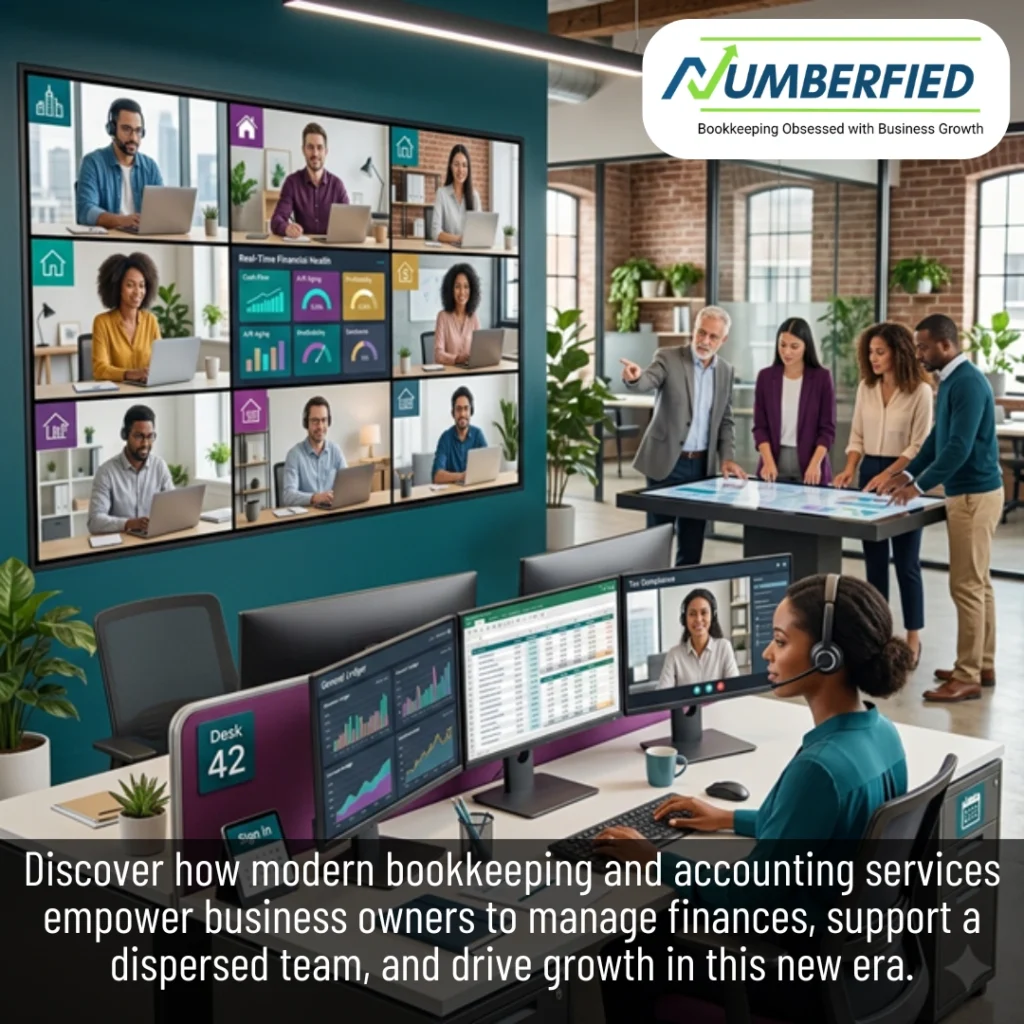
Introduction
The debate is over. According to Gallup’s extensive research in The Future of the Office Has Arrived: It’s Hybrid, the workplace has undergone a permanent transformation. After surveying over 200,000 employees, Gallup confirms that eight in 10 remote-capable employees now expect to work hybrid or fully remote. The era of the five-day, in-person work week is fading, replaced by a flexible model where employees split their time between home and the office.
For business owners, this shift presents a unique paradox. While a hybrid workforce boosts employee engagement, reduces burnout, and widens the talent pool, it also introduces new complexities -especially in financial operations. How do you track expenses when your team is spread across different locations? How do you manage cash flow when collaboration happens asynchronously? The answer lies in leveraging professional bookkeeping and accounting services designed for the distributed world. By integrating expert financial oversight with business growth strategies, companies can not only survive the hybrid transition but thrive within it.
The Hybrid Mandate: Why Remote Flexibility Is Here to Stay
Gallup’s data paints a clear picture: the future of the office is not a binary choice between fully remote or fully on-site. Instead, it is a middle ground. Currently, five in 10 remote-capable employees work hybrid, three in 10 are fully remote, and only two in 10 work entirely on-site. More importantly, employees have largely settled into these patterns, with long-term projections showing this balance holding steady.
This isn’t just a temporary adjustment. Eight in 10 CHROs from Fortune 500 companies report no plans to decrease remote flexibility in the next year. For entrepreneurs, this means that your operational strategy -including how you handle bookkeeping and accounting -must be built for a world where your team may never all be in the same room on the same day. The old methods of passing paper receipts around the office or having ad-hoc financial chats by the water cooler are obsolete.
The Employee Expectations Driving Change
Employees are not just accepting hybrid work; they are demanding it. Gallup found that nine in 10 remote-capable employees prefer some form of remote flexibility. When employees work from their desired location, they are more engaged, less burned out, and less likely to quit. For a small business owner, this is critical. Turnover is expensive. Replacing a skilled team member can cost anywhere from 50% to 200% of their annual salary -a direct hit to your financials.
Modern bookkeeping and accounting practices can help you quantify this impact. By tracking recruitment costs, training expenses, and productivity dips associated with turnover, your financial partner can build a business case for maintaining hybrid flexibility. In essence, your books can tell the story of why retention matters, turning a human resources challenge into a data-backed financial strategy.
The Productivity Question: What the Data Really Says
One of the biggest concerns for employers has been productivity. Gallup notes that the research is mixed: some studies show fully remote work can slightly decrease efficiency in certain roles, while hybrid work tends to yield small to moderate improvements. However, the real takeaway is that manager effectiveness is four times more important to employee engagement than where they work.
This is where bookkeeping and accounting software and services become a competitive advantage. When your team is hybrid, visibility is key. Cloud-based accounting platforms allow for real-time expense tracking, automated invoicing, and live cash flow dashboards. Instead of waiting for a weekly in-person update, you can see your financial health from anywhere. The right virtual accounting service doesn’t just record past transactions; it provides a live pulse on your business, enabling better decision-making across time zones.
Overcoming the Top Financial Challenges of a Hybrid Team
Gallup highlights that the greatest risks of hybrid work revolve around frayed collaboration, communication, and culture. While these are often seen as HR issues, they have direct financial implications. Disorganized communication leads to lost receipts, delayed client invoicing, and missed tax deductions. A disjointed culture can mean that no one takes ownership of expense reporting, leaving the business owner to clean up the mess.
Professional bookkeeping and accounting services act as the central nervous system for your hybrid business’s finances. They provide the structure that remote collaboration often lacks.
Solving the Receipt and Expense Tracking Nightmare
In a hybrid environment, an employee might buy client lunch on a Tuesday (in-office), purchase software on a Wednesday (at home), and take a ride-share to a meeting on Thursday (remote). Without a centralized system, those receipts get lost in email threads, Slack messages, or physical wallets.
A dedicated bookkeeping and accounting partner will implement a seamless, cloud-based expense management system. This often includes:
- Mobile receipt capture: Employees snap a photo of a receipt via an app, and it is automatically uploaded and categorized.
- Corporate card integration: Transactions sync directly with your accounting software, eliminating manual data entry.
- Real-time policy enforcement: The system flags out-of-policy spending immediately, preventing budget blowouts.
By automating these workflows, you eliminate the “Where’s the receipt for that?” conversation, saving hours of administrative time and ensuring your books are audit-ready at all times.
Cash Flow Management in a Decentralized World
Cash flow is the lifeblood of any small business. Hybrid work can distort it. For example, you might have upfront costs for home office stipends, new collaboration software subscriptions, or periodic office space rental. If these are not tracked against your accounts receivable -which might be delayed due to slower internal approvals in a hybrid setup -you could face a liquidity crunch.
Strategic bookkeeping and accounting moves beyond simple categorization. It involves:
- Weekly cash flow forecasting that accounts for the new timing of hybrid-related expenses.
- Segmented budgeting that separates in-office costs from remote work allowances.
- Automated accounts receivable follow-ups to ensure client payments don’t fall through the cracks when your billing team is working asynchronously.
As noted on the Numberfied platform, modern financial health reviews and strategic growth planning sessions are essential. These are not just about looking backward at what you spent; they are about looking forward to how your hybrid structure affects your runway and investment capacity.
Building a Growth-Driven Hybrid Business With the Right Financial Partner
Gallup advises leaders to create a “workplace value proposition” -making coming into the office worth it. Similarly, you need a value proposition for your bookkeeping and accounting function. It should not be a compliance grind. It should be a growth driver. This is particularly true for hybrid businesses that need to be agile and data-informed.
The best virtual accounting services, like those offered by Numberfied, combine traditional bookkeeping with business growth coaching. This is the “unmatched combination” that transforms finance from a back-office chore into a front-line strategy tool.
From Compliance to Collaboration: The New Role of the Accountant
Gallup’s research emphasizes that hybrid teams need to collaboratively determine their work strategies. The same applies to your relationship with your financial team. Instead of receiving a PDF of a profit and loss statement once a quarter, you need a collaborative partner who can join a Zoom call, share a live screen, and answer the question: Based on our hybrid team’s spending patterns, where can we cut costs and reinvest for growth?
This is the essence of the growth advisory arm mentioned in the Numberfied philosophy. For accountants and bookkeepers, this means moving beyond “categorizing transactions” to “interpreting financial data in the context of hybrid work.” For example, they might analyze that your team is most productive on Tuesdays and Wednesdays (when they are in-office) and recommend scheduling client payment collections or strategic planning sessions on those days, while leaving admin work for remote days.
Training Your Team for Financial Accountability
Gallup found that 80% of hybrid workers have received no formal training on how to work in a hybrid environment. Similarly, few businesses train their teams on financial accountability in a dispersed setting. This is a critical gap.
Your bookkeeping and accounting service can help you create simple, standard operating procedures (SOPs) for hybrid financial hygiene, such as:
- The “Friday Close” protocol: Every team member must submit all receipts and expense reports by Friday at 2 PM.
- Budget owner check-ins: Each department head (even if remote) gets a 15-minute monthly sync with the bookkeeper to review their spend against budget.
- Client invoicing triggers: An automation that sends an invoice the moment a project milestone is marked “complete” in your project management tool.
By embedding these practices, you turn every employee into a steward of company finances, regardless of where they log in from.
Leveraging Real Estate Savings for Strategic Reinvestment
One of the most significant financial impacts of hybrid work is real estate. Gallup reports that four in 10 Fortune 500 CHROs plan to reduce their real estate footprint. For a small to medium-sized business, downsizing from a large office to a co-working space or a smaller HQ can free up tens of thousands of dollars annually.
Where should that money go? Into growth. With the guidance of a proactive bookkeeping and accounting partner, you can redirect real estate savings into:
- Higher-value talent (since you can now hire nationally).
- Advanced automation software that further reduces manual work.
- Marketing and lead generation activities that drive revenue.
This is the strategic growth planning that Numberfied emphasizes. It’s not just about saving money on rent; it’s about reallocating those savings to areas with the highest return on investment. Your books should reflect this intentional shift, and your weekly business coaching sessions should track the performance of those new investments.
Conclusion
The future of the office has arrived, and it is undeniably hybrid. As Gallup’s extensive data confirms, employees have settled into new patterns that blend on-site collaboration with remote autonomy. For business owners, this is not a signal to fight the trend but to embrace it operationally and financially. The organizations that will win in this new era are those that adapt their infrastructure to support flexibility.
Central to that adaptation is a modern approach to bookkeeping and accounting. The days of shoeboxes full of receipts and monthly panic-driven number crunching are over. In a hybrid world, you need real-time visibility, automated workflows, and a financial partner who acts as a growth coach, not just a compliance officer. By integrating strategic financial management with the realities of a distributed team -tracking expenses accurately, forecasting cash flow dynamically, and reallocating savings from reduced real estate into growth initiatives -you turn a potential challenge into your greatest competitive advantage.
Don’t let outdated financial processes hold your hybrid team back. Embrace a bookkeeping and accounting solution that is as agile and forward-thinking as the new world of work itself.
Also Read: Why Outsourced Accounts Receivable Services Are Your Business’s Secret Weapon
Frequently Asked Questions (FAQs)
How does hybrid work affect my bookkeeping and accounting needs?
Hybrid work creates more decentralized expenses (home office stipends, remote software, variable office attendance). It requires cloud-based bookkeeping and accounting systems that can track spending in real-time from multiple locations and employees, ensuring nothing falls through the cracks.
Can virtual bookkeeping services support a hybrid team effectively?
Yes. Virtual bookkeeping and accounting services are specifically designed for hybrid and remote teams. They use cloud software (like QuickBooks Online or Xero), mobile apps for receipt capture, and video conferencing for monthly reviews, making them a perfect fit for a dispersed workforce.
What is the biggest financial risk of a hybrid workforce according to Gallup?
While not solely financial, Gallup identifies frayed collaboration and communication as top risks. Financially, this translates to lost receipts, unapproved expenses, and delayed client invoicing. A structured bookkeeping and accounting process mitigates these risks by enforcing clear, automated workflows.
How can I track employee expenses when they work from home?
Implement an expense management tool integrated with your bookkeeping and accounting software. Set clear policies for home office internet, phone bills, and equipment. Employees can then submit expenses with digital receipts, and your bookkeeper can categorize them correctly.
Will moving to a hybrid model save my business money?
Potentially, yes. Savings can come from reduced real estate, lower utilities, and less office supply spending. However, you may incur new costs (software, home office stipends). A detailed bookkeeping and accounting analysis can help you compare pre- and post-hybrid expenses to see the true net impact.
How often should I review my finances in a hybrid work environment?
Monthly is a bare minimum. Due to the faster pace and distributed nature of hybrid work, a weekly financial health review is ideal. Many modern bookkeeping and accounting services offer live dashboards so you can monitor cash flow daily.
Can hybrid work complicate tax deductions for home offices?
Yes, but with proper bookkeeping and accounting, it becomes manageable. If employees are voluntary remote, the home office deduction might not apply to them. However, if you as the employer mandate a home office or provide a stipend, those can be deductible business expenses. Always consult your accountant.
What is a “team charter” for hybrid financial management?
Inspired by Gallup’s best practices, a team charter is a collaborative agreement on how your team handles finances. It might state: “All expenses submitted by Friday EOD” or “Invoices approved within 48 hours.” Your bookkeeping and accounting partner can help you draft and enforce this charter.
How do I choose a bookkeeping service for my hybrid business?
Look for services that offer: 1) Cloud-based software expertise, 2) No long-term contracts (flexibility is key), 3) Weekly coaching or strategy sessions (not just data entry), and 4) Experience with remote team expense management. The bookkeeping and accounting service should act as a growth partner, not just a record-keeper.
Should I reduce my office space based on Gallup’s data? Gallup’s data shows a 37% reduction in office foot traffic compared to 2019, leading many companies to downsize. Before making a decision, use your bookkeeping and accounting team to model the financial impact: calculate your cost per square foot now, compare it to projected hybrid attendance, and forecast the savings from a smaller space.