

Introduction
Welcome. If you run a small business in Australia and want clear, practical guidance on bookkeeping fees for small business, you’re in the right place. Understanding what you should expect to pay and why can feel confusing, especially with different pricing models, service levels, and technology options available. Bookkeeping is more than just recording transactions; it plays a vital role in maintaining accurate financial records, meeting compliance obligations such as BAS and GST, and providing insights into your business performance. Because every business is unique, bookkeeping fees for small businesses can vary depending on factors such as transaction volume, payroll complexity, reporting needs, and the level of expertise required.
In this guide, we break down what drives costs, explain common pricing structures, show you how to compare providers effectively, and share practical ways to manage and reduce expenses without compromising quality. Whether you’re starting or looking to improve your current processes, our goal is to keep things simple, transparent, and useful so you can make confident financial decisions. If you need tailored support, Numberfied is here to help.
Key takeaways
- Bookkeeping fees for small businesses vary by scope, complexity and service model.
- Understand the drivers of cost: transaction volume, systems, industry rules and compliance needs.
- Compare in-house, freelance and accounting firm options to find the best fit.
- Effective technology and clean records reduce bookkeeping fees for small businesses over time.
- Numberfied can help set up efficient workflows and provide transparent, tailored bookkeeping solutions.
Why bookkeeping fees for small business matter
What this guide covers
This guide explains bookkeeping fees for small businesses in practical terms. It covers typical service structures, factors that influence pricing, how to evaluate providers, and actionable strategies to manage and reduce costs without sacrificing compliance or useful reporting.
Who should read this
Small business owners, sole traders, start-up founders and managers in Australia who want to understand bookkeeping fees for small businesses and how to get more value from their bookkeeping investment.
How we approach recommendations
Our recommendations focus on transparency, efficiency and the right fit. We highlight options across different budgets and business stages while pointing out common pitfalls that can inflate bookkeeping fees for businesses.
Section 1: Understanding bookkeeping fees for small business
Types of bookkeeping fees
Bookkeeping fees for small businesses usually come in several formats: fixed monthly packages, hourly rates, project fees, and hybrid models. Each approach suits a different client profile, depending on transaction predictability and reporting needs.
What’s included in common packages
Most packages that define bookkeeping fees for business include transaction processing, reconciliation, BAS preparation support and periodic reporting. Some provide payroll services, while others exclude tax advice and require coordination with your accountant.
How pricing structures affect predictability
Flat monthly packages make budgeting simple but can be less flexible. Hourly models provide flexibility but can make bookkeeping fees for business unpredictable. Hybrid models seek a balance by offering a base fee plus variable charges for additional work.
Section 2: Key drivers of bookkeeping fees for small business
Transaction volume and complexity
The number and complexity of transactions are the primary drivers of bookkeeping fees for businesses. Frequent sales, numerous suppliers, or complex invoices increase processing time and the need for supervision.
Use of technology and integrations
Well-integrated software reduces manual work. When quoting bookkeeping fees for businesses, providers consider whether you use cloud accounting platforms and whether bank feeds, point-of-sale systems, and e-commerce platforms are connected.
Industry-specific compliance and reporting
Certain industries require extra compliance steps or specialised reporting. These factors push up bookkeeping fees for small business because they demand deeper expertise and sometimes more frequent reconciliations.
Section 3: Service models and how they influence bookkeeping fees for small business
In-house bookkeeping
In-house bookkeeping gives control but also entails employment costs, training time, and management responsibilities. When evaluating bookkeeping fees for a small business, remember to include onboarding and overhead expenses beyond salary.
Freelancers and contractors
Freelancers can be cost-effective for some businesses. They typically charge by the hour or on a project basis, and their pricing influences bookkeeping fees for small businesses through variability and availability.
Professional bookkeeping firms
Firms offer scalability, defined processes, and a wider skill set. Their packages often reflect higher quality assurance, which is a key factor when comparing bookkeeping fees for business against the benefits of reliability and consistent reporting.
Section 4: Comparing value: What to look for beyond bookkeeping fees for small business
Quality of reporting and insights
Lower bookkeeping fees for businesses can be tempting, but quality reporting that informs decision-making provides long-term value. Look for providers who offer useful, timely reports rather than only a compliance-focused approach.
Turnaround time and responsiveness
Consider how quickly the bookkeeper responds to queries and delivers regular tasks. Fast, accurate communication can justify bookkeeping fees for small business by reducing downtime and enabling better cash flow management.
Credentials and local knowledge
Local knowledge of Australian tax and BAS rules reduces risk. Providers with relevant credentials and experience can process submissions correctly and on time, which affects overall bookkeeping fees for small business through fewer errors and rework.
Section 5: Practical steps to manage bookkeeping fees for small business
Keep records tidy and regular
Clean, well-organised records reduce the time a bookkeeper spends on reconciliations. That directly reduces ongoing bookkeeping fees for small business because less time is required to complete routine tasks.
Automate where possible
Automating bank feeds, invoicing and expense capture reduces manual entry. Automation lowers bookkeeping fees for business over time by making workflows faster and more predictable.
Choose the right service level
Match the provider’s package to your actual needs. Don’t pay for advanced reporting if you only need BAS support, but consider investing in regular cash flow reporting if you want proactive advice that can improve profitability and reduce hidden costs.
Section 6: Negotiating and clarifying bookkeeping fees for small business
Ask for a detailed scope of work
Always request a written scope to understand what is included in bookkeeping fees for a small business. This prevents surprises and makes it easier to compare quotes objectively.
Negotiate service levels, not just price
Negotiation can focus on service frequency, reporting formats and defined response times. Adjusting these elements can often achieve cost savings without compromising the quality that justifies bookkeeping fees for business.
Request a trial or phased onboarding
A trial period or phased approach helps assess whether the service delivers value at the stated bookkeeping fees for small business. It also allows both parties to refine workflows and expectations before committing long-term.
Section 7: Special considerations for Australian small businesses
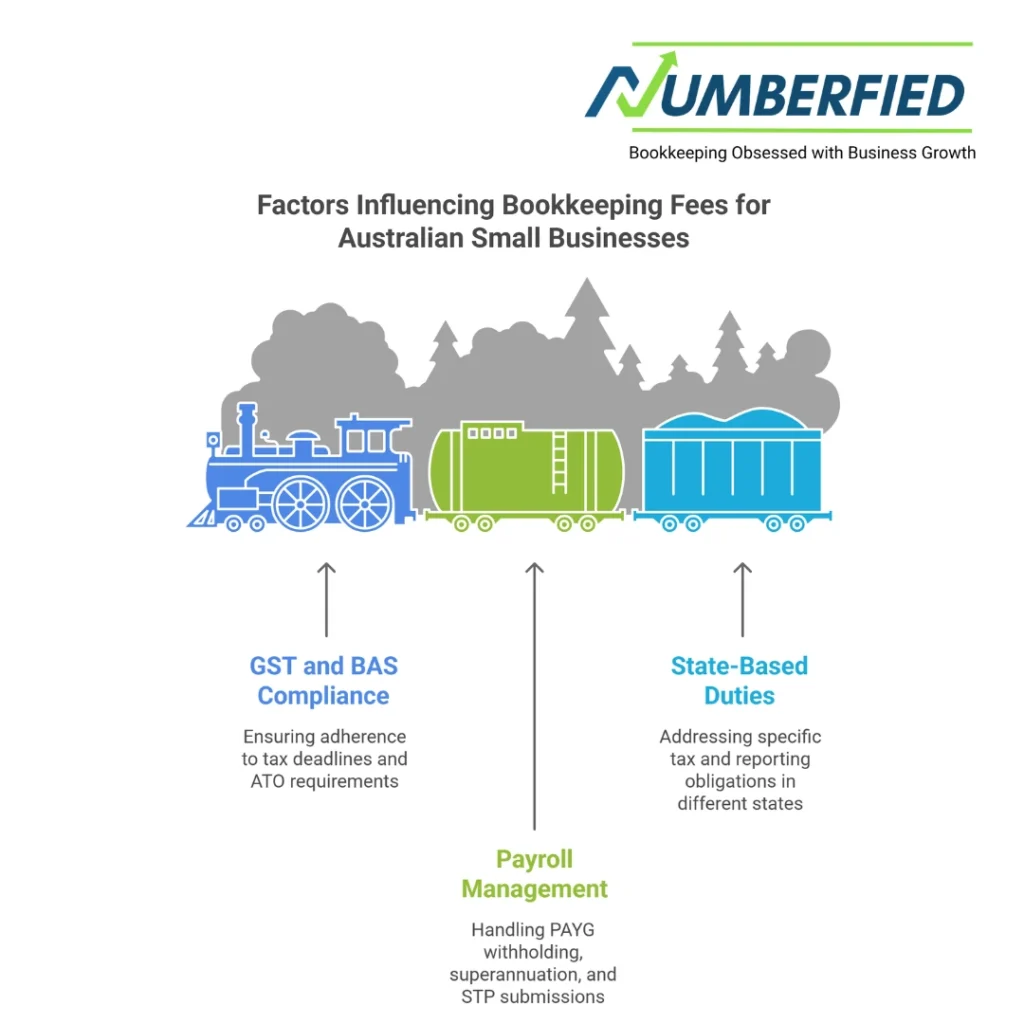
GST, BAS and ATO obligations
Compliance with GST and BAS deadlines is non-negotiable. When evaluating bookkeeping fees for small business, confirm the provider’s process for preparing and reviewing BAS to ensure alignment with ATO requirements.
Payroll and superannuation management
Payroll obligations add complexity and can affect bookkeeping fees for small business. Ensure the service covers PAYG withholding, superannuation calculations and STP submissions, or clarify if these items are additional.
State-based duties and reporting
Some obligations vary by state. Providers with Australian experience can advise on specific requirements, which reduces the risk of penalties and can influence the overall cost profile associated with bookkeeping fees for small business.
Section 8: How technology affects bookkeeping fees for small business
Cloud accounting platforms and their benefits
Cloud platforms reduce manual work and support real-time collaboration. When cloud systems are used well, bookkeeping fees for small business are lower due to reduced reconciliation time and easier access to financial data.
Add-on tools and integrations
Integrations with payment processors, inventory systems and e-commerce platforms streamline workflows. Although they may require initial configuration, they reduce ongoing bookkeeping fees for small business by cutting repetitive tasks.
Security and data handling
Secure systems and clear data-handling policies protect your business. Reliable providers factor security into their pricing, ensuring that bookkeeping fees for small business reflect safe storage and responsible handling of sensitive information.
Section 9: When to outsource bookkeeping vs keep it in-house
Signs it’s time to outsource
If bookkeeping tasks consume time that could be spent growing your business, or if compliance risks are increasing, outsourcing can be more cost-effective than keeping services in-house. Smart outsourcing can optimise bookkeeping fees for small business by aligning costs with output and expertise.
When to keep bookkeeping internal
Small businesses with very simple transactions and limited growth plans may keep bookkeeping in-house to control immediate bookkeeping fees for small business. However, regular reviews should assess whether this remains the most efficient option.
Blended models for flexibility
A blended model combines internal oversight with external expertise for complex tasks. This approach manages bookkeeping fees for small business by leveraging external efficiency while keeping strategic control in-house.
Section 10: Choosing the right bookkeeping partner
Assess communication and cultural fit
Good chemistry and clear communication reduce friction. A partner who understands your business will deliver more value and justify bookkeeping fees for small business through better insights and timely support.
Check references and case studies
Ask for examples of similar clients in Australia. Proven experience reduces onboarding time and hidden costs, influencing how worthwhile bookkeeping fees for small business will be in practice.
Evaluate transparency and billing practices
Transparent billing avoids surprises. Choose providers who clearly explain what drives bookkeeping fees for small business and provide easy-to-understand statements that align with the agreed scope.
Section 11: How Numberfied approaches bookkeeping fees for small business
Transparent packages tailored to needs
At Numberfied we offer tailored solutions that match your scale and reporting needs. We focus on transparent pricing so you understand exactly what contributes to bookkeeping fees for small business and the value you receive in return.
Technology-first workflows
Numberfied uses cloud systems and automated workflows to reduce manual work and keep bookkeeping fees for small business efficient. Clean integrations and proactive account management are core to how we deliver value.
Local Australian expertise and ongoing support
Our team combines local compliance knowledge with practical business insight. We aim to reduce the total cost of ownership and make bookkeeping fees for small business a predictable, worthwhile investment.
Section 12: Making the transition: onboarding and ongoing review
Onboarding checklist
A clear onboarding checklist reduces set-up time and surprises. A good onboarding process helps control the initial costs associated with bookkeeping fees for small business by ensuring records and systems are ready to go.
Regular review cadence
Regular performance reviews help ensure bookkeeping fees for small business continue to match your needs. Quarterly or biannual check-ins allow adjustments to scope or technology that can reduce costs and increase value.
Exit and continuity planning
Plan for continuity to avoid disruption if you change providers. Clear handover processes protect your data and ensure future bookkeeping fees for small business are not inflated by recovery work.
Conclusion
Understanding bookkeeping fees for small business helps you budget effectively and choose a partner who drives real value. Focus on scope, technology, local expertise and transparent billing to make fees predictable and worthwhile. If you want a partner that balances efficiency, clarity and Australian compliance expertise, Numberfied can help. We design tailored solutions that reduce the friction around bookkeeping fees for small business and provide the insights you need to grow.
Ready to discuss how to streamline your bookkeeping and make fees work for your business? Contact Numberfied and start a conversation at https://numberfied.com/. We’d love to help you understand and optimise bookkeeping fees for small business.
Frequently asked questions
What factors most affect bookkeeping fees for small business?
The most significant factors are transaction volume, complexity, payroll requirements and the level of reporting you need. Systems integration and industry-specific compliance also influence fees. Additionally, the provider’s location, credentials and the chosen service model (in-house, freelance or firm) will shape the final price.
Are bookkeeping fees for small business fixed or variable?
Both models exist. Some providers offer fixed monthly packages that make budgeting straightforward, while others use hourly or project-based pricing that varies with workload. Hybrid approaches combine a base fee with variable charges for extra work, giving a predictable baseline plus flexibility when needed.
How can I reduce bookkeeping fees for small business without sacrificing accuracy?
Cleaner records, automation and regular reconciliations reduce time spent on bookkeeping tasks. Choosing appropriate service levels and ensuring good documentation upfront also helps. Regularly review workflows with your provider to eliminate unnecessary steps and focus on valuable reporting.
Should I hire a bookkeeper locally in Australia to manage bookkeeping fees for small business?
Local Australian bookkeepers bring knowledge of GST, BAS and state-specific obligations, which reduces compliance risk. While remote providers can be cost-effective, local expertise often offsets any fee differences by preventing costly mistakes and ensuring timely lodgements.
How do cloud accounting systems impact bookkeeping fees for small business?
Cloud systems typically reduce manual entry and improve collaboration, lowering ongoing bookkeeping fees for small business. The initial setup may require time, but the efficiency gains and improved data accuracy often lead to lower total costs over time.
Can I negotiate bookkeeping fees for small business?
Yes. Focus negotiations on scope, frequency and response times rather than only on price.Providers may offer customised packages or phased onboarding to align services with your needs, which can create savings without reducing service quality.
How often should I review bookkeeping fees for small business?
Review fees at least biannually or whenever major changes occur, such as growth in transaction volume or new compliance requirements. Regular reviews ensure that your bookkeeping fees for small business reflect current needs and help you avoid surprises.
What should be included in a bookkeeping fees for small business quote?
A clear quote should list the scope of work, deliverables, frequency of tasks, turnaround times, onboarding process and billing terms. It should also specify what is excluded so you can compare options and understand potential additional costs before they arise.
How does payroll affect bookkeeping fees for small business?
Payroll adds complexity through PAYG withholding, superannuation and Single Touch Payroll reporting. If payroll is part of the service, it will influence bookkeeping fees for small business due to the additional processing, compliance checks and reporting responsibilities involved.
When is it worth investing more in bookkeeping fees for small business?
Invest more when the service reduces risk, provides timely cash flow insights or saves owner time that can be invested in growth. Spending on higher-quality reporting and proactive advice often pays for itself by improving decision-making and avoiding costly compliance errors, making bookkeeping fees for small business a strategic investment.
Also Read: Why the Best Bookkeeping Services for Small Business Are Your Australian Success Key