

Introduction
As a small or medium-sized business owner, navigating financial complexities can be daunting, but financial accounting advisory services provide the expertise needed to thrive. These services go beyond basic bookkeeping, offering strategic guidance to optimise operations and ensure long-term success. Whether you’re a startup scaling up or an established firm seeking efficiency, financial accounting advisory services deliver tailored solutions that align with your goals. In this guide, we break down the practical benefits, key features, and how to choose the right provider, helping you make informed decisions without the guesswork.
Practical Benefits of Financial Accounting Advisory Services
Financial accounting advisory services are essential for businesses aiming to grow sustainably. They provide more than compliance; they empower decision-making.
Strategic Planning for Business Growth
Financial accounting advisory services help craft long-term strategies, including expansion plans and investment recommendations. By analysing financial data, advisors identify opportunities for revenue growth and cost reduction. For instance, business accounting advisory can forecast future trends, ensuring your business stays ahead in competitive markets.
Effective Risk Management
One key advantage of financial accounting advisory services is identifying and mitigating financial risks. Advisors assess potential threats like cash flow shortages or market volatility, implementing safeguards. Outsourced CFO services often include risk audits, helping prevent costly surprises and maintaining stability.
Growth Insights Through Data Analysis
Financial advisory services offer deep insights into your business’s performance, using metrics like profitability ratios and ROI. This enables informed decisions on pricing, product lines, or market entry. Strategic financial advisory turns raw data into actionable intelligence, fostering sustainable expansion.
Ensuring Regulatory Compliance
Financial accounting advisory services keep your business compliant with evolving regulations, from GAAP standards to tax laws. Accounting consulting services handle audits and reporting, reducing penalty risks. This peace of mind allows you to focus on core activities without legal worries.
In-House vs Outsourced Financial Accounting Advisory Services
Choosing between in-house and outsourced options depends on your business needs. Here’s a comparison to help you decide.
Cost Comparison
In-house financial accounting advisory services require salaries, benefits, and training, often exceeding $100,000 annually for a full-time advisor. Outsourced CFO services, on the other hand, start at $2,000–$5,000 per month, offering flexibility without fixed costs. For SMBs, outsourcing provides high-level expertise at a fraction of the price.
Expertise Availability
In-house teams may lack specialised knowledge in niche areas like international tax or M&A. Financial advisory services from outsourced providers bring diverse experience across industries. Business accounting advisory firms often have teams of experts, ensuring comprehensive coverage without hiring multiple staff.
Scalability and Flexibility
In-house financial accounting advisory services are fixed, making scaling difficult during growth phases. Outsourced options allow you to adjust services as needed add strategic financial advisory during expansions or reduce during slow periods. This adaptability suits dynamic SMB environments.
Control and Integration
In-house provides direct control but can lead to silos. Outsourced accounting consulting services integrate seamlessly with your systems via cloud tools, maintaining oversight through regular reports. Choose providers with strong communication to balance control and efficiency.
Key Features of Financial Accounting Advisory Services
The best financial accounting advisory services offer features that address SMB pain points effectively.
Financial Forecasting
Accurate forecasting is a core feature, projecting revenue, expenses, and cash flow for 12–36 months. This helps in budgeting and scenario planning. Strategic financial advisory uses historical data and market trends for reliable predictions.
Budgeting and Planning
Financial accounting advisory services include detailed budgeting and aligning expenses with goals. Advisors create custom budgets, track variances, and adjust in real time. Business accounting advisory often incorporates KPI monitoring for ongoing optimisation.
Cash Flow Analysis
Cash flow analysis identifies bottlenecks and opportunities, ensuring liquidity. Outsourced CFO services provide weekly or monthly reports, highlighting patterns in receivables and payables. This feature is crucial for SMBs with variable income.
Compliance and Reporting
These services ensure GAAP-compliant financial statements and timely regulatory filings. Accounting consulting services handle audits and internal controls, reducing risk. Features like automated reporting tools streamline the process.
Strategic Advisory
Beyond numbers, financial advisory services offer growth strategies, such as funding options or cost-cutting measures. Strategic financial advisory includes M&A guidance or exit planning for long-term success.
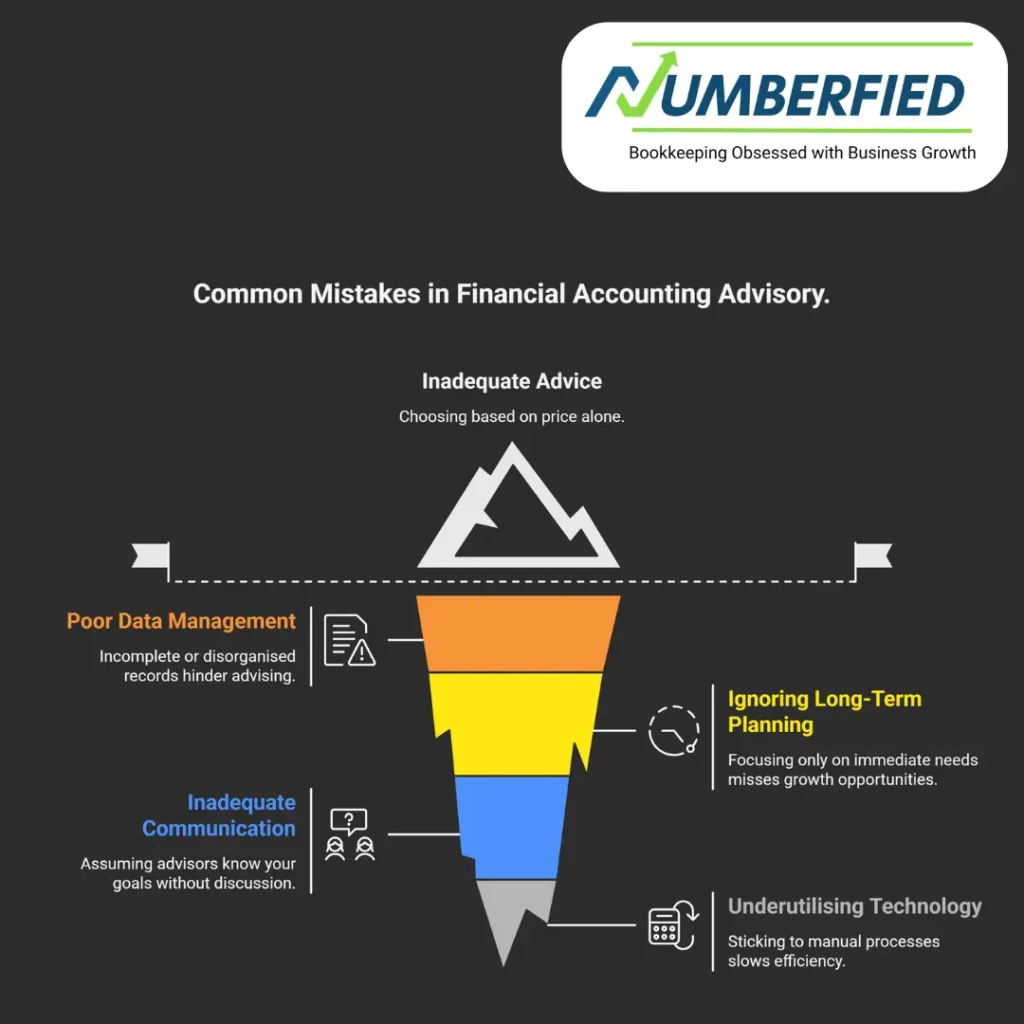
Common Mistakes in Financial Accounting Advisory
Avoid these pitfalls to maximise the value of financial accounting advisory services.
Overlooking Provider Expertise
Choosing based on price alone often leads to inadequate advice. Vet financial accounting advisory services for industry experience and certifications. Look for providers with an SMB focus to ensure relevant insights.
Poor Data Management
Incomplete or disorganised records hinder effective advising. Implement cloud systems early for seamless integration with outsourced CFO services. Regular data backups prevent loss and facilitate accurate analysis.
Ignoring Long-Term Planning
Focusing only on immediate needs misses growth opportunities. Engage a strategic financial advisor for forecasting and scenario planning. This prevents reactive decisions that could harm your business.
Inadequate Communication
Assuming advisors know your goals without discussion leads to misaligned advice. Schedule regular check-ins with business accounting advisory providers. Clear communication ensures services evolve with your business.
Underutilising Technology
Sticking to manual processes slows efficiency. Embrace accounting consulting services with AI tools for automation. This reduces errors and provides real-time data for better decisions.
Step-by-Step Guide to Choosing Financial Accounting Advisory Services
Follow this guide to select the right partner.
Step 1: Assess Your Business Needs
Identify pain points like cash flow issues or compliance gaps. Determine if you need full financial accounting advisory services or specific areas like forecasting. Consider your industry and growth stage for tailored support.
Step 2: Research Providers
Look for firms with strong reviews and SMB experience. Check certifications (CPA, CMA) and specialisations in financial advisory services. Use directories like Clutch or LinkedIn for vetted options.
Step 3: Evaluate Expertise
Review case studies and client testimonials. Ask about their approach to risk management and growth insights. Ensure they have experience in your sector for relevant business accounting advisory.
Step 4: Check Technology Integration
Confirm compatibility with your systems (QuickBooks, Sage). Outsourced CFO services should offer secure, cloud-based platforms for real-time access. Look for AI-driven tools in strategic financial advisory.
Step 5: Compare Pricing and Contracts
Get detailed quotes for services. Compare value, not just cost, and include features like monthly reports. Review contracts for flexibility, confidentiality, and termination terms.
Step 6: Schedule Consultations
Meet potential providers to discuss your needs. Ask about communication frequency and response times. This step ensures a good fit for accounting consulting services.
Step 7: Start with a Trial
Many offer trial periods or initial assessments. Monitor service quality and adjust as needed before full commitment.
Top Providers and Trends in Financial Accounting Advisory Services in 2026
In 2026, financial accounting advisory services are evolving with an AI and sustainability focus. Leading providers include:
- Deloitte: Comprehensive strategic financial advisory for mid-sized businesses
- KPMG: Strong in outsourced CFO services with risk management expertise
- PwC: Excellent business accounting advisory with digital tools
- Bench: Affordable virtual options for SMBs
- Pilot: Tech-driven accounting consulting services for startups
Trends include AI-powered forecasting for precise growth insights, ESG reporting integration in financial advisory services, and fractional CFO models for flexible expertise. Providers are emphasising cybersecurity in outsourced CFO services amid rising threats. Blockchain for audit trails and real-time data sharing is emerging in strategic financial advisory.
Conclusion
Financial accounting advisory services are a game-changer for small to medium businesses, offering strategic planning, risk management, growth insights, and compliance in one package. By partnering with the right provider, you gain the tools to navigate challenges and seize opportunities. Whether it’s cash flow analysis or budgeting, these services empower your success. Ready to elevate your financial strategy? Request a free consultation today and discover how financial accounting advisory services can transform your business.
FAQ
What is a financial accounting advisory service?
Financial accounting advisory service is professional guidance that combines accounting expertise with strategic financial advice. It helps businesses prepare accurate financial statements, ensure compliance with accounting standards, and use financial data for planning, forecasting, risk management, and growth decisions.
What are financial accounting and advisory services?
Financial accounting and advisory services involve preparing compliant financial statements (balance sheets, income statements, and cash flow) while providing advisory support such as budgeting, cash flow management, KPI analysis, and strategic recommendations.
.
What are accounting advisory services?
Accounting advisory services provide expert recommendations on accounting policies, financial reporting improvements, internal controls, system implementations, and transaction structuring. They help companies optimise financial processes, adopt new standards, and use accounting information for better business outcomes, often beyond routine compliance work.
What are examples of advisory services?
Examples include financial forecasting and budgeting, cash flow optimisation, cost reduction analysis, merger and acquisition due diligence support, internal control reviews, ERP system implementation advice, and valuation services. Other common examples are risk assessment, performance benchmarking, and capital structure recommendations.
What is a financial advisory service?
Financial advisory service offers expert guidance on managing money, investments, financial planning, risk management, and business strategy. It includes wealth management, retirement planning, investment portfolio advice, debt structuring, and business valuation for individuals and companies.
Why am I getting calls from financial advisors?
You are likely receiving calls from financial advisors due to lead generation tactics such as purchased contact lists, public business directories, or responses to online inquiries. Many advisors use cold calling, networking events, or referral programs to find potential clients.
What is a FIS officer with Centrelink?
A Financial Information Service (FIS) officer with Centrelink is a free government service that provides independent, unbiased financial information and education to Centrelink customers. They explain how financial decisions affect Centrelink payments, superannuation, investments, and retirement planning.
Is $500,000 enough to work with a financial advisor?
Yes, $500,000 is generally enough to work with most financial advisors, as many accept clients with $250,000–$500,000 in investable assets. Some fee-only or robo-advisory services start even lower, while high-net-worth advisors may require $1 million+.
Is paying 1% to a financial advisor worth it?
Paying 1% of assets under management can be worth it if the advisor adds significant value through tax optimisation, better investment returns, comprehensive planning, or peace of mind. Studies show good advisors can add 1–3% in net value annually through behavioural coaching and portfolio management.
What is a red flag for a financial advisor?
A major red flag is promising guaranteed returns or high returns with low risk, as no legitimate investment is risk-free. Other red flags include pressure to act quickly, reluctance to provide credentials or fee disclosure, guarantees of beating the market consistently, or pushing proprietary products without clear justification.
Also Read: Why Accounts Receivable Outsourcing Services Will Skyrocket Your Australian Business