
Introduction
For decades, the accounting department has been the quiet engine room of the business world. Hidden away, focused on historical data, compliance, and tax returns, it was often viewed as a necessary cost center rather than a value driver. However, the tides are turning. In a post-pandemic economy defined by volatility, talent shortages, and digital acceleration, clinging to the traditional in-house model is becoming a liability.
Today, a paradigm shift is underway. According to a recent PwC survey of over 2,000 respondents, “Top-performing organisations are turning to a more strategic set of managed services partnerships to access talent and technology, with the goal of not only reducing costs but becoming faster and more innovative.”
This isn’t just about hiring a freelancer to do your data entry. It is about redefining the role of accounting within the organization. When executed correctly, outsourcing accounting functions transforms the ledger from a rearview mirror into a GPS for business growth. This article explores the strategic, financial, and operational benefits of letting go of the books to focus on the business.
The Evolution of Accounting: From Cost Center to Growth Driver
To understand why outsourcing is winning, we must first understand what modern accounting actually entails. Historically, businesses outsourced “bookkeeping” -the simple recording of transactions. Today, we are talking about outsourcing accounting functions.
The Shift from Compliance to Strategy
The regulatory landscape is more complex than ever. Whether it is IFRS, GAAP, or local tax codes, keeping up requires continuous education. An in-house generalist might handle a monthly close, but a specialized outsourced accounting partner brings a team of experts in tax, treasury, risk management, and financial forecasting.
As PwC notes, accounting professionals in service firms remain updated on the latest regulations and leading technology trends. This allows businesses to benefit from enhanced and accurate insights that a generalist might miss.
The Technology Gap
Modern accounting is no longer about physical ledgers or even just QuickBooks. It involves AI-driven reconciliation, real-time cash flow dashboards, and robotic process automation (RPA). The cost of purchasing and training an in-house team on these tools is prohibitive for most small-to-medium enterprises (SMEs). Outsourced providers spread this tech cost across multiple clients, giving you enterprise-grade infrastructure for a fraction of the price.
The 5 Strategic Advantages of Outsourced Accounting
While cost reduction is the most obvious benefit, the true value of outsourcing accounting lies in strategic agility. Based on the PwC framework, here are five distinct advantages that move beyond saving money.
1. Access to Specialized Talent (Without the HR Headache)
The “Great Resignation” hit the accounting industry hard. Finding a qualified CPA who is willing to work for a single SME is expensive and difficult.
- The In-house reality: You hire one person. If they are good at tax, they might be weak in forensic analysis or managerial accounting.
- The Outsourced reality: You hire a firm. You gain access to a bench of specialists. Need help with a merger? There is an expert. Need to sort out international sales tax? There is a specialist. You pay for the expertise only when you need it.
2. Scalability and Flexibility
Business is rarely linear. You might experience rapid growth, seasonal spikes, or a sudden downturn. Accounting volume fluctuates violently with transaction volume.
Outsourcing provides “elasticity.” You can scale your accounting support up during an audit or year-end closing, and scale it down during quiet periods. As PwC highlights, this allows businesses to “respond quickly to market opportunities, mitigate risks and maintain a competitive edge” without firing staff or scrambling for temps.
3. Enhanced Data Security and Risk Management
One of the biggest fears regarding outsourcing is data security. However, reputable accounting firms invest millions in cybersecurity, encryption, and secure data centers -investments most SMEs cannot afford.
Furthermore, outsourcing creates a natural segregation of duties, a key component of internal controls. By removing the internal staff from the payment approval process (if you outsource payables), you significantly reduce the risk of internal fraud.
4. Refocusing on Core Business Functions
This is the “CEO Advantage.” Every hour a founder spends reconciling a bank statement is an hour they are not spending on product development, sales, or customer service.
By outsourcing accounting, leadership can delegate the “counting” to focus on the “creating.” The business can reallocate internal resources to revenue-generating activities that drive top-line growth, secure in the knowledge that the financial engine is running smoothly.
5. Turning Data into Foresight
Traditional accounting is backward-looking (Last month’s P&L). Strategic accounting is forward-looking (Cash flow forecast, scenario planning).
Outsourced partners use cloud technology to deliver real-time dashboards. This transforms the relationship from “Here are your receipts” to “Based on your current burn rate, you have 14 months of runway, but if you hire that salesperson, you will need to raise capital in Q3.” That level of strategic insight is rarely found in a solo in-house bookkeeper.
Debunking the Myths of Outsourcing (Control & Quality)
Despite the clear advantages, many business owners hesitate. They fear losing control or receiving low-quality work from a faceless provider. These fears are valid but manageable with the right partner selection.
The “Loss of Control” Myth
You do not lose control; you change how you control. In-house accounting gives you “direct” oversight (you can walk to their desk). Outsourced accounting gives you “systemic” oversight (you review KPIs, SLAs, and dashboards).
In reality, a good outsourced partner requires you to define clear reporting lines and approval matrices. This often forces business owners to implement better financial governance than they had when they were informally chatting with the bookkeeper at the water cooler.
Quality Assurance
The quality of accounting is only as good as the systems and training behind it. A solo in-house accountant might get sick, go on vacation, or simply burn out.
Outsourced firms operate on a team model. If one staff member is unavailable, another picks up the slack. They have internal review processes (Supervisor reviews the junior’s work) that act as a quality filter, ensuring the output is accurate before it reaches the CEO.
How to Transition Your Accounting Function Successfully
Transitioning from in-house to outsourced accounting requires change management. However, following a structured process ensures a smooth landing.
Step 1: The Internal Audit (What to Keep vs. Send)
Not everything needs to go. High-level treasury management (signing checks, banking relationships) often stays internal. Transactional processing (AP/AR), tax filing, and month-end close are excellent candidates for outsourcing.
Step 2: Technology Integration
Ensure the provider uses cloud-based platforms (like Xero, QuickBooks Online, or NetSuite) that integrate with your CRM and inventory systems. Real-time syncing is the goal to eliminate “lag.”
Step 3: The Phased Rollout
Start with a small function, like accounting for Accounts Payable or Payroll. Once trust is established, migrate the General Ledger and Financial Reporting. This reduces risk and allows your internal team to adjust to the new workflow.
Step 4: Standard Operating Procedures (SOPs)
Document everything. An outsourced team runs on SOPs. If you want your revenue recognized in a specific way, write it down. This clarity improves the quality of the accounting output.
Conclusion
The question is no longer “Should I outsource my accounting?” but rather “How much of my accounting should I outsource to stay competitive?”
The data is clear: top-performing organizations view outsourced accounting not as a cost-cutting exercise, but as a strategic weapon. By leveraging external expertise, businesses gain access to elite talent, bleeding-edge technology, and the most precious resource of all -time.
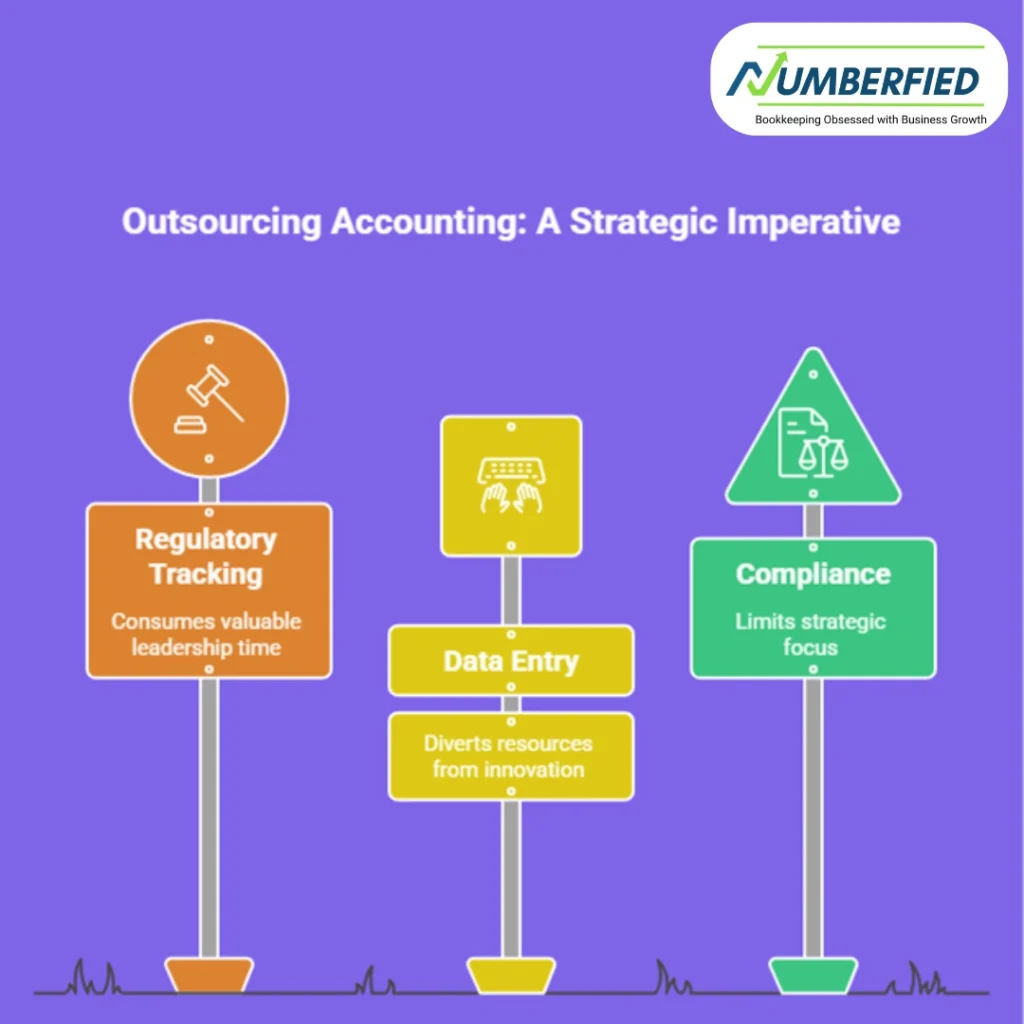
When you remove the burden of regulatory tracking, data entry, and compliance, you free your leadership team to focus on innovation and execution. In the race to scale, the businesses that win are not necessarily the ones with the biggest internal teams, but the ones with the smartest partnerships.
If you are ready to turn your financial operations from a bottleneck into a growth catalyst, it is time to look beyond the ledger and towards the horizon.
Also Read: Why Accounting Services for Ecommerce Are Your Australia Online Store’s Secret Sauce
Frequently Asked Questions (FAQs)
What exactly is “outsourced accounting”?
It is the practice of hiring an external third-party firm to handle some or all of your business’s financial tasks -including bookkeeping, tax preparation, payroll, and financial reporting -rather than employing an internal accounting staff.
Is outsourcing accounting cheaper than hiring an in-house employee?
Yes, generally. The median salary for a full-time accountant includes taxes, health benefits, 401k, and software licenses. Outsourcing converts that fixed cost into a variable cost, often saving businesses 30-50% annually.
How do I ensure data security if my financials are off-site?
Reputable firms use bank-level 256-bit encryption, multi-factor authentication, and secure cloud servers. Ensure your provider signs a confidentiality agreement (NDA) and complies with data protection regulations like GDPR or CCPA.
Will I lose visibility of my daily cash flow?
No. In fact, you gain better visibility. Most outsourced accounting providers offer real-time dashboard access via cloud software (like QuickBooks Online or Xero), so you can check your cash flow on your phone 24/7.
Can outsourcing help me prepare for an audit?
Absolutely. Professional outsourced firms keep meticulous, organized records. Because they follow standardized procedures, they can produce a clean audit trail much faster than a busy internal team, reducing audit stress and fees.
What is the difference between bookkeeping and strategic accounting?
Bookkeeping is the daily recording of transactions (data entry). Strategic accounting involves analyzing that data to provide insights on profitability, cost reduction, and forecasting. Outsourcing allows you to access both levels easily.
I run a small startup. Is outsourcing only for big corporations?
Not at all. Outsourcing is a lifeline for startups. It allows founders to access CFO-level advice without paying a six-figure salary, ensuring they don’t make costly early-stage tax or cash flow mistakes.
How do I transition from my current bookkeeper to an outsourced firm?
Start with a “parallel run.” Run your internal accounting alongside the outsourced firm for one month. Compare the outputs. Once you trust the accuracy, shut down the internal process and have the outsourced firm handle the historical data migration.
What happens if the outsourced firm makes a mistake?
Service Level Agreements (SLAs) should cover “errors and omissions.” Reputable firms carry professional indemnity insurance. If a mistake costs you penalties, the contract usually holds the provider liable for those direct costs.
Does outsourced accounting work for international businesses?
Yes, but you need a specialist. Multi-currency accounting, cross-border tax (VAT/GST), and transfer pricing are complex. You should outsource to a firm that specifically lists international compliance as a core competency.