
Introduction
Running an ecommerce business means juggling sales across platforms, tracking inventory costs, reconciling marketplace fees, calculating sales tax in multiple states, and still trying to understand true profitability. Accounting services for ecommerce business exist to take that burden off your plate. These specialized services go far beyond basic bookkeeping; they help you stay compliant with sales tax nexus rules, accurately calculate cost of goods sold (COGS), reconcile every Stripe, PayPal, Shopify Payments, and Amazon fee, and deliver clear profit insights that actually guide decisions. Whether you sell on Shopify, run Amazon FBA, operate a WooCommerce store, manage an Etsy shop, or dropship products, the right ecommerce accounting services can turn chaotic numbers into a competitive advantage.
In this guide, we explain the real benefits, compare in-house vs outsourced approaches, detail must-have services, highlight common mistakes, provide a step-by-step selection process, review top providers, and look at key trends shaping the space in 2026.
Key Benefits of Accounting Services for Ecommerce Business
Specialized accounting services for ecommerce business solve pain points that generic bookkeeping simply cannot address.
Accurate Sales Tax Compliance & Nexus Management
Ecommerce sellers must collect and remit sales tax in every state where they have nexus physical presence, economic thresholds, or marketplace facilitator laws. Accounting services for ecommerce business track nexus thresholds, automate tax calculations at checkout, file returns in multiple jurisdictions, and maintain audit-ready records. This prevents surprise tax bills and penalties that can easily reach tens of thousands of dollars.
Precise Inventory & COGS Tracking
Profitability in ecommerce hinges on knowing exact cost of goods sold, including landed costs (product cost + shipping + duties). Ecommerce accounting services integrate with inventory platforms to match purchases with sales, handle FIFO/LIFO costing, allocate freight-in properly, and produce accurate gross margin reports. Without this precision, most sellers dramatically overstate or understate true profits.
Full Platform Fee Reconciliation
Shopify, Amazon, WooCommerce, Etsy, PayPal, Stripe, and other processors charge dozens of fees (referral, transaction, FBA storage, advertising, refunds, chargebacks). Accounting services for ecommerce business automatically reconcile every fee line-by-line so your P&L reflects reality instead of inflated revenue. Missing or misclassifying these fees is one of the most common reasons ecommerce profit reports are misleading.
Clear Profit Insights by Channel & Product
Generic accounting lumps all revenue together. Multichannel ecommerce accounting breaks revenue, costs, fees, returns, and profit down by sales channel (Amazon vs Shopify vs Etsy), by product/ASIN, by ad campaign, or by customer segment. These insights show which products or channels are actually profitable and where to double down or cut losses.
Cash Flow Forecasting for Inventory-Heavy Businesses
Ecommerce involves heavy upfront inventory purchases and delayed payouts (Amazon pays every 14 days, Shopify varies by plan). Accounting services for ecommerce business forecast cash needs around inventory buys, ad spend, and payout cycles so you avoid stockouts or overdrafts. Reliable cash-flow visibility is critical when margins are thin and growth is capital-intensive.
In-House vs Outsourced Accounting Services for Ecommerce Business
Deciding between in-house and outsourced accounting services for ecommerce business comes down to cost, expertise, and scalability.
Cost Comparison
In-house bookkeeping + tax support usually costs $60,000–$100,000 per year (salary, benefits, software, training). Outsourced ecommerce accounting services typically run $500–$3,500 per month ($6,000–$42,000 annually), with no employment overhead. For most online sellers, outsourcing delivers higher expertise at 50–70% lower cost.
Ecommerce-Specific Expertise
In-house staff rarely have deep experience with Amazon FBA fees, Shopify payouts, sales tax nexus laws, or 1099-K reporting. Outsourced ecommerce accounting services specialize in these areas, using software built for multichannel sellers (A2X, Link My Books, Sellbrite integrations) and staying current with changing marketplace and tax rules.
Scalability During Peak Seasons
In-house headcount is fixed; scaling during Q4 requires hiring and training. Outsourced accounting services for ecommerce business scale instantly: add transaction volume during Black Friday/Cyber Monday without extra payroll. You pay only for the activity level.
Access to Advanced Tools & Reporting
In-house solutions often rely on basic QuickBooks setups. Leading outsourced providers use ecommerce-specific tools that automatically reconcile Amazon settlements, categorize Shopify fees, calculate landed COGS, and produce channel-level profitability dashboards features most in-house teams cannot replicate affordably.
Essential Services in Accounting Services for Ecommerce Business
The strongest accounting services for ecommerce business cover these core areas.
Transaction & Fee Reconciliation
Automatic import and reconciliation of every order, refund, fee, and payout from Shopify, Amazon, WooCommerce, Etsy, PayPal, Stripe, etc. This ensures revenue and expenses are recorded correctly, and profit calculations are accurate.
Sales Tax Nexus Tracking & Filing
Monitoring economic nexus thresholds in all 50 states, automating tax collection at checkout, filing returns in multiple jurisdictions, and maintaining nexus documentation for audits. Many services now handle marketplace facilitator laws where platforms collect tax on behalf of sellers.
Inventory & COGS Management
Integrating with inventory systems to track purchases, landed costs, freight-in allocation, and accurate COGS per sale. This provides true product-level profitability instead of inflated gross margins that ignore true acquisition costs.
1099 & Vendor Reporting
Issuing 1099-NEC/MISC forms to contractors and 1099-K reconciliation for marketplace payments. Services also track vendor expenses and ensure proper classification for deductions.
Channel-Level Profit & Loss Reporting
Breaking down revenue, fees, returns, ad spend, COGS, and net profit by sales channel, product, or campaign. This shows which parts of the business are truly profitable and where to optimize spending.
Common Challenges & Mistakes in Ecommerce Accounting
Ecommerce sellers frequently make these costly errors when handling accounting without specialized support.
Mixing Personal & Business Finances
Using personal cards or accounts for business purchases creates chaos during tax time and makes deductions nearly impossible to prove. Always maintain separate business banking and credit cards.
Ignoring Platform Fees & Refunds
Many sellers record gross sales without deducting referral fees, FBA fees, advertising costs, or refunds. This inflates revenue and profit on the books. Proper ecommerce accounting services reconcile every fee automatically.
Poor Inventory & COGS Tracking
Treating all purchases as immediate expenses instead of inventory distorts COGS and profitability. Failing to allocate freight-in or track landed costs leads to overstated margins. Accurate COGS is essential for pricing and tax reporting.
Not Tracking Sales Tax Nexus
Selling into states without understanding economic nexus thresholds triggers unexpected tax liabilities and penalties. Many sellers discover they owe back taxes in multiple states after years of non-compliance.
Using Generic Accounting Software Without Integrations
Relying on basic QuickBooks without ecommerce connectors creates manual entry and reconciliation errors. The best accounting services for ecommerce business use tools designed for multichannel sellers (A2X, Link My Books, etc.).
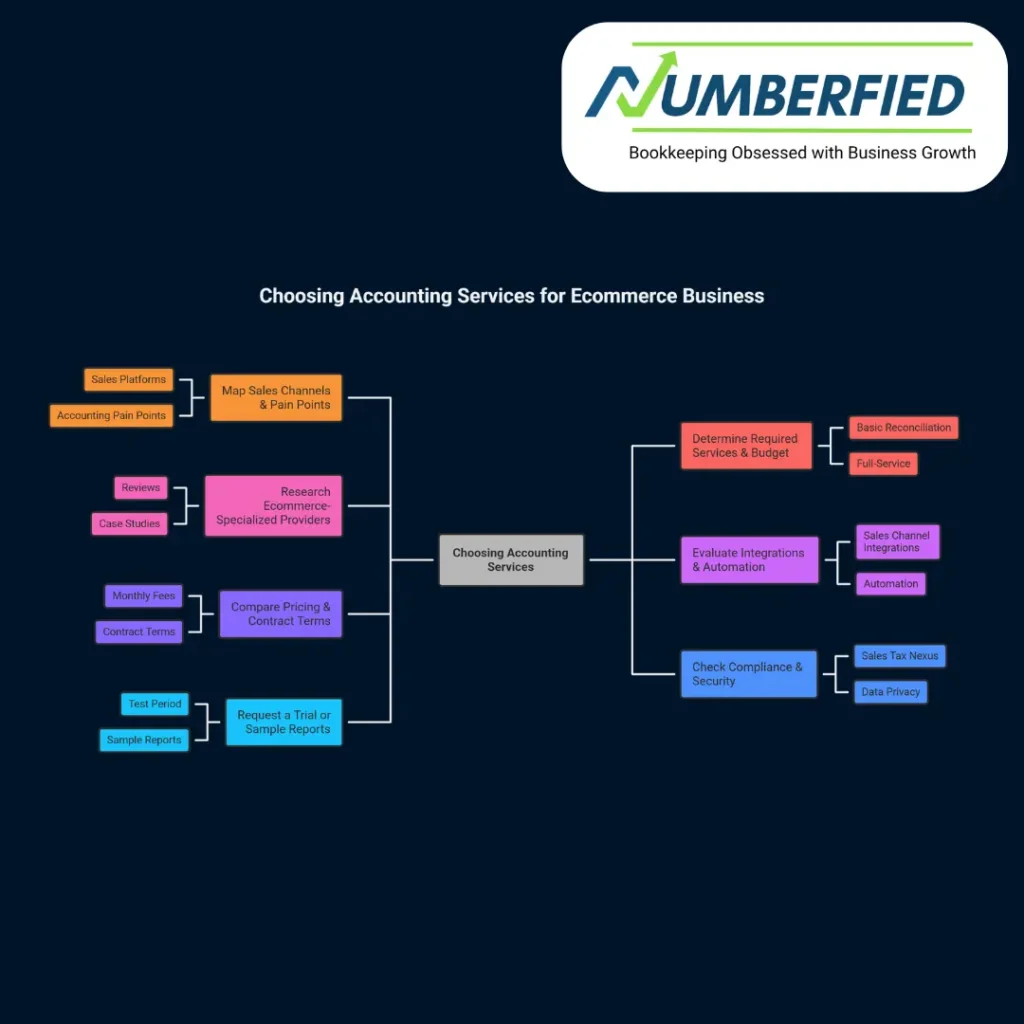
Step-by-Step Guide to Choosing Accounting Services for Ecommerce Business
Follow this process to select the right partner.
Step 1: Map Your Sales Channels & Pain Points
List every sales platform (Shopify, Amazon, WooCommerce, Etsy, eBay, etc.) and identify current accounting pain points: sales tax, fee reconciliation, inventory tracking, profit reporting, tax filings, etc.
Step 2: Determine Required Services & Budget
Decide if you need basic reconciliation or full-service (tax, advisory, forecasting). Set a realistic monthly budget. Most ecommerce sellers spend $500–$3,000 depending on complexity.
Step 3: Research Ecommerce-Specialized Providers
Search for providers experienced with your platforms. Read reviews on G2, Capterra, and seller forums. Look for case studies with similar businesses.
Step 4: Evaluate Integrations & Automation
Confirm direct integrations with your sales channels, payment processors, and inventory tools. Strong automation for fee reconciliation and COGS calculation is non-negotiable.
Step 5: Compare Pricing & Contract Terms
Request detailed quotes showing monthly fees, included services, and any setup/onboarding charges. Look for transparent pricing with no hidden fees and flexible month-to-month terms.
Step 6: Check Compliance & Security
Verify the provider is familiar with sales tax nexus, marketplace facilitator laws, 1099-K reporting, and IRS compliance. Confirm they use secure, encrypted systems and comply with data privacy standards.
Step 7: Request a Trial or Sample Reports
Ask for a test period or a sample channel-level P&L report. Evaluate accuracy, clarity, and usefulness before committing.
Conclusion
Accounting services for ecommerce business are no longer optional; they are essential for accurate profitability reporting, sales tax compliance, and sustainable growth. The right provider saves you time, prevents expensive tax mistakes, and gives you clear visibility into which products, channels, and marketing efforts actually make money. By avoiding common pitfalls and following a structured selection process, you can find a partner that scales with your business.
Ready to get your ecommerce finances under control? Request a free consultation today and see how specialized accounting services for ecommerce business can transform your numbers and your results.
FAQ
What are accounting services for ecommerce business?
Accounting services for ecommerce business specialize in tracking online sales, reconciling platform fees (Shopify, Amazon, Etsy, etc.), calculating accurate COGS and landed costs, managing multi-state sales tax nexus, and producing channel-level profit reports.
How much do accounting services for ecommerce business cost?
Costs typically range from $500 to $3,500 per month in 2026, depending on sales volume, number of channels, and services needed. Basic reconciliation and reporting start around $500–$1,200, while full-service packages (tax filing, payroll, advisory, advanced COGS tracking) often fall between $1,500–$3,500+ monthly.
Is accounting services for ecommerce business worth it?
Yes, they are worth it for most online sellers. These services prevent costly sales tax penalties, fix inaccurate profit reporting caused by untracked fees, ensure proper COGS and inventory accounting, and deliver insights that help optimize pricing and ad spend, often paying for themselves through tax savings and better decisions.
What services are included in ecommerce accounting packages?
Typical packages include automated transaction and fee reconciliation from all sales channels, sales tax nexus tracking and filing, inventory and COGS management, 1099 reporting, monthly channel-level P&L reports, cash flow forecasting, and tax preparation support.
Should I choose in-house or outsourced accounting services for ecommerce business?
Outsourced is usually better for ecommerce businesses due to lower costs (no salary/benefits), access to specialists in platform fees and sales tax, scalability during peak seasons, and integration with tools like A2X or Link My Books.
Do I need a CPA for accounting services for ecommerce business?
Not necessarily for day-to-day reconciliation and reporting, but a CPA is highly recommended for sales tax compliance across states, complex deductions, multi-entity structures, or IRS audit support. Many ecommerce sellers use specialized bookkeepers for routine tasks and a CPA for tax returns and strategic planning.
How do I choose the best accounting services for ecommerce business?
Look for providers with proven experience in your platforms (Shopify, Amazon, WooCommerce, etc.), strong integrations (A2X, Link My Books), sales tax expertise, transparent pricing, and good reviews from other sellers. Request sample reports, check references, and start with a trial or consultation to test accuracy and fit.
What are common mistakes with ecommerce accounting?
Common mistakes include mixing personal and business finances, ignoring platform fees and refunds, treating inventory purchases as immediate expenses (distorting COGS), not tracking sales tax nexus, and using generic software without ecommerce integrations.
What are the latest trends in accounting services for ecommerce business in 2026?
Trends include full AI automation of fee reconciliation and landed COGS, built-in sales tax compliance for marketplace facilitator states, channel- and product-level profitability dashboards as standard, expanded support for crypto/digital goods taxation, and stronger integration with ad platforms for ROI tracking.
How can I get started with accounting services for ecommerce business?
Start by mapping your sales channels, transaction volume, and pain points (tax, fees, COGS, reporting). Research ecommerce-specialized providers, compare quotes, check integrations and reviews, and request a trial or sample report.
Read Also: 9 Surprising Ways a Bookkeeping Service for Small Business Can Boost Your Success