
Introduction
Small and medium business owners and financial managers seeking better cash flow and reduced operational costs increasingly turn to accounts receivable outsourcing services. Outsourcing accounts receivable can transform your accounts receivable process, from invoice processing and collections to accounts receivable automation and reporting. This guide explains the benefits of accounts receivable outsourcing, practical best practices, a DIY vs. outsourced comparison with current cost estimates, and how to choose the right accounts receivable outsourcing partner or accounts receivable outsourcing firm for your business needs.
What Are Accounts Receivable Outsourcing Services?
Accounts receivable outsourcing, sometimes called AR outsourcing or outsourced invoicing, is the delegation of receivable function tasks, including invoice generation, payment process management, customer accounts communications, collections services, and reporting to a third-party service provider. Outsourcing providers range from specialized accounts receivable outsourcing companies and accounting outsourcing firms to full-service outsourcing companies offering accounting and bookkeeping services and accounts payable and receivable management.
Common Services Offered
- Invoice processing and delivery (paperless and electronic)
- Payment process management and reconciliation
- Collections services for overdue accounts and debt recovery outsourcing
- Accounts receivable automation and AR software integration
- Reporting and KPI tracking for cash flow and days sales outstanding (DSO)
- Customer accounts support and dispute resolution
Primary Benefits of Accounts Receivable Outsourcing
Outsource accounts receivable services to deliver measurable advantages for growing companies and small to medium businesses that want to focus on core business activities. Key benefits include:
Improve Cash Flow and Faster Collections
One of the most immediate benefits of accounts receivable management services is improved cash flow. Professional collections teams and accounts receivable automation shorten the payment cycle, reduce days sales outstanding, and lead to faster collections. Outsourcing companies use proven payment process workflows and technology to ensure invoices are issued correctly, and follow-ups on overdue accounts are timely and professional.
Cost Savings and Reduced Overhead Costs
Outsourcing accounts receivable reduces overhead costs associated with hiring and training in-house staff, maintaining collections systems, and paying benefits. Many businesses realize significant cost savings by converting fixed payroll expenses into scalable service fees. Outsourcing providers offer flexible pricing models per-invoice, per-transaction, or flat monthly fees so you can align costs with receivables volume.
Access to Expertise and Advanced Accounts Receivable Tools
Accounts receivable outsourcing firms bring specialized expertise in accounts receivable management, best practices, and regulatory compliance. They often offer advanced accounts receivable automation, payment integrations, and analytics that would be expensive to implement internally. This is especially valuable for small businesses that lack the resources to invest in high-end accounts receivable solutions.
Focus on Core Business Activities
Outsourcing the receivable function lets finance teams focus on strategic financial planning, managing accounts payable and other high-value tasks, and supporting business growth. By freeing internal teams from routine invoice collections and dispute handling, your business gains capacity to concentrate on customer relationships and revenue-generating activities.
Related Terms and How They Fit In
When evaluating accounts receivable outsourcing services, you’ll encounter related terms such as AR services, accounts receivable management services, outsource AR services, receivable service, and accounts receivable solutions. These terms refer to different combinations of services and technology that collectively form a modern accounts receivable service offering. Top accounts receivable outsourcing companies and nearshore outsourcing firms can tailor a package of invoice processing, collections, reconciliation, and reporting to your business needs.
DIY vs. Outsourced Accounts Receivable: Which Should You Choose?
Deciding between managing accounts receivable in-house and outsourcing accounts receivable functions depends on cost, scale, expertise, and strategic priorities. Below is a practical comparison, including current cost estimates typical for U.S.-based small to medium-sized businesses. Adjust these figures to reflect your location, industry, and complexity.
DIY Accounts Receivable (In-House)
- Staffing: 1–2 full-time AR clerks or a small AR team. Average fully loaded salary per AR clerk: $45,000–$70,000/year (including benefits and payroll taxes). For two clerks, the total annual salary ranges from $90,000 to $140,000.
- Software: Accounting platform or AR software subscription $50–$500/month, depending on features; advanced automation and integrations $500–$2,000/month.
- Training & Overhead: Onboarding, ongoing training, workstation, and office space $5,000–$20,000/year.
- Cost of Errors & Delays: Higher risk of late invoices, longer DSO, and write-offs from overdue accounts. The estimated hidden cost may equal 1–3% of annual receivables.
Annual DIY approximate cost for SMB: $100,000–$200,000+ (varies with volume and complexity).
Outsourced Accounts Receivable
- Service Fees: Outsourcing providers typically charge per invoice ($1–$10 per invoice), per payment processed ($0.50–$5), or a percentage of collections (1–5%), or a combination. For a business issuing 2,000 invoices/year, the per-invoice fees would range from $2,000 to $20,000/year.
- Platform/Integration Fees: Some providers include software, while others may charge a platform fee of $200–$1,500/month.
- Collections Success Fees: If a provider charges a contingency fee on recovered debt, expect 10–30% of recovered balances for delinquent accounts, depending on age and complexity.
- Scalability: Fees scale with transaction volume, allowing lower marginal cost as the business grows.
Annual outsourcing approximate cost for SMB: $30,000–$120,000, depending on volume, services selected, and region, often substantially lower than DIY when you consider reduced write-offs and improved cash flow.
Financial Comparison Example
Company A issues $5 million in annual invoices and struggles with a DSO of 60 days and 2.5% bad debt. Consider two scenarios:
- DIY: $120,000/year in AR staff and systems + 2.5% lost revenue = $125,000 + $125,000 = $250,000 total cost (staff + bad debt).
- Outsource: $60,000/year in outsourcing fees + improved collections reduces bad debt to 1%, resulting in a total cost of $ 110,000 ($ 60,000 + $50,000).
Net benefit: $140,000 annual savings, plus improved cash flow enabling better working capital management.
How Accounts Receivable Outsourcing Improves Cash Flow
Outsourcing partners enhance the core accounts receivable process by standardizing invoice delivery, automating payment reminders, facilitating multichannel communication with customer accounts, and handling skilled collections. Key mechanisms:
- Immediate and accurate invoice processing to reduce disputes and delays
- Automated reminders, statements, and payment options to shorten payment cycles
- Professional collections outreach for overdue accounts to recover receivables without harming customer relationships
- Integrated payment processing to accept ACH, credit card, and virtual card payments
- Continuous monitoring and reporting to proactively manage aging receivables and forecast cash flow
Choosing the Right Accounts Receivable Outsourcing Partner
Selecting an outsourcing partner or accounts receivable outsourcing firm requires careful vetting. Consider these criteria:
Experience and Specialization
Look for a service provider with experience in your industry and with businesses of your size. Accounts receivable management services vary by sector. B2B, healthcare, retail, and SaaS have different needs for invoice cadence, dispute handling, and compliance.
Technology and Automation
An effective accounts receivable outsourcing partner will offer robust accounts receivable automation, invoice processing workflows, and ERP or accounting system integrations. Ask about data security, API capabilities, and support for electronic payments.
Service Model and Pricing
Compare pricing models and evaluate the total cost of ownership. Transparent fees, clear SLAs for DSO improvement and collections performance, and predictable billing are essential. Determine whether the provider will act as an extension of your staff or operate independently in customer-facing situations.
Reputation and Compliance
Check references and client case studies from accounts receivable outsourcing companies or top accounts receivable outsourcing companies. Ensure the provider follows collections best practices, legal compliance for debt recovery outsourcing, and maintains strong data protection standards.
Best Practices for a Successful Transition
To maximize the benefits of outsourcing accounts receivable, follow these best practices:
- Perform a pre-assessment of your accounts receivable process, aging reports, and current DSO.
- Define clear objectives and KPIs to target DSO, percentage of overdue accounts, and reduction in bad debt.
- Map workflows and integrate systems upfront to minimize manual handoffs.
- Communicate changes to customer accounts with transparency to maintain relationships.
- Implement phased transitions, start with invoice processing and payment reconciliation before moving to collections for overdue accounts.
- Schedule regular performance reviews with the outsourcing partner to iterate and optimize.
Advanced Accounts Receivable: Automation and Analytics
Advanced accounts receivable solutions offered by many outsourcing providers include machine learning-driven credit scoring, predictive analytics for payment behavior, and automated dispute handling. Accounts receivable automation reduces manual errors and accelerates invoice-to-cash cycles. Outsourcing companies that offer these capabilities can help businesses optimize working capital, forecast cash flow more reliably, and prioritize collection efforts for maximum recovery.
Risks and How to Mitigate Them
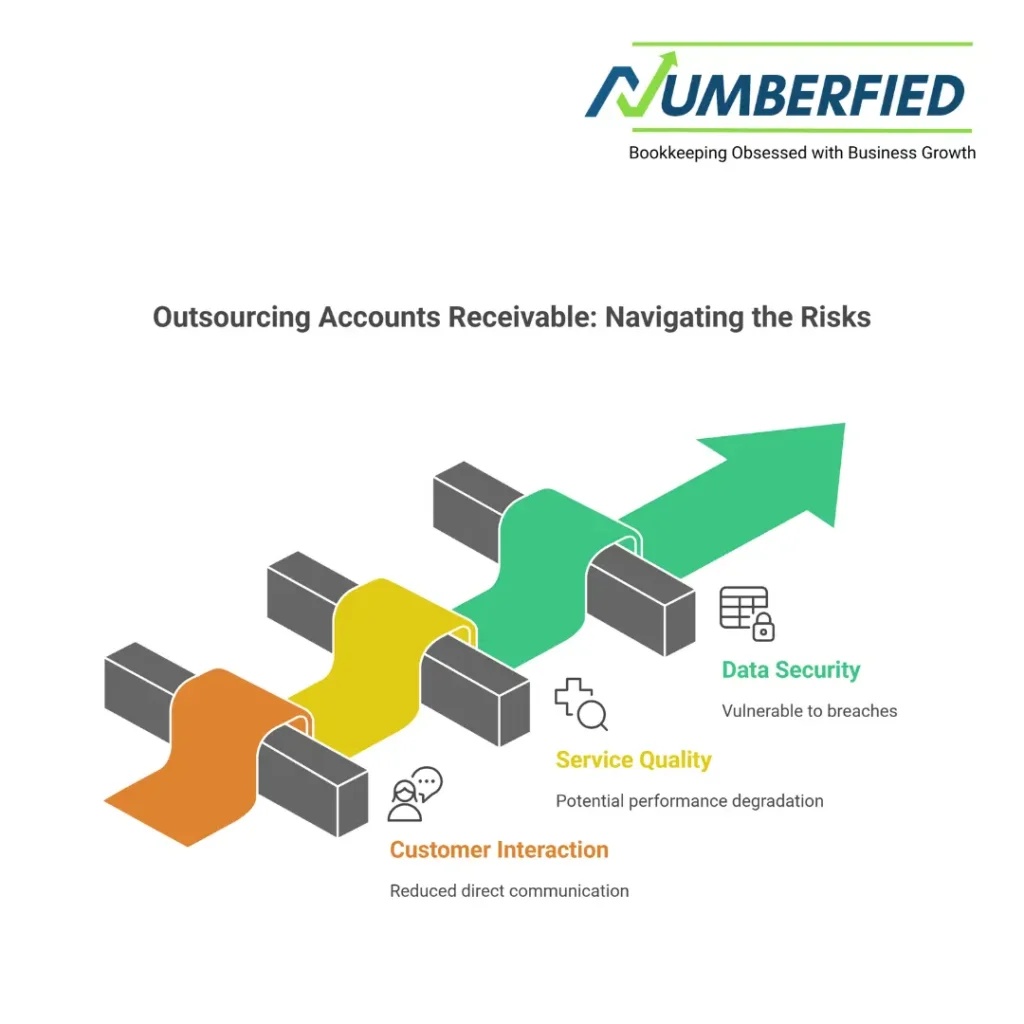
While benefits are significant, risks exist when outsourcing accounts receivable. Common concerns include loss of control over customer interactions, potential service quality issues, and data security. Mitigation strategies:
- Maintain clear contractual SLAs and performance metrics.
- Retain oversight through dashboards and regular reporting.
- Set escalation paths and keep certain client-sensitive collections in-house if necessary.
- Verify the outsourcing firm’s security certifications and data handling policies.
Nearshore and Offshore Options
Outsourcing providers include nearshore and offshore outsourcing firms as well as domestic service providers. Nearshore outsourcing can offer time zone alignment and cultural affinity, while offshore providers often provide cost advantages. When choosing between nearshore and offshore accounts receivable outsourcing, weigh cost savings against communication needs, regulatory compliance, and the complexity of customer accounts.
How to Measure Success
Track these KPIs to evaluate the impact of accounts receivable outsourcing:
- Days Sales Outstanding (DSO)
- Average Days Delinquent (ADD)
- Percentage of overdue accounts
- Collection rate and recovery on overdue balances
- Cost per invoice processed
- Customer satisfaction with billing and collections interactions
When to Consider Outsourcing Accounts Receivable
Consider outsourcing accounts receivable when you experience one or more of the following:
- Persistent cash flow gaps or high working capital needs
- Rising overhead costs and difficulty scaling AR staff
- High DSO or increasing levels of overdue accounts
- Need for improved invoice processing, automation, or payment options
- Desire to focus internal resources on core business activities and growth
Conclusion:
Accounts receivable outsourcing services offer small and medium businesses a powerful way to improve cash flow, reduce overhead costs, and gain access to advanced accounts receivable automation and expert collections services. Whether you need outsourced invoicing, receivables management, or debt recovery outsourcing, the right accounts receivable outsourcing partner can transform your payment process and free your team to focus on core business functions. Evaluate DIY costs against realistic outsourcing fees and expected improvements in DSO and bad debt reduction. Many businesses find that the financial and operational benefits of outsourcing outweigh the investment. If improving cash flow, lowering operational costs, and achieving more effective accounts receivable management are important for your business, exploring accounts receivable outsourcing services is a strategic next step.
FAQ
What are the four types of outsourcing?
The four main types of outsourcing are professional outsourcing (specialized services like accounting or legal), IT outsourcing (software development and tech support), manufacturing outsourcing (production of goods), and process-specific outsourcing (ongoing tasks like payroll or customer service). Many sources also categorize by location: onshore (same country), nearshore (nearby countries), offshore (distant countries), and process/operational outsourcing.
Is receivables outsourcing legit?
Yes, accounts receivable outsourcing is a legitimate and widely used practice where businesses hire third-party providers to manage invoicing, collections, and payments. Reputable firms offer expertise, improve cash flow, and reduce costs, with many success stories from companies across industries. It’s regulated and effective when choosing vetted providers.
What is the 10 rule for accounts receivable?
The 10 rule (or 10% cross-aging rule) states that if 10% or more of a customer’s total outstanding invoices are overdue (often over 90 days), the entire account is classified as high risk. This triggers actions like tighter credit terms or increased collections efforts to mitigate bad debt.
What are the GAAP rules for accounts receivable?
Under GAAP, accounts receivable must be reported at net realizable value (gross AR minus allowance for doubtful accounts). Use the allowance method to estimate uncollectible amounts based on historical data or aging. Recognize revenue when earned, and receivables when the right to payment is unconditional (except for passage of time).
What is a good percentage of AR over 90 days?
A good percentage of accounts receivable over 90 days is under 10-15% for most businesses, with top performers aiming for 10% or less. Benchmarks vary by industry (e.g., healthcare often targets below 20%), but anything over 20-25% signals collection problems and higher bad debt risk.
What are the 5 C’s of accounts receivable management?
The 5 C’s of credit (used in AR management) are Character (payment history and reliability), Capacity (ability to pay based on cash flow), Capital (financial reserves), Collateral (assets for security), and Conditions (economic/environmental factors). They help assess customer creditworthiness and reduce risk.
What is accounts receivable outsourcing?
Accounts receivable outsourcing involves hiring a third-party provider to handle invoicing, payment processing, collections, credit checks, dispute resolution, and reporting. It streamlines cash flow, reduces overhead, and leverages expert tools for faster, more efficient collections.
What is receivables outsourcing?
Receivables outsourcing (or AR outsourcing) delegates management of outstanding customer invoices to an external specialist. This includes tracking payments, sending reminders, handling collections, and ensuring compliance, allowing businesses to focus on core operations while improving recovery rates.
Can you outsource accounts receivable?
Yes, businesses commonly outsource accounts receivable to specialized providers for tasks like invoicing, collections, and risk management. It’s scalable, cost-effective, and legitimate, especially for growing companies needing expertise without building an in-house team.
How does accounting outsourcing work?
Accounting outsourcing involves partnering with an external provider who handles tasks like bookkeeping, payroll, tax prep, and financial reporting remotely. You share data securely via cloud tools, set scopes/SLAs, and receive regular reports, scaling services as needed while maintaining oversight.