

Introduction
For small to medium business owners, startups, entrepreneurs, sole proprietors, freelancers, and self-employed professionals, financial accuracy isn’t optional; it’s the foundation of survival and growth. An accurate bookkeeping & tax service delivers clean, compliant books and intelligent tax planning so you avoid IRS penalties, claim every legitimate deduction, and gain the clear insights needed to make confident decisions. These professional services go far beyond basic data entry: they ensure transaction-level precision, proper quarterly estimates, audit-ready documentation, and strategic deduction optimization that often saves thousands annually.
In 2026, with expanded IRS data-matching, AI-assisted audits, and stricter 1099-K reporting, partnering with an accurate bookkeeping & tax service has become essential for anyone who wants to protect their earnings and focus on building their business instead of worrying about compliance. This guide covers the real benefits, compares DIY/in-house approaches to professional help, details the core services you should expect, highlights common mistakes, provides a step-by-step selection process, reviews top providers, examines key IRS compliance trends in 2026, and shows you how to get started with confidence.
Key Benefits of Accurate Bookkeeping & Tax Service
An accurate bookkeeping & tax service provides advantages that directly reduce risk and increase your take-home earnings.
IRS Compliance Assurance & Penalty Avoidance
The IRS continues to tighten data-matching and audit selection in 2026, especially on self-employment income, home office claims, vehicle expenses, and 1099 reporting. Accurate bookkeeping & tax service maintains clean, defensible records and ensures timely quarterly estimated payments, virtually eliminating underpayment penalties (which can reach 8% annualized) and late-filing fees. Professionals also prepare audit-ready books with supporting documentation, so if you are selected for review, your file stands up to scrutiny.
Maximized Deductions & Lower Tax Liability
Many self-employed individuals and small business owners leave money on the table by missing or misclassifying deductions. Precise accounting and tax for small businesses identify and properly document every allowable write-off: home office (simplified or actual method), mileage or actual vehicle expenses, health insurance premiums, retirement contributions (SEP-IRA, Solo 401(k)), business use of phone/internet, professional development, supplies, advertising, and more. Reliable bookkeeping & tax preparation often uncovers 10–30% more deductions than DIY filing, directly reducing your taxable income and overall tax bill.
Audit-Ready Books & Representation Support
An error-free bookkeeping and tax service builds records that are organized, categorized correctly, and backed by receipts and logs. Many providers include audit representation (or coordinate with your CPA/EA), so if the IRS contacts you, a professional handles communication and documentation. This protection is invaluable for freelancers and contractors who face higher audit rates due to Schedule C complexity.
Clear Financial Insights for Better Decisions
Accurate records reveal your true profitability, cash flow patterns, expense trends, and breakeven point. Compliant bookkeeping and tax solutions deliver monthly profit & loss statements, balance sheets, cash flow reports, and key metrics (gross margin, burn rate, runway) in easy-to-read dashboards. These insights help you set better rates, control spending, plan for slow periods, and decide when to invest in growth.
Time Freedom & Reduced Stress
DIY bookkeeping and tax prep can consume 10–20 hours a month, especially during quarter-end and tax season. An accurate bookkeeping & tax service removes that burden, freeing you to focus on client work, marketing, product development, or simply taking time off without financial anxiety. The mental bandwidth you reclaim is often the biggest hidden benefit.
In-House/DIY vs. Professional Accurate Bookkeeping & Tax Service
Many self-employed professionals start with DIY tools or in-house efforts, but professional services usually outperform both for accuracy and value.
Cost Comparison
DIY software (QuickBooks Self-Employed, Wave, FreshBooks) costs $15–$50/month but requires your time and carries a high error risk. In-house bookkeeping (part-time or full-time) typically runs $35,000–$70,000 annually, including salary, benefits, and software. Professional accurate bookkeeping & tax service averages $300–$1,500/month ($3,600–$18,000/year), often saving more in tax than the fee through better deductions and penalty avoidance.
Accuracy & Expertise
DIY relies on your knowledge of IRS rules, which change yearly. Common errors include incorrect home office calculations, missed QBI deductions, or improper vehicle expense tracking. In-house staff may gain company-specific knowledge but rarely have broad tax expertise. Reliable bookkeeping & tax preparation brings in certified professionals (CPAs, EAs, or experienced bookkeepers) who know current rules and specialize in self-employment and small-business filings.
Time & Stress Savings
DIY and in-house approaches demand ongoing attention. Accurate bookkeeping & tax service offloads the work completely, with real-time dashboards so you stay informed without doing the heavy lifting. This time freedom is critical for freelancers and entrepreneurs whose income depends on client delivery.
Compliance & Audit Protection
DIY increases audit risk due to common mistakes; in-house can be accurate but lacks external objectivity. Compliant bookkeeping and tax solutions include organized documentation, quarterly estimate calculations, and often audit representation or coordination, significantly lowering risk.
Essential Services in Accurate Bookkeeping & Tax Service
The best accurate bookkeeping & tax service covers these core areas with precision and proactivity.
Transaction Accuracy & Reconciliation
Every bank, credit card, and payment processor transaction is imported, categorized correctly (deductible vs. non-deductible), and reconciled monthly. This eliminates duplicate entries, catches bank errors, and ensures your books match reality.
Quarterly Estimated Taxes & Filings
Calculating and reminding you of Form 1040-ES due dates (April, June, September, January), adjusting estimates as income fluctuates, and ensuring payments are made on time. This prevents underpayment penalties that can add 8% annualized interest.
Schedule C & 1099 Preparation
Accurate Schedule C creation for business income/expenses, proper classification of 1099-NEC/MISC income, and issuance of 1099s to contractors/vendors when required. Error-free bookkeeping and tax service ensures all income is reported and deductions are substantiated.
Deduction Optimization & Documentation
Identifying and documenting every allowable deduction: home office (simplified $5/sq ft or actual), mileage (standard or actual), health insurance, retirement contributions, business use of phone/internet, professional fees, supplies, advertising, travel, meals (50%), and more. The service maintains digital receipt files and mileage logs for audit defense.
Financial Reporting & Basic Advisory
Monthly profit & loss statements, balance sheets, cash flow summaries, and key metrics (gross margin, net profit percentage, breakeven point). Many accurate bookkeeping & tax service providers include simple advisory: cash flow alerts, pricing recommendations, or retirement contribution optimization.
Common Mistakes to Avoid with Accurate Bookkeeping & Tax Service
Even with professional help, these errors can reduce value or create problems.
Inaccurate Transaction Categorization
Misclassifying personal expenses as business or vice versa triggers red flags. Insist on clear categorization rules and regular reviews with your accurate bookkeeping & tax service provider.
Missed Quarterly Estimated Payments
Underpaying estimates leads to penalties even if you’re due a refund. Professional services calculate and remind you of exact amounts based on year-to-date income.
Poor Documentation & Receipt Management
The IRS requires substantiation for deductions. Use receipt-scanning apps and maintain digital folders so your error-free bookkeeping and tax service can produce records instantly if audited.
Mixing Personal & Business Finances
Using personal accounts for business expenses creates chaos and disallowed deductions. Open dedicated business checking and credit cards from day one.
Choosing Based on Price Alone
The cheapest provider may skip reviews, use outdated methods, or lack IRS knowledge. Focus on value: expertise, communication, technology, and audit support in accurate bookkeeping & tax service.
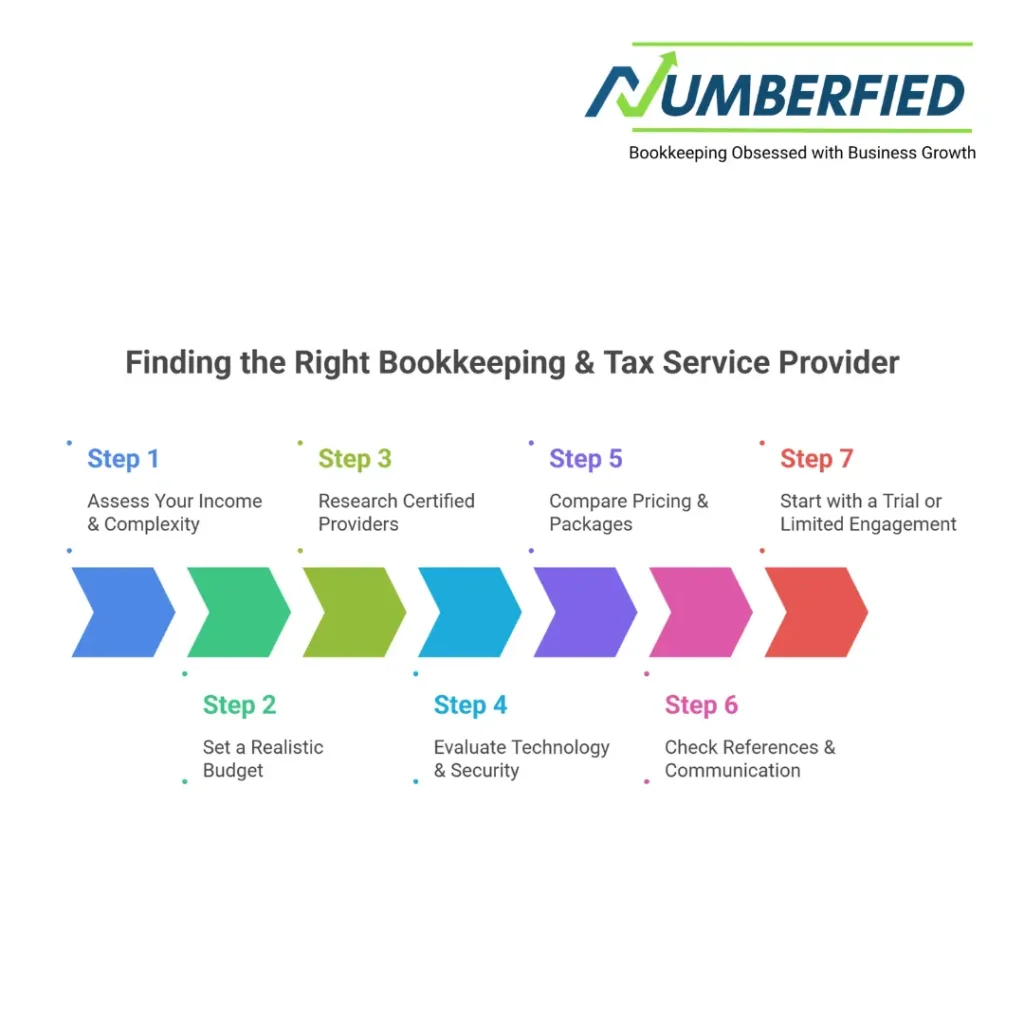
Step-by-Step Guide to Selecting Accurate Bookkeeping & Tax Service Providers
Follow this process to find a reliable partner.
Step 1: Assess Your Income & Complexity
Estimate annual gross revenue, number of income streams (1099s, platforms), deduction categories (home office, vehicle, etc.), and whether you have employees/contractors. This determines whether you need basic bookkeeping or comprehensive, accurate bookkeeping & tax service.
Step 2: Set a Realistic Budget
Budget $300–$1,500/month for professional service. Simple Schedule C filers may spend $300–$600; freelancers with multiple streams and deductions often need $800–$1,500 for full support.
Step 3: Research Certified Providers
Look for Enrolled Agents (EAs), CPAs, or experienced bookkeepers with strong reviews on Google, Yelp, or industry forums. Search for “accurate bookkeeping & tax service near me” or “self-employed tax services” and prioritize providers specializing in freelancers/contractors.
Step 4: Evaluate Technology & Security
Ensure the provider uses current cloud software (QuickBooks Online, Xero, Wave) with bank feeds, receipt scanning, and secure client portals. Verify SOC 2 compliance or similar security standards.
Step 5: Compare Pricing & Packages
Request detailed proposals from 3–5 providers. Compare inclusions (reconciliations, quarterly estimates, reporting frequency, audit support) and fee structure (monthly fixed, hourly, or project-based).
Step 6: Check References & Communication
Ask for client references or case studies. Schedule consultations to assess responsiveness, clarity, and understanding of self-employment nuances.
Step 7: Start with a Trial or Limited Engagement
Many providers offer a discounted first month or single-quarter engagement. Use this to test accuracy, communication, and overall value before committing to the long term.
Top Providers & IRS Compliance Trends in 2026
IRS trends in 2026 include:
- Expanded 1099-K reporting threshold ($600) fully enforced, capturing more platform income
- Increased AI-assisted audits targeting high deduction categories (home office, vehicle, meals)
- Stronger focus on gig economy income matching from payment processors
- Continued emphasis on proper QBI deduction calculation
- Mandatory e-filing for nearly all self-employed returns
Providers are integrating AI for automatic deduction flagging, real-time compliance alerts, and secure document portals.
Conclusion
Accurate bookkeeping & tax service gives small to medium business owners, startups, entrepreneurs, sole proprietors, freelancers, and self-employed professionals the compliance assurance, maximized deductions, penalty avoidance, audit-ready books, and clear financial insights needed to thrive. By avoiding common mistakes and following a structured selection process, you can find a partner that protects your earnings and supports your independence. As IRS enforcement and data-matching intensify in 2026, professional support becomes even more essential.
Ready to eliminate tax stress and keep more of what you earn? Request a free consultation today from a trusted, accurate bookkeeping & tax service provider and take control of your financial future.
FAQ
How much does accurate bookkeeping & tax service cost for small businesses?
Accurate bookkeeping & tax service typically costs $300–$1,500 per month in 2026, depending on transaction volume and scope. Basic monthly bookkeeping starts around $300–$600, while full-service packages (including quarterly estimates, Schedule C prep, and advisory) range from $800–$1,500+.
Is accurate bookkeeping & tax service worth it for small businesses and freelancers?
Yes, it’s worth it for most small businesses and freelancers earning $40,000+. The service saves time, uncovers deductions (often thousands annually), prevents penalties, and provides audit protection, usually delivering more tax savings and peace of mind than the fee costs.
What services are included in accurate bookkeeping & tax service?
Typical packages include accurate transaction recording & reconciliation, quarterly estimated tax calculations & reminders, Schedule C preparation, 1099 tracking, deduction optimization, monthly financial reports, and basic advisory support. Many also handle bill pay, invoicing, and payroll if needed.
How do I choose the best accurate bookkeeping & tax service provider?
Look for Enrolled Agents, CPAs, or experienced bookkeepers with strong reviews, cloud software (QuickBooks Online, Xero), transparent fixed-fee pricing, audit support, and clear communication. Request a consultation, sample reports, and references to ensure fit for your business.
How does accurate bookkeeping & tax service differ from basic tax preparers?
Basic tax preparers focus mainly on filing your annual return, often missing year-round planning and ongoing bookkeeping accuracy. Accurate bookkeeping & tax service provides continuous transaction-level precision, quarterly estimate guidance, deduction optimization, and audit-ready books throughout the year.
Is my data secure with accurate bookkeeping & tax service?
Yes, reputable accurate bookkeeping & tax service providers use bank-level encryption, two-factor authentication, secure client portals, and regular backups. Look for SOC 2 compliance or similar certifications, and never share full bank login credentials; use accountant-specific read-only access.
What are the latest IRS compliance trends affecting accurate bookkeeping & tax service in 2026?
In 2026, the IRS continues aggressive data-matching on 1099-K forms ($600 threshold), home office/vehicle deductions, and self-employment income. AI-assisted audits are increasing, making clean, documented books and accurate quarterly estimates more important than ever.
What are red flags when evaluating accurate bookkeeping & tax service providers?
Red flags include promising guaranteed refunds or unrealistically high deductions, pressure to sign quickly, reluctance to show credentials/references, poor communication, no written agreement, hidden fees, or lack of audit representation/support.
How can I get started with accurate bookkeeping & tax service?
Start by assessing your income, deductions, and quarterly tax needs, then research Enrolled Agents/CPAs or experienced bookkeepers with strong reviews. Request a free consultation, share sample records, and begin with a single quarter or annual return to test accuracy and fit.
Are accurate bookkeeping & tax service suitable for freelancers vs. larger small businesses?
Yes, they’re highly suitable for both. Freelancers benefit from 1099 tracking, deduction optimization, and simple Schedule C filing; larger small businesses gain from payroll support, inventory/COGS accuracy, and monthly reporting. The service scales to match your size and complexity.
Read Also: 7 Insider Tips to Simplify Your Finances with QuickBooks Bookkeeping Services for Small Businesses