

Introduction
Running a small to medium business, startup, freelance operation, sole proprietorship, or self-employed venture means your financial life is rarely simple. Income fluctuates, expenses vary by season or project, deductions can be tricky to substantiate, quarterly taxes loom every few months, and one missed compliance detail can trigger penalties that wipe out weeks of profit. Balanced bookkeeping & tax services are built to solve exactly that problem: they deliver steady, reliable financial management that keeps compliance rock-solid while actively hunting for every deduction and credit you’re entitled to, all without overwhelming you with complexity or cost.
The “balanced” part isn’t marketing fluff; it means the service strikes an intentional equilibrium between meticulous compliance accuracy (so you never face surprises from the IRS) and proactive savings optimization (so you keep more of what you earn). In 2026, with IRS data-matching at an all-time high, 1099-K reporting fully enforced at $600, AI-assisted audits targeting common Schedule C deductions, and inflation still pressuring margins, a truly balanced bookkeeping & tax service has become one of the highest-leverage investments most independent professionals and small business owners can make.
This guide walks you through the real benefits, compares DIY/in-house approaches to professional balanced services, details what strong packages actually deliver, flags the most common pitfalls, gives you a clear step-by-step selection process, reviews leading specialized providers, and highlights key IRS compliance trends shaping the space in 2026 so you can choose a partner that brings stability and savings without unnecessary complexity.
Key Benefits of Balanced Bookkeeping & Tax Services
Balanced bookkeeping & tax services are designed to protect your downside (compliance & penalty risk) while actively improving your upside (deductions, cash-flow clarity, profitability). Here’s what that looks like in practice.
Balanced Accuracy & Compliance Assurance
The IRS audits self-employed and small business returns at higher rates than W-2 filers, often focusing on Schedule C deductions, 1099 income mismatches, and quarterly estimated tax underpayments. Balanced bookkeeping & tax services maintain clean, defensible records with proper categorization, digital receipt trails, mileage logs, and organized documentation so you’re audit-ready at all times. They also calculate and remind you of the exact quarterly estimated payments (Form 1040-ES) based on year-to-date income, preventing underpayment penalties that can run as high as 8% annualized.
Optimized Deductions & Tax Savings
Many self-employed individuals and small business owners under-claim deductions by 15–35% because they don’t know the rules or can’t document them properly. Balanced bookkeeping and tax solutions systematically capture and substantiate every allowable write-off: home office (simplified $5/sq ft or actual), mileage or actual vehicle expenses, health insurance premiums, retirement contributions (SEP-IRA, Solo 401(k)), business use of phone/internet, supplies, advertising, travel, meals (50%), and more. Professional providers often find $3,000–$15,000+ in additional annual savings, frequently more than the service fee itself.
Balanced Cash-Flow & Profitability Visibility
Generic bookkeeping often produces reports that are accurate but not actionable. Balanced services deliver monthly profit & loss statements, balance sheets, cash flow summaries, and key performance indicators (gross margin, burn rate, breakeven point, runway) in clear, customized dashboards. You see exactly where money is coming from, where it’s going, and when cash will tighten, helping you set better rates, time investments, and avoid overdrafts or stockouts.
Time Freedom with Reduced Stress
DIY bookkeeping and tax prep can easily consume 10–25 hours a month, especially during quarter-end and tax season. Balanced bookkeeping & tax services offload that burden completely, giving you back time for client work, marketing, product development, or simply taking a break. The mental relief of knowing your numbers are accurate, and deadlines are handled, is one of the most underrated benefits.
Audit Protection & Strategic Clarity
An accurate set of books is only half the battle; being able to defend it matters more. Balanced services maintain meticulous digital trails (receipts, logs, notes) and many include support for audit coordination or representation. They also provide strategic clarity, highlighting which clients/products/services are truly profitable, where costs are creeping, and when to adjust pricing or spending so you make decisions with confidence rather than guesswork.
In-House/DIY vs. Professional Balanced Bookkeeping & Tax Service Comparison
Most self-employed professionals and small businesses start with DIY tools or in-house efforts, but professionally balanced services usually outperform both in terms of accuracy, savings, and scalability.
Cost Comparison
DIY software (QuickBooks Self-Employed, Wave, FreshBooks) costs $15–$50/month but demands your time and carries a high error risk. In-house bookkeeping averages $45,000–$75,000/year, including salary, benefits, taxes, software, and training. Professional balanced bookkeeping & tax services typically cost $500–$2,000/month ($6,000–$24,000/year), often saving more in tax deductions and penalty avoidance than the fee itself, especially when compared to the true cost of DIY mistakes or in-house overhead.
Accuracy/Consistency & Expertise Level
DIY relies on your knowledge. Common errors include wrong deduction classification, missed QBI, or improper vehicle tracking. In-house staff gain company-specific knowledge but rarely have broad tax expertise. Balanced bookkeeping & tax services bring certified professionals (CPAs, EAs, or experienced bookkeepers) who specialize in small-business and self-employment rules, delivering greater consistency and fewer mistakes.
Flexibility & Scalability
In-house is rigid; adding volume means hiring, which takes time and adds fixed cost. DIY is flexible but error-prone. Balanced services scale precisely: add hours, change scope, or adjust workflows as your business evolves, without long-term lock-in or hiring risk.
Control, Advisory Value & Technology Access
Some owners fear losing visibility or advisory input with outsourcing. Modern balanced services provide full transparency via shared cloud access, real-time dashboards, and proactive advisory notes. In-house/DIY often lags in adopting advanced tools unless you invest heavily, while balanced providers leverage cutting-edge platforms as standard.
Essential Services Included in Balanced Bookkeeping & Tax Services
Strong, balanced bookkeeping & tax services cover these core areas with deliberate equilibrium between compliance and optimization.
Precise Transaction Processing & Reconciliation
Every bank, credit card, and payment processor transaction is imported, categorized correctly (deductible vs. non-deductible), and reconciled monthly. This eliminates duplicate entries, catches bank errors, and ensures your books match reality.
Quarterly Estimated Payments & Filings
Calculating and reminding you of Form 1040-ES due dates (April, June, September, January), adjusting estimates as income fluctuates, and ensuring payments are made on time. This prevents underpayment penalties that can add 8% annualized interest.
Schedule C & 1099 Optimization
Accurate Schedule C creation for business income/expenses, proper classification of 1099-NEC/MISC income, and issuance of 1099s to contractors/vendors when required. Balanced bookkeeping & tax services ensure all income is reported and deductions are substantiated.
Deduction Balancing & Documentation
Identifying and documenting every allowable deduction: home office (simplified or actual), mileage or actual vehicle expenses, health insurance, retirement contributions, business use of phone/internet, professional fees, supplies, advertising, travel, meals (50%), and more. The service maintains digital receipt files and mileage logs for audit defense.
Monthly Balanced Financial Statements & KPI Tracking
Compilation of clean monthly trial balances, profit & loss statements, balance sheets, and cash flow reports. Balanced services include KPI tracking (gross margin, net profit percentage, breakeven point, burn rate) and variance analysis so you see trends early.
Basic Tax Planning & Audit Readiness
Year-round planning to maximize deductions and contributions (e.g., “Maximize SEP-IRA by $X before year-end”), coordination with your tax preparer, and audit-ready files with supporting documentation. Many providers include representation support or liaison during IRS inquiries.
Common Mistakes to Avoid with Balanced Bookkeeping & Tax Services
These errors can tip the balance and reduce the value of even a strong service.
Over-Focusing on Cost vs. Balance
Choosing the cheapest provider often means unbalanced service (heavy on basic entry, light on deduction hunting or advisory). Prioritize providers that deliver true equilibrium between compliance accuracy and optimization.
Unbalanced Categorization & Missed Deductions
Allowing sloppy or inconsistent categorization leads to missed write-offs and IRS red flags. Insist on clear rules and monthly reviews to keep the balance correct.
Poor Quarterly Estimate Balancing
Underpaying estimates triggers penalties even if you’re due a refund. Professional balanced bookkeeping & tax services calculate and adjust estimates based on year-to-date income. Don’t skip this step.
Inadequate Documentation
The IRS requires substantiation for deductions. Use receipt-scanning apps and maintain digital folders so your balanced bookkeeping & tax services can produce records instantly if audited.
Ignoring Ongoing Review & Communication
Assuming “it’s balanced” and never reviewing reports allows small imbalances to grow. Schedule monthly check-ins and use shared dashboards to maintain equilibrium.
Step-by-Step Guide to Selecting & Onboarding Balanced Bookkeeping & Tax Services
Follow this process to find and activate a balanced solution.
Step 1: Assess Your Income & Complexity
Estimate annual gross revenue, number of income streams (1099s, platforms), deduction categories (home office, vehicle, etc.), and whether you have employees/contractors. This determines whether you need basic balancing or comprehensive balanced bookkeeping & tax services.
Step 2: Set a Realistic Budget
Budget $500–$2,000/month for professional service. Simple Schedule C filers may spend $500–$900; freelancers with multiple streams and deductions often need $1,000–$2,000 for a full balance.
Step 3: Research Certified Providers
Look for Enrolled Agents (EAs), CPAs, or experienced bookkeepers with strong reviews on Google, Yelp, or industry forums. Search for “balanced bookkeeping & tax services near me” or “self-employed tax services” and prioritize providers specializing in freelancers/contractors.
Step 4: Evaluate Technology & Security
Ensure the provider uses current cloud software (QuickBooks Online, Xero, Wave) with bank feeds, receipt scanning, and secure portals. Verify SOC 2 compliance or similar security standards.
Step 5: Compare Pricing & Packages
Request detailed proposals from 3–5 providers. Compare inclusions (reconciliations, quarterly estimates, reporting frequency, audit support) and fee structure (monthly fixed, hourly, or project-based).
Step 6: Check References & Communication
Ask for client references or case studies. Schedule consultations to assess responsiveness, clarity, and understanding of self-employment nuances.
Step 7: Start with a Trial or Limited Engagement
Many providers offer a discounted first month or single-quarter engagement. Use this to test accuracy, communication, and overall value before committing to the long term.
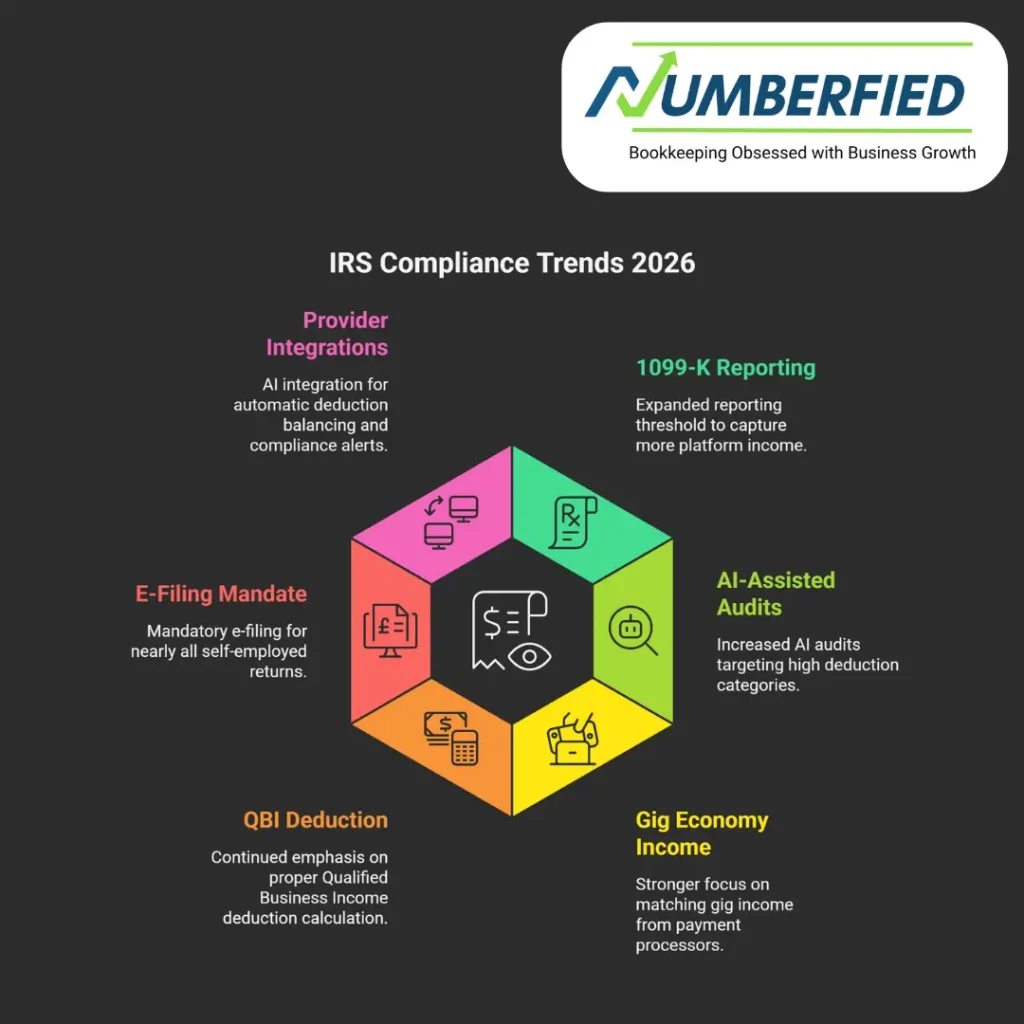
IRS compliance trends in 2026 include:
- Expanded 1099-K reporting threshold ($600) fully enforced, capturing more platform income
- Increased AI-assisted audits targeting high deduction categories (home office, vehicle, meals)
- Stronger focus on gig economy income matching from payment processors
- Continued emphasis on proper QBI deduction calculation
- Mandatory e-filing for nearly all self-employed returns
Providers are integrating AI for automatic deduction balancing, real-time compliance alerts, and secure document portals.
Conclusion
Balanced bookkeeping & tax services give small to medium business owners, startups, entrepreneurs, sole proprietors, freelancers, and self-employed professionals the equilibrium of rock-solid compliance and proactive optimization that protects earnings and fuels growth. By avoiding common mistakes and following a structured selection process, you can find a partner that brings stability without sacrificing savings. As IRS enforcement and data-matching intensify in 2026, professional balanced support becomes even more essential.
Ready to eliminate tax stress and keep more of what you earn? Request a free balanced financial review or consultation today from a trusted provider and take control of your financial future.
FAQ
How much do balanced bookkeeping & tax services cost for small businesses?
Balanced bookkeeping & tax services typically cost $500–$2,000 per month in 2026, depending on transaction volume and scope. Basic monthly support starts around $500–$900, while full-service packages (reconciliations, reporting, advisory) range from $1,000–$2,000+.
Are balanced bookkeeping & tax services worth it for small businesses and freelancers?
Yes, they’re worth it for most businesses earning $40,000+ annually. Balanced bookkeeping & tax services save time, uncover thousands in deductions, prevent penalties, and provide audit-ready books, usually delivering more tax savings and clarity than the fee costs.
What services are included in balanced bookkeeping & tax services?
Typical packages include precise transaction processing & reconciliation, quarterly estimated payments & filings, Schedule C/1099 optimization, deduction balancing & documentation, monthly balanced financial statements & KPI tracking, and basic tax planning & audit readiness.
How do I choose the best balanced bookkeeping & tax services provider?
Look for Enrolled Agents, CPAs, or experienced bookkeepers with strong reviews, cloud software proficiency, transparent fixed-fee pricing, and audit support. Request a consultation, sample reports, and references to ensure fit for your business.
How do balanced bookkeeping & tax services differ from standard or unbalanced options?
Standard/unbalanced services often prioritize either compliance or cost-cutting; balanced bookkeeping & tax services intentionally maintain equilibrium, meticulous accuracy on the compliance side, and proactive deduction optimization on the savings side for better overall results.
Is my data secure with balanced bookkeeping & tax services?
Yes, reputable, balanced bookkeeping & tax services use bank-level encryption, two-factor authentication, secure client portals, and regular backups. Look for SOC 2 compliance or similar certifications, and use accountant-specific read-only access instead of full bank logins.
What are the latest IRS compliance trends affecting balanced bookkeeping & tax services in 2026?
In 2026, the IRS continues aggressive data-matching on 1099-K forms ($600 threshold), home office/vehicle deductions, and self-employment income. AI-assisted audits are increasing, making clean, documented books and accurate quarterly estimates more important than ever.
What are red flags when evaluating balanced bookkeeping & tax services providers?
Red flags include promising guaranteed refunds or unrealistically high deductions, pressure to sign quickly, reluctance to show credentials/references, poor communication, no written agreement, hidden fees, or lack of audit representation/support.
How can I get started with balanced bookkeeping & tax services?
Start by assessing your income, deductions, and quarterly tax needs, then research Enrolled Agents/CPAs or experienced bookkeepers with strong reviews. Request a free consultation, share sample records, and begin with a single quarter or annual return to test accuracy and fit.
Are balanced bookkeeping & tax services suitable for freelancers vs. larger small businesses?
Yes, they’re highly suitable for both. Freelancers benefit from 1099 tracking, deduction optimization, and simple Schedule C filing; larger small businesses gain from payroll support, inventory/COGS accuracy, and monthly reporting. The service scales to match your size and complexity.
Read Also: 9 Surprising Ways a Bookkeeping Service for Small Business Can Boost Your Success