
Introduction
For startup founders, every minute counts. You are focused on product development, customer acquisition, and team building. Yet, the engine of your business-your finances-often becomes a massive, time-consuming burden. Manual financial tracking, receipt chasing, and spreadsheet management are not only tedious but risky. According to recent data, 40% of businesses spend over 80 hours every year on bookkeeping and tax preparation, diverting crucial energy away from scaling the venture.
The solution is not working harder; it is working smarter through automation. Automated bookkeeping is no longer a luxury reserved for large corporations. It is an essential tool for agile startups. This article explores eight transformative benefits of bookkeeping automation, showing you how to move beyond simple compliance and into strategic business growth, all while keeping your financial data pristine and accessible.
At Numberfied, we understand that founders need more than just tidy books. You need a financial partner that combines professional bookkeeping with business growth coaching. Let’s dive into why automating this critical function is the best decision for your startup.
What is Bookkeeping Automation and Why Does It Matter?
Before examining the benefits, it is crucial to define what bookkeeping automation actually means. In essence, it is the use of software and technology to automate repetitive financial tasks. This includes automatically importing bank transactions, categorizing expenses, reconciling accounts, generating invoices, and preparing financial reports. Instead of manually entering every data point, a founder or finance team sets up rules and connections that allow the system to do the heavy lifting.
Bookkeeping automation matters because financial accuracy is the bedrock of a healthy startup. A single clerical error in a spreadsheet can lead to flawed forecasts, missed tax deductions, or even an inaccurate valuation during a funding round. Furthermore, manual bookkeeping scales poorly. As your transaction volume grows, the time required grows linearly. Automation creates a scalable, error-resistant financial infrastructure that supports growth rather than hindering it.
The Top 8 Benefits of Automating Your Startup’s Bookkeeping
The shift from manual to automated bookkeeping yields tangible, immediate results. Here are the eight most significant advantages for a growing startup, based on current industry best practices.
1. Significant Time Savings for Founders and Teams
Time is the most non-renewable resource for an entrepreneur. Studies show that 25% of business owners work more than 60 hours each week, often sinking a disproportionate amount of that time into administrative tasks like bookkeeping. Every hour spent reconciling accounts is an hour not spent on sales pitches, product innovation, or team leadership.
Automated bookkeeping directly reclaims that time. By automating data entry and reconciliation, tasks that once took four hours each week can be reduced to 30 minutes of review. This efficiency allows founders to focus on high-value activities that drive revenue and growth. It transforms the finance function from a weekly chore into a rapid, automated background process. For lean startups where every team member wears multiple hats, this time saving is not just convenient; it is a competitive advantage.
2. Painless and Accurate Tax Filing
Tax season is notoriously stressful for business owners, especially those who have fallen behind on their bookkeeping. The scramble to gather receipts, categorize expenses, and reconcile accounts often leads to rushed work, missed deductions, and late nights.
Automation turns tax preparation from a dreaded event into a seamless process. An automated bookkeeping system keeps your financial data updated in real-time. When it is time to file, all your income, expenses, and deductions are already organized and ready for your accountant or tax software. This ensures you never miss a deduction and reduces the risk of filing errors that can trigger audits or penalties. Furthermore, having year-round, organized books allows for proactive tax planning, enabling you to make strategic purchasing decisions before year-end to minimize your tax liability.
3. Enhanced Productivity Across the Organization
The benefits of automated bookkeeping extend beyond the finance department. When the core financial data is clean and automated, every department that relies on that data becomes more productive. Your sales team can trust commission calculations. Your operations team can track project profitability in real time. Your leadership team can access up-to-date cash flow statements before a critical board meeting.
By delegating routine financial data processing to an automated system, you empower your team to focus on analysis and action, not data entry. This shift from “record keeping” to “strategic analysis” elevates the entire organization’s capability. It breaks down silos, as everyone has access to the same, accurate, real-time financial information, leading to better collaboration and faster decision-making.
4. Drastically Improved Accuracy and Reduced Errors
Human error is an inevitable part of manual bookkeeping. A transposed number, a missed decimal, or a miscategorized expense can have a ripple effect, leading to incorrect financial statements, failed bank reconciliations, and flawed business forecasts. For a startup seeking investment, a single material error in your books can erode investor confidence.
Machines, when programmed correctly, do not make these kinds of errors. Automated bookkeeping systems follow consistent rules for categorizing transactions, matching invoices to payments, and calculating totals. This dramatically increases the reliability of your financial data. While regular review is still a best practice, the level of accuracy achieved through automation is far superior to manual entry. This leads to “audit-ready” books at all times, giving founders peace of mind that their financial foundation is solid.
5. Real-Time Cloud Access to Financial Data
Gone are the days of storing financial information on a single office computer or in a filing cabinet. Modern automated bookkeeping systems are cloud-native, meaning your financial data is accessible from anywhere, at any time, on any device. This is not just a convenience; it is a necessity for modern, distributed teams.
Real-time cloud access means a founder can check cash flow from a coffee shop, a CFO can review reports from a different time zone, and an external accountant can access the books for quarterly filings without needing a file transfer. This instant access to live data enables faster decision-making. You no longer have to wait for a monthly bookkeeping close to know your financial position. You have a live dashboard showing exactly where your startup stands, empowering you to make informed moves immediately.
6. Lightning-Fast Data Retrieval and Reporting
When a potential investor asks for a specific financial metric during a due diligence call, or a lender requests last year’s profit and loss statement by the end of the day, speed matters. Manually sifting through digital folders or paper files is slow and prone to error.
Automated bookkeeping systems function as a searchable database for all your financial transactions. You can generate custom reports-from cash flow statements to expense breakdowns by vendor-in seconds. This fast data retrieval capability is invaluable. It allows you to respond to stakeholder requests with professionalism and speed, building trust and credibility. It also enables more dynamic financial modeling, where you can quickly pull historical data to test assumptions and forecast future scenarios without tedious manual data aggregation.
7. Enterprise-Grade Secure File Storage
Protecting sensitive financial information is a top priority for any startup. Manual storage methods, from paper receipts to unencrypted USB drives, are vulnerable to loss, theft, or disaster. Even local server storage may lack sophisticated security protocols.
Automated bookkeeping platforms typically offer robust security features that exceed what most startups could implement on their own. This includes data encryption (often military-grade 256-bit AES), secure data centers with redundant backups, and strict access controls. For instance, many systems securely store digital copies of receipts, eliminating the need for paper and ensuring that supporting documents are always linked to the correct transaction. This secure, digital storage also simplifies compliance with record retention regulations, allowing you to keep e-records for the required 7-10 years without physical clutter.
8. Improved Cash Flow Management and Forecasting
Ultimately, the goal of all bookkeeping is to understand your financial health, and cash flow is the lifeblood of a startup. Manual bookkeeping often provides a historical, rear-view mirror perspective. By the time you reconcile last month’s books, the information is already outdated for making forward-looking decisions.
Automation provides real-time visibility into cash flow. You can see incoming payments, outstanding invoices, and scheduled expenses on a live dashboard. This enables more accurate cash flow forecasting. You can predict a cash crunch weeks in advance and take corrective action, or identify surplus cash that can be reinvested into growth. With better data, you can make strategic decisions about hiring, marketing spend, and inventory purchases with confidence, directly linking your automated bookkeeping to proactive business management.
Moving Beyond Automation: How Numberfied Integrates Bookkeeping with Growth
While automation provides the tools for efficient bookkeeping, technology alone does not guarantee business growth. Many founders automate their data entry only to find themselves staring at accurate reports, unsure of how to use the information to scale. This is where the traditional bookkeeping model falls short for startups. You need more than a compliance partner; you need a strategic ally.
Numberfied was built to fill this exact gap. We combine professional, tech-enabled bookkeeping services with integrated business growth coaching. Most accounting firms stop at delivering accurate financial statements. We help you act on them. Our platform includes monthly financial health reviews where we don’t just present numbers, we help you interpret what they mean for your lead generation, sales strategies, and profit maximization.
For a startup, this integration is powerful. Your automated bookkeeping feeds into a strategic framework. We use your clean, real-time financial data to inform weekly business coaching sessions on sales, marketing, and negotiation. You are not just tracking expenses; you are learning how to optimize them for growth. You are not just reconciling accounts; you are forecasting cash flow to time a new hire perfectly. It transforms bookkeeping from a cost center into a growth driver.
The Numberfied Approach
- Professional Bookkeeping: We set up or integrate with your existing system (QuickBooks, Xero, etc.) to automate the daily financial grind.
- Strategic Growth Planning: Semi-annual sessions to align your financial health with your business goals.
- Weekly Business Coaching: Actionable training on using your financial insights for sales, lead gen, and better negotiation.
- A Growth-Focused Community: Peer support and accountability pods to ensure you stay on track.
Conclusion
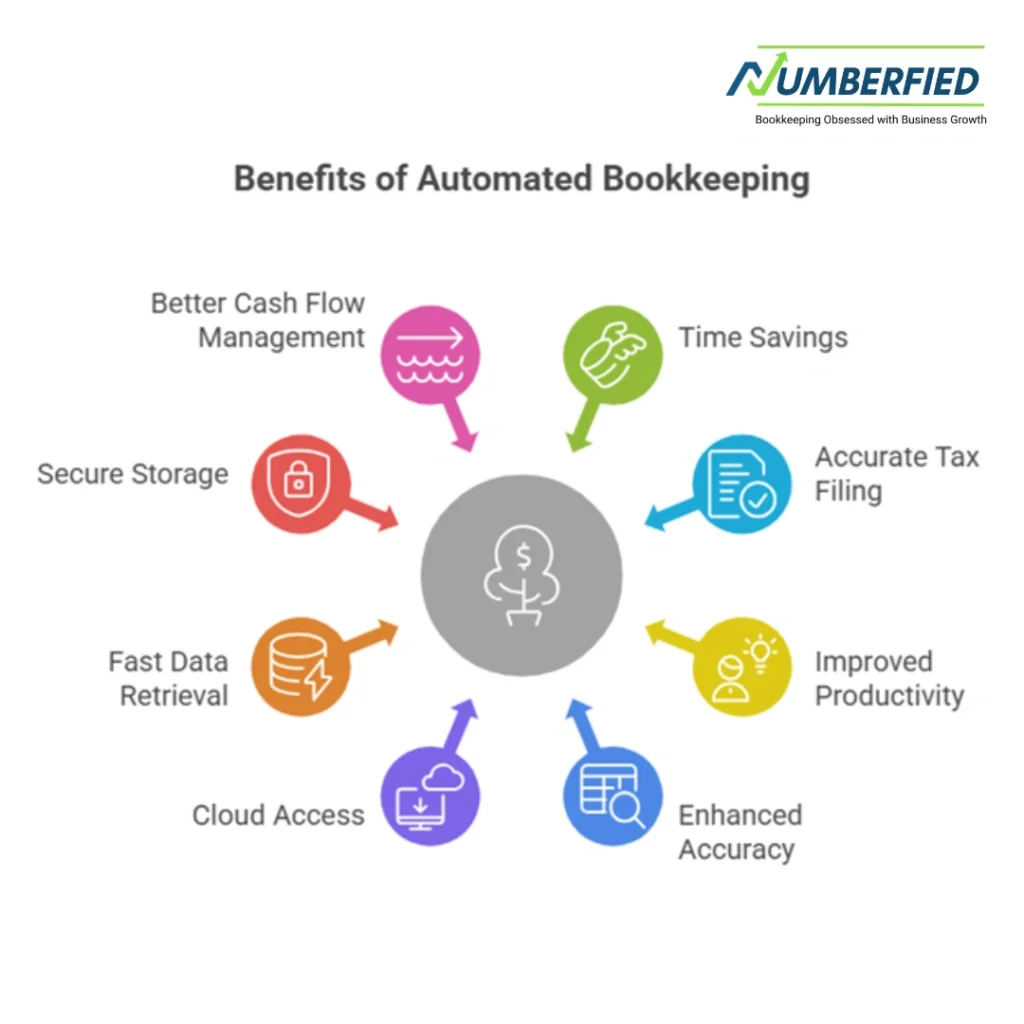
For startups, the choice between manual and automated bookkeeping is a choice between being stuck in the past or building for the future. The eight benefits-time savings, accurate tax filing, improved productivity, enhanced accuracy, cloud access, fast data retrieval, secure storage, and better cash flow management-create a compelling case for automation. It frees you from the grind of data entry and gives you a reliable, real-time view of your financial health.
However, technology is only the first step. To truly leverage your financial data for growth, you need a partner like Numberfied. We bridge the gap between accurate bookkeeping and actionable business strategy. Our model ensures your books are not just compliant, but that they actively inform your sales, marketing, and leadership decisions.
Don’t let manual bookkeeping hold your startup back. Embrace automation, and then go further with a team dedicated to your growth.
Read Also: Why Do Accountants Charge So Much? Exploring Accounting Firm CFO Services
FAQs
What exactly is bookkeeping automation?
It is the use of software to automatically perform routine bookkeeping tasks like transaction import, categorization, bank reconciliation, and report generation, minimizing manual data entry.
Is automated bookkeeping secure?
Yes, reputable platforms use bank-level encryption (like 256-bit AES), secure cloud servers, and multi-factor authentication, making it generally more secure than manual or local file storage.
Can automation completely replace a human bookkeeper?
No. Automation handles repetitive tasks but cannot replace strategic oversight, error review, financial analysis, or personalized advice. A hybrid model-automation plus expert humans-is best.
How much time can a startup really save?
Significantly. Many businesses reduce bookkeeping time by 70-80%, cutting a 5-10 hour weekly task down to 1-2 hours of review.
Is automated bookkeeping suitable for very early-stage startups?
Absolutely. In fact, early adoption builds clean financial habits from day one, making it much easier to scale, raise funds, and file taxes accurately later.
How does automation help with filing taxes?
It keeps all income and expense data categorized and updated in real-time, so when tax time comes, your information is complete, audit-ready, and easy to hand off to a CPA.
Can I access my financial data on my phone?
Yes, most automated bookkeeping systems are cloud-based and offer mobile apps, giving you real-time access to cash flow, invoices, and reports from anywhere.
What if I already use spreadsheets? Can I switch?
Yes. You can typically import your existing spreadsheet data into an automated platform. Numberfied also helps with seamless onboarding from any existing system.
What is the difference between bookkeeping automation and accounting software?
Bookkeeping automation is a core feature of modern accounting software. The automation aspect refers to the software’s ability to perform tasks without human intervention, using rules and AI.
How does Numberfied differ from standard automated bookkeeping services?
Numberfied goes beyond compliance by integrating weekly business growth coaching and strategic planning directly with your bookkeeping, helping you use your financial data to actively scale your startup.
Ready to stop wrestling with spreadsheets and start growing your startup with confidence? At Numberfied, we provide more than expert bookkeeping automation. We give you a complete growth ecosystem, including monthly financial reviews, weekly business coaching, and a powerful community of entrepreneurs.
Don’t let perfect timing be the enemy of growth. Book a free strategy call with Numberfied today. Let us show you how to transform your financial data into your startup’s greatest strategic asset. Your future self-and your bottom line-will thank you.