

Introduction
Your office phone rings with a new listing agreement. The agent celebrates. You open the commission tracker and realize last month’s splits still are not posted. This is the exact moment most broker-owners decide to fix their bookkeeping for real estate brokerage. We are the Numberfied team, and we have rebuilt these systems for brokerages in every market across the USA.
In the pages ahead, we give you the same checklists, templates, and workflows we hand to new clients on day one. Follow them in order, and your books will stay clean, your agents will stay paid, and your business will stay profitable. Pick one section if you need a fast win today.
Here are the highlights we cover:
- Commission structures that post themselves
- Expense policies that every agent follows
- Monthly close routines that take one hour
- Reports that show true brokerage profit
- Hiring or outsourcing decisions made simple
Let us start building.
Designing Commission Plans That Feed the Books
Clear plans prevent payout fights and ledger errors.
Write Every Split in Plain Language
List each tier, cap, and bonus on one page. Include start date, end date, and any franchise fees. Post the sheet in the agent portal so everyone sees the same rules.
When a deal closes, the HUD matches the plan exactly. No surprises, no manual overrides.
Create a Closing Checklist Tied to Bookkeeping
Require the closing statement, agent contract, and referral agreement before any payout. Scan all three into a folder named by MLS number.
The bookkeeper pulls the folder, enters the gross, applies the plan, and posts the net. Consistency starts here in bookkeeping for real estate brokerage.
Automate Calculations with Software Rules
Enter the commission plan once in QuickBooks or BrokerWolf. Set percentage rules by agent tier. The software splits the gross and creates payable entries.
Run a test closing every quarter. Verify the numbers match the written plan. Agents trust the system when it never changes.
Controlling Office and Marketing Expenses
Agents spend company money fast. Channel it correctly.
Issue Company Cards with Spending Limits
Give each agent a debit card linked to the brokerage account. Set monthly caps for gas, staging, and signs. Transactions feed directly into the books.
Review charges weekly. Question anything outside policy. Return unused balances to the main account.
Require Pre-Approval for Large Items
Office furniture, website redesign, or event sponsorships need the owner’s sign-off. Use a one-page form with a budget line and expected return.
Approved forms attach to the invoice. Bookkeeping for real estate brokerage stays predictable when big spends are planned.
Track Marketing ROI by Campaign
Tag every ad dollar with a campaign code. Facebook carousel for Listing A gets code FB-LA. Measure leads and closings against spend.
Monthly reports from your bookkeeping for real estate brokerage show which channels earn their keep. Cut the rest and reallocate to winners.
Running a Smooth Monthly Close
Close the books on the fifth, not the fifteenth.
Reconcile All Accounts by the Third
Pull bank and credit card statements on the first business day. Match every line to the ledger. Investigate the differences the same day. This discipline is the foundation of solid bookkeeping for real estate brokerage.
Sign the reconciliation report and file it. Auditors love dated proof.
Accrue Unbilled Expenses
Office rent, utilities, and franchise fees hit mid-month. Enter the prorated amount on the last day so the profit reflects reality.
Reverse the accrual when the bill arrives. Accuracy improves lending and tax planning.
Issue Agent Statements on the Tenth
Generate payout summaries showing gross commission, deductions, and net check. Email with payment confirmation.
Agents see transparency and stay motivated. This cadence defines professional bookkeeping for real estate brokerage.
Reading Reports That Matter to Broker-Owners
Skip the noise. Your bookkeeping for real estate brokerage should focus on three views.
Brokerage Profit Dashboard
Display total closed volume, gross commission income, operating expenses, and owner profit on one screen. Update live from the books.
Review every Monday morning. Celebrate wins, address dips immediately.
Agent Production Leaderboard
Rank agents by closed sides, volume, and net commission to the house. Share anonymized versions in team meetings.
Healthy competition drives recruitment and retention. Numbers come straight from the bookkeeping for the real estate brokerage ledger.
Cash Runway Projection
List cash balance today, average monthly burn, and upcoming commission pipeline. Update weekly.
Know exactly when to hire or pause spending. Cash confidence powers growth.
Hiring or Outsourcing Your Bookkeeping Team
Decide based on transaction volume and the complexity of your bookkeeping for real estate brokerage.
Define the Role Before You Post the Job
Write a description covering commission entry, expense coding, monthly close, and report prep. Require QuickBooks proficiency and brokerage experience.
Interview with a sample closing statement. Watch them post the transaction live.
Start with Part-Time Help
Bring in a bookkeeper for ten hours a week at first. Hand over daily entries and reconciliations. Keep strategy and owner reviews yourself.
Scale hours as volume grows. Most brokerages hit full-time around fifty agents.
Consider Numberfied for Full Outsourcing
Send us your bank feeds and closing files. We handle everything and deliver clean books plus weekly insights.
Clients close more deals because they never touch receipts. Bookkeeping for real estate brokerage becomes a profit center, not a chore.
Protecting Data and Staying Compliant
Brokerages handle sensitive financials daily; this is a critical part of bookkeeping for real estate brokerage.
Secure File Storage and Access
Store closing statements and agent contracts in encrypted cloud folders. Grant access by role- agents see only their files.
Run permission audits quarterly. Remove departed team members the same day.
Follow State Trust Account Rules
Keep the client’s earnest money in a separate IOLTA account. Reconcile monthly and retain records for five years.
Post interest earned to the state bar if required. Compliance in your bookkeeping for real estate brokerage protects your license.
Prepare for Annual Audits
Maintain a binder with monthly reconciliations, commission plans, and expense policies. Update the table of contents yearly.
Auditors finish faster with organized files. Confidence replaces stress.
Scaling Systems as You Add Agents and Offices
Growth breaks weak processes. Build your bookkeeping for real estate brokerage for tomorrow.
Standardize Onboarding Paperwork
Create a new-agent packet with W-9, contract, card request, and portal login. Require completion before the first closing.
Uniform data flows into the books without gaps. Expansion stays smooth.
Open Location Tracking in Software
Tag income and expenses by office- Downtown, Suburbs, Beach. Run profit reports by branch to measure manager performance.
Multi-office brokerages need this visibility from day one.
Schedule Quarterly Owner Reviews
Meet with your bookkeeper every ninety days. Review new expense categories, cleanup old agents, and plan for tax season.
Continuous tweaks keep the system strong. This discipline supports bookkeeping for real estate brokerage at any size.
Conclusion
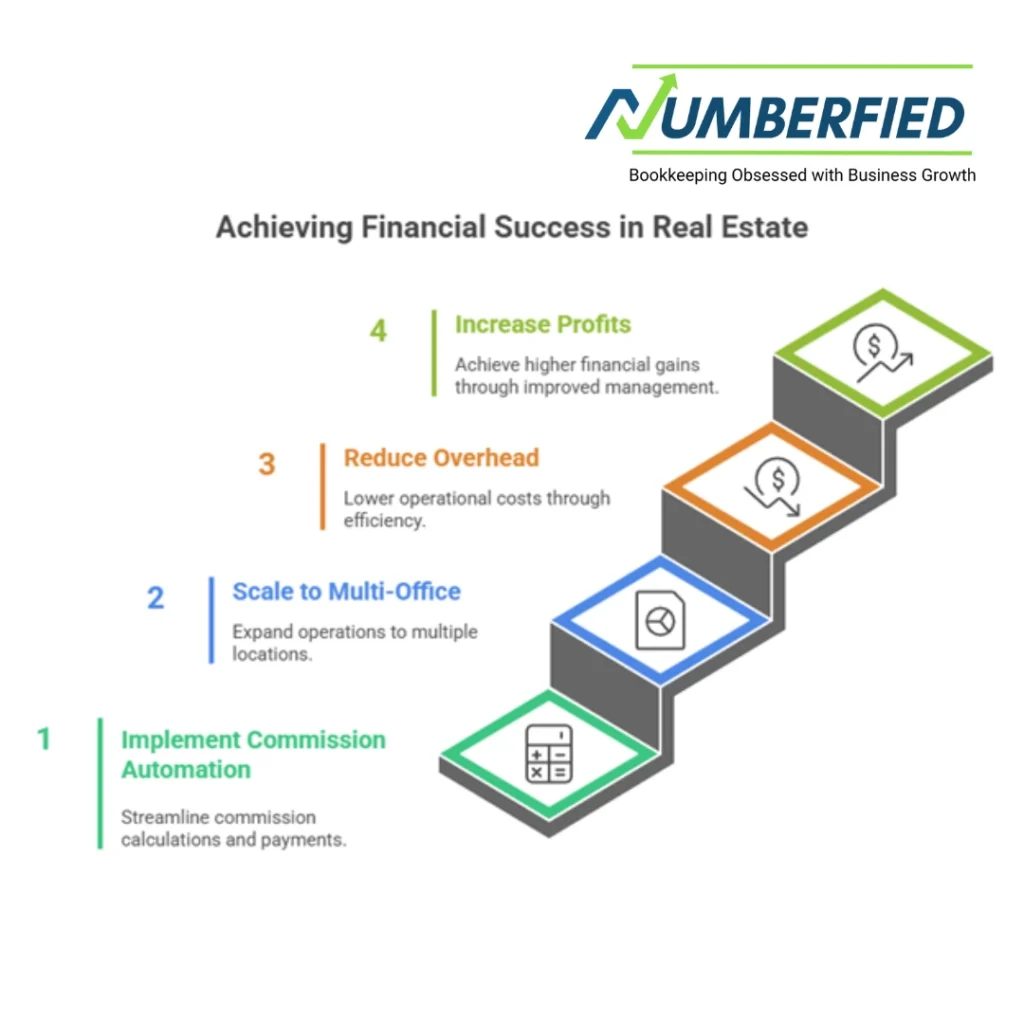
You now own a complete operating manual for bookkeeping for real estate brokerage- from commission automation to multi-office scaling. Implement one section this week. Add another next week. Watch overhead drop and profits rise.
The Numberfied team runs these exact playbooks for brokerages nationwide. Ready to offload the details and focus on recruiting top producers? Visit https://numberfied.com/ and schedule a call. Let us keep the books perfect so you can keep the growth coming.
Read Also: Virtual Bookkeeping Services for Small Businesses That’ll Change Your Life!
FAQs
How do I handle desk fees in my books?
Record desk fees as income when invoiced, not when paid. Create a recurring invoice for each agent on the first of the month. Track aging to spot late payers quickly.
What if an agent leaves mid-month with pending closings?
Calculate prorated desk fees and commissions owed through departure date. Issue a final settlement statement. Remove card access and portal login the same day.
How do I account for E&O insurance paid annually?
Enter the full premium as a prepaid asset on the payment date. Amortize one-twelfth to expense each month. The balance sheet stays accurate all year.
Should transaction coordinators be employees or contractors?
Review IRS control tests- schedule, tools provided, and payment method. Classify correctly from the first paycheck to avoid back taxes and penalties.
How do I track sign installation and removal costs?
Create a fixed asset category for signs. Capitalize purchase and installation. Expense removal and disposal. Depreciate over useful life for tax benefits.
What reports help me set agent caps and tiers next year?
Pull closed volume and gross commission by agent for the past twelve months. Sort by production to identify top earners. Use the data to design fair, motivating plans.
How do I handle referral fees paid to outside brokers?
Record the gross commission first, then the referral as a separate expense line. Issue a 1099 if the recipient is not a corporation. Keep the referral agreement on file.
Can I deduct agent appreciation gifts?
Yes, up to IRS limits per person per year. Code to Agent Relations expense and keep receipts. Track totals to stay within deductible thresholds.
How do I close the books when I sell the brokerage?
Reconcile every account through closing date. Prepare final agent payouts and vendor payments. Deliver audited financials to the buyer for due diligence.
What if my state requires commission trust accounts?
Open a separate account for undistributed commissions. Deposit agent shares immediately after closing. Disburse only with written authorization. Reconcile monthly.