
Introduction: Why Bookkeeping for Real Estate Matters
Real estate businesses face unique cash flow patterns, regulatory requirements, and transaction types. Bookkeeping for real estate provides the foundation for accurate performance tracking, tax compliance, and confident business decisions. Whether you manage rental properties, renovate homes for resale, or operate a brokerage, a reliable bookkeeping system turns complex transactions into clear, actionable data. This article delivers industry-focused best practices, implementation steps, and tools to modernize your real estate bookkeeping and scale with confidence.
Effective bookkeeping for real estate is essential for property managers, investors, brokers, and developers who want clarity, profitability, and compliance. This guide offers practical financial guidance, industry insights, and actionable bookkeeping strategies tailored to real estate businesses. Read on to learn systems, workflows, and reporting techniques that make accounting accurate and decision-ready, and discover how Numberfied can simplify your bookkeeping for real estate operations.
Key Takeaways
- Bookkeeping for real estate requires a specialized chart of accounts and a clear separation of property-level finances.
- Consistent processes for rent, security deposits, and expense allocation reduce errors and audit risk.
- Leverage technology, monthly reconciliations, and standardized reporting to improve cash flow visibility.
- Tax preparation and compliance are simplified with organized records and timely bookkeeping practices.
- Numberfied provides tailored bookkeeping for real estate, so you can focus on growth and operations.
Understanding the Foundations of Bookkeeping for Real Estate
What makes real estate bookkeeping unique?
Real estate transactions involve multiple income streams, property-specific expenses, escrow activity, tenant funds, and long-term capital projects. Bookkeeping is distinct because it must:
- Track property-level performance separately.
- Manage tenant security deposits and escrow obligations.
- Differentiate between capital improvements and repairs.
- Handle mortgage interest, principal payments, and property taxes accurately.
Core accounting principles to apply
Applying consistent accrual or cash accounting principles is critical. Bookkeeping should include documented policies for revenue recognition, capitalization thresholds, and depreciation schedules to ensure consistent financial statements and tax reporting.
Setting up a real estate-friendly chart of accounts
Create a chart of accounts tailored to property management, investment properties, or development projects. Key categories should include rental income, lease incentives, maintenance expenses, property management fees, mortgage and loan accounts, property taxes, insurance, utilities, and capex. A specialized chart of accounts is foundational for accurate real estate bookkeeping.
Property-Level Accounting and Segregation
Why property-level accounting matters
Property-level accounting ensures you can analyze profitability by property, not just at the company level. Bookkeeping for real estate that breaks out income and expenses by property enables better pricing, portfolio optimization, and investor reporting.
How to structure property-level ledgers
Use separate classes, departments, or sub-ledgers for each property within your accounting system. Assign lease income, maintenance costs, and capital expenditures to the relevant property to maintain clean records.
Best practices for tenant and escrow accounts
Maintain separate liability accounts for tenant security deposits and escrow funds. Bookkeeping for real estate requires clear policies for holding and disbursing tenant funds to avoid commingling and to comply with local laws.
Revenue Recognition and Rent Accounting
Recording rent and lease income
Record rent using consistent criteria tied to lease agreements. For accrual-basis real estate bookkeeping, recognize rent when earned, even if not yet collected. Track lease incentives, allowances, and rent concessions separately to maintain clarity.
Handling prepaid rent and concessions
Prepaid rent should be recorded as a liability and recognized as income over the period it covers. Concessions should be properly amortized and not hidden in other expense lines. Clear bookkeeping for real estate ensures accurate net operating income calculations.
Managing late fees, NSF charges, and other tenant income
Late fees, returned check fees, and other supplemental tenant charges should be coded to distinct revenue accounts in your real estate bookkeeping system to enable analysis of tenant behavior and additional income streams.
Expense Tracking and Categorization
Routine vs. capital expenses
Differentiate repairs and maintenance (expense) from capital improvements (capitalized). Establish a capitalization threshold aligned with tax strategy and document depreciation schedules. Proper bookkeeping ensures tax efficiency and accurate asset valuation.
Vendor management and accounts payable
Implement standardized vendor onboarding, purchase order controls, and invoice approval workflows to ensure accurate accounts payable. Use coding templates to ensure consistent expense categorization across properties.
Allocating shared expenses across properties
When expenses benefit multiple properties, such as regional marketing or corporate insurance, use allocation keys like square footage, revenue, or unit count. Accurate allocation is a critical element of real estate bookkeeping that preserves fairness and analytical value.
Cash Flow Management and Forecasting
Building a monthly cash flow model
Create a rolling 12-month cash flow forecast that includes rent collections, operating expenses, mortgage payments, capital projects, and reserves. Bookkeeping provides the historical data needed to populate and refine forecasts.
Managing seasonal fluctuations
Recognize seasonal patterns in occupancy, leasing activity, and maintenance. Use cash reserves and contingency planning informed by real estate bookkeeping to smooth operational disruptions.
Preparing for capital projects
Budget capital projects with clear timelines and funding sources. Track project costs against budgets in your bookkeeping for real estate system to avoid overruns and to provide accountability to investors or lenders.
Technology and Automation in Bookkeeping for Real Estate
Selecting the right accounting software
Choose property-focused accounting software that supports property-level tracking, lease management, and integrated payment processing. Integration capability with banking, payment platforms, and property management systems is essential.
Automating rent collection and reconciliations
Use automated payment and bank feed reconciliation to reduce manual entry and accelerate month-end close. Automation improves bookkeeping accuracy in real estate and frees team members for analysis rather than data entry.
Integrations and data syncs
Integrate your property management platform, CRM, and banking systems with your accounting software to ensure seamless data flow. Automated integrations reduce errors and improve the timeliness of bookkeeping for real estate records.
Monthly Close and Financial Reporting
Establishing a monthly close checklist
A consistent monthly close reduces errors and provides timely insights. Typical steps in bookkeeping for real estate monthly close include reconciling bank accounts, posting rent, reviewing A/P and A/R, recording accruals and depreciation, and preparing property-level income statements.
Key reports landlords and investors need
Prepare profit and loss statements by property, consolidated P&L, balance sheet, cash flow statements, variance reports, and capital project reports. Bookkeeping for real estate that outputs clear, investor-ready reports builds trust and supports decision-making.
Using KPIs to monitor performance
Track occupancy rates, rent per unit, operating expense ratio, net operating income (NOI), and cash-on-cash return. Real estate bookkeeping should produce reliable data that feeds these KPIs each month.
Tax Preparation and Compliance
Organizing records for taxes
Keep detailed records of income, expenses, depreciation schedules, and capital expenditures. Up-to-date bookkeeping for real estate simplifies tax preparation and reduces the risk of missed deductions or audit issues.
Understanding deductible expenses
Common deductible expenses include repairs, maintenance, property management fees, insurance, mortgage interest, and property taxes. Clear classification in real estate bookkeeping ensures accurate tax filings.
Preparing for audits and lender reporting
Maintain supporting documentation for large transactions, tenant deposits, and capital projects. Well-documented real estate bookkeeping reduces audit friction and meets lender reporting requirements.
Scaling Operations and Portfolio Growth
Standardizing processes across properties
As your portfolio grows, standardize the chart of accounts, vendor lists, and reporting templates. Standardization is central to scalable bookkeeping operations.
Centralized vs. decentralized bookkeeping models
Evaluate whether centralized bookkeeping (one team handling all properties) or decentralized (property-level bookkeepers) fits your organization. Both approaches can work when supported by consistent policies and technology that enable real estate bookkeeping for visibility.
Preparing investor-ready financials
Investor reporting requires transparency and consistency. Bookkeeping for real estate that produces timely, audited-friendly financials increases investor confidence and helps secure capital for growth.
Risk Management and Internal Controls
Mitigating fraud and errors
Implement segregation of duties, approval hierarchies, and bank reconciliation reviews. Regular audits and spot checks are important controls in real estate bookkeeping to protect cash and maintain accurate records.
Insurance and liability considerations
Maintain appropriate insurance documentation linked to property records. Bookkeeping for real estate should reflect insurance premiums, claims, and recoveries consistently.
Data security and privacy
Secure tenant and financial data with access controls and encrypted storage. Bookkeeping for real estate increasingly relies on cloud platforms, so prioritize vendors with strong security practices.
Implementing Bookkeeping for Real Estate: Step-by-Step
Step 1: Assess current state
Document existing processes, systems, and pain points. Identify gaps in property-level tracking, reconciliations, and reporting that real estate bookkeeping needs to address.
Step 2: Design a tailored chart of accounts
Create a property-centric chart of accounts aligned with your portfolio structure. Ensure capitalization thresholds and depreciation methods are documented to ensure consistent real estate bookkeeping.
Step 3: Adopt tools and automate
Select software that integrates with property management systems and automates routine entries. Set up bank feeds and recurring transactions to streamline real estate bookkeeping.
Step 4: Train your team and document policies
Provide clear SOPs for coding, vendor approvals, tenant funds, and monthly close activities. Documentation reduces errors and ensures continuity in bookkeeping for real estate operations.
Step 5: Monitor, refine, and scale
Review KPIs and reports monthly, refine processes, and plan capacity for growth. Continuous improvement in real estate bookkeeping keeps information actionable.
How Numberfied Supports Bookkeeping for Real Estate
Tailored bookkeeping workflows
Numberfied specializes in real estate bookkeeping by designing processes that align with your portfolio structure and reporting needs. We align charts of accounts, reconciliations, and month-end procedures to your business model.
Technology-enabled automation
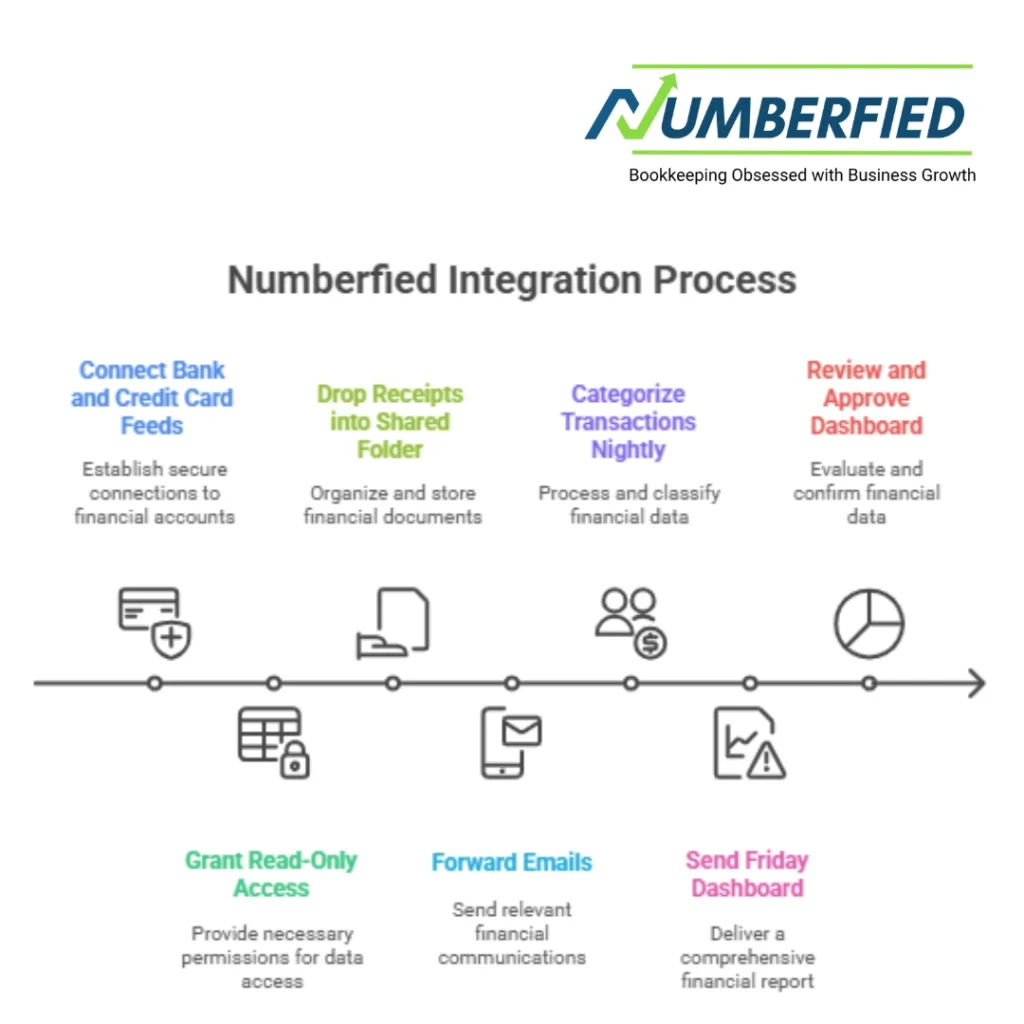
We integrate property management systems, bank feeds, and payment platforms to automate routine bookkeeping for real estate tasks, reducing manual entry and closing times.
Actionable reporting and advisory
Numberfied delivers property-level financials and KPIs that help you make better decisions. Our bookkeeping for real estate services includes insights to improve cash flow, control costs, and prepare for capital projects.
Common Bookkeeping for Real Estate Mistakes and How to Avoid Them
Mixing personal and property funds
Commingling owner funds with property accounts can cause reporting inaccuracies and create legal problems. Maintain separate accounts for each property and for owner distributions within each estate’s bookkeeping systems.
Failing to track capital projects
Not properly tracking capex leads to misstated assets and taxable income. Use project codes and budgets in your real estate bookkeeping to capture every cost.
Skipping monthly reconciliations
Without reconciliations, errors compound. Reconcile bank accounts and tenant ledgers monthly to keep bookkeeping for real estate accurate and timely.
Case Studies and Practical Examples
Multi-family portfolio streamlines month-end
A multi-family operator reduced close time by implementing a property-level chart of accounts and automating rent feeds. Bookkeeping for real estate improvements led to faster investor reporting and fewer reconciliation issues.
Single-property investor improves NOI tracking
An investor adopted standardized expense codes and monthly variance reporting, enabling clearer cost control and more accurate net operating income measurement through improved real estate bookkeeping.
The developer manages construction costs
A developer used project-based bookkeeping to monitor budgets and vendor payments. Better bookkeeping for real estate enabled timely schedule adjustments and preserved margins during construction.
Conclusion
Bookkeeping for real estate is more than compliance; it’s a strategic tool that uncovers profitability, supports growth, and reduces risk. By adopting property-level accounting, automating repetitive tasks, and standardizing reporting, real estate businesses gain the clarity needed to scale. If you’re ready to transform your bookkeeping for real estate and free your team to focus on operations and investments, contact Numberfied. Our specialized bookkeeping for real estate services is designed to deliver accurate financials, timely insights, and peace of mind.
Contact Numberfied today to optimize your real estate bookkeeping and unlock clearer financial performance.
Read Also: Why Numberfied’s Bookkeeping Accounting Service Is Your Small Business’s Secret Weapon
FAQs
What is bookkeeping for real estate, and why is it different?
Bookkeeping for real estate focuses on property-level income and expenses, tenant funds, escrow accounts, and capital projects. It differs from general bookkeeping by emphasizing property-specific reporting, lease accounting, and the treatment of long-term assets.
Should I use cash or accrual accounting for my properties?
Choice depends on business needs. Accrual accounting provides a more accurate long-term view and is preferred for investor reporting and larger portfolios. Bookkeeping for real estate using accruals better captures earned income and obligations.
How do I handle tenant security deposits in bookkeeping?
Record security deposits as liabilities on the balance sheet until they are returned or applied. Proper bookkeeping for real estate separates these funds from operating cash to prevent commingling.
How often should I reconcile bank and tenant accounts?
Monthly reconciliations are recommended. For high-volume operations, consider more frequent reconciliations. Regular reconciliations are a core control in real estate bookkeeping.
What expenses should be capitalized vs. expensed?
Capitalize costs that improve or extend the life of a property (e.g., major renovations). Routine repairs and maintenance should be expensed. Establish a capitalization policy for real estate in your bookkeeping to ensure consistency.
Can bookkeeping software integrate with property management systems?
Yes. Many modern real estate bookkeeping solutions integrate with property management platforms to automatically sync rent, tenant charges, and vendor bills.
How does bookkeeping support tax preparation for property owners?
Accurate bookkeeping for real estate ensures deductible expenses are captured, depreciation schedules are maintained, and necessary documentation is organized for tax filing, reducing the risk of missed deductions or audit issues.
What KPIs should I track in my real estate bookkeeping?
Important KPIs include NOI, occupancy rate, rent per unit, operating expense ratio, and cash-on-cash return. Reliable real estate bookkeeping provides the data needed to calculate these metrics monthly.
When should I consider outsourcing bookkeeping for real estate?
Outsource when volume, complexity, or compliance demands exceed internal capacity, or when you want faster close cycles and higher-quality reporting. Specialized providers like Numberfied focus on real estate bookkeeping to streamline operations.
How do I prepare my real estate bookkeeping for investor or lender review?
Maintain consistent, property-level financial statements, supporting documentation for major transactions, and a clear audit trail for expenses and capital projects. Regular, accurate bookkeeping for real estate builds credibility with investors and lenders.
Read Also: 7 Insider Tips to Simplify Your Finances with QuickBooks Bookkeeping Services for Small Businesses