

Introduction
Real estate professionals face unique accounting demands. Tailored bookkeeping packages for realtors streamline transaction tracking, protect margins, and keep compliance current so you can focus on clients and growth. This guide explains benefits, challenges, compliance expectations, provider selection, tools, tax preparation, onboarding, and ROI, plus actionable tips to choose the right package.
Quick Takeaways
- Bookkeeping for realtors centralize trust accounting, commissions, expenses, and reconciliations.
- They reduce costs, deliver expert financial oversight, and scale with your brokerage or solo practice.
- Select providers with real estate experience, strong security controls, and integration with QuickBooks or Xero.
- Expect streamlined tax prep, better decision-making, and measurable ROI within a few months.
Why Realtors Need Specialized Bookkeeping Packages
Complex Revenue Streams
Real estate revenue includes commissions, referral fees, rental income, and ancillary services. Bookkeeping packages classify income correctly for accurate profit analysis and tax reporting.
Frequent Trust and Escrow Transactions
Trust accounts and escrow hold client funds that require meticulous tracking. A dedicated bookkeeping package for realtors enforces ledger-level controls and reconciliations to reduce errors and legal exposure.
High Transaction Volume and Seasonality
Seasonal listings and clustered closings create transaction spikes. Scalable bookkeeping packages handle variable volume without sacrificing accuracy or timeliness.
Core Benefits of Bookkeeping Packages for Realtors
Cost Savings and Predictable Pricing
Fixed-fee bookkeeping packages convert variable labor costs into predictable monthly expenses. Predictability helps with cash flow planning and reduces the need for in-house hiring during peak season.
Expertise and Real Estate-Specific Knowledge
Specialized packages come with chart-of-accounts templates, reporting formats, and reconciliations designed for real estate transactions. This reduces misclassifications that can complicate tax filings and financial insights.
Scalability and Flexibility
As your team or transaction volume grows, bookkeeping packages scale services, adding payroll, merchant processing reconciliation, or trust account oversight without disrupting operations.
Core Business Focus
When your team does not manage books, agents and managers can concentrate on client acquisition, listings, and transactions. Outsourced bookkeeping packages for realtors free internal resources for revenue-generating activities.
Common Challenges and How to Address Them
Data Privacy and Security
Handling client financial data requires robust security. Choose bookkeeping packages for realtors that use encrypted transfers, role-based access, and SOC 2 or equivalent compliance to mitigate breaches.
System Integration and Data Consistency
Integrations with MLS platforms, CRM systems, and bank feeds are essential. The best bookkeeping packages for realtors offer API-ready workflows and scheduled imports to maintain consistent ledgers.
Oversight and Control
Outsourcing requires governance. Implement review cycles, approval workflows, and monthly management reporting as part of bookkeeping packages for realtors to retain control and oversight.
U.S. Compliance: IRS, GAAP, and Real Estate-Specific Rules
IRS Reporting Requirements
Bookkeeping packages for realtors must support W-2, 1099-NEC, 1099-MISC, and Schedule C reporting. Accurate categorization of commissions, benefits, and contractor payments prevents penalties and audits.
GAAP Considerations for Brokerages
Brokerages that prepare financial statements should follow GAAP recognition and disclosure rules. Bookkeeping packages for realtors can produce accrual-based statements, track deferred revenue, and provide standardized disclosures.
Trust Account Compliance and State Regulations
State bar or real estate commission rules often dictate trust accounting procedures. Bookkeeping packages for realtors include reconciliation templates and audit trails to demonstrate compliance with escrow and fiduciary obligations.
Choosing a Provider: What to Look For
Industry Experience and References
Prefer bookkeeping packages for realtors from providers with proven real estate clientele. Ask for case studies, testimonials, and references that show success with brokerages and solo agents.
Technology and Integration Capability
Verify compatibility with QuickBooks, Xero, MLS exports, CRM systems, and bank feeds. The most valuable bookkeeping packages for realtors automate imports and reduce manual entry.
Security, SLAs, and Service Levels
Confirm security certifications, data retention policies, and service-level agreements. Bookkeeping packages for realtors should guarantee response times, error resolution, and monthly close timelines.
Custom Reporting and KPI Dashboards
Choose bookkeeping packages for realtors that provide custom reports, commission reconciliations, per-agent profitability, cash flow forecasts, and listing-level performance to support decision-making.
Accounting Tools: QuickBooks, Xero, and Complementary Software
QuickBooks Online for Real Estate
QuickBooks Online integrates well and supports classes, locations, and custom charts commonly used in real estate bookkeeping packages. It’s often the backbone for many provider offerings.
Xero as an Alternative
Xero offers robust bank feeds and collaboration features. Bookkeeping packages for realtors built on Xero are attractive for firms wanting straightforward reconciliation and multi-user access.
Complementary Tools: CRMs, MLS Feeds, and Payment Platforms
Pair bookkeeping packages for realtors with CRMs and payment platforms to capture commissions, referrals, and fees automatically. Integration reduces reconciliation time and error rates.
Tax Preparation and Year-End Services
Accurate Records for Tax Filing
Bookkeeping packages for realtors that maintain consistent charts and categorized expenses simplify tax preparation. Clean books reduce CPA hours and associated costs.
Preparation of 1099s and Payroll Filings
Packages can include payroll reconciliation and 1099 preparation for independent contractors. Ensuring correct contractor classification is a key service within bookkeeping packages for realtors.
Audit Support and Documentation
In the event of an audit, bookkeeping packages for realtors should provide organized documentation, supporting schedules, and a liaison to your tax preparer to expedite resolution.
Onboarding and Implementation Best Practices
Discovery and Chart of Accounts Setup
Effective onboarding for bookkeeping packages for realtors begins with a discovery session to design a chart of accounts that reflects commissions, referral fees, escrow, and operating expenses.
Data Migration and Cleanup
Migration includes opening balances, historical transactions, and clearing inconsistencies. Strong bookkeeping packages for realtors include a reconciliation phase to validate historic data before going live.
Training, Access Controls, and Ongoing Review
Provide agent and manager training on how bookkeeping packages for realtors receive documents, submit expenses, and request reports. Establish access controls and monthly review meetings to ensure alignment.
Measuring ROI from Bookkeeping Packages for Realtors
Cost-Benefit Analysis
Compare internal staffing costs to bookkeeping package fees for realtors, including error reduction and time savings. Factor in reduced CPA fees and improved cash flow management.
Operational Metrics to Track
Track days-to-close accounting, reconciliation error rates, time spent on payroll processing, and tax preparation hours saved to quantify the impact of bookkeeping packages for realtors.
Long-Term Financial Benefits
Accurate, timely books enable better pricing, commission management, and profitability analysis. Bookkeeping packages for realtors contribute to strategic planning and sustainable growth.
Practical Tips for Maximizing Value
Standardize Document Submission
Require agents and staff to submit receipts, invoices, and commission statements through a single portal. Consistent inputs make bookkeeping packages for realtors more efficient.
Schedule Regular Financial Reviews
Monthly reviews of P&L, balance sheet, and cash flow ensure issues are resolved promptly. Align realtor bookkeeping packages with these recurring checks for proactive management.
Use Automation Where Possible
Automate bank feeds, recurring transactions, and rule-based categorization. Automation is a core efficiency driver in modern real estate bookkeeping software.
How Numberfied Supports Realtors with Bookkeeping Packages
Real Estate-Focused Accounting Services
Numberfied delivers bookkeeping packages for realtors that include a specialized chart of accounts, trust account reconciliation, and commission tracking tailored to real estate operations.
Integration with Leading Platforms
Numberfied integrates with QuickBooks, Xero, major CRMs, and payment processors to streamline data flow and reduce manual reconciliation within realtor bookkeeping packages.
Dedicated Onboarding and Ongoing Support
Our onboarding includes discovery, data migration, and agent training. Ongoing support ensures bookkeeping packages for realtors remain aligned with regulatory and business changes.
Case Example: From Manual Books to Scalable Bookkeeping Packages
Initial Situation
A mid-size brokerage struggled with inconsistent commission posting, missed deductions, and long close times. They engaged bookkeeping packages for realtors to standardize processes.
Implementation Steps
We implemented a tailored chart of accounts, automated bank feeds, and a monthly reconciliation cadence. Agents adopted a single submission portal for documents.
Results and ROI
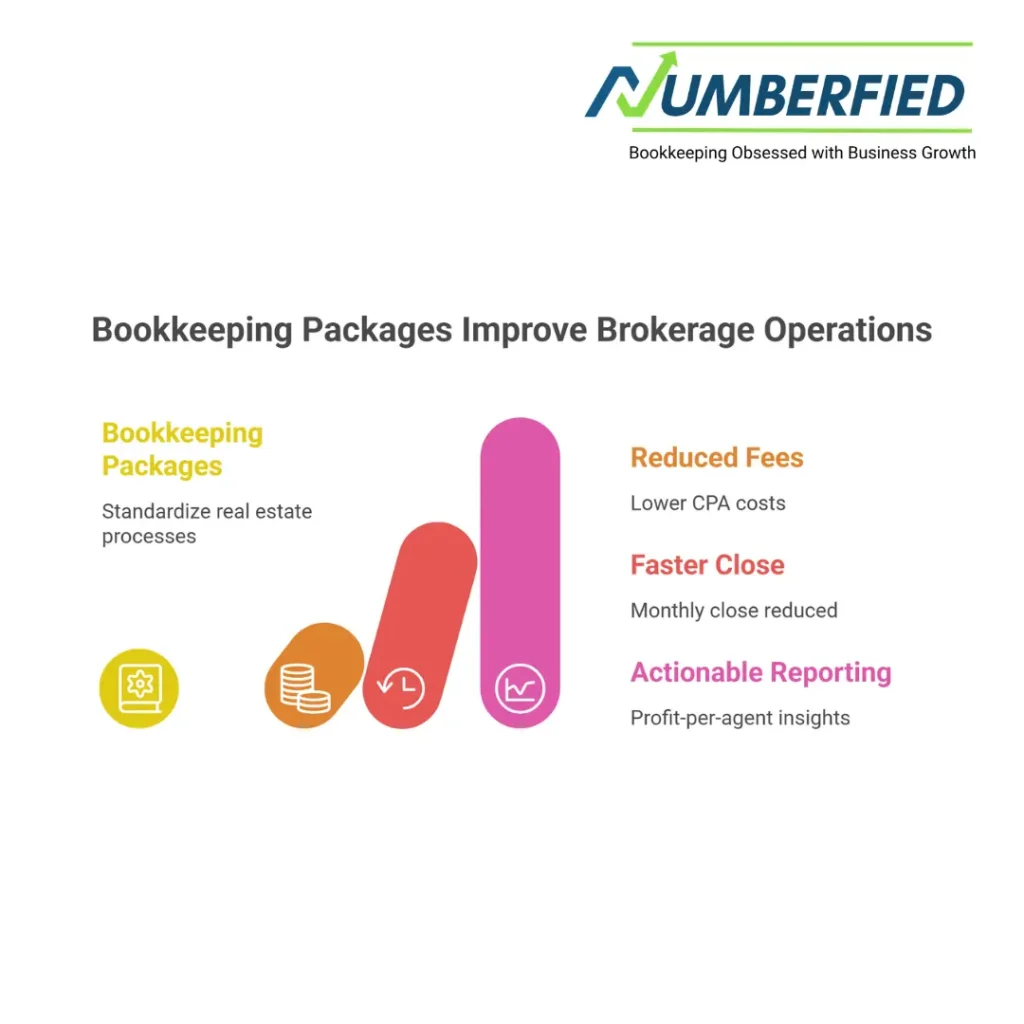
The brokerage reduced CPA fees, shortened the monthly close from 15 to 5 days, and gained actionable profit-per-agent reporting demonstrating the measurable value of bookkeeping packages for realtors.
Checklist: Selecting and Implementing Bookkeeping Packages for Realtors
Selection Criteria
- Real estate experience and references
- Integration with QuickBooks/Xero and CRM
- Security certifications and SLAs
Implementation Milestones
- Discovery session and chart of accounts design
- Data migration and historical reconciliation
- Training, role setup, and monthly review schedule
Monitoring and Improvement
- Track KPIs: reconciliation time, error rate, tax prep hours
- Quarterly process reviews and software updates
- Plan for scaling services as transaction volume grows
Conclusion
Bookkeeping packages for realtors deliver cost savings, domain expertise, scalability, and the ability to focus on core business activities while maintaining IRS and GAAP compliance. They mitigate trust accounting risks, enable cleaner tax preparation, and deliver measurable ROI by reducing errors and staff time. For brokerages and individual agents seeking an efficient, secure, and integrated bookkeeping solution, consider a provider with real estate experience, strong technology integrations, and clear service levels. Contact Numberfied to discuss bookkeeping packages for realtors tailored to your operations and to start a streamlined onboarding process that delivers fast value.
Frequently Asked Questions
What are bookkeeping packages for realtors?
Bookkeeping packages for realtors are specialized accounting services designed to manage real estate transactions, commissions, trust accounts, and related financial reporting. They provide structured financial records for tax and management purposes.
How much do bookkeeping packages for realtors cost?
Cost varies by transaction volume, services included, and platform integrations. Expect monthly fixed fees plus add-ons for payroll, tax filing, or intensive reconciliations. A cost-benefit analysis often shows quick payback.
Can bookkeeping packages for realtors handle trust accounts?
Yes. Leading bookkeeping packages for realtors include trust account reconciliation, audit trails, and state-specific compliance procedures to ensure fiduciary duties are met and documented.
Which software works best with bookkeeping packages for realtors?
QuickBooks Online and Xero are common foundations for bookkeeping packages for realtors. Providers also integrate CRMs, MLS platforms, and payment processors to streamline accounting processes.
How do these packages help with taxes?
They maintain clean, categorized records, prepare 1099s and payroll reconciliations, and provide year-end packages that reduce CPA time and audit risk simplifying tax preparation for realtors.
What security measures should I require?
Require encrypted data transfers, role-based access, regular backups, and industry certifications like SOC 2. These protections are standard expectations for bookkeeping packages for realtors handling sensitive information.
How long does onboarding take?
Onboarding duration depends on data volume and complexity. Typical timelines range from 2 to 8 weeks for migration, reconciliation, and training when adopting bookkeeping packages for realtors.
Will outsourcing reduce my internal control?
No, if you implement review cycles and approvals. Bookkeeping packages for realtors should include governance features, monthly reporting, and audit trails to preserve oversight and control.
Can small brokerages benefit from bookkeeping packages for realtors?
Yes. Small brokerages and solo agents benefit from predictable costs, expert classification, and reduced administrative burden. Packages scale to deliver appropriate service levels for smaller operations.
How do I evaluate ROI?
Measure reduced internal labor, lower CPA costs, faster monthly close, fewer reconciliation errors, and improved financial visibility. These metrics demonstrate the ROI of bookkeeping packages for realtors within months.
Read Also: Why Do Accountants Charge So Much? Exploring Accounting Firm CFO Services