

Introduction
For small to medium business owners, startups, entrepreneurs, sole proprietors, freelancers, and self-employed professionals, accurate and timely financial records are the foundation of smart decision-making, tax savings, and long-term success. Expert bookkeeping services go far beyond basic data entry; they deliver precise transaction handling, full compliance, strategic insights, and audit-ready books that protect you from penalties and position you to grow confidently.
In 2026, with IRS data-matching intensifying, deduction scrutiny rising, and cash flow remaining a top concern for most businesses, partnering with specialized bookkeeping experts has become one of the highest-ROI investments you can make. These professionals free you from administrative overload so you can focus on revenue generation, client relationships, product development, or simply enjoying the freedom you started your business for.
This guide covers the real benefits of expert bookkeeping services, compares in-house/DIY approaches to professional support, details the core services you should expect, highlights common mistakes to avoid, provides a step-by-step selection and onboarding process, reviews top specialized providers, examines key industry trends in 2026, and shows you exactly how to get started.
Key Benefits of Expert Bookkeeping Services
Expert bookkeeping services provide advantages that directly impact profitability, risk, and peace of mind.
Superior Accuracy & Compliance Assurance
Inaccurate records lead to wrong tax filings, missed deductions, and IRS penalties that can reach thousands of dollars. Expert bookkeeping services use standardized processes, automated matching, peer review, and advanced tools to achieve near-perfect accuracy. They keep you compliant with current IRS rules, state tax requirements, and payroll regulations, delivering audit-ready books backed by organized documentation and digital trails.
Maximized Deductions & Meaningful Tax Savings
Most self-employed individuals and small business owners under-claim deductions by 10–30% due to poor categorization or lack of awareness. Professional bookkeeping services systematically identify and document every allowable write-off: home office (simplified or actual), mileage or actual vehicle expenses, health insurance premiums, retirement contributions, business use of phone/internet, supplies, advertising, travel, meals (50%), and more. This precision often saves $2,000–$15,000+ annually, far more than the service cost.
Strategic Financial Insights for Growth
Clean books are useless if they don’t inform decisions. Expert bookkeeping for small businesses delivers monthly profit & loss statements, balance sheets, cash flow reports, gross margin analysis, breakeven point, and key performance indicators in easy-to-read dashboards. You see exactly which products, services, or clients are most profitable, where costs are creeping, and when cash flow will tighten, enabling better pricing, expense control, and investment timing.
Time Freedom for Core Activities
DIY bookkeeping or managing an in-house person can consume 10–25 hours per month. High-quality outsourced bookkeeping eliminates that burden, giving you back time for sales calls, client delivery, marketing, product creation, or simply taking a break. Many owners report reclaiming an entire workday per week once the service is fully implemented.
Audit-Ready Books & Reduced Stress
The IRS audits self-employed and small business returns at higher rates than W-2 filers, often targeting Schedule C deductions and 1099 income. Premium bookkeeping solutions maintain meticulous records, digital receipt files, mileage logs, and supporting documentation so you’re prepared if questioned. Many providers include audit coordination or representation support, removing a major source of anxiety.
In-House/DIY vs. Professional Expert Bookkeeping Services Comparison
Most businesses start with DIY tools or in-house efforts, but professional expert bookkeeping services usually outperform both in accuracy, savings, and scalability.
Cost Comparison
DIY software (QuickBooks Self-Employed, Wave, FreshBooks) costs $15–$50/month but requires your time and carries a high error risk. In-house bookkeeping averages $45,000–$75,000/year, including salary, benefits, taxes, software, and training. Professional expert bookkeeping services typically cost $500–$2,500/month ($6,000–$30,000/year), often saving more in tax deductions and penalty avoidance than the fee itself.
Accuracy & Expertise Level
DIY relies on your knowledge. Common errors include wrong deduction classification, missed QBI, or improper vehicle tracking. In-house staff gain company-specific knowledge but rarely have broad tax expertise. Expert bookkeeping services bring certified professionals (often CPAs, EAs, or QuickBooks ProAdvisors) who specialize in small business and self-employment rules, delivering higher consistency and fewer mistakes.
Time & Stress Savings
DIY and in-house demand ongoing attention. Professional services offload the work completely, with real-time dashboards so you stay informed without doing the heavy lifting. The mental bandwidth reclaimed is often the most valuable outcome.
Compliance & Audit Protection
DIY increases audit risk; in-house can be accurate but lacks external objectivity. Expert bookkeeping services include organized documentation, quarterly estimate calculations, and often audit representation or coordination, significantly lowering risk.
Essential Services in Expert Bookkeeping Services
The highest-quality expert bookkeeping services cover these core areas with precision and proactivity.
Precise Transaction Categorization & Coding
Every bank, credit card, and payment processor transaction is imported, categorized correctly (deductible vs. non-deductible), and coded to your chart of accounts with custom rules. This ensures accurate profit & loss reporting and maximum deduction capture.
Bank & Credit Card Reconciliations
Monthly full reconciliations for every account, investigating discrepancies, eliminating duplicates, and clearing reconciled items. This keeps books accurate and catches bank errors early.
Accounts Payable & Vendor Bill Management
Entry of vendor bills, matching to purchase orders (if used), coding correctly, scheduling payments, and executing bill pay. This reduces late fees and captures early-payment discounts.
Accounts Receivable & Invoicing Support
Creating and sending invoices (recurring or one-off), tracking open receivables, sending polite follow-up reminders, and recording payments. Many integrate with invoicing tools for automation.
Monthly Financial Statements & Reporting
Compilation of clean monthly trial balances, profit & loss statements, balance sheets, and cash flow reports. Specialized bookkeeping experts often include variance analysis, key ratio tracking, and custom dashboards.
Sales Tax, 1099 & Basic Compliance Support
Tracking sales tax liability by jurisdiction, preparing 1099 information for vendors/contractors, and flagging compliance deadlines. While the service does not prepare or sign tax returns, it delivers organized books that make tax season faster for your CPA/EA.
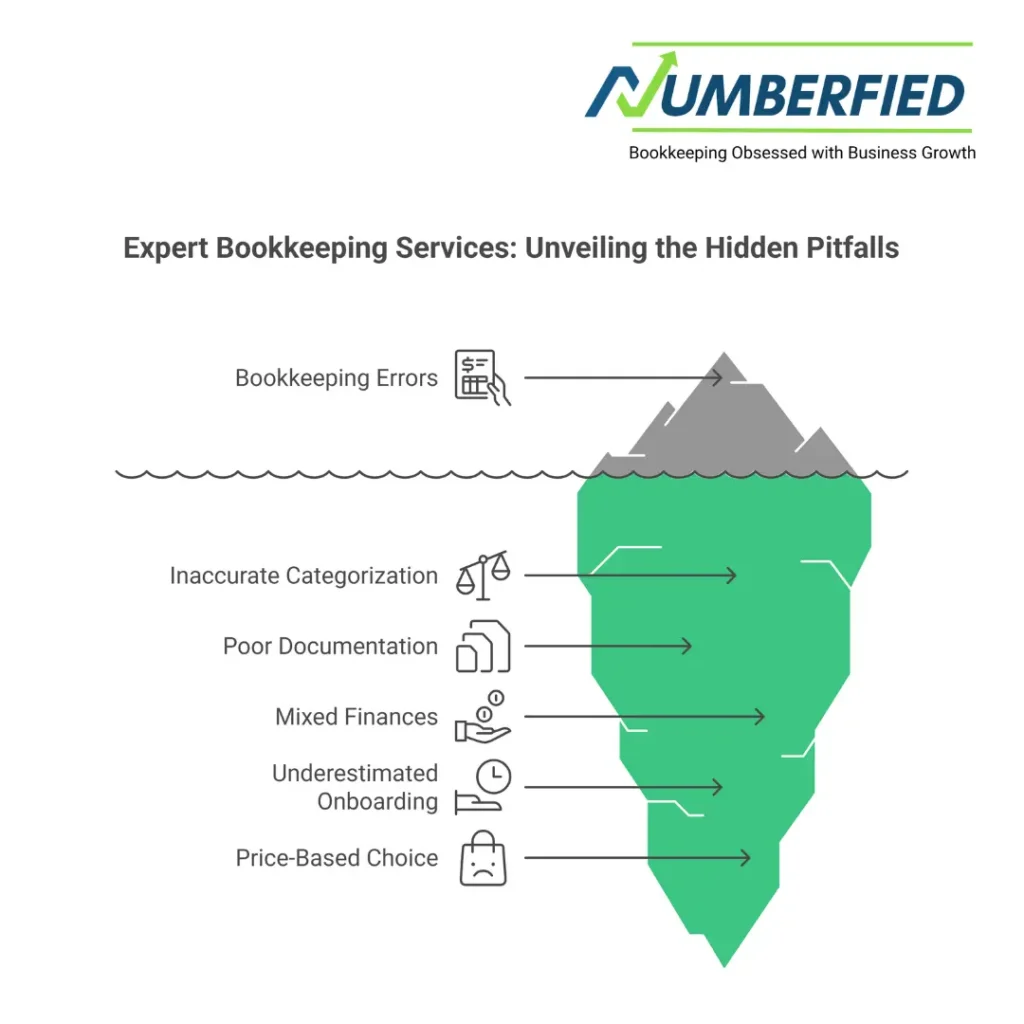
Common Mistakes to Avoid with Expert Bookkeeping Services
Even with professional help, these errors can reduce value or create problems.
Inaccurate or Inconsistent Categorization
Misclassifying expenses (personal vs. business, deductible vs. non-deductible) creates tax issues. Insist on clear categorization rules and monthly reviews with your expert bookkeeping services provider.
Poor Documentation & Receipt Management
The IRS requires substantiation for deductions. Use receipt-scanning apps and maintain digital folders so your professional bookkeeping services can produce records instantly if audited.
Mixing Personal & Business Finances
Using personal accounts for business expenses creates chaos and disallowed deductions. Open dedicated business checking and credit cards from day one.
Underestimating Onboarding Time
Expecting instant perfection after handover delays results. Create a thorough onboarding folder with a chart of accounts, prior year data, recurring bills, and key processes before the service begins.
Choosing Based on Price Alone
The cheapest provider may skip reviews, use outdated methods, or lack expertise. Focus on value: accuracy, communication, technology, and compliance support in expert bookkeeping services.
Step-by-Step Guide to Selecting & Onboarding Expert Bookkeeping Services
Follow this process to find and integrate the right provider.
Step 1: Define Your Bookkeeping Needs & Goals
List must-have tasks (transaction entry, reconciliations, bill pay, invoicing, reporting), desired reporting frequency, and any compliance concerns (sales tax, 1099s, quarterly estimates). Set goals: time saved, deduction increase, and audit readiness.
Step 2: Set a Realistic Budget
Budget $500–$2,500/month for professional Expert bookkeeping services . Simple situations may spend $500–$1,000; complex businesses with inventory, payroll, or multi-state sales tax often need $1,200–$2,500 for full support.
Step 3: Research Certified & Specialized Providers
Look for QuickBooks Online ProAdvisors, Xero Certified Advisors, CPAs, or EAs with strong reviews on Google, G2, Capterra, or industry forums. Prioritize providers specializing in small business, self-employment, or your industry.
Step 4: Evaluate Technology Stack & Security
Ensure current cloud software (QuickBooks Online, Xero, Wave) with bank feeds, receipt scanning, and secure portals. Verify SOC 2 compliance or similar security standards and cyber-insurance.
Step 5: Compare Pricing, Packages & Value
Request detailed proposals from 3–5 providers. Compare inclusions (reconciliations, reporting, support hours), fee structure (monthly fixed, hourly, or hybrid), and extras (audit support, tax coordination).
Step 6: Check References & Communication
Ask for client references or case studies. Schedule consultations to assess responsiveness, clarity, and whether they understand your business model and goals.
Step 7: Start with a Trial or Limited Engagement
Many providers offer a discounted first month or single-quarter engagement. Use this to test accuracy, communication, and overall value before committing long-term.
Key industry trends in 2026:
- AI-enhanced categorization and anomaly detection reduce manual review by 60–80%
- Advanced compliance tools (automated sales tax tracking, 1099-K reconciliation, estimated tax alerts)
- Real-time advisory integration (dashboards with action items for CPAs or owners)
- Cybersecurity focus (SOC 2 Type II mandatory, zero-knowledge encryption options, regular penetration testing)
- Increased demand for ESG/sustainability tracking as more businesses pursue green certifications or impact funding
Conclusion
Expert bookkeeping services give small to medium business owners, startups, entrepreneurs, sole proprietors, freelancers, and self-employed professionals superior accuracy, maximized deductions, penalty avoidance, audit-ready books, and clear financial insights that protect earnings and fuel growth. By avoiding common mistakes and following a structured selection process, you can find a partner that becomes one of your most valuable assets. As IRS enforcement, AI tools, and compliance demands evolve in 2026, professional support becomes even more essential.
Ready to eliminate financial stress and keep more of what you earn? Request a free consultation or quote today from a trusted expert bookkeeping services provider and take control of your financial future.
FAQ
How much do expert bookkeeping services cost for small businesses?
Expert bookkeeping services typically cost $500–$2,500 per month in 2026, depending on transaction volume and scope. Basic monthly support starts around $500–$1,000, while full-service packages (reconciliations, reporting, advisory) range from $1,200–$2,500+.
Are expert bookkeeping services worth it for small businesses and freelancers?
Yes, they’re worth it for most businesses earning $50,000+ annually. Expert bookkeeping services save time, uncover thousands in deductions, prevent penalties, and provide audit-ready books, usually delivering more tax savings and clarity than the fee costs.
What services are included in expert bookkeeping services?
Typical packages include precise transaction categorization, bank/credit card reconciliations, accounts payable & receivable management, monthly financial statements, sales tax & 1099 support, and basic advisory. Many also handle bill pay, invoicing, and payroll if needed.
How do I choose the best expert bookkeeping services provider?
Look for QuickBooks ProAdvisors, Xero Certified Advisors, or CPAs with strong reviews, cloud software proficiency, transparent fixed-fee pricing, and audit support. Request a consultation, sample reports, and references to ensure fit for your business.
How do expert bookkeeping services differ from basic bookkeepers or DIY tools?
Basic bookkeepers or DIY software focus on simple entry and categorization; expert bookkeeping services add compliance checks, deduction optimization, audit-ready documentation, monthly reporting, and strategic insights. They deliver cleaner books and more tax savings.
Is my data secure with expert bookkeeping services?
Yes, reputable expert bookkeeping services use bank-level encryption, two-factor authentication, secure client portals, and regular backups. Look for SOC 2 compliance or similar certifications, and use accountant-specific read-only access instead of full bank logins.
What are the latest trends in expert bookkeeping services for 2026?
Trends include AI-enhanced categorization and anomaly detection (reducing manual review by 60–80%), advanced compliance tools for sales tax & 1099-K rules, real-time advisory dashboards, and stronger cybersecurity standards (SOC 2 Type II, zero-knowledge encryption).
What are red flags when evaluating expert bookkeeping services providers?
Red flags include very low prices, vague scope descriptions, no certifications or references, reluctance to do a paid test task, poor communication during consultation, hidden fees, and lack of audit support or security certifications.
How can I get started with expert bookkeeping services?
Define your must-have tasks and monthly budget, research providers with strong reviews and certifications, request detailed proposals, and assign a small paid test task. Many offer free consultations or discounted first months. Schedule one today to simplify your books.
Are expert bookkeeping services suitable for different business sizes and types?
Yes, they work well for freelancers (10–20 hours/month, basic categorization & reporting), small teams (20–40 hours, full AP/AR), and growing SMBs (40+ hours, inventory/COGS, advisory). The service scales to match your size, industry, and complexity.
Read Also: Virtual Bookkeeping Services for Small Businesses That’ll Change Your Life!