

Introduction
Choosing the right online bookkeeping service transforms financial management from a time sink into a growth engine. This guide explains the benefits, challenges, compliance requirements, tools, selection criteria, onboarding best practices, and how to measure ROI. It also explains how Numberfied supports US business owners with compliant bookkeeping and timely tax preparation. Accurate, timely books drive better decisions, reduce tax risk, and free leaders to focus on strategy. An online bookkeeping service provides remote expertise that aligns with US regulations and modern accounting tools.
Bullet Takeaways
- An online bookkeeping service saves money, provides expertise, and scales with your business.
- Key challenges include security, integration, and maintaining oversight; strong contracts and controls mitigate risk.
- Select providers who understand IRS rules and GAAP, and who integrate with QuickBooks or Xero.
- Onboarding and clean-up are critical; expect an initial surge of work followed by steady reporting.
- Measure ROI by time saved, reduced tax exposure, and improved decision-making.
Benefits of an Online Bookkeeping Service
Cost Savings and Predictable Pricing
Outsourcing to an online bookkeeping service typically reduces labor costs compared with hiring in-house staff. Fixed monthly plans replace unpredictable payroll expenses and benefits, and many providers bundle software licensing, backups, and routine reconciliations into one predictable fee.
Access to Expertise and Best Practices
An online bookkeeping service brings professionals familiar with industry-specific accounting practices, chart-of-accounts design, and IRS expectations. That expertise reduces classification errors, improves financial statements, and supports cleaner tax preparation.
Scalability and Operational Flexibility
As companies grow or contract, an online bookkeeping service scales resources up or down without hiring cycles. This elasticity supports seasonal businesses and rapid growth while maintaining continuity of accounting processes.
Operational Focus: Freeing Leadership for Core Work
More Time for Strategy and Sales
Handing transactional accounting to an online bookkeeping service lets business owners concentrate on sales, product development, and customer experience areas that directly affect revenue.
Standardized Reporting for Better Decisions
Consistent, timely reports from an online bookkeeping service provide reliable inputs for forecasting, budgeting, and performance management.
Delegated Compliance Responsibilities
The provider handles routine reconciliations and supports tax preparation, reducing administrative burdens and minimizing surprises during tax season.
Challenges and Risks of Online Bookkeeping Service Engagements
Privacy and Data Security
Sharing sensitive financial data with an online bookkeeping service raises privacy concerns. Mitigate risk by verifying encryption practices, data access controls, and secure storage policies.
Integration with Existing Systems
Seamless integration with point-of-sale, payroll, and banking systems is essential. Confirm that the online bookkeeping service has experience linking your specific tools and can maintain automated data flows.
Maintaining Oversight and Internal Controls
Outsourcing does not eliminate the need for internal oversight. Establish approval workflows, periodic review meetings, and segregation of duties to retain control over financial operations.
US Compliance: IRS, GAAP, and State Requirements
IRS Expectations and Documentation
An online bookkeeping service should maintain documentation that supports deductions, income recognition, and asset records. Proper categorization and retention policies minimize audit risk and facilitate explanations if the IRS requests verification.
Adherence to GAAP and Accounting Policies
For entities required to follow Generally Accepted Accounting Principles, an online bookkeeping service must prepare statements that comply with GAAP conventions and disclosure rules. Ensure the provider understands accrual vs. cash basis reporting and adjusting entries.
State-Level Sales Tax and Registration
Sales tax rules vary by state and product. An online bookkeeping service must be prepared to record sales tax appropriately, track nexus thresholds, and support filings or provide data for state returns.
Selecting the Right Online Bookkeeping Service
Evaluate Industry Experience
Seek providers with experience in your industry. Niche knowledge reduces startup friction, improves account mapping, and anticipates common expense classifications and revenue recognition issues.
Check Certifications and References
Certifications such as QuickBooks ProAdvisor, Xero Advisor, or CPA affiliations indicate technical competence. Request client references and case studies that demonstrate reliable delivery and measurable outcomes.
Review Service Level Agreements and Escalation Paths
Carefully review response times, deliverable schedules, confidentiality clauses, and escalation procedures. A clear SLA reduces downtime and sets expectations for bookkeeping cadence and issue resolution.
Tools and Integrations: QuickBooks, Xero, and Beyond
QuickBooks and Xero as Core Platforms
Most online bookkeeping service providers work extensively with QuickBooks Online and Xero. These platforms provide secure cloud access, audit trails, and app marketplaces for add-ons like payroll, inventory, and payment processing.
Integrating Payroll, Banking, and POS Systems
Confirm the online bookkeeping service can connect payroll providers, bank feeds, and point-of-sale systems to minimize manual data entry and reconciliation. Automation reduces errors and shortens close cycles.
Data Backup, Versioning, and Audit Trails
Ensure the provider maintains backups and preserves audit trails. A reliable online bookkeeping service documents adjustments, who made changes, and why, which is essential for audits and financial transparency.
Tax Preparation and Year-End Coordination
Preparing Clean Books for Tax Filing
An online bookkeeping service prepares accrual reconciliations, depreciation schedules, and expense classifications that feed directly into tax returns. Clean, reconciled records reduce tax preparer hours and potential IRS inquiries.
Supporting Tax Professionals and CPAs
Coordinate between your online bookkeeping service and your CPA to avoid duplicate work. The provider should deliver trial balances, workpapers, and supporting documentation in formats your tax advisor prefers.
Quarterly Estimates and Compliance Deadlines
Regular bookkeeping supports accurate quarterly tax estimates and timely payroll filings. An online bookkeeping service can provide monthly projections that reduce underpayment penalties and surprise balances due.
Onboarding and Clean-Up: Practical Steps
Initial Assessment and Data Gathering
Onboarding begins with an assessment of current records, bank statements, and accounting policies. The online bookkeeping service will request access to bank feeds, payroll, merchant statements, and prior-year tax returns.
Reconciliation and Backlog Reduction
Most new clients require a clean-up period where the online bookkeeping service reconciles accounts, corrects misclassifications, and establishes a reliable opening balance. Expect an initial intensive phase followed by regular maintenance.
Establishing Reporting Cadence and KPIs
Set expectations for reporting frequency: monthly, quarterly, or real-time dashboards. Define key performance indicators such as gross margin, burn rate, and days sales outstanding that the online bookkeeping service will track.
Measuring ROI from an Online Bookkeeping Service
Direct Cost Reductions
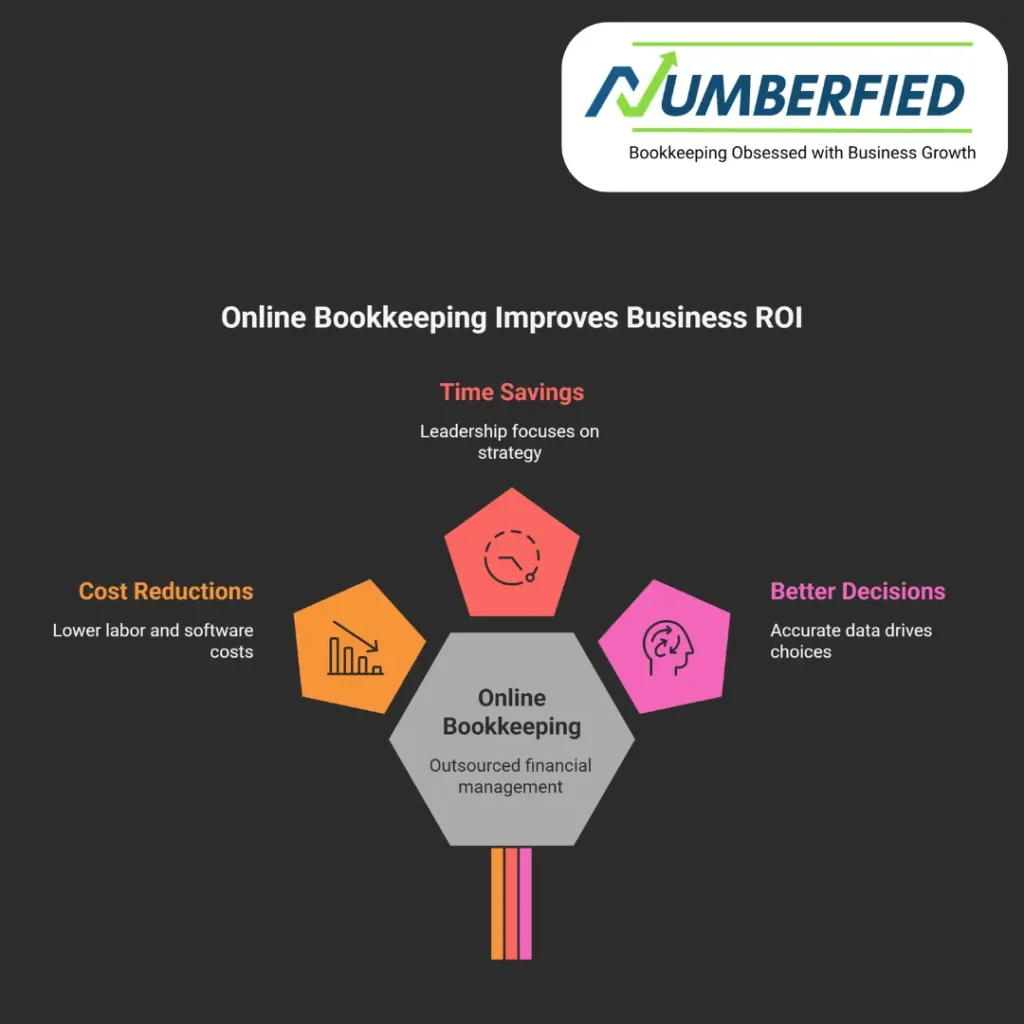
Calculate labor savings by comparing outsourced monthly fees against in-house salary, payroll taxes, and benefits. Include savings from reduced software licenses and reduced error correction.
Indirect Value: Time and Decision Quality
Monetize time returned to leadership and count on improved decision-making from reliable reports. Faster, more accurate data often yields better pricing, procurement, and staffing decisions.
Reduced Tax Exposure and Audit Risk
An online bookkeeping service that enforces consistent processes reduces the likelihood of audit adjustments and penalties. Historical accuracy and documentation limit exposure and potential interest payments.
Actionable Tips for Working Effectively with Your Provider
Maintain Clear Communication Channels
Designate primary contacts, set regular meetings, and use shared project management tools. Clarity prevents duplication and accelerates issue resolution when using an online bookkeeping service.
Set Monthly Reconciliation Deadlines
Agree on a monthly close calendar. Prompt reconciliations shorten reporting cycles and ensure that the online bookkeeping service catches errors early.
Retain Final Approval Authority
Keep sign-off controls for critical items such as large vendor payments, unusual journal entries, and expense policy exceptions. Outsourcing does not remove the need for oversight.
Pricing Models and What to Expect
Fixed Monthly Plans
Many online bookkeeping service providers offer tiered fixed monthly pricing based on transaction volume and services included. Fixed plans make budgeting straightforward and predictable.
Hourly or Project-Based Fees
For initial clean-up or special projects, expect hourly or project-based pricing. Clarify scope and deliverables up front to prevent scope creep during backlog reduction.
Value-Added Services and Upsells
Additional services, such as payroll, CFO advisory, or tax preparation, may be offered for an extra fee. Evaluate bundled offerings against standalone vendors for overall value.
Security, Privacy, and Contractual Protections
Encryption and Access Controls
Confirm the online bookkeeping service uses industry-standard encryption for data in transit and at rest and enforces multi-factor authentication for user access.
Data Ownership and Retention Policies
Ensure contracts specify data ownership, retention timelines, and procedures for data return if the agreement ends. Clear terms prevent disputes over legacy records.
Confidentiality and Non-Disclosure Agreements
Request confidentiality clauses or NDAs to protect proprietary information. A reputable online bookkeeping service will be transparent about data handling and breach response plans.
Case Examples and Practical Scenarios
Startup Scaling from Founder-Managed Books
A growing SaaS startup moved to an online bookkeeping service to replace founder-managed spreadsheets. The provider implemented monthly closes, improved GAAP categorization, and reduced the CFO’s ad-hoc data tasks by 60%.
Retail Business with Complex POS Integration
A multi-store retailer adopted an online bookkeeping service that integrated POS feeds, sales tax management, and inventory reconciliation. Automated feeds eliminated manual uploads and reduced variance in bank reconciliations.
Professional Services Firm Preparing for Audit
An accounting firm preparing for a lender audit used an online bookkeeping service to standardize client revenue recognition, generating consistent reports and supporting schedules that satisfied the auditor’s requests.
Conclusion
An online bookkeeping service offers cost-effective expertise, scalability, and improved compliance when selected and managed correctly. The right provider reduces tax exposure, enhances reporting quality, and frees owners to focus on growth. For US businesses seeking structured, secure bookkeeping aligned with IRS and GAAP requirements, professional remote bookkeeping is a strategic investment. Contact Numberfied to discuss tailored plans, onboarding timelines, and how an online bookkeeping service can deliver measurable ROI for your business.
Frequently Asked Questions
What is an online bookkeeping service?
An online bookkeeping service is a remote provider that records, reconciles, and maintains financial transactions using cloud-based accounting platforms. They deliver regular reports and support tax preparation while integrating with payroll and bank systems.
How secure is my financial data with an online bookkeeping service?
Security varies by provider, but reputable services use encryption, multi-factor authentication, and strict access controls. Verify security certifications and data handling policies during selection.
How long does onboarding typically take?
Onboarding depends on backlog and complexity; simple setups can take 2–4 weeks, while clean-ups and reconciliations for older accounts may require 4–12 weeks. Expect an initial intensive phase followed by steady maintenance.
Will an online bookkeeping service handle payroll and taxes?
Many providers offer payroll and tax-preparation support either directly or through integrations. Confirm which services are included versus offered as add-ons before signing a contract.
Which accounting software should I use with an online bookkeeping service?
QuickBooks Online and Xero are the most common platforms supported. Choose the platform that aligns with your operations and the provider’s expertise for the best integration and efficiency.
How do I ensure compliance with IRS and GAAP?
Hire a provider familiar with GAAP and IRS documentation requirements, enforce monthly reconciliations, and maintain supporting documents. Regular reviews and coordination with your CPA enhance compliance.
What pricing models do bookkeeping services use?
Providers typically offer fixed monthly plans, hourly rates for special projects, or tiered pricing based on transaction volume. Compare inclusions, response times, and SLA terms when evaluating cost.
How can I measure ROI from outsourcing bookkeeping?
Measure direct labor cost savings, reduced error corrections, time regained by leadership, and reduced tax exposure. Track KPIs like close time, variance reduction, and forecast accuracy to quantify value.
What are common red flags when choosing a provider?
Red flags include lack of references, unclear SLAs, no documented security measures, inflexible software choices, and reluctance to provide sample deliverables or client case studies.
How do I end a relationship with a bookkeeping provider and transfer data?
Ensure contract terms specify data return procedures and formats. Request a complete export of accounting data and supporting documentation, and verify that access to linked accounts is revoked after successful transfer.