

The hardest check to sign is the one that admits you were robbed by someone you trusted. This is a hard truth. Small business owners often believe that keeping financial processes in-house is the only way to maintain control. They think looking the bookkeeper in the eye ensures safety. It does not. In reality, keeping AP in-house often creates a single point of failure. It creates opportunity. Opportunity breeds theft.
When you handle everything internally with a small team, you rarely have the resources for proper checks and balances. You rely on trust. Trust is not a control. Trust is a vulnerability. When you outsource accounts payable services, you are not giving up control. You are upgrading your security infrastructure. You are replacing “blind trust” with verified process. Let’s look at how professional external teams actually close the doors on fraud that your internal team might leave wide open.
Key Takeaways
- Trust is not a strategy: Relying on a single loyal employee creates a “super user” risk that professional firms eliminate.
- Segregation prevents theft: Outsourcing forces a split between who approves the invoice and who releases the payment.
- Automation watches everything: Digital workflows catch duplicates and anomalies that tired human eyes miss.
- The audit trail helps: External AP creates a permanent, unalterable record of every action taken within your financial systems.
The Myth of “In-House” Control Versus Process Reality
We need to redefine what control means. Most entrepreneurs define control as “touching the paper.” If they see the physical invoice and sign the physical check, they feel safe. This is an illusion. Physical paper is the easiest thing to manipulate. It gets lost. It gets copied. It gets altered.
True control is visibility. True control is a defined process that functions the same way every time, regardless of who is on vacation or who is having a bad day.
The Small Team Vulnerability
In a typical small business, one person manages the inbox. That same person enters the bill into QuickBooks or Xero. That same person queues up the payment. Sometimes, they even sign the check or have the owner’s stamp. This is the “Super User” problem.
If this person creates a fake vendor, approves the invoice, and cuts the check, who catches them? Nobody. You catch them three years later when the bank account is empty. Professional AP firms operate differently. They function on a platform of transparency that internal teams find hard to replicate without hiring three distinct employees.
Segregation of Duties: Breaking the “Super User”
The most effective weapon against occupational fraud is the segregation of duties (SoD). This is an accounting principle that mandates no single person should handle more than one key part of a transaction.
The Three-Person Rule
In a secure system, three distinct roles must exist:
- Authorization: The person who says “Yes, we ordered this.”
- Recording: The person who enters the data into the ledger.
- Custody: The person who holds the cash and releases the payment.
How Outsourcing Enforces SoD
When you hire an external firm, you instantly separate these roles. The external team becomes the Recording arm. They receive the invoice. They validate the data. They enter it.
You, the business owner or your designated manager, remain the Authorization and Custody arm. The external team cannot move your money. They can only queue it up for your approval. This creates a firewall. The person entering the bill has zero ability to pay the bill. The person paying the bill (you) relies on clean data provided by a third party. Collusion becomes nearly impossible because the two parties are not sitting in the same room, sharing lunch, or covering for each other.
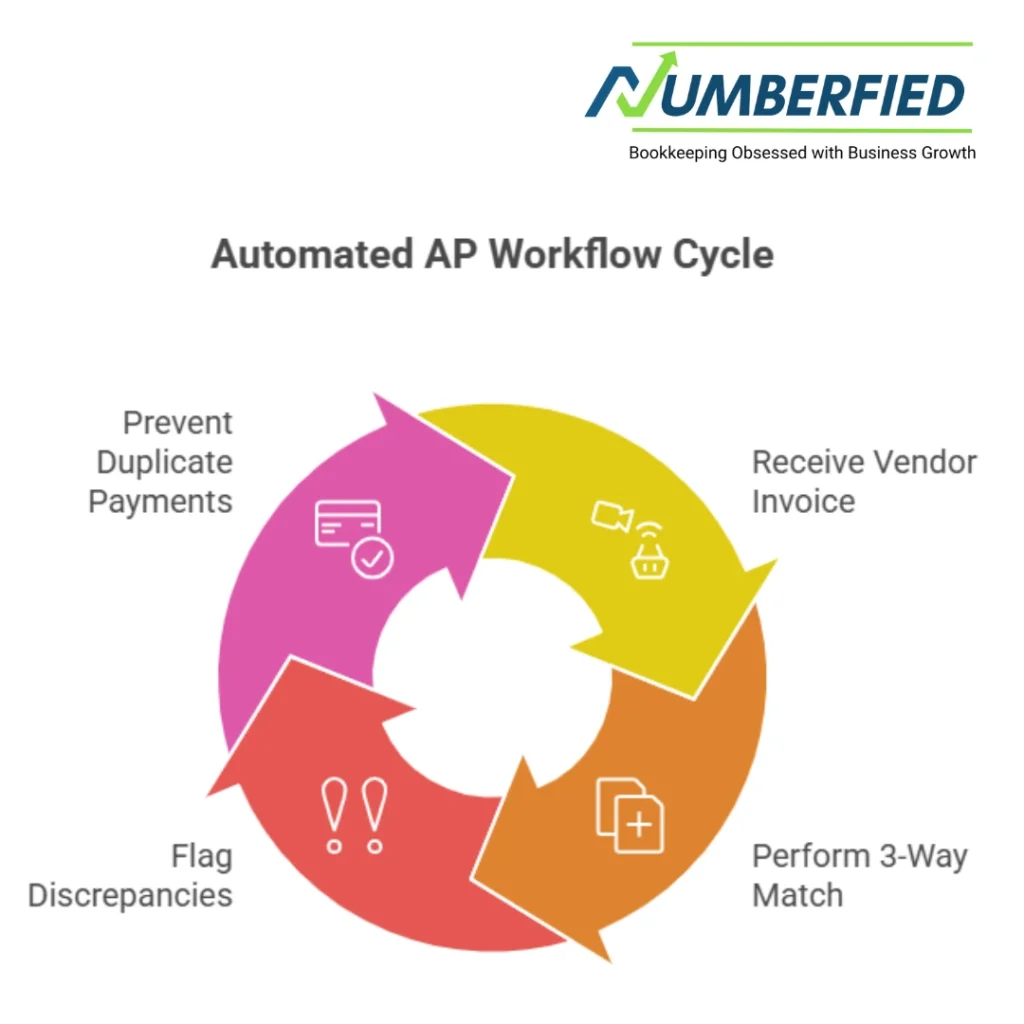
Automated Workflows: Robots Do Not Conspire
Humans get tired. Humans get lazy. Humans make friends with vendors. Software does none of these things. Outsourced AP providers utilize enterprise-level technology stacks that are often too expensive or complex for a small business to set up alone.
The 3-Way Match
This is the gold standard of AP processing. It matches:
- The Purchase Order (What you ordered).
- The Receiving Report (What actually arrived).
- The Vendor Invoice (What you are being billed for).
If these three documents do not match perfectly, the system halts. It flags the discrepancy. An in-house bookkeeper might override a mismatch because “Bob from shipping said it’s fine.” An automated system used by an external firm requires digital proof to proceed.
Duplicate Payment Prevention
A common “accidental fraud” is double payment. A vendor sends an invoice via email. Then they send a paper copy. Your in-house staff pays both. It happens constantly.
Professional AP platforms use Optical Character Recognition (OCR) to scan every incoming document. They compare invoice numbers, dates, and amounts against the entire historical database. If a duplicate is detected, it is blocked immediately. This saves cash. It reduces the headache of requesting refunds.
The Audit Trail: A Digital Witness That Never Sleeps
Paper trails are easily shredded. Digital trails are forever. One of the primary benefits of moving your AP to a professional third party is the creation of a forensic-grade audit trail.
Timestamped Accountability
Every action in a cloud-based AP system is recorded.
- Who logged in?
- What time did they upload the invoice?
- Who coded the expense?
- Who approved it?
- When was the payment released?
The “Tone at the Top”
This deterrent holds true in a significant manner. The chance of deceiving staff members is drastically lowered when they are aware that an outsider team is scrutinizing each document and every click is logged. It signals that management is watching. It signals that the financial operations are professional.
Internal fraudsters look for chaos. They look for messy desks and unfiled receipts. They hide in the disorder. Outsourcing imposes order. It shines a light in the dark corners where fraud grows.
Vendor Verification: Stopping the Phantom Vendor
External threats are just as dangerous as internal ones. A common scam involves “phantom vendors” or invoice redirection fraud. This is where a fraudster sends an invoice that looks real but directs payment to a new bank account.
The Master File Guard
Your “Vendor Master File” is the database of people you pay. In a loose internal environment, adding a new vendor is easy. A bookkeeper just types it in.
Outsourced firms treat the Vendor Master File like a bank vault.
- Validation: They verify tax IDs (W-9s) before a vendor is entered.
- Bank Verification: If a vendor requests a change in banking details, professional firms have a protocol. They call the vendor using the number on file (not the number in the suspicious email) to verbally confirm the change.
- Sanctions Checks: They ensure you aren’t paying entities on government watch lists.
Catching Social Engineering
Phishing emails are getting smarter. They look exactly like an email from your main supplier. They use the same logo. They use the same font. They just want you to click a link or change a wire destination.
An in-house employee, rushing to leave at 5:00 PM, might click. An outsourced AP team, whose sole KPI is accuracy and security, is trained to spot these anomalies. They see thousands of invoices a day. They know what a fake looks like.
Why You Should Outsource Accounts Payable Services for Expertise
You are an expert in your business. You are likely not an expert in forensic accounting or payment security. That is fine. You shouldn’t be. But you also shouldn’t rely on a generalist administrator to protect your cash flow.
The Cost of Expertise
Hiring a CFO or a Controller to oversee your AP process is expensive. It costs six figures. So, small businesses hire junior data entry clerks instead. They get junior-level security.
By outsourcing, you fractionalize the cost of high-level expertise. You get the Controller-level oversight, the enterprise-grade software, and the strict security protocols for less than the cost of a part-time employee. You buy a team. You buy a system.
Continuity of Business
What happens when your sole bookkeeper quits? Or gets sick? The payments stop. The checks pile up. In that chaos, mistakes happen. Fraudsters strike when you are desperate to catch up.
An outsourced firm provides continuity. They have multiple people trained on your account. If one person is out, the system keeps moving. The controls remain in place. Your vendors get paid. Your risk remains low.
Conclusion
Letting go is the only way to gain control. It sounds contradictory. It is the reality of modern business growth. When you cling to the manual signing of checks and the opening of mail, you are not protecting your business. You are exposing it to human error and human greed.
When you outsource accounts payable services, you build a fortress around your cash. You implement segregation of duties, automated validation, and continuous monitoring. You stop relying on luck. You start relying on structure. Your business deserves to keep the money it earns. Secure your AP. Secure your future.
Also Read: US Bookkeeping Services: The One Business Secret No One Talks About (Until Now)
FAQs
1. Will I lose the ability to choose who gets paid?
No. You actually gain more control. The outsourced team prepares the payments, but you retain the final “click” to release funds. Nothing leaves the bank without your say-so.
2. Is it safe to give a third party access to my bank?
We don’t need direct access to your bank login. We use read-only access for reconciliation and secure payment portals that push data to the bank. We never hold your credentials.
3. What if the outsourced team makes a mistake?
We carry professional liability insurance. If your in-house employee makes a mistake, you pay for it. If we make a mistake, we are accountable.
4. Is this only for big corporations?
No. Small businesses are the biggest targets for fraud because they lack controls. Outsourcing is the most affordable way for small players to get enterprise-level protection.
5. How fast can we switch?
Fast. We can usually map your process, set up the software, and take over the workflow within two to three weeks.
CTA
Stop losing sleep over your bank account. Stop hoping your process is safe. Know it is. Contact Numberfied Today – Let’s secure your cash flow and build a system that scales with you.