
Introduction
Cash flow kills businesses. Fast. It is not always about a lack of revenue. It is about the burn rate consuming that revenue before it hits the bank. The single most dangerous element of a high burn rate is fixed payroll. I have watched brilliant founders build incredible products only to suffocate because they hired a full-time finance team for a “best case scenario” that didn’t happen on schedule. They built a heavy castle on a foundation of quicksand.
The hard truth is that in-house accountants get paid the exact same salary whether you close ten massive deals or zero. This rigidity is a massive liability. It creates a disconnect between your expense structure and your income reality. The modern strategic move is to leverage outsourced accounting services to transform this financial anchor into a dial you can control. This is not about firing people. It is about mathematical survival. This article breaks down exactly how to execute that pivot.
Key Takeaways
- Structural Agility: How to move accounting from a fixed liability line item to a variable expense.
- The 1.4x Rule: Why an employee’s salary is actually 40% higher than their paycheck.
- Elasticity: Matching your back-office costs to your real-time revenue flow.
- Recession Proofing: Using outsourcing to insulate the business against market volatility.
- Founder Focus: Reallocating your personal capital from management to expansion.
The Fixed Cost Trap: Why Payroll Is Your Heaviest Anchor
We need to redefine how we view “stability” in business operations. For decades, having a full team in-house was a status symbol. It signaled growth. It signaled that you had “made it.” Today, that mindset is obsolete. It signals inefficiency. Fixed costs are the enemy of agility. When you hire a full-time Senior Accountant or Controller, you are locking in a recurring expense that exists independently of your performance.
Consider the math. If your revenue drops by 30% next quarter due to a market correction or a lost client, your fixed payroll remains at 100%. Your margins compress instantly. Your cash runway shortens significantly. You are now paying full price for a resource that has less work to do. This creates a dangerous inverted leverage where your costs are heaviest exactly when you are weakest.
The graph above illustrates the danger zone. In a fixed cost model (the flat line), costs remain high even when revenue (the rising line) dips. In a variable model, costs hug the revenue line. The gap between revenue and fixed expense during a downturn is where businesses die. It is simple arithmetic. Yet, founders ignore it until payroll day arrives and the bank account looks thin.
You must stop viewing accounting as a “staffing” issue. It is a “capacity” issue. Capacity should always match demand. Fixed payroll forces you to buy maximum capacity 24/7/365. That is financial suicide for a growth-stage company. You are paying for peak load during valid valleys.
The “Iceberg” of In-House Employment
The sticker price of a salary is a lie. When you hire an internal accountant for $85,000, you are not spending $85,000. You are spending closer to $115,000 or $120,000. This is the “Iceberg Effect” of human capital. Most founders only look at the tip of the iceberg, the gross salary, and crash their ship into the submerged mass of hidden costs.
The Visible Costs vs. The Invisible Burden
Most founders only calculate the gross salary. They forget the rest.
- Payroll Taxes: The employer portion of Social Security and Medicare adds up immediately.
- Benefits Packages: Health insurance premiums, 401(k) matches, and life insurance are non-negotiable for top talent.
- Physical Overhead: Even in remote setups, you pay for laptops, monitors, ergonomic chairs, and stipends.
- Software Stack: You pay for the QuickBooks or Xero seats. You pay for the bill pay platforms. You pay for the expense management tools.
The Cost of Friction
Then there are the soft costs that do not show up on a spreadsheet until it is too late. Recruitment fees usually run 20% of the first year’s salary. The time you spend interviewing is time you aren’t selling. There is the three to six months of “ramping up” where the employee is not fully productive but is fully paid. There is the severance you pay if it doesn’t work out.
When you analyze these numbers, the “cost per productive hour” of an internal employee skyrockets. You are paying for their coffee breaks. You are paying for their downtime. You are paying for their sick days. This accumulation of non-productive cost creates a bloated P&L. It reduces your EBITDA. It makes your company less attractive to investors who look for lean operations.
Outsourced Accounting Services as a Strategic Lever
This is where the pivot happens. By switching to outsourced accounting services, you are not just “hiring a firm.” You are fundamentally changing the physics of your P&L. You are converting a fixed block of granite into a fluid stream.
This is a structural change. You move the expense from “Payroll” (Fixed) to “Professional Services” (Variable). This categorization matters.
The Volume-Based Dial
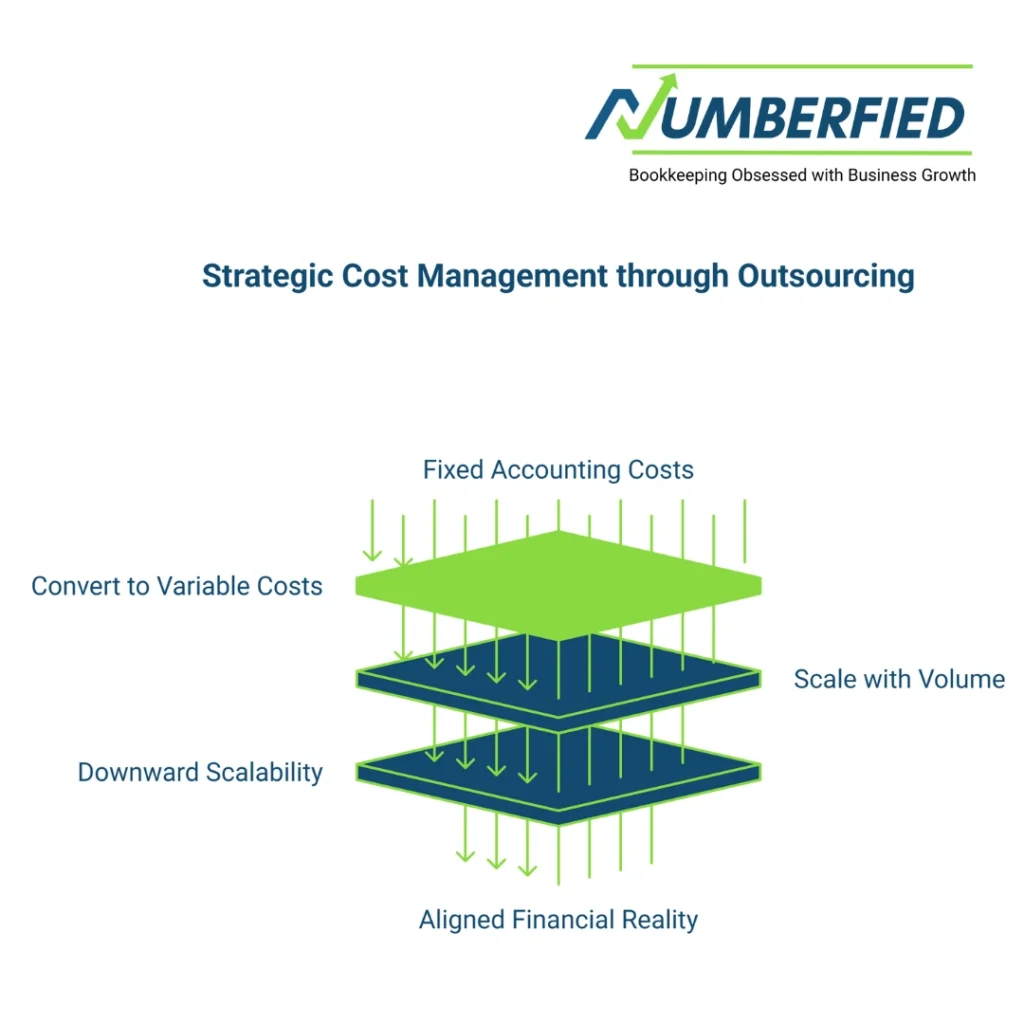
Good outsourcing partners operate on a tiered or volume-based model. If you are a SaaS company with 500 transactions a month, you pay for that volume. If you launch a new product and transactions jump to 5,000, you step up to the next tier. The cost scales with the activity. You are never overpaying for capacity you aren’t using.
Downward Scalability
Here is the crucial part that nobody talks about. Scalability works both ways. If you lose a major client and your transaction volume drops, your accounting costs should drop too. You cannot tell an in-house employee: “We had a bad month, so I’m paying you 20% less.” They will quit. With an outsourced firm, you simply adjust the scope. You align the expense with the reality of your bank account. This creates a financial safety valve that releases pressure during hard times.
Weathering Volatility: The Recession-Proof Model
Markets are cyclical. Volatility is guaranteed. The businesses that survived the last few economic downturns were not necessarily the ones with the most cash in the bank. They were the ones with the lowest burn rates and the highest adaptability.
Speed of Adaptation
When a recession hits, you need to cut costs immediately. In a fixed-salary environment, cutting costs means firing people. That is traumatic. It destroys morale. It opens you up to legal risks. It takes time. You might hesitate for two months because you “like the guy” or fear the culture hit. That hesitation costs you $30,000 in salary burn.
With an outsourced model, the conversation is transactional: not emotional. You contact your account manager at Numberfied. You say: “We need to pause the CFO advisory services and stick to basic compliance for Q3.” Done. The expense is cut instantly. You have preserved cash without firing a single person.
Think of it like a thermostat. You lower the temperature when you leave the house to save energy. You cannot do that with a salaried employee. They are a furnace that burns fuel at the same rate regardless of the temperature outside. Outsourcing gives you the thermostat.
Accessing the “Fractional” Brain Trust
There is a quality gap in the sub-$10M revenue range. You cannot afford a $200,000 CFO. So you compromise. You hire a $60,000 bookkeeper and hope they can help with strategy. They can’t. They are data entry specialists. They look backward: not forward. They record history. They do not make history.
Vertical Expertise
Outsourcing firms aggregate talent. They employ high-level CPAs, tax strategists, and CFOs. By using a firm, you gain fractional access to this brain trust. You get the insights of a CFO without the full-time price tag. You get a team that sees hundreds of P&Ls across your industry. They know the benchmarks. They know what “good” looks like.
The Technology Stack Advantage
Internal teams get lazy with tech. They stick to what they know. Outsourced firms are obsessed with efficiency because their margin depends on it. We use the latest AI-driven reconciliation tools, OCR receipt scanning, and automated cash flow forecasting.
When you outsource, you inherit this tech stack. You don’t have to research which bill-pay software is best. We already know. We implement it. You get enterprise-grade financial infrastructure on a startup budget. This allows you to punch above your weight class. You get better data. You get it faster.
Reallocating Founder Capital (Time and Money)
Every dollar you save on fixed overhead is a dollar you can deploy into growth. This is the concept of Opportunity Cost.
The Capital Reallocation
Let’s say outsourcing saves you $40,000 a year compared to a fully loaded internal hire. That is $40,000 you can spend on:
- Customer Acquisition: Pouring fuel on Google Ads or LinkedIn campaigns.
- Product: Hiring a developer to ship features faster.
- Sales: paying commissions to closers who bring in cash.
You are taking money from a “support” function and moving it to a “revenue-generating” function. That is how you compound growth.
The Time Reallocation
But the money is secondary to the time. Managing an internal finance team is a job. You have to approve their time off. You have to manage their interpersonal conflicts. You have to conduct performance reviews. You have to ensure they are actually working.
As a founder, your hourly rate is effectively $1,000 or more based on the value you create. If you spend 5 hours a week managing a bookkeeper, you are wasting $5,000 of potential value per week. Outsourcing removes the management burden. You look at the reports. You ask questions. You move on. You get your brain back.
Conclusion
The era of the bloated back office is over. We are in the era of the lean, agile enterprise. The pivot from fixed salaries to outsourced accounting services is not just a cost-saving measure. It is a strategic maneuver. It transforms your cost structure from a rigid cage into a flexible engine.
You gain the ability to scale up instantly when you grow. You gain the safety of scaling down instantly when the market turns. You access higher-level talent for a fraction of the cost. Most importantly, you free yourself to focus on the only thing that matters: building your business. Stop renting employees. Start buying results.
FAQs
1. Is outsourcing accounting safe for my data?
Yes. Reputable firms use bank-level encryption and secure cloud portals. It is often safer than having files on a local server or a physical drive in an unlocked office where anyone can walk in.
2. What happens if my business grows rapidly?
We scale the team. We add more controllers or bookkeepers to your account immediately. You don’t have to post a job ad or interview anyone. We handle the capacity planning.
3. Will I lose control of my finances?
No. You actually gain control. You get cleaner, more timely reports. You stop worrying about data entry and start focusing on data analysis. You move from “doing” to “reviewing.”
4. Can I outsource just the CFO role and keep a bookkeeper?
Absolutely. Hybrid models work well. We can provide high-level oversight and strategy while your internal staff handles the daily administrative tasks. We plug in where you need us.
5. How quickly can we switch?
Usually within 2 to 4 weeks. We perform an initial audit, map your processes, and take over the workflow. It is designed to be a rapid transition so you don’t lose momentum.
Schedule your free consultation with Numberfied
Your finances should fuel your growth: not anchor it. Stop overpaying for fixed overhead. Click here to schedule your free consultation with Numberfied and let’s build a variable cost structure that scales with you.
Also Read: Best Outsourced Accounting Services Your Growth Partner with Numberfied