

Introduction
We are excited to guide you through the essential practice of real estate investment underwriting, the disciplined process that separates promising opportunities from risky ventures. In an ever-changing real estate environment, strong real estate investment underwriting enables investors to evaluate properties with precision, forecast performance reliably, and protect capital effectively. Whether you manage a growing portfolio or are exploring your first multifamily acquisition, understanding real estate investment underwriting equips you to make confident, data-backed decisions.
Key Takeaways
- Real estate investment underwriting combines financial analysis, market evaluation, and risk assessment to determine investment viability.
- Accurate underwriting minimizes surprises and improves long-term portfolio performance.
- Core elements include income verification, expense forecasting, debt structuring, and scenario testing.
- Realistic assumptions grounded in current market data produce the most dependable projections.
- Technology and ongoing monitoring keep underwriting relevant in shifting conditions.
- Professional collaboration often uncovers insights that individual analysis might miss.
Understanding the Core Principles of Real Estate Underwriting
Real estate investment underwriting is the rigorous examination that determines whether a property deserves capital allocation. We view it as both an art and a science, requiring analytical rigor and practical judgment.
What Real Estate Underwriting Really Means
Real estate underwriting is the detailed review of a property’s financial statements, physical condition, market position, and legal standing to project future cash flows and returns. It answers whether the asset can deliver the targeted yield while withstanding economic stress.
Why Underwriting Matters More Than Ever
In periods of rising interest rates or shifting tenant preferences, thorough real estate \underwriting prevents overpaying and identifies hidden value. It transforms gut feelings into evidence-based conviction.
Dispelling Common Myths Surrounding Underwriting
Some assume real estate underwriting is reserved for institutional investors, yet disciplined individuals and small syndicates use the same principles successfully. Others believe it guarantees success; in reality, it dramatically improves the probability when executed consistently.
Essential Components of a Thorough Real Estate Underwriting Process
A complete underwriting effort rests on several interconnected pillars that together create a clear picture of the investment’s potential.
Income Verification and Rent Roll Analysis
The rent roll serves as the foundation of real estate underwriting. Confirming in-place rents, lease terms, concessions, and collection history establishes reliable gross potential income.
Operating Expense Examination and Budgeting
A detailed expense line-item review of utilities, maintenance, management fees, and insurance reveals the true net operating income. Real estate underwriting demands normalizing one-time or owner-specific costs for accurate forecasting.
Capital Expenditure Reserves and Replacement Planning
Underestimating future capital needs frequently erodes returns. Real estate underwriting allocates appropriate reserves for roof replacements, HVAC systems, parking resurfacing, and other major items.
Market Analysis Techniques That Strengthen Real Estate Underwriting
No underwriting is complete without a robust understanding of the surrounding market forces.
Evaluating Employment and Economic Drivers
Job growth, major employers, and wage trends directly influence rental demand. Real estate investment underwriting incorporates these macroeconomic signals to project occupancy stability.
Inventory Levels and New Supply Pipeline
Tracking permitted and under-construction units helps anticipate future competition. Real estate investment underwriting adjusts rent growth and vacancy assumptions when significant new inventory is expected.
Submarket Comparables and Rent Benchmarking
Recent lease comps and sales of similar properties provide critical context. Real estate investment underwriting uses this data to validate or challenge the seller’s asking price and projected rents.
Building Reliable Financial Models for Real Estate Investment Underwriting
Financial modeling translates assumptions into projected performance metrics that guide go/no-go decisions.
Constructing Detailed Pro Forma Projections
A multi-year pro forma forecasts revenue growth, expense inflation, and NOI. Real estate investment underwriting relies on conservative yet realistic growth rates supported by market evidence.
Performing Sensitivity and Stress Testing
Varying key inputs rent growth, vacancy, interest rates shows how returns hold up under adverse conditions. Real estate investment underwriting that includes stress testing builds investor confidence.
Calculating Key Return Metrics
Internal rate of return (IRR), equity multiple, cash-on-cash return, and net present value offer complementary perspectives. Real estate investment underwriting prioritizes metrics aligned with the investor’s specific objectives.
Risk Identification and Management in Real Estate Investment Underwriting
Proactive risk management is central to protecting downside while preserving upside potential.
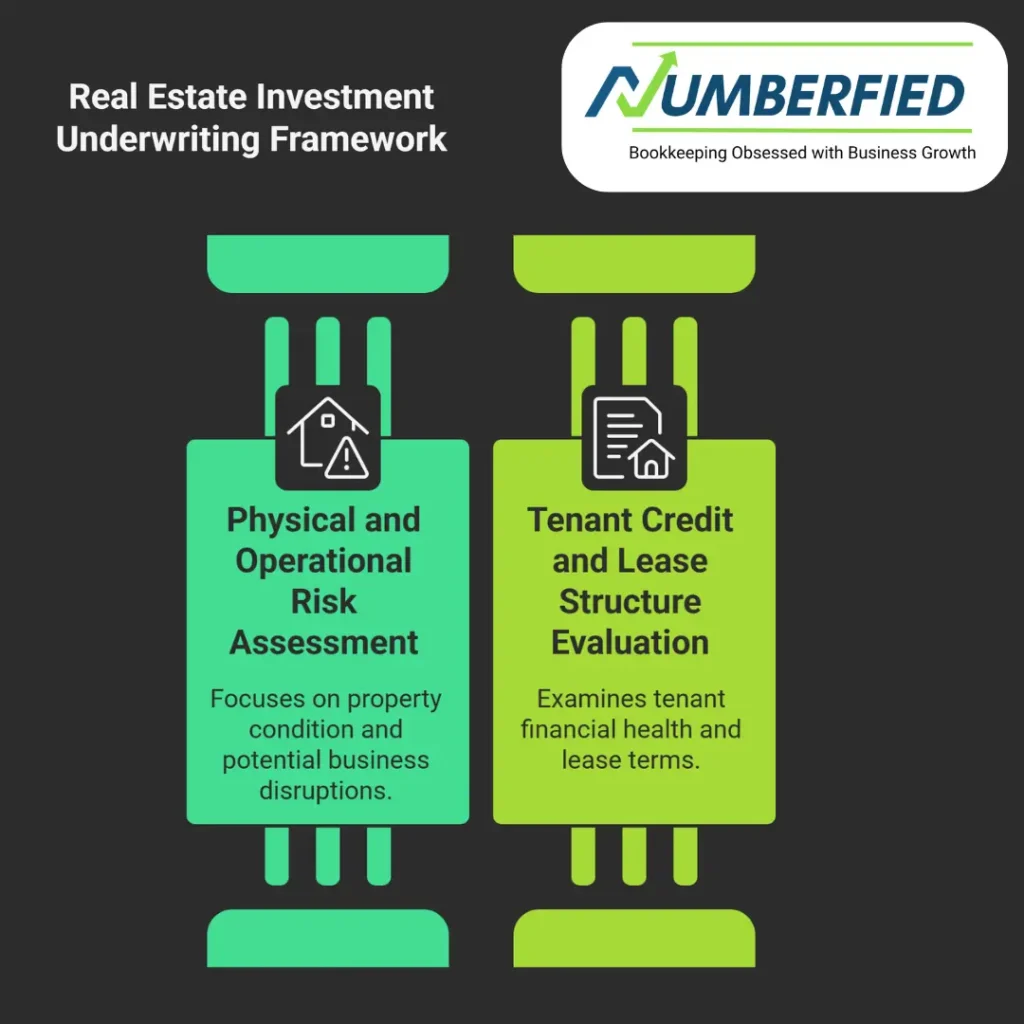
Physical and Operational Risk Assessment
Property condition reports and third-party inspections uncover deferred maintenance. Real estate investment underwriting factors in repair costs and potential business interruption into the analysis.
Tenant Credit and Lease Structure Evaluation
For commercial assets, tenant financial health and lease guaranties matter greatly. Real estate investment underwriting scrutinizes credit profiles and lease expiration schedules to gauge rollover risk.
Macro and Interest Rate Risk Mitigation
Fixed-rate financing or interest rate caps can shield cash flow. Real estate investment underwriting models debt service coverage under higher-rate scenarios to confirm resilience.
Legal, Title, and Regulatory Considerations in Real Estate Investment Underwriting
Overlooking legal details can derail even the strongest financial case.
Title Search and Encumbrance Review
Clear title and absence of liens or easements are non-negotiable. Real estate investment underwriting includes preliminary title commitment examination early in due diligence.
Zoning Compliance and Entitlement Status
Confirming permitted uses and any required variances prevents future restrictions. Real estate investment underwriting verifies that the current or planned use aligns with zoning ordinances.
Environmental and Phase I/II Site Assessment Findings
Recognized environmental conditions can impose substantial remediation costs. Real estate investment underwriting integrates Phase I results and, when necessary, Phase II sampling outcomes.
Advanced Underwriting Practices for Experienced Investors
Seasoned investors refine their real estate investment underwriting with sophisticated techniques.
Portfolio-Level Underwriting and Correlation Analysis
Assessing how new acquisitions interact with existing holdings reduces concentration risk. Real estate investment underwriting at the portfolio level optimizes overall diversification.
Monte Carlo Simulation for Probabilistic Outcomes
Running thousands of randomized scenarios provides a distribution of possible returns. Real estate investment underwriting enhanced by Monte Carlo methods quantifies uncertainty more precisely.
Post-Closing Performance Tracking and Model Recalibration
Monitoring actual versus projected results allows continuous improvement. Real estate investment underwriting extends beyond acquisition to ongoing asset management.
Conclusion
Real estate investment underwriting remains one of the most powerful tools available to serious investors. By mastering income analysis, market evaluation, financial modeling, risk management, legal diligence, and advanced techniques, you position yourself to capture value while avoiding common pitfalls. We encourage you to apply these principles consistently and refine your process with each transaction. Should you want expert assistance tailoring real estate investment underwriting to your specific strategy, we warmly invite you to reach out to Numberfied for personalized support.
FAQs
What is the primary goal of real estate investment underwriting?
The main objective is to determine whether a property will generate acceptable risk-adjusted returns. It systematically evaluates financial performance, market support, and potential downsides. Thorough underwriting increases the likelihood of achieving targeted outcomes.
How long should the underwriting process typically take?
Depending on deal complexity, underwriting usually spans two to six weeks. Residential deals often move faster, while large commercial transactions require more extensive due diligence. Allowing sufficient time prevents rushed decisions.
What is the difference between underwriting and due diligence?
Underwriting focuses on financial modeling and return projections, while due diligence encompasses the broader investigation of legal, physical, and operational aspects. Real estate investment underwriting integrates due diligence findings into the financial analysis.
How do I choose appropriate rent growth assumptions?
Base rent growth on historical submarket trends, forward-looking economic indicators, and comparable properties. Real estate investment underwriting favors conservative estimates supported by verifiable data rather than optimistic projections.
Why is the debt service coverage ratio important in underwriting?
DSCR measures the property’s ability to cover loan payments from net operating income. Lenders typically require 1.20–1.35× coverage. Real estate investment underwriting ensures the investment maintains an adequate cushion under stress scenarios.
Should I always use third-party property condition reports?
Yes, professional reports provide objective assessments of deferred maintenance and immediate repair needs. Real estate investment underwriting relies on these findings to adjust capital expenditure reserves accurately.
How does inflation impact real estate investment underwriting?
Inflation affects both revenue (rent increases) and expenses (utilities, labor, materials). Real estate investment underwriting models different inflation scenarios to understand the net effects on cash flow and returns.
What role do exit cap rates play in underwriting?
The assumed exit cap rate determines the projected sale price at disposition. Real estate investment underwriting typically applies a cap rate higher than the entry cap to reflect future market uncertainty and ensure a conservative terminal value.
Can real estate investment underwriting be done without specialized software?
Yes, detailed Excel models work effectively for many investors. As portfolio size grows, dedicated platforms improve efficiency and reduce manual errors. Start with spreadsheets and scale tools as needed.
How frequently should I refresh my underwriting assumptions?
Review and update assumptions quarterly or whenever significant market shifts occur interest rate changes, major employer announcements, or new supply deliveries. Real estate investment underwriting remains dynamic to stay relevant.
Read Also: 9 Surprising Ways a Bookkeeping Service for Small Business Can Boost Your Success