

Introduction
The role of accounting in modern business is undergoing its most significant transformation in a generation. Historically viewed as a rearview-mirror function -recording history, managing tax compliance, and reconciling past transactions -accounting is now being pushed firmly into the driver’s seat.
According to a recent readiness checklist published by the INAA (January 19, 2026), the question is no longer “Does your software work?” but rather “Is your technology stack ready for the complexity of 2026?” The data suggests that fragmented systems, manual workarounds, and outdated processes are not just inefficiencies; they are leadership failures waiting to happen.
For decision-makers, the message is clear: Accounting technology readiness is now a leadership issue. If your financial systems are not integrated, your firm cannot scale. If your data requires manual reconciliation, you cannot offer advisory services. If you are still using spreadsheets to bridge software gaps, you are losing control.
This article explores the INAA’s findings, breaks down a practical readiness checklist, and explains why mastering accounting technology is the single most critical lever for business growth in 2026.
Why Accounting Technology Readiness Defines Leadership in 2026
For decades, accounting technology was treated as an operational afterthought. A firm would buy QuickBooks, Xero, or MYOB, add a payroll module, maybe a CRM, and call it a day. The leadership team focused on sales, marketing, and product, while the finance team quietly struggled with data silos.
That era is over.
The INAA report highlights a critical shift: “Accounting technology has quietly become one of the strongest signals of a firm’s maturity.” Clients may not ask about your API integrations, but they feel the consequences of poor tech -delays in reporting, inconsistent data, and an inability to answer strategic questions in real-time.
The Cost of Fragmented Accounting Systems
When your accounting stack is fragmented, the business bleeds in three invisible ways:
- Opportunity Cost: Your best accountants spend 60% of their time wrestling with data instead of advising clients.
- Risk Exposure: Manual reconciliations lead to errors. Errors lead to compliance risks.
- Scalability Stall: You cannot add more clients without adding more headcount because your systems don’t talk to each other.
The INAA notes that “growth does not break systems overnight. It exposes weaknesses gradually.” A leader who ignores tech readiness is essentially building a skyscraper on a foundation of sand.
From Compliance to Advisory: The Leadership Pivot
The most valuable accounting firms in 2026 are not those with the neatest ledgers; they are those that offer forward-looking guidance. However, you cannot advise on future cash flow if you are still manually cleaning last month’s data.
True leadership means insisting on a tech stack that automatically delivers a “single source of truth.” When integration exists, accounting teams stop explaining the past and start predicting the future. This is the difference between a vendor and a strategic partner.
The 2026 Readiness Checklist for Accounting Leaders
Based on the INAA’s framework, assessing your accounting readiness requires looking for friction, not features. You don’t necessarily need the most expensive software; you need the right alignment.
Here is a practical checklist to run with your finance team today.
The Friction Audit (Where does work get stuck?)
The INAA advises: “Where do handovers slow down? Which reports require reworking before they are client-ready?”
- Checkpoint: Does your accounting software export directly into your reporting dashboard, or does a human have to reformat CSV files every Monday?
- Red Flag: If you have a “month-end hero” who stays late to reconcile bank feeds because the auto-categorization is broken, your stack is failing.
- Leadership Action: Map the journey of a single invoice. Count how many times a human touches it. Technology readiness means reducing that number to zero.
Integration vs. Volume (The Scalability Test)
Many leaders think, “We have 500 clients; our system handles volume.” But the INAA warns that accounting scalability depends on integration, not volume.
- The Question: When you add a new client, does their data flow seamlessly from the CRM to the billing system to the general ledger?
- The Test: Look for manual journal entries. If your team is manually keying data from Stripe into QuickBooks, you are not scalable. Real accounting readiness means APIs do the walking.
- Leadership Action: Refuse to buy any new software that does not have an open API. Closed ecosystems are the enemy of modern accounting.
The Advisory Depth Indicator
The INAA states: “Scalability, Control, and Advisory Depth Are Now Structurally Linked.”
You know your accounting tech is leadership-ready when you can answer client questions without “running a report later.”
- Good: “Here is your profit and loss for last month.”
- Leadership Ready: “Here is your live dashboard showing cash flow by project, a predictive forecast for next quarter, and three tax strategies based on real-time data.”
If your current stack cannot produce the second response, it is not an accounting problem; it is a governance problem.
How to Align Your Accounting Stack for Strategic Growth
Knowing your stack is broken is one thing. Fixing it is another. The INAA emphasizes that “not every firm needs new systems. Many need better alignment.”
Here is how leaders align accounting technology for growth without causing operational chaos.
Step 1 – Consolidate Before You Add
The worst mistake a leader can make is “tech debt.” This happens when you buy a niche solution for every tiny problem. Suddenly, you have five different software subscriptions that don’t talk.
The Strategy: Audit your accounting stack. Can your ERP (Enterprise Resource Planning) do what your separate inventory tool does? Consolidation reduces friction. As the INAA notes, where tools require “constant interpretation or duplication, they are quietly eroding margin.”
Step 2 – Automate the “Boring” Middle
High-value accounting talent hates repetitive data entry. It demoralizes staff and introduces errors.
- Action Item: Automate bank reconciliation, expense categorization, and payroll journal entries.
- The Goal: Your human accountants should never type a number. They should only interpret numbers.
Step 3 – Build a “Growth Loop” with Your Accountant
Finally, leadership means recognizing that you cannot do this alone. The INAA suggests that “assessing accounting technology in isolation can be misleading.”
This is where strategic partnerships come in. Whether you are a business owner or a firm leader, you need a partner who understands that accounting is a growth engine, not a compliance jail. You need a partner who has already solved the integration puzzle so you don’t have to.
At Numberfied, we have built our entire platform on the premise that bookkeeping and strategic growth coaching must coexist. We don’t just reconcile your books; we align your accounting data with weekly business coaching, sales training, and lead generation strategies. When your tech stack is ready, you don’t just file taxes -you scale businesses.
Conclusion: The Future of Accounting is Leadership
The INAA has drawn a line in the sand for 2026. Accounting is no longer a back-office utility. It is a barometer of leadership quality.
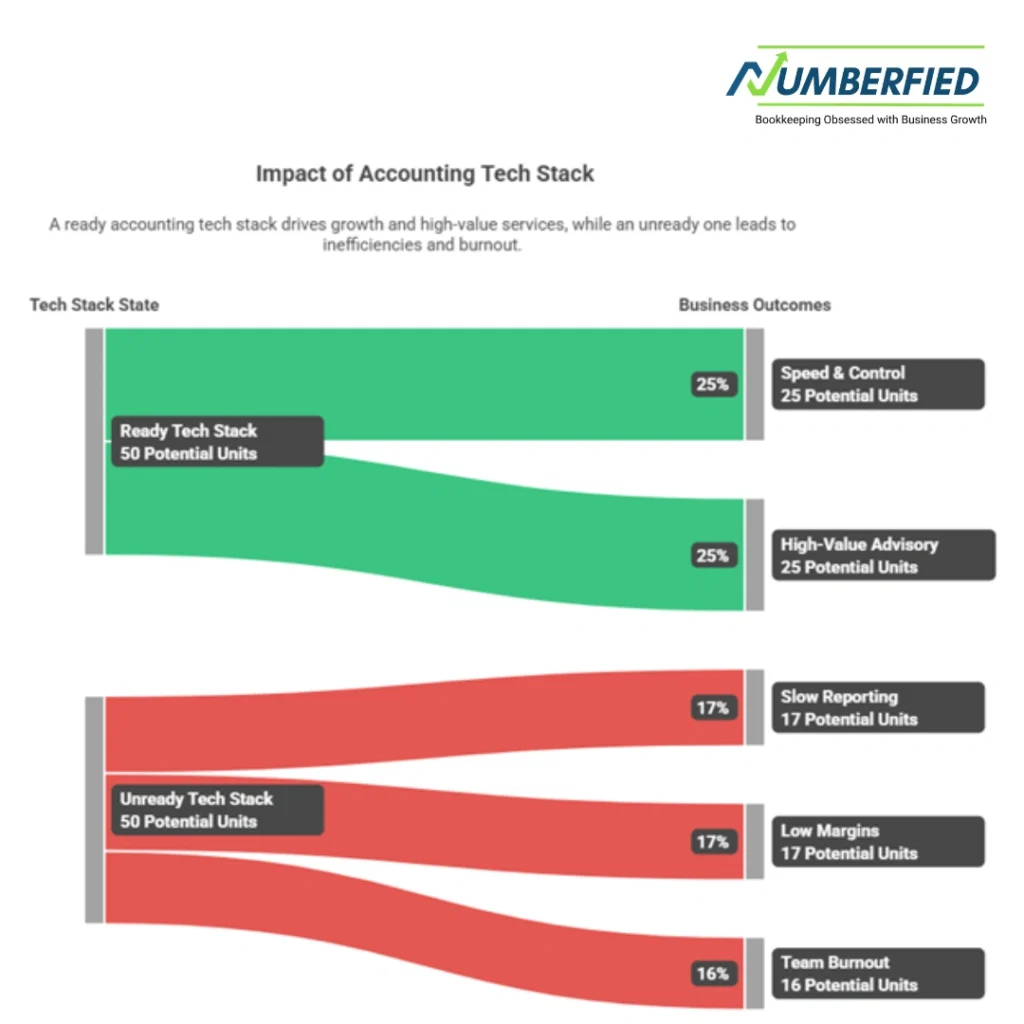
If your tech stack is ready, you enjoy speed, control, and the ability to offer high-value advisory services. If it isn’t, you will suffer from slow reporting, low margins, and a team that burns out on manual work.
Leaders do not wait for the system to crash. They audit friction, demand integration, and partner with experts who understand that accounting drives strategy.
Take a hard look at your checklist today. Is your technology amplifying your growth or silently throttling it?
Read Also: The Amazing Way Bookkeeping and Accounting Services in USA Can Skyrocket Your Success!
FAQs
Why is accounting technology now considered a “leadership issue”?
Fragmented systems directly impact scalability, risk management, and the ability to offer advisory services. Leaders are responsible for growth, and bad tech stops growth.
What is the biggest sign my accounting stack is failing?
The INAA suggests looking for “friction” -specifically, manual workarounds like exporting data to Excel to reformat it before it can be used.
Do I need to buy the most expensive accounting software to be “ready”?
No. Readiness is about integration and alignment, not price tags. A cheap, open-API platform that integrates with your CRM is better than an expensive, closed system.
How does poor accounting tech affect my clients?
Indirectly. They won’t see your software, but they will see late reports, inconsistent answers to financial questions, and an inability to provide strategic forecasts.
Can I fix my accounting stack without hiring a full-time IT team?
Yes. Many firms partner with specialized providers (like Numberfied) who offer integrated accounting and bookkeeping services paired with growth coaching, removing the tech burden from internal staff.
What is “advisory depth” in accounting?
The ability to move beyond reporting what happened (last month’s sales) to advising on what will happen (cash flow forecast for next quarter) and how to improve it.
How often should I audit my accounting technology stack?
At least annually, or whenever you double in size, the INAA notes that growth exposes weaknesses gradually, so a bi-annual “friction audit” is wise.
What is the risk of ignoring integration?
You will suffer from “data debt.” As you grow, the time spent reconciling systems grows exponentially, eventually consuming all your profit margins.
Is cloud-based accounting sufficient for 2026?
Cloud is the baseline, not the finish line. You need cloud plus integration. Having data in the cloud is useless if it is siloed in five different cloud platforms that don’t sync.
How do I convince my leadership team to invest in new accounting tech?
Don’t talk about features. Talk about the “friction cost.” Calculate how many hours your team spends on manual data cleaning multiplied by their hourly rate. Show them the ROI of automation.
Is your accounting tech stack holding you back?
You don’t need to struggle with fragmented systems alone. At Numberfied, we combine professional bookkeeping with strategic business growth coaching -ensuring your financial data actually drives decisions.
Stop reconciling. Start scaling.
Book Your Free Strategy Call Today – Let’s audit your readiness for 2026 and unlock your firm’s full potential.