

Introduction
Being self-employed, whether as a freelancer, gig worker, independent contractor, sole proprietor, or other professional, offers freedom and flexibility, but it also brings unique financial challenges like tracking variable income, calculating quarterly taxes, and claiming every allowable deduction. Accounting and tax services for self-employed individuals provide the expertise to handle these tasks efficiently, turning potential headaches into opportunities for savings and growth.
These services are designed to keep you compliant with IRS rules while uncovering deductions you might miss on your own, from home office expenses to retirement contributions. In this guide, we explore the key benefits of accounting and tax services for self-employed professionals, compare DIY or in-house approaches to professional help, detail essential offerings, highlight common mistakes, provide a practical selection process, review top providers, and examine IRS trends in 2026. By the end, you’ll have the knowledge to choose a service that supports your independence without compromising your financial security.
Key Benefits of Accounting and Tax Services for Self-Employed
Accounting and tax services for self-employed professionals offer targeted advantages that address the irregular income and expense patterns common in independent work.
Maximizing Deductions and Credits
One of the most valuable benefits of accounting and tax services for self-employed is identifying and claiming all eligible deductions, such as vehicle mileage, home office space, business supplies, and health insurance premiums. Professionals ensure you take full advantage of items like the Qualified Business Income (QBI) deduction or self-employed health insurance adjustment, potentially reducing your tax bill by thousands. This expertise turns what could be overlooked opportunities into significant savings, helping you retain more of your hard-earned income.
Quarterly Tax Compliance and Payment Accuracy
Self-employed individuals must estimate and pay taxes quarterly to avoid underpayment penalties. Self-employed tax services calculate accurate estimates based on your income fluctuations, ensuring you meet IRS deadlines without overpaying. This proactive approach prevents year-end surprises and interest charges, providing financial stability in an otherwise unpredictable income stream.
Audit Protection and Peace of Mind
The IRS audits self-employed returns at a higher rate due to common reporting inconsistencies. Tax preparation for self-employed through professional services includes audit defense, with experts representing you if needed, and maintaining detailed records to support every claim. This protection reduces stress and potential costs, allowing you to focus on your work knowing your finances are defensible.
Financial Clarity for Better Business Decisions
With variable income, tracking cash flow and profitability can be challenging. Accounting for independent contractors provides clear reports on net earnings, expense ratios, and growth trends, helping you set rates, budget for slow periods, or plan investments. This clarity empowers self-employed professionals to make data-driven choices that sustain and expand their operations.
In-House/DIY vs. Professional Accounting and Tax Services Comparison
For self-employed individuals, deciding between handling finances yourself (DIY) or hiring professional accounting and tax services for self-employed depends on time, expertise, and cost.
Cost Implications
DIY tools like QuickBooks Self-Employed cost $15–$25/month, but errors can lead to penalties or lost deductions costing hundreds or thousands. Professional freelance bookkeeping and taxes average $200–$1,500/month, often saving more through optimized filings. For most self-employed, professionals provide better value by preventing overpayments and uncovering savings.
Expertise and Accuracy Levels
DIY relies on your knowledge of IRS rules, which change annually; missing a deduction or misclassifying expenses is common. Sole proprietor accounting via professionals brings certified expertise in self-employed specifics like Schedule SE for self-employment tax. This accuracy reduces audit risk and ensures full compliance.
Time and Effort Required
DIY can consume 5–10 hours monthly on tracking and estimates, diverting time from client work. Professional tax preparation for self-employed handles everything, freeing you to focus on income-generating activities. The time savings alone often outweigh the cost for busy freelancers.
Scalability as Income Grows
DIY works for low-income gig workers but becomes overwhelming as earnings rise (e.g., over $400 in self-employment income requires filing). Professional accounting for independent contractors scales with you, adding services like retirement planning without learning new rules yourself.
Essential Services in Accounting and Tax Services for Self-Employed
The best accounting and tax services for self-employed cover core needs tailored to independent work.
1099 Tracking and Reporting
Tracking 1099-NEC/MISC forms from clients and ensuring proper income reporting. Services verify that all income is captured and classified correctly for Schedule C preparation.
Quarterly Tax Estimates and Payments
Calculating and filing Form 1040-ES for estimated taxes based on variable income. Self-employed tax services adjust estimates as earnings fluctuate to avoid underpayment penalties.
Schedule C Preparation and Filing
Completing Schedule C for business income/expenses, including home office deductions and vehicle expenses. Tax preparation for self-employed ensures all allowable items are claimed accurately.
Home Office and Business Expense Deductions
Guiding on qualifying home office space (regular and exclusive use) and calculating deductions using simplified or actual expense methods. Accounting for independent contractors tracks business-use percentages for utilities, rent, and supplies.
Retirement Planning and Contributions
Advising on SEP IRA, Solo 401(k), or SIMPLE IRA setups for tax-advantaged savings. Sole proprietor accounting helps maximise contributions (up to 25% of net earnings for SEP) to reduce taxable income.
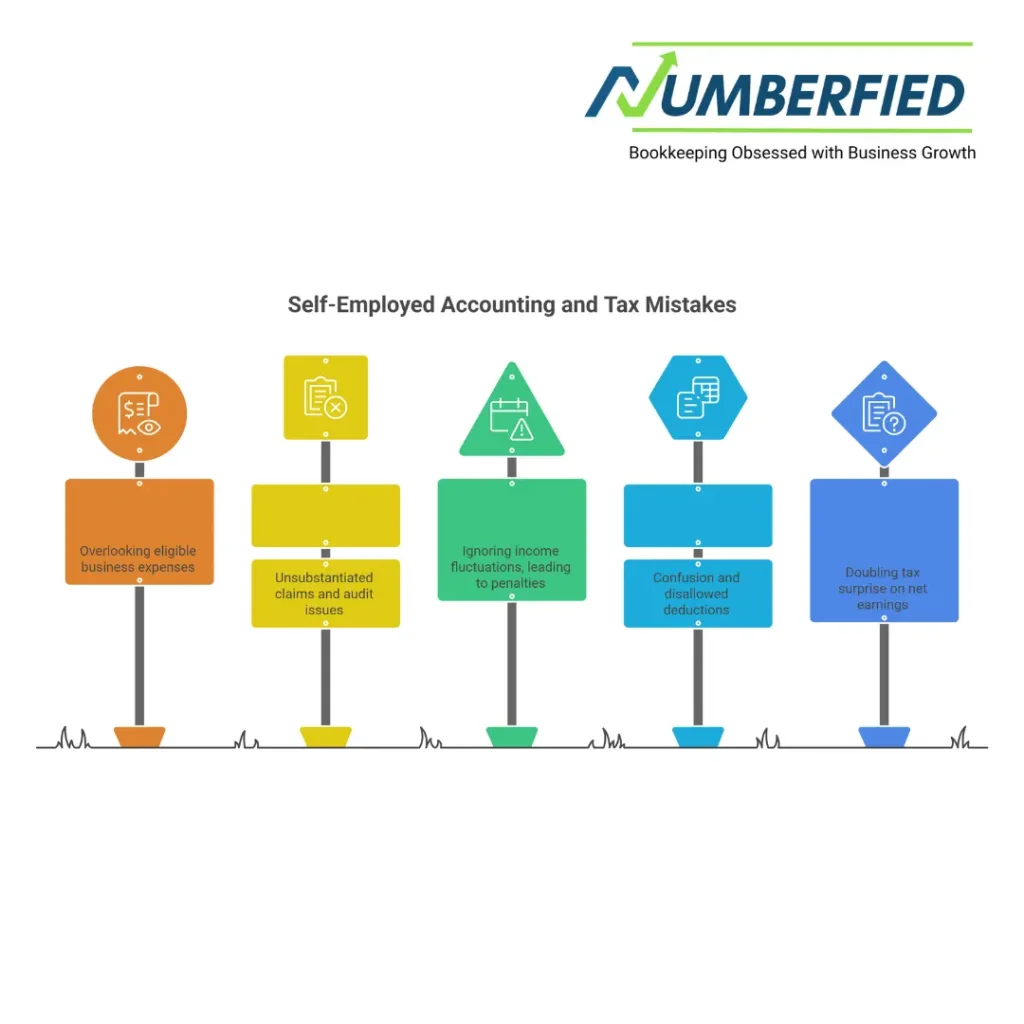
Common Mistakes to Avoid with Accounting and Tax Services for Self-Employed
Self-employed professionals often fall into these traps, even with help, awareness prevents them.
Missing Eligible Deductions
Many overlook deductions like internet costs, phone bills, or professional development. Use accounting and tax services for self-employed to audit expenses regularly and claim everything allowable.
Poor Record-Keeping Habits
Failing to log mileage or save receipts leads to unsubstantiated claims and audit issues. Implement apps like MileIQ or Expensify early to support your freelance bookkeeping and taxes.
Underpaying Quarterly Estimates
Basing estimates on last year’s income ignores fluctuations, leading to penalties. Adjust quarterly with professional self-employed tax services as earnings change.
Not Separating Business and Personal Finances
Using personal accounts for business creates confusion and disallows deductions. Open dedicated business banking from day one for clear accounting for independent contractors.
Ignoring Self-Employment Tax
Forgetting the 15.3% self-employment tax (Social Security/Medicare) on net earnings over $400 doubles your tax surprise. Factor it into estimates with tax preparation for self-employed.
Step-by-Step Guide to Choosing Accounting and Tax Services for Self-Employed
Follow this process to find a reliable provider.
Step 1: Assess Your Income and Needs
Estimate annual earnings and list requirements: basic 1099 tracking, full Schedule C prep, or retirement planning. Consider variable income patterns for self-employed tax services.
Step 2: Research Certified Providers
Look for EAs, CPAs, or tax pros with a self-employed focus on sites like the IRS directory or Yelp. Check reviews for experience with freelancers and gig workers.
Step 3: Evaluate Technology and Tools
Ensure compatibility with your apps (QuickBooks Self-Employed, FreshBooks). Virtual options should offer secure portals and mobile receipt capture for easy freelance bookkeeping and taxes.
Step 4: Compare Pricing and Packages
Request quotes for your income level, expect $200–$800 for basic annual returns, $500–$2,000 for ongoing support. Compare inclusions like audit protection.
Step 5: Check Compliance Expertise
Verify IRS certification and knowledge of self-employment specifics (SE tax, QBI deduction). Ask about audit representation experience.
Step 6: Review Communication and Fit
Schedule consultations to discuss your work style. Choose providers with flexible scheduling for gig workers’ irregular hours.
Step 7: Start with a Trial or Single Service
Begin with one tax return or quarter’s estimates to test accuracy and service before committing annually.
Conclusion
Accounting and tax services for self-employed professionals are crucial for maximising deductions, ensuring quarterly compliance, providing audit protection, and delivering financial clarity. By avoiding common mistakes and following a thoughtful selection process, you can find a partner that supports your independent lifestyle. As IRS trends evolve in 2026, professional help becomes even more valuable. Ready to take control of your finances? Request a free consultation today and see how accounting and tax services for self-employed can boost your earnings and peace of mind.
FAQ
How much does it cost to have taxes done by an accountant?
The cost to have taxes done by an accountant in the US typically ranges from $300 to $1,200 for individual returns and $800 to $3,500 for self-employed or small business returns in 2026. Prices depend on complexity (number of forms, income sources, deductions), location, and whether the accountant is a CPA or enrolled agent.
Do self-employed people need an accountant?
Yes, most self-employed people benefit greatly from an accountant, especially if income exceeds $50,000–$100,000 annually or involves multiple income streams, deductions, or quarterly estimated taxes. An accountant helps maximize deductions (home office, mileage, health insurance), calculate accurate quarterly payments to avoid penalties, and ensure proper Schedule C and self-employment tax reporting.
How much does an accountant charge for self-employed?
An accountant typically charges self-employed clients $800 to $3,500 for annual tax preparation and filing in 2026, with most falling between $1,000 and $2,500 for a standard Schedule C return. Monthly ongoing services (bookkeeping, quarterly estimates, planning) usually cost $300 to $1,500 per month, depending on transaction volume and complexity.
At what point is it worth getting an accountant?
It becomes worth getting an accountant when self-employment income reaches $40,000–$60,000 annually, when you have significant deductions (home office, vehicle, supplies), or when quarterly estimated taxes become complicated. The break-even point is usually when the accountant saves you more in deductions and penalties than their fee costs, often around $1,000–$2,000 in annual tax savings.
Should I get an accountant as an independent contractor?
Yes, most independent contractors should get an accountant, especially if you receive multiple 1099 forms, have variable income, claim home office or mileage deductions, or need to make quarterly estimated payments. An accountant ensures accurate Schedule C filing, proper self-employment tax calculation (15.3%), and maximum deductions, often saving far more than the cost of service.
Do I need payroll if I’m self-employed?
No, you generally do not need payroll services if you’re truly self-employed (sole proprietor or single-member LLC without employees), as you pay yourself through owner draws rather than a salary. You still must pay self-employment tax (Social Security and Medicare) on net earnings and make quarterly estimated payments.
How much does an accountant for self-employed cost?
An accountant for self-employed individuals typically costs $800–$3,500 for annual tax preparation and filing in 2026, with most fees falling between $1,000 and $2,500 for a standard Schedule C return. Ongoing monthly support (bookkeeping, quarterly estimates, planning) usually ranges from $300 to $1,500 per month, depending on transaction volume and complexity.
How much does it cost for someone to do their taxes self-employed?
The cost for someone to do their self-employed taxes generally ranges from $800 to $3,500 in 2026, depending on income complexity, number of deductions, and the states involved. A simple Schedule C return with few expenses often costs $800–$1,500, while returns with multiple income sources, home office, vehicle, or retirement contributions average $1,500–$2,500.
How much does it cost to have taxes done by an accountant?
Having taxes done by an accountant typically costs $300–$1,200 for individual returns and $800–$3,500 for self-employed or small business returns in 2026. Self-employed Schedule C returns with moderate complexity usually fall in the $1,000–$2,500 range, including basic planning and filing.
What is a reasonable CPA?
A reasonable CPA for self-employed clients charges $150–$350 per hour or $800–$3,000 for annual tax preparation in 2026, depending on complexity and location. They provide transparent fixed-fee quotes, clear communication, strong references, and measurable value through deductions, compliance, and planning.