

Introduction
Every small to medium business, startup, entrepreneur, sole proprietor, freelancer, self-employed professional, and growing e-commerce seller has a unique financial story. Generic bookkeeping packages force you into rigid templates that miss nuances in your industry, transaction patterns, deduction opportunities, and reporting needs. Custom bookkeeping services solve this by building a system specifically designed for your business. Your chart of accounts, categorization rules, reporting templates, automation workflows, and advisory focus are all shaped around how you actually operate.
In 2026, with IRS data-matching tightening, multi-channel e-commerce complexity increasing, and AI tools making personalization faster and more affordable, custom bookkeeping services have become one of the highest-ROI decisions growing businesses can make. These tailored solutions deliver higher accuracy, better deduction capture, improved cash-flow visibility, reduced compliance risk, and the peace of mind that comes from knowing your books truly reflect your reality.
This guide covers the real benefits of custom bookkeeping services, compares them to in-house/DIY and generic outsourced options, details the essential elements that make a service truly custom, highlights common mistakes to avoid, provides a step-by-step process for finding and implementing the right custom solution, reviews top specialized providers, and explores key customization trends in 2026 so you can choose a partner that grows with you.
Key Benefits of Custom Bookkeeping Services
Custom bookkeeping services provide advantages that generic packages simply cannot match.
Perfectly Matched Workflows & Higher Accuracy
Generic plans use one-size-fits-all charts of accounts and categorization rules that force your transactions into the wrong buckets. Custom bookkeeping services start with a detailed discovery process to map your exact business model, whether you’re a service-based freelancer, multi-channel e-commerce seller, contractor with job costing, or consultant with retainer billing. The result is precise categorization, fewer miscoded expenses, cleaner profit & loss statements, and significantly lower error rates (often 90–95%+ accuracy after onboarding vs. 70–80% with off-the-shelf services).
Better Deduction Capture & Tax Savings
Many businesses leave 10–30% of eligible deductions unclaimed because generic providers don’t know to look for them. Tailored bookkeeping services build custom rules and checklists for your industry: mileage patterns for rideshare drivers, home office square footage for remote consultants, COGS & freight-in allocation for e-commerce sellers, job-cost tracking for contractors, subscription software for SaaS businesses. This proactive deduction hunting often uncovers $3,000–$20,000+ in additional annual tax savings, far more than the extra cost of customization.
Improved Cash-Flow Visibility & Forecasting
Standard reports lump everything together; custom bookkeeping services create client-specific dashboards that show exactly what you need to see: cash runway by project, product-line profitability, seasonal cash-flow patterns, aged receivables by client type, burn rate, and breakeven point. Many include tailored forecasting models so you know when to hire, invest in inventory, or tighten expenses, giving you the clarity to make confident decisions.
Reduced Compliance Risk & Audit Readiness
Generic services may miss industry-specific compliance traps (e.g., sales tax nexus for online sellers, 1099-K thresholds, job-cost allocation rules for contractors). Personalized bookkeeping for small business builds compliance directly into your workflows: automated sales tax jurisdiction tracking, 1099 vendor monitoring, mileage log reminders, receipt substantiation requirements, and organized digital audit trails. This dramatically lowers audit risk and speeds up any IRS or state inquiry.
True Flexibility & Ownership of Your System
Unlike rigid packages, custom bookkeeping services evolve with your business. You own the custom chart of accounts, rules, templates, and integrations, meaning you’re never locked into a provider’s proprietary system. If you outgrow the relationship, you can take your tailored setup to another provider or bring it in-house without starting over.
In-House/DIY vs. Custom Outsourced Bookkeeping Comparison
Most businesses begin with DIY tools or in-house efforts, but custom outsourced bookkeeping usually outperforms both in accuracy, savings, and scalability.
Cost Comparison
DIY software (QuickBooks Self-Employed, Wave, Xero) costs $15–$50/month but requires your time and carries a high risk of errors. In-house bookkeeping averages $50,000–$85,000/year, including salary, benefits, taxes, software, and training. Custom bookkeeping services typically cost $800–$3,500/month ($9,600–$42,000/year), often saving more in tax deductions and penalty avoidance than the fee itself, especially when compared to the true cost of DIY mistakes or in-house overhead.
Fit, Accuracy & Customization Level
DIY and generic outsourcing force your business into predefined templates, leading to miscoded transactions and missed deductions. In-house staff eventually learn your needs, but it takes months/years and still lacks broad expertise. Bespoke outsourced bookkeeping starts with a deep discovery process to build your exact workflows, rules, and reports delivering higher accuracy (often 95%+ after onboarding) and better deduction capture than either alternative.
Flexibility & Scalability
In-house is rigid; adding volume means hiring, which takes time and adds fixed cost. Generic outsourcing offers some scalability, but within fixed package limits. Custom-fit bookkeeping solutions scale precisely: add hours, change scope, or adjust workflows as your business evolves, without long-term lock-in or hiring risk.
Control, Ownership & Technology Access
Some owners fear losing visibility or ownership with outsourcing. Modern custom bookkeeping services provide full transparency via shared cloud access, real-time dashboards, and client-owned setups. You keep control of your data and can transition providers or bring the system in-house if needed. In-house/DIY often lags in adopting advanced tools unless you invest heavily.
Essential Elements of Strong Custom Bookkeeping Services
What separates truly custom bookkeeping services from generic packages is attention to these details.
Dedicated Specialist Assigned to Your Account
The best custom bookkeeping services assign a single senior bookkeeper or a small, consistent team to your account, not a rotating pool. This dedicated specialist deeply understands your business, anticipates your needs, and maintains continuity, critical to accuracy and advisory value.
Industry-Specific Chart of Accounts & Categorization Rules
Generic charts force your transactions into broad buckets. Tailored bookkeeping services build a custom chart of accounts and rule set that mirrors your business model: job costing for contractors, product/SKU tracking for e-commerce, retainer vs. project billing for consultants, subscription revenue for SaaS. This ensures every transaction is coded correctly from day one.
Client-Specific Reporting Templates & Dashboards
Standard reports are one-size-fits-all. Personalized bookkeeping for small businesses creates custom templates showing the metrics you actually care about: cash runway by client/project, product-line profitability, burn rate, breakeven point, seasonal trends, and key ratios. Dashboards are tailored to your goals, whether cash-flow focused, profitability-focused, or growth-oriented.
Tailored Automation & Integrations
Generic providers use off-the-shelf rules. Custom solutions build automation specific to your workflows: custom bank feed rules, receipt parsing tailored to your vendors, automated invoice matching, custom alerts (e.g., low cash, overdue invoices, tax deadlines), and deep integrations with your tools (Shopify, Stripe, PayPal, CRM, POS, ERP).
Proactive Deduction Hunting & Advisory Notes
The best bespoke outsourced bookkeeping doesn’t just record; they hunt for deductions. They flag potential write-offs you may have missed (e.g., new home office equipment, mileage patterns, subscription software), suggest documentation improvements, and include monthly advisory notes highlighting planning opportunities (e.g., “Maximize SEP-IRA contribution by $X before year-end”).
Common Mistakes to Avoid with Custom Bookkeeping Services
These errors can turn a powerful custom solution into an expensive disappointment.
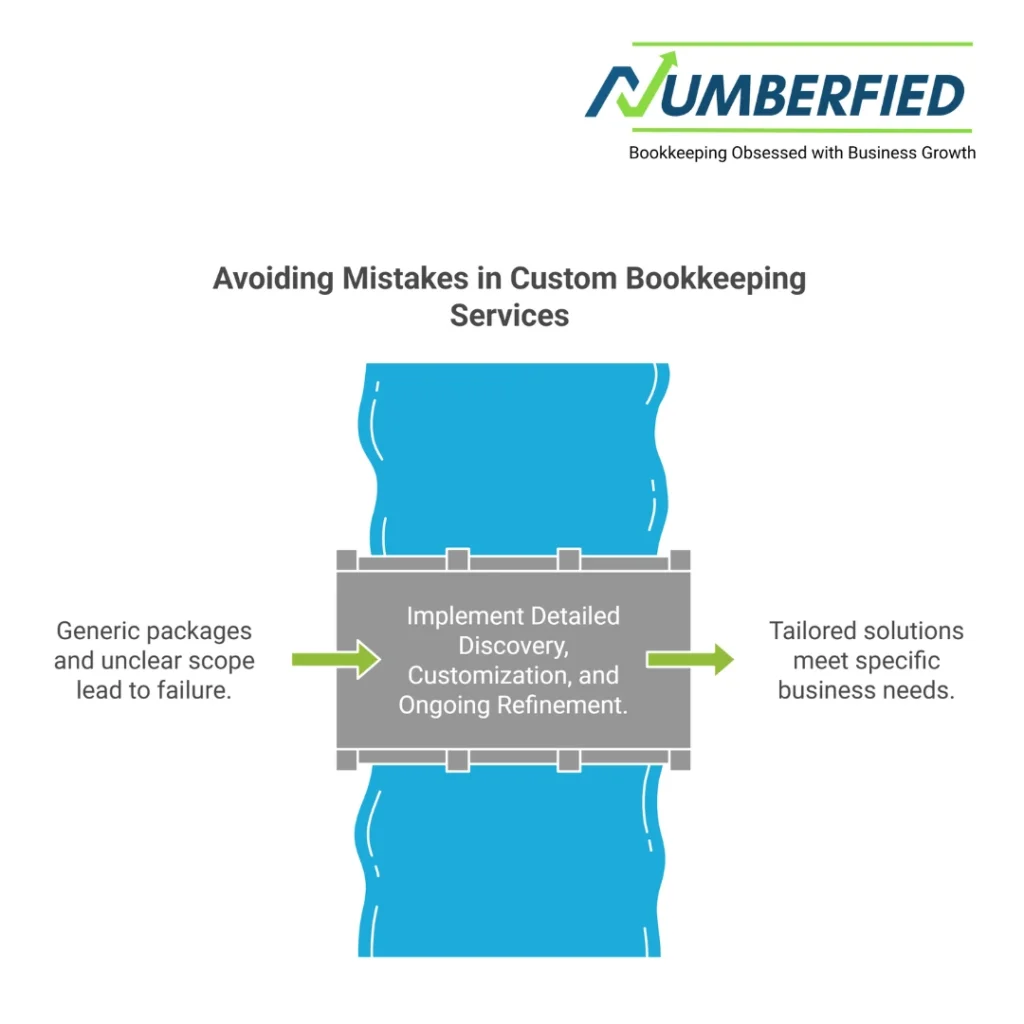
Choosing Generic Packages Instead of True Custom
Many providers advertise “custom” but deliver slightly modified standard packages. Insist on a detailed discovery call and written customization plan before signing true custom bookkeeping services should show exactly how they will adapt to your business.
Unclear Customization Scope & Expectations
Vague agreements lead to disappointment (“I thought you’d customize the chart of accounts”). Define exactly what will be customized (chart of accounts, rules, reports, automations, advisory focus) and document it in the SOW.
Skipping Detailed Discovery & Onboarding
Rushing onboarding with incomplete data creates months of corrections. Invest 2–4 weeks in thorough discovery (business model walkthrough, sample transactions, existing reports, goals) and clean handover before the service begins.
Underestimating Setup Time & Effort
Customization takes longer than generic onboarding, expect 4–12 weeks for full setup, depending on complexity. Plan for parallel processing and budget extra time in the first quarter.
Ignoring Ongoing Refinement & Feedback Loops
Custom isn’t “set it and forget it.” Schedule monthly refinement meetings to tweak rules, add new automations, and adjust reports as your business evolves. Providers who resist ongoing changes are not truly customer-focused.
Step-by-Step Guide to Finding & Implementing Custom Bookkeeping Services
Follow this process to select and activate a tailored solution.
Step 1: Conduct a Thorough Needs Assessment
Document your current pain points, transaction volume, industry model, deduction categories, compliance concerns, reporting needs, existing tools (QuickBooks, Xero, Shopify, etc.), and growth goals. This becomes your “customization blueprint.”
Step 2: Research Specialized Custom Providers
Search for “custom bookkeeping services” or “tailored bookkeeping for [your industry].” Focus on providers that emphasize discovery, customization, and senior-level oversight, not mass-market volume models. Look for QuickBooks ProAdvisor, Xero Advisor, or CPA/EA involvement.
Step 3: Schedule Customization Discovery Calls
Book 45–60 minute discovery calls with 3–5 shortlisted providers. Come prepared with your needs assessment and sample transactions. Ask:
- How do you build a custom chart of accounts and rules?
- What does your onboarding & customization timeline look like?
- Can you show examples of custom reports/dashboards for similar businesses?
- How do you handle ongoing refinement?
Step 4: Evaluate Proposals & Customization Plans
Request detailed proposals that include:
- custom chart of accounts & rule examples
- tailored reporting templates/mockups
- automation/integration plan
- dedicated specialist assignment
- onboarding timeline & deliverables
- pricing (fixed monthly + any setup fee)
- contract terms (scope, hour caps, change orders, termination)
Compare value true custom bookkeeping services should feel bespoke, not generic.
Step 5: Run a Paid Pilot or Limited Engagement
Start with a 1–3-month pilot on a subset of your books or specific tasks (e.g., one sales channel or one month of transactions). Test accuracy, communication, customization quality, and reporting usefulness before committing to the long term.
Step 6: Onboard & Implement the Custom System
Provide clean historical data, connect all feeds/integrations, and collaborate on the final chart of accounts, rules, and templates. Run parallel processing for the first month to validate accuracy. Hold weekly alignment calls for the first 60–90 days.
Step 7: Optimize & Refine Continuously
Schedule monthly refinement meetings to tweak rules, add automations, update reports, and review advisory notes. Treat the relationship as a partnership. Regular feedback keeps the system perfectly aligned with your evolving business.
Top Specialized Custom Bookkeeping Providers & Customization Trends in 2026
Key customization trends in 2026:
- AI-assisted rule learning: tools analyze your past transactions to suggest and auto-refine categorization rules, cutting setup time by 50–70%.
- Vertical-specific packages: pre-built but fully customizable frameworks for e-commerce (Shopify/Amazon reconciliation), contractors (job costing), professional services (retainer billing), SaaS (MRR tracking), and restaurants (inventory/POS integration).
- Fractional senior bookkeeper access: senior-level oversight (CPA/EA) for 5–15 hours/month on top of junior execution, blending cost and expertise.
- Deeper CRM/ERP/POS integrations: seamless two-way sync with HubSpot, Salesforce, Shopify, Square, Toast, Lightspeed, and NetSuite for end-to-end accuracy.
- ESG & sustainability tracking modules: custom categories and reporting for carbon tracking, sustainable sourcing, and impact metrics as green certifications and funding requirements grow.
Conclusion
Custom bookkeeping services give small to medium businesses, startups, entrepreneurs, sole proprietors, freelancers, self-employed professionals, and growing e-commerce sellers perfectly matched workflows, higher accuracy, better deduction capture, improved cash-flow visibility, and reduced compliance risk, delivering ROI that generic packages can’t match. By investing in true customization and avoiding common mistakes, you create a financial system that evolves with your business and becomes a competitive advantage. As AI rule learning, vertical packages, fractional senior access, deeper integrations, and ESG tracking accelerate in 2026, custom solutions become even more powerful. Ready to stop forcing your business into a generic box? Schedule a free customization consultation today with a specialized provider and build bookkeeping that finally fits you perfectly.
FAQ
How much do custom bookkeeping services cost compared to standard packages?
Custom bookkeeping services usually cost 20–50% more than standard packages ($800–$3,500/month in 2026), depending on complexity and customization depth. The extra cost is often offset by higher accuracy, more deductions captured, and better reporting value.
What value do custom bookkeeping services provide over generic options?
Custom bookkeeping services deliver perfectly matched workflows, industry-specific accuracy, better deduction capture (often $3,000–$20,000+ in annual tax savings), tailored reports/dashboards, and proactive advisory notes, creating a financial system that truly reflects your business and supports better decisions.
What does “custom” actually mean in custom bookkeeping services?
Custom means your chart of accounts, categorization rules, reporting templates, automations, integrations, and advisory focus are built specifically for your business model, industry, and goals, not forced into a generic template. It includes a detailed discovery process and ongoing refinement.
How do I know if I need custom bookkeeping services vs. off-the-shelf?
You likely need custom if you have unique transaction patterns, industry-specific compliance needs, complex deductions (e.g., job costing, multi-channel e-commerce, retainers), or want tailored reports/dashboards. If your business fits a standard template (simple service-based, low volume), off-the-shelf may suffice.
How do custom bookkeeping services differ from generic outsourced bookkeeping?
Generic outsourced bookkeeping uses one-size-fits-all processes and templates; custom bookkeeping services start with a deep discovery phase to build your exact workflows, rules, reports, and automations. The result is higher accuracy, more deductions, better insights, and a system you truly own.
Is my data secure with custom bookkeeping services?
Yes, reputable custom bookkeeping services use bank-level encryption, two-factor authentication, secure client portals, role-based access, regular backups, and SOC 2 compliance or similar standards. Never share full bank logins; use accountant-specific read-only access or bank feeds.
What are the latest trends in custom bookkeeping services for 2026?
Trends include AI-assisted rule learning (auto-refining categorization from your data), vertical-specific customizable packages, fractional senior bookkeeper access, deeper CRM/ERP/POS integrations, and ESG/sustainability tracking modules as green certifications and funding requirements grow.
What are red flags when requesting custom bookkeeping services?
Red flags include providers who skip a detailed discovery call, offer “custom” without showing examples of past customizations, present vague scope proposals, lack senior oversight, refuse to provide references, or pressure to sign without a clear customization plan.
How can I get started with custom bookkeeping services?
Start by documenting your current pain points, transaction patterns, industry needs, and goals, then research providers who emphasize customization. Schedule discovery calls with 3–5 shortlisted options, request a written customization plan, and begin with a paid pilot or limited engagement to test fit.
Are custom bookkeeping services suitable for different business types and sizes?
Yes, freelancers benefit from tailored deduction tracking & simple reporting; e-commerce sellers gain from SKU-level COGS & multi-channel reconciliation; service-based firms get custom retainer billing & project tracking; growing SMBs leverage advisory & scalability. Custom bookkeeping services adapt to any size or type.
Read Also: Why Accounting and Bookkeeping Services Will Change Your Business for the Better!