

Introduction
As a small to medium business owner, startup founder, entrepreneur, sole proprietor, freelancer, or self-employed professional, your time is one of your most limited resources. Virtual assistant bookkeeping services give you professional financial support without the expense or commitment of a full-time employee. A trained virtual assistant (VA) handles day-to-day bookkeeping tasks remotely, using secure cloud tools to keep your records accurate, up-to-date, and compliant while you focus on revenue-generating work.
These services have grown rapidly in popularity because they combine affordability with high-quality execution. You get transaction categorization, bank reconciliations, bill payments, invoicing, monthly reporting, and even basic tax-prep support, all delivered by a dedicated remote assistant who works your hours and scales with your business. In 2026, with AI handling routine matching and stronger security standards across platforms, virtual assistant bookkeeping services are more reliable and capable than ever.
This guide covers the real benefits, compares in-house vs virtual models, details the core tasks a VA handles, addresses common challenges and mistakes, provides a step-by-step hiring process, reviews leading platforms and providers, highlights 2026 trends, and shows you how to get started confidently.
Key Benefits of Virtual Assistant Bookkeeping Services
Virtual assistant bookkeeping services solve several pain points that small business owners face every day.
Cost-Effective Expertise
The biggest draw is cost. A full-time in-house bookkeeper in the US typically costs $45,000–$75,000 per year (salary + benefits + taxes + software + training). Virtual assistant bookkeeping services usually run $800–$2,800 per month (roughly $9,600–$33,600 annually), with no employment overhead. You pay only for the hours or package you need, gaining certified or highly trained bookkeeping expertise at 40–70% less than traditional staffing.
Significant Time Savings
Manual transaction entry, chasing receipts, reconciling accounts, paying bills, and chasing invoices can easily eat 10–25 hours a month. A virtual assistant for bookkeeping takes over these repetitive tasks, freeing you to focus on client work, marketing, product development, or simply taking a weekend off. Many owners report reclaiming 15+ hours per month once the VA is fully onboarded.
Scalability That Matches Your Growth
Unlike a full-time hire, virtual assistant bookkeeping services scale up or down instantly. During launch or peak seasons, you can increase hours; in quieter periods, you reduce them, with no awkward conversations or severance costs. This flexibility is perfect for startups with unpredictable revenue or freelancers who have busy and slow months.
Real-Time Financial Visibility
Most virtual bookkeeping assistant arrangements use cloud platforms (QuickBooks Online, Xero, Wave, Zoho Books) with live bank feeds and client portals. You log in any time to see the current cash balance, outstanding invoices, upcoming bills, profit & loss, and cash flow trends. No more waiting for “the books to be done” at month-end.
Compliance & Accuracy You Can Trust
A good virtual assistant for bookkeeping ensures transactions are categorized correctly (deductible vs. non-deductible), reconciliations are complete, and basic compliance items (quarterly estimated taxes reminders, 1099 tracking) are handled. While VAs do not prepare or sign tax returns (that requires a CPA/EA), they deliver clean, organized books that make tax season faster and less expensive for your accountant.
In-House vs. Virtual Assistant Bookkeeping Comparison
Understanding the differences helps you decide whether a virtual assistant bookkeeping services model fits your business.
Cost Structure & Savings
In-house bookkeeping carries fixed costs: salary ($40,000–$65,000 base for junior roles), payroll taxes (~10–15%), benefits (health insurance, 401(k) match), software licenses, training, and office overhead. Virtual assistant bookkeeping services typically cost $20–$60 per hour or $800–$2,800 monthly fixed, with no benefits or long-term commitment. Most small businesses save 50–75% going virtual.
Expertise & Specialization
In-house hires often start with general skills and learn your business over time. Virtual assistants can be chosen for niche experience (e-commerce, professional services, SaaS subscriptions, contractors) and usually come pre-trained on modern cloud tools. Many VAs have QuickBooks Online ProAdvisor certification or Xero advisor status.
Scalability & Flexibility
In-house is rigid: hiring takes weeks/months, and reducing hours can be awkward. Virtual assistant bookkeeping services allow you to add or subtract hours week-to-week or month-to-month. If a project ends or revenue dips, you simply reduce the VA’s schedule, with no HR paperwork.
Control, Oversight & Communication
Some owners worry about losing visibility with remote help. Modern virtual bookkeeping assistant setups include shared cloud access, daily/weekly status updates via Slack/Asana/email, scheduled video check-ins, and real-time dashboards. You see everything the VA sees, often faster than you would with an in-house person buried in desktop software.
Essential Tasks Handled by Virtual Assistant Bookkeeping Services
A capable virtual assistant for bookkeeping typically manages these recurring tasks, customized to your business.
Transaction Categorization & Coding
Daily/weekly import of bank, credit card, and payment processor feeds (Stripe, PayPal, Square, Shopify Payments). The VA categorizes every transaction (office supplies, advertising, travel, COGS, etc.) using your chart of accounts and custom rules, ensuring accurate profit & loss reporting.
Bank & Credit Card Reconciliations
Matching imported transactions to bank/credit card statements, investigating discrepancies, and clearing reconciled items. This keeps your books accurate and catches errors (duplicate charges, missing deposits) early.
Accounts Payable: Bill Pay & Vendor Management
Entering vendor bills, matching to purchase orders (if used), scheduling payments, and executing bill pay through your bank or bill-pay platform. The VA ensures discounts are taken and late fees are avoided.
Accounts Receivable: Invoicing & Collections
Creating and sending invoices (recurring or one-off), tracking open receivables, sending polite follow-up reminders, and recording payments. Many VAs integrate with invoicing tools (Wave, FreshBooks, QuickBooks) for automation.
Monthly Financial Reporting
Preparing and delivering clean monthly reports: profit & loss statement, balance sheet, cash flow statement, aged receivables/payables, and key performance indicators (gross margin, burn rate, runway). Some include custom dashboards or variance analysis.
Basic Tax-Prep Support & Compliance Reminders
Tracking deductible expenses, collecting 1099 information from vendors/contractors, reminding you of quarterly estimated tax due dates, and preparing clean trial balances for your CPA/EA. Virtual assistant bookkeeping services do not prepare or sign tax returns that require a licensed tax professional.
Common Challenges & Mistakes with Virtual Assistant Bookkeeping Services
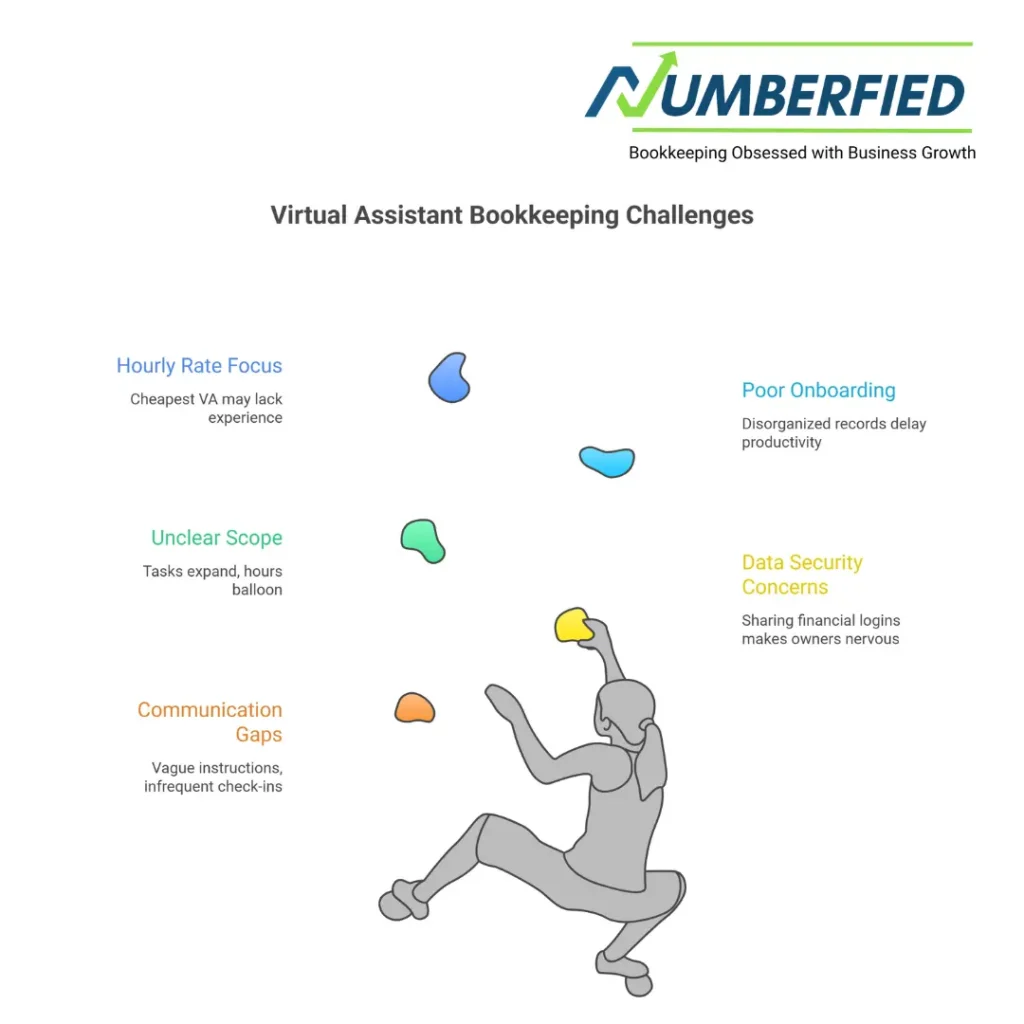
Even great virtual assistants can under-deliver if these common issues are not addressed.
Communication Gaps & Misaligned Expectations
Vague instructions, infrequent check-ins, or mismatched time zones cause frustration. Solution: set clear weekly meeting times, use shared task tools (Asana, Trello), and document processes in a shared Google Doc or Notion page from day one.
Data Security Concerns
Sharing financial logins makes some owners nervous. Choose VAs who use secure practices: unique logins per client, password managers, two-factor authentication everywhere, and platforms with SOC 2 or similar compliance. Never share full bank credentials; use read-only bank feeds or accountant-specific access.
Unclear Scope & “Scope Creep”
Without a detailed agreement, tasks expand (“Can you just do this one thing?”) and hours balloon. Solution: define exact tasks, monthly hour caps, and extra-hour rates in the contract before starting.
Poor Onboarding & Data Handover
Sending disorganized records or incomplete access information delays productivity. Create a shared onboarding folder with: a chart of accounts, prior year financials, login instructions, a recurring bills list, and key processes before the VA starts.
Choosing a VA Based Only on Hourly Rate
The cheapest VA may lack experience, certifications, or reliability. Look for QuickBooks Online ProAdvisor, Xero Certified Advisor, or similar credentials, strong reviews, and relevant industry experience rather than the lowest rate.
Step-by-Step Guide to Hiring & Working with Virtual Assistant Bookkeeping Services
Follow this proven process to hire and onboard effectively.
Step 1: Define Your Bookkeeping Needs & Budget
List must-have tasks (transaction entry, reconciliations, bill pay, invoicing, reporting), desired frequency (daily/weekly/monthly), and monthly hour estimate. Set a realistic budget. Most small businesses spend $800–$2,500/month for 20–40 hours of virtual assistant bookkeeping services.
Step 2: Decide Onshore vs. Offshore
Onshore VAs (US-based) cost more ($30–$60/hour) but offer same-time-zone communication and deeper IRS knowledge. Offshore VAs (Philippines, India, Eastern Europe) cost less ($10–$25/hour) and often work US hours. Many businesses start offshore for cost and move onshore for complex advisory.
Step 3: Source Candidates on Trusted Platforms
Popular platforms for virtual assistant bookkeeping services include:
- Upwork (large pool, skills tests, hourly & fixed-price contracts)
- Belay or Time Etc (US-based, vetted VAs with bookkeeping experience)
- OnlineJobs.ph (Philippines-based, direct hire model)
- Fancy Hands or Boldly (managed VA services with bookkeeping specialists)
Filter for QuickBooks Online ProAdvisor, Xero certification, or similar credentials.
Step 4: Screen & Interview Thoroughly
Review profiles for:
- Relevant experience (small business, QuickBooks/Xero proficiency)
- Certifications or completed courses
- Client reviews & feedback scores
- Written communication quality
Conduct 2–3 video interviews. Ask:
- “Walk me through how you reconcile a bank account in QuickBooks Online.”
- “How do you handle a client who sends receipts late?”
- “What tools do you use for secure file sharing and communication?”
Assign a small paid test task (e.g., categorize one month of transactions) to evaluate accuracy and process.
Step 5: Draft a Clear Agreement & Onboard
Use a simple contract that covers:
- Scope of work & monthly hour cap
- Hourly rate or fixed monthly fee
- Payment terms (weekly/bi-weekly via Wise/PayPal)
- Confidentiality & data security clauses
- Termination notice (usually 2–4 weeks)
Create an onboarding folder (Google Drive/Notion) with:
- Chart of accounts & naming conventions
- Login instructions (read-only bank feeds, accountant access)
- Recurring bills list
- Key processes (how to code advertising, travel, etc.)
- Communication cadence (Slack daily, Zoom weekly)
Step 6: Monitor, Give Feedback & Optimize
Review work weekly in the first month, then monthly. Use shared task tools to track progress. Provide constructive feedback early. Once trust is built, increase the scope or automate more tasks.
Step 7: Scale or Transition as Needed
As your business grows, add hours, bring on a second VA, or transition to a fractional bookkeeper/CPA for more advanced work. Good VAs often refer trusted colleagues when capacity is reached.
Key trends shaping virtual assistant bookkeeping services in 2026:
- AI tools (Dext, Hubdoc, DocuClipper) handle 70–80% of receipt/transaction categorization, letting VAs focus on review and advisory.
- Specialized VA niches: e-commerce (Shopify/Amazon reconciliation), professional services (retainer invoicing), contractors (job costing), and SaaS (MRR tracking).
- Security standards rising SOC 2 Type II compliance, end-to-end encryption, and regular penetration testing are now table stakes.
- Fractional “bookkeeper + light advisory” roles are growing, where VAs work alongside your CPA for year-round planning.
- Increased demand for ESG/sustainability tracking as more small businesses pursue green certifications or impact funding.
Conclusion
Virtual assistant bookkeeping services give small to medium businesses, startups, entrepreneurs, sole proprietors, freelancers, and self-employed professionals a cost-effective, scalable way to maintain accurate books, stay compliant, and gain real-time financial visibility without hiring full-time staff. By avoiding common pitfalls and following a structured hiring process, you can build a reliable remote partnership that grows with your business. As AI automation and security standards continue to improve in 2026, virtual support becomes even more powerful.
Ready to simplify your finances and reclaim your time? Find your virtual bookkeeping assistant today, request a consultation, or post a job on a trusted platform, and take the first step toward stress-free books.
FAQ
How much do virtual assistant bookkeeping services cost?
Virtual assistant bookkeeping services typically cost $800–$2,800 per month in 2026 for 20–40 hours of support. Hourly rates range from $20–$60, depending on location (US-based higher, offshore lower) and experience level.
Are virtual assistant bookkeeping services worth it for small businesses?
Yes, most small businesses and startups find them highly worthwhile.They save 50–75% compared to full-time staff, deliver accurate books, ensure compliance, and free up 10–25 hours per month for revenue-generating work.
What tasks do virtual assistant bookkeeping services usually handle?
Typical tasks include transaction categorization, bank/credit card reconciliations, accounts payable (bill entry & pay), accounts receivable (invoicing & collections), monthly financial reporting, and basic tax-prep support (1099 tracking, deduction organization).Many VAs also manage expense receipt capture and payroll entry.
How do I choose the right virtual assistant bookkeeping services?
Start by defining your needs and monthly hour budget, then search platforms like Upwork, Belay, or OnlineJobs.ph for VAs with QuickBooks/Xero certification and relevant reviews.Interview 3–5 candidates, assign a small paid test task, check references, and draft a clear scope agreement before starting.
How do virtual assistant bookkeeping services differ from traditional bookkeepers?
Virtual assistants work remotely via cloud tools, offer more flexible hours/scaling, and usually cost less than traditional in-office or full-time bookkeepers.Traditional bookkeepers may provide in-person meetings, but often come with higher fixed costs and less scalability.
Is my data safe with virtual assistant bookkeeping services?
Yes, reputable virtual assistant bookkeeping services use bank-level encryption, two-factor authentication, secure client portals, and password managers.Look for SOC 2 compliance or similar certifications, and never share full bank login credentials; use accountant-specific read-only access instead.
What are the latest trends in virtual assistant bookkeeping services for 2026?
AI tools now automate 70–80% of transaction categorization and receipt processing, letting VAs focus on review and advisory.Specialized niches (e-commerce, contractors, SaaS), stronger cybersecurity standards, and fractional “bookkeeper + light advisory” roles are growing rapidly.
What red flags should I watch for when hiring virtual assistant bookkeeping services?
Red flags include very low rates with no certifications, vague scope descriptions, reluctance to do a paid test task, poor written/spoken English (for US clients), no references, and pressure to start without a contract.
How do I get started with virtual assistant bookkeeping services?
Define your must-have tasks and monthly budget, post a detailed job on Upwork/Belay/OnlineJobs.ph, screen for QuickBooks/Xero experience, interview top candidates, assign a small paid test, and draft a clear agreement.Many VAs can be fully onboarded in 1–2 weeks. Start now to reclaim your time.
Are virtual assistant bookkeeping services suitable for different business sizes?
Yes, they work well for solopreneurs (10–20 hours/month), small teams (20–40 hours), and growing SMBs (40+ hours).Packages scale easily: basic transaction entry for freelancers, full AP/AR + reporting for startups, or advanced advisory for businesses preparing for funding or acquisition.
Read Also: Virtual Bookkeeping Services for Small Businesses That’ll Change Your Life!