
Introduction
Deciding whether outsourcing QuickBooks bookkeeping makes sense for your business is a significant operational decision that can impact efficiency, accuracy, and overall financial visibility. This article explores the tangible benefits of outsourcing, such as cost savings and access to expertise, alongside realistic challenges like data control and communication. We also cover key US compliance considerations, how to evaluate and select the right provider, and the tools and integrations that support seamless bookkeeping workflows. In addition, we outline how outsourced bookkeeping fits into tax preparation processes, what to expect during onboarding, and how to calculate return on investment. We aim to provide clear, practical, and actionable guidance so you can confidently determine whether outsourcing your QuickBooks bookkeeping aligns with your business goals.
Key Takeaways
- Outsourcing QuickBooks bookkeeping reduces overhead and gains access to trained professionals.
- Expect improved accuracy, timely reporting, and scalable support.
- Challenges include data privacy, systems integration, and required oversight.
- Choose providers with US compliance experience (IRS, GAAP), strong references, and transparent pricing.
- Onboarding, clear processes, and the right tools accelerate ROI.
Why Outsourcing QuickBooks Bookkeeping Delivers Value
Outsourcing QuickBooks bookkeeping centralizes bookkeeping tasks to specialized teams, lowering the cost per transaction and increasing consistency in financial records. For US business owners focused on growth and daily operations, moving bookkeeping off-site can free internal resources and deliver reliable month-end close cycles.
Cost Savings and Predictable Pricing
Outsourcing QuickBooks bookkeeping converts unpredictable labor costs into predictable monthly fees. You avoid benefits, payroll taxes, recruiting, and training expenses. Many providers offer pricing tiers aligned with transaction volume, making budgeting straightforward.
Access to Expertise and Best Practices
Skilled bookkeeping teams follow established workflows and reconciliation routines. Outsourcing QuickBooks bookkeeping provides access to professionals who understand the chart of accounts design, accrual vs. cash reporting, and clean audit trails, skills that internal staff may lack.
Scalability and Operational Flexibility
As your business grows or experiences seasonal cycles, outsourcing QuickBooks bookkeeping scales up or down without the complexity of hiring or layoffs. This flexibility supports rapid expansion or temporary slowdowns with minimal disruption.
Common Challenges When Outsourcing QuickBooks Bookkeeping
While benefits are substantial, realistic challenges must be managed. Identify issues early and clearly define responsibilities in your service agreement.
Data Privacy and Security
Outsourcing QuickBooks bookkeeping requires granting access to sensitive financial data. Ensure providers use multi-factor authentication, role-based access, encryption at rest and in transit, and regular security audits. Verify data breach policies and insurance coverage.
Systems Integration and Workflow Alignment
Integrating point-of-sale systems, payment processors, payroll, and inventory software with QuickBooks is a technical task. Providers should document integration steps, mapping rules, and troubleshooting protocols to maintain accurate books.
Oversight and Quality Control
Even with an outsourced team, business owners must define oversight routines, including monthly reconciliation reviews, variance analysis, and sign-off authority for financial statements. Regular KPIs and periodic audits maintain quality.
US Compliance: IRS, GAAP, and State Requirements
Compliance in the United States requires adherence to IRS tax rules, generally accepted accounting principles (GAAP) for financial reporting where applicable, and state-specific sales tax and employment regulations.
IRS Considerations
Accurate recordkeeping supports IRS obligations: payroll tax filings, 1099 reporting for contractors, deductible expenses, and accurate income reporting. Outsourcing QuickBooks bookkeeping can reduce audit risk if records are complete, timely, and well-documented.
GAAP and Accurate Financial Statements
Larger private companies or those seeking financing may need GAAP-compliant financials. Providers experienced in GAAP understand accrual accounting, depreciation schedules, and appropriate classification of expenses and liabilities.
State and Local Sales Tax
Sales and use tax rules differ by state and by transaction type. Outsourcing QuickBooks bookkeeping to a provider familiar with your state obligations minimizes under- or over-collection and supports accurate returns.
How to Select a Provider for Outsourcing QuickBooks Bookkeeping
Choosing the right partner is critical. Use a structured evaluation covering credentials, processes, tools, and culture fit.
Verify Experience and References
Request case studies or references from businesses similar in size and industry. Confirm experience with QuickBooks versions you use (Online, Desktop) and with US tax contexts.
Check Certifications and Controls
Look for QuickBooks ProAdvisor status, CPA partnerships, SOC 2 or ISO controls, and documented internal review processes. Certifications signal technical competence and security awareness.
Evaluate Communication and Reporting
Assess how the provider reports: frequency of financial reports, access to dashboards, and responsiveness. Clear SLAs for turnaround times and issue escalation are important.
Tools and Technology: QuickBooks, Xero, and Integrations
Cloud tools accelerate bookkeeping workflows and improve data access. QuickBooks remains a leading platform for US small and mid-sized businesses, but alternatives like Xero can also integrate with your stack.
QuickBooks Online vs Desktop
QuickBooks Online offers real-time access, automatic updates, and seamless integrations with payment processors and payroll. QuickBooks Desktop still serves businesses with complex inventory or custom reporting needs. Confirm with your provider which platform aligns with your requirements when outsourcing QuickBooks bookkeeping.
Third-Party Integrations
Popular integrations include payroll providers (Gusto, ADP), payment processors (Stripe, Square), CRM systems, and inventory platforms. Providers should map transactions consistently and regularly reconcile integrated systems with QuickBooks.
Automation and Bank Feeds
Bank feeds, categorization rules, and automation reduce manual entry. A good outsourcing partner configures these tools to minimize exceptions and streamline monthly closes when outsourcing QuickBooks bookkeeping.
Tax Preparation and Year-End Close
Outsourcing QuickBooks bookkeeping improves tax readiness by maintaining clean ledgers, preparing necessary schedules, and coordinating with tax preparers.
Monthly Close and Documentation
Consistent monthly reconciliations, fixed asset schedules, and accrual adjustments simplify tax preparation. Providers should supply workpapers and reconciliations that tax professionals can use directly.
Coordination with CPAs
A coordinated workflow between the bookkeeping provider and your CPA reduces duplication and costs. Establish an annual calendar for close, schedules, and tax deliverables when outsourcing QuickBooks bookkeeping.
Support for Audits and Inquiries
If an audit or IRS inquiry occurs, an experienced provider can quickly assemble transaction histories, supporting documents, and reconciliation reports, reducing disruption and potential penalties.
Onboarding: Steps to a Smooth Transition
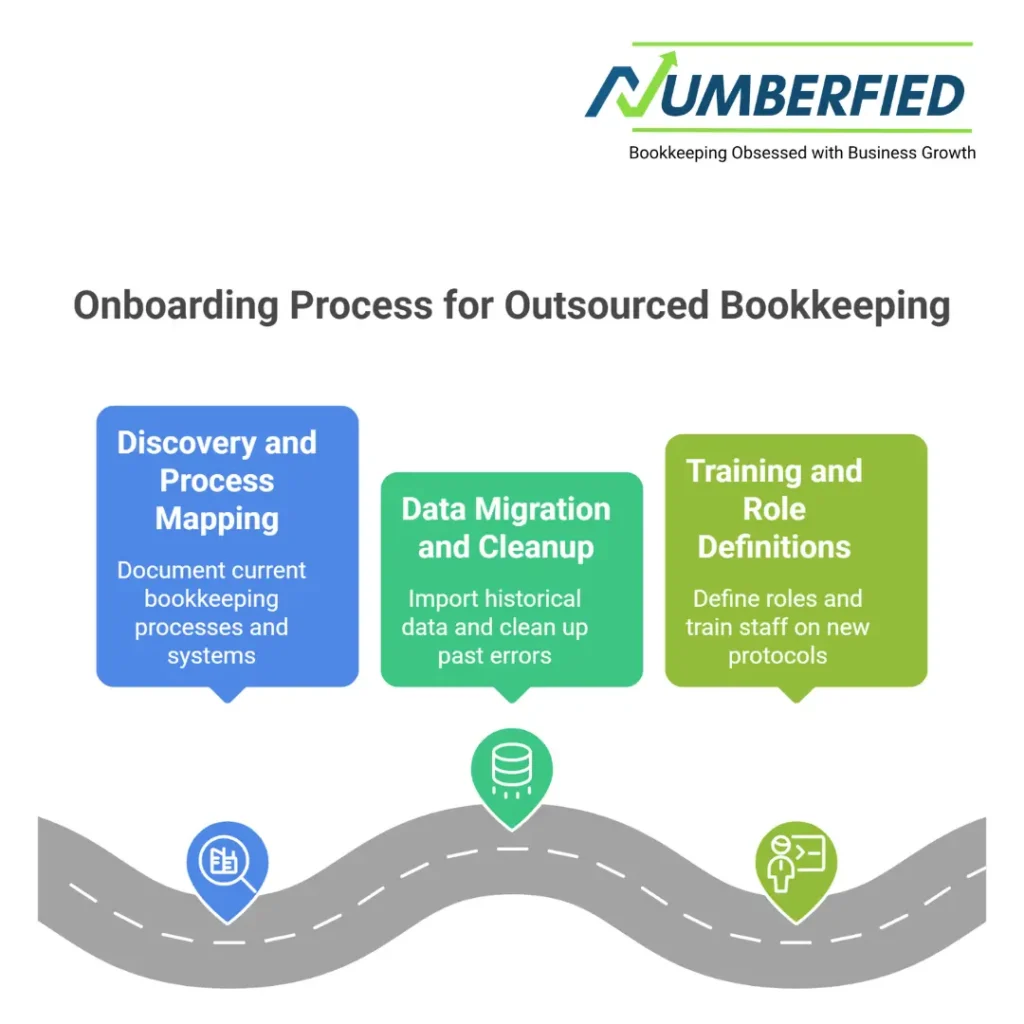
Effective onboarding sets expectations and accelerates value. A typical process includes discovery, access setup, data migration, workflow definition, and training.
Discovery and Process Mapping
Start with a discovery phase to document current bookkeeping processes, systems, and pain points. Clear process maps ensure the provider understands transaction flows and reporting needs.
Data Migration and Cleanup
Historical data import, chart of accounts consolidation, and clean-up tasks are necessary to avoid compounding past errors. Define the migration period and agree on reconciliation milestones when outsourcing QuickBooks bookkeeping.
Training and Role Definitions
Define roles for your internal team and the provider. Train staff on access protocols, approval workflows, and communication channels. Regular check-ins during the first 90 days reveal gaps that can be corrected quickly.
Measuring ROI from Outsourcing QuickBooks Bookkeeping
Quantifying return on investment requires tracking cost savings, time recovered, error reduction, and improved financial visibility.
Direct Cost Comparisons
Compare total internal costs (salary, benefits, equipment, training) to the provider’s fees. Include recruiting and turnover costs to get a true picture of savings from outsourcing QuickBooks bookkeeping.
Time Savings and Opportunity Cost
Estimate hours freed for leadership and staff to focus on revenue-generating activities. Multiply saved hours by effective hourly rates to estimate opportunity gains.
Improved Financial Decisions
Timely and accurate financial reporting supports better pricing, cash flow management, and capital planning. Assign a conservative value to improved decision-making benefits when calculating ROI for outsourcing QuickBooks bookkeeping.
Pricing Models and Contract Considerations
Understand common pricing models: per-transaction, monthly flat-fee, or tiered plans. Review contract terms for termination, data ownership, and service levels.
Transparent Billing and Scope
Insist on clear definitions of what is included. Unexpected add-ons can erode savings. A defined scope reduces scope creep when outsourcing QuickBooks bookkeeping.
Data Ownership and Exit Strategy
Confirm that you retain ownership of all accounting data and that the provider will return or migrate data in a standard format. Plan for a structured exit to avoid operational gaps.
Security and Compliance Clauses
Include data security requirements, breach notification timelines, and evidence of compliance with relevant standards in the contract to protect your business when outsourcing QuickBooks bookkeeping.
Operational Best Practices Post-Transition
Maintain oversight without micromanaging. Set KPIs, schedule periodic third-party reviews, and use dashboards to track cash flow, AR/AP aging, and profitability.
Monthly Review Meetings
Hold a monthly financial review focusing on variances, cash flow forecast, and open reconciliation items. Use these meetings to refine categories and reporting templates.
Annual Process Audit
Commission an annual audit of bookkeeping processes and controls. This independent check ensures continued compliance and process improvements when outsourcing QuickBooks bookkeeping.
Continuous Improvement
Encourage providers to propose efficiency gains, automation opportunities, and reporting enhancements as part of ongoing service. A proactive partner increases long-term value.
Industry-Specific Considerations
Certain sectors have specialized needs: e-commerce requires sales tax and marketplace reconciliations, construction needs job costing, and nonprofits need fund accounting. Choose a provider with relevant industry experience when outsourcing QuickBooks bookkeeping.
E-commerce and Marketplaces
Reconcile marketplace fees, chargebacks, and multi-state sales tax. Ensure the provider configures rules for common exceptions and performs inventory reconciliations where applicable.
Construction and Job Costing
Accurate job costing requires committed processes for labor, materials, and subcontractor tracking. Verify the provider’s experience with job costing features in QuickBooks or integrated systems.
Nonprofit Fund Accounting
Nonprofits require restricted fund tracking, grant reporting, and donor contribution statements. Confirm that the provider can handle fund designations and reporting requirements.
Conclusion
Outsourcing QuickBooks bookkeeping offers measurable benefits: cost savings, access to expertise, scalability, and improved compliance for US businesses. Challenges such as data privacy, integration, and oversight are manageable with careful provider selection, clear contracts, and defined processes. For business owners seeking to reclaim time and improve financial visibility, outsourcing QuickBooks bookkeeping is a practical option. If you want a thorough evaluation or a tailored plan, contact Numberfied for a confidential conversation and a customized proposal.
Frequently Asked Questions
What businesses benefit most from outsourcing QuickBooks bookkeeping?
Small to mid-sized businesses with recurring transactions, seasonal volume, or limited internal accounting resources benefit most. Companies seeking predictable costs and professional reporting gain the most value.
How secure is my financial data when outsourcing QuickBooks bookkeeping?
Security depends on provider controls: encryption, access management, SOC reports, and contractual clauses. Request documentation and ensure multi-factor authentication and regular audits are in place.
Can outsourcing QuickBooks bookkeeping reduce my tax preparation costs?
Yes. Clean, reconciled books reduce the time your CPA spends preparing returns, often lowering tax preparation fees and reducing the risk of audits or adjustments.
How long does onboarding typically take?
Onboarding ranges from 2 to 8 weeks, depending on data complexity and cleanup needs. Agree on milestones for data migration, reconciliations, and reporting delivery during onboarding.
Will I lose control over my finances?
No. A well-structured arrangement maintains owner oversight with scheduled reports, dashboard access, and approval workflows. Define review points and sign-off responsibilities in the contract.
Do providers support both QuickBooks Online and Desktop?
Many providers support both, though QuickBooks Online is increasingly preferred for cloud access and integrations. Confirm platform expertise before contracting.
How do providers handle payroll and contractor payments?
Providers coordinate with payroll services or manage payroll directly if included. Contractors prepare 1099s and maintain records to ensure compliance with IRS rules.
What pricing models are common for outsourcing QuickBooks bookkeeping?
Pricing models include flat monthly fees, tiered packages based on transaction volume, or per-service pricing. Choose a model that aligns with your transaction profile and growth plans.
How can I measure the success of outsourcing QuickBooks bookkeeping?
Track KPIs such as month-end time, error rates, cash flow accuracy, and cost comparisons with internal staffing. Improved decision-making and reduced tax fees also reflect success.
What should I include in the service contract?
Include scope of services, SLAs, pricing, data ownership, security requirements, termination terms, and an exit plan to ensure continuity and protection.
Read Also: Why Numberfied’s Bookkeeping Accounting Service Is Your Small Business’s Secret Weapon