

Introduction
For investors managing one property or dozens, disciplined real estate investor bookkeeping is a competitive advantage. Accurate books support financing applications, improve rental yield decisions, and minimize surprises at tax time. When bookkeeping is aligned with strategic objectives, owners gain clarity on performance and stronger negotiation power. This article explains the benefits and challenges, outlines US compliance considerations, recommends tools, and provides practical guidance to select a bookkeeping provider and measure ROI. If you want an efficient transition from spreadsheets to a professional system, contact Numberfied for a consultation tailored to real estate investor bookkeeping needs.
Efficient real estate investor bookkeeping transforms scattered receipts and ad hoc spreadsheets into a reliable financial foundation that supports smarter acquisitions, confident lending, and predictable tax outcomes. This guide shows how focused bookkeeping delivers cost savings, operational scalability, and stronger tax readiness while explaining US compliance requirements, provider selection tips, tooling, onboarding, and ROI measurement.
Key Takeaways
- Real estate investor bookkeeping centralizes transactions, improves cash flow insight, and reduces tax risk.
- Benefits include cost savings, access to bookkeeping expertise, scalability across portfolios, and freeing owners to focus on deals.
- Main challenges are data privacy, systems integration, and maintaining oversight of outsourced work.
- US compliance focuses on IRS rules, GAAP considerations, and proper classification of income, expenses, and basis.
- Top tools include QuickBooks and Xero; integrations with property management and bank feeds are essential.
- Choose a provider based on industry experience, compliance processes, security, and client onboarding workflows; request ROI projections.
Benefits of Professional Real Estate Investor Bookkeeping
Cost Savings and Accurate Expense Tracking
Professional bookkeeping reduces costly errors like misclassified expenses or missed deductions. By automating bank and credit card feeds, reconciliations happen faster, reducing monthly friction and accounting fees. Accurate books also reduce audit exposure and lower overall tax liabilities through proper expense capture.
Expertise and Industry-Specific Knowledge
Bookkeepers experienced in rental real estate understand specialized accounts: security deposits, tenant charges, capital improvements versus repairs, depreciation, and cost segregation basics. That knowledge prevents common missteps and ensures that the financial records reflect real property economics accurately.
Scalability Across Portfolios
As property counts grow, bookkeeping that scales with standardized charts of accounts and automated processes avoids the exponential complexity that spreadsheets create. Scalable bookkeeping enables rapid onboarding of acquisitions and consistent reporting across single-family homes, multi-family units, and commercial assets.
Allowing Owners to Focus on Core Activities
Effective bookkeeping frees investors to concentrate on sourcing deals, property management strategy, and capital planning. Delegating financial maintenance to a qualified provider maintains confidence in numbers while owners pursue growth.
Challenges and How to Mitigate Them
Data Privacy and Security Concerns
Entrusting financial data introduces privacy risk. Ensure providers use encryption, MFA, and strict access controls. Demand SOC 2 reports or equivalent attestations, and require written data handling policies as part of the engagement.
Systems Integration and Fragmented Data Sources
Real estate accounting often requires linking bank feeds, property management platforms, payment processors, and escrow accounts. Poor integration creates reconciliation gaps. Prioritize providers with experience integrating common systems and mapping transactions to a consistent chart of accounts for real estate investor bookkeeping.
Maintaining Oversight and Avoiding Blind Delegation
Outsourcing bookkeeping should improve oversight, not eliminate it. Establish regular reporting cadences, access to live dashboards, and periodic review meetings. Retain approval controls for large transfers or vendor changes.
Transition Complexity from Legacy Records
Migrating years of historical data can be time-consuming. A structured onboarding plan that includes a cleanup phase, reconciliation of historical balances, and staged go-live minimizes disruption and preserves continuity for tax and financing purposes.
US Compliance: IRS and GAAP Considerations
IRS Classification of Rental Income and Deductions
Rental income must be reported appropriately on Schedule E or as part of a business return, depending on activity level. Accurate real estate investor bookkeeping distinguishes rental income, tenant fees, and reimbursements. Deductions require proper documentation and classification to withstand IRS scrutiny.
Depreciation, Cost Basis, and Capital Improvements
Depreciation schedules must be maintained to track basis and accumulated depreciation. Capitalized improvements differ from repairs; bookkeeping must correctly classify transactions to calculate depreciation and gain/loss at sale.
Entity Structure, Pass-Throughs, and Tax Election Effects
Entities (LLCs, partnerships, S corporations) change reporting and book-to-tax adjustments. Bookkeeping should reflect entity-level transactions, owner draws, distributions, and guaranteed payments to align with tax filings and K-1 preparation.
GAAP vs. Tax Reporting: Reconciliations Required
GAAP-based financial statements used for lenders or investors may differ from tax basis reports. Regular reconciliations and transparent book-to-tax adjustments ensure that decision-makers have accurate, compliant financial information.
Tools and Tech for Real Estate Investor Bookkeeping
QuickBooks Online: Market Standard
QuickBooks Online offers robust features for small- to mid-size real estate portfolios, including multi-entity support, property classification, and bank feeds. It integrates with property management software and supports customizable charts of accounts for real estate investor bookkeeping.
Xero: Cloud-First Flexibility
Xero provides a clean interface and strong integrations. It is suitable for investors who prefer simplified workflows and multiple third-party add-ons for rent rolls, payment processing, and document storage. Xero’s API supports automated workflows for recurring transactions.
Property Management Integrations
Integrations with Yardi, Buildium, AppFolio, and Rentec reduce duplicate data entry. A bookkeeping system that imports rent rolls, tenant payments, and vendor invoices reduces reconciliation time and errors.
Bank Feeds, Payment Processors, and Escrow Handling
Direct bank and credit card connections shorten the reconciliation cycle. Ensure the bookkeeping setup can handle escrow accounts, security deposits, and separate operating and reserve accounts per property or entity.
Tax Preparation and Year-End Readiness
Document Organization and Audit Trails
Consistent, labeled digital records of receipts, invoices, and contracts streamline tax prep. A bookkeeping system with linked attachments and a clear audit trail reduces tax preparer hours and the risk of missing deductions.
Quarterly Estimates and Cash Flow Planning
Real estate investor bookkeeping that produces accurate monthly P&Ls and cash flow projections helps estimate quarterly tax liabilities. This reduces underpayment penalties and improves cash allocations for capital expenditures.
Coordination with Tax Professionals
Bookkeepers should work closely with tax preparers to provide required schedules, depreciation tables, and reconciliations. Early coordination prevents last-minute adjustments and facilitates timely filings.
Preparing for Sales and 1031 Exchanges
When preparing to sell, books must be ready to calculate adjusted basis, depreciation recapture, and appropriate gain or loss treatment. Proper bookkeeping supports 1031 exchange planning and documentation.
Selecting a Real Estate Investor Bookkeeping Provider
Industry Experience and References
Choose a provider with demonstrable experience in real estate investor bookkeeping, preferably with clients of similar size and asset mix. Request case studies and references focused on portfolio scalability and tax readiness.
Security, Compliance, and Data Access Policies
Verify security practices: encryption, role-based access, backups, and incident response. Confirm whether the provider stores data on your behalf or uses client-owned accounts. Review contractual SLAs for access and retention.
Service Scope and Customization
Define the scope: transaction categorization, reconciliations, payroll for property staff, monthly reporting, and tax deliverables. Ensure the provider can tailor the chart of accounts and reporting packages to meet lender and investor requirements.
Pricing, Transparency, and ROI Projections
Compare pricing models: hourly, fixed monthly, or per-entity. Request an ROI analysis that estimates time savings, tax optimization, and error reduction. Transparent billing prevents surprises and helps measure value.
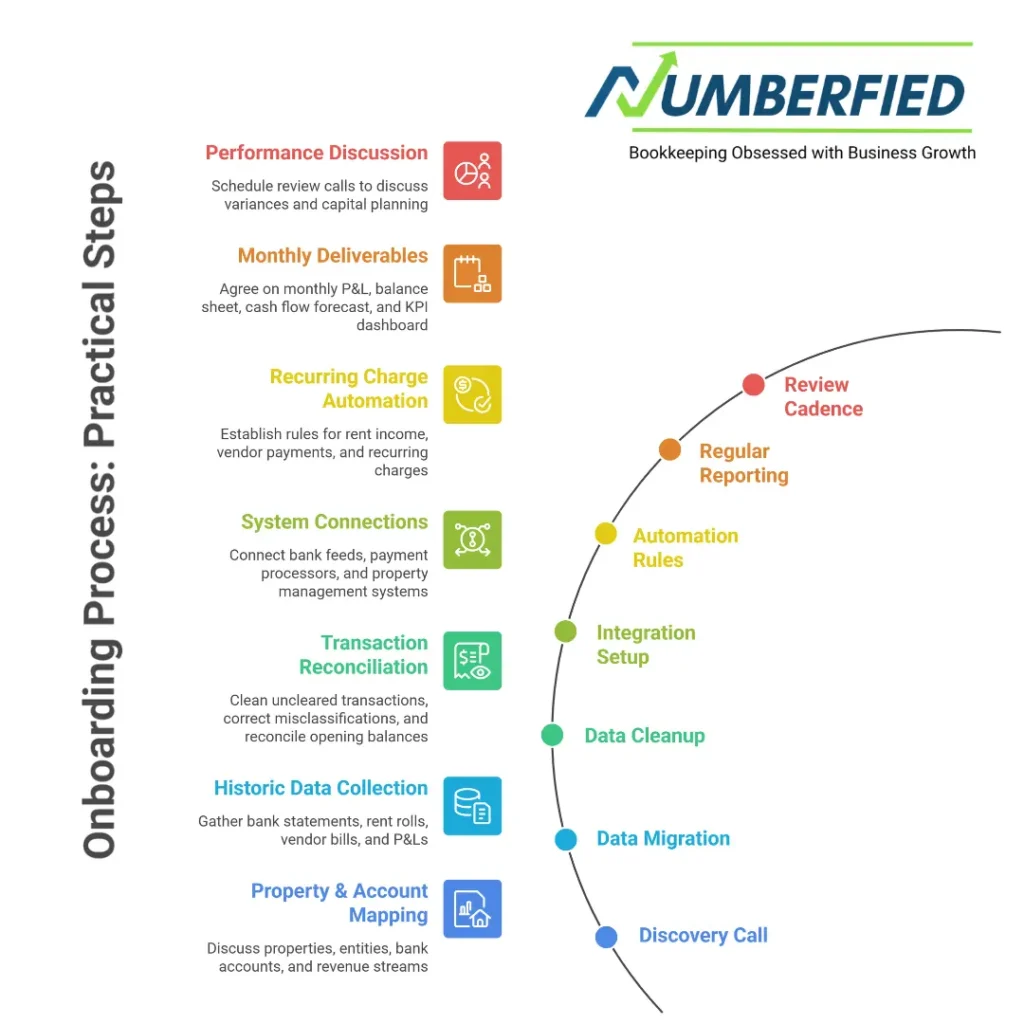
Onboarding Process: Practical Steps
Discovery and Chart of Accounts Design
Begin with a discovery call to map properties, entities, bank accounts, and revenue streams. Design a chart of accounts that supports performance reporting by property, entity, and cost center.
Data Migration and Cleanup
Gather historic bank statements, rent rolls, vendor bills, and previous year P&Ls. Clean up uncleared transactions, correct prior misclassifications, and reconcile opening balances to ensure continuity.
Integration Setup and Automation Rules
Connect bank feeds, payment processors, and property management systems. Establish automation rules for recurring charges, rent income, and vendor payments to reduce manual entry and accelerate month-end close.
Regular Reporting and Review Cadence
Agree on monthly deliverables: reconciled P&L by property, balance sheet, cash flow forecast, and KPI dashboard. Schedule review calls to discuss variances and capital planning.
Measuring ROI from Real Estate Investor Bookkeeping
Direct Cost Savings and Time Reclamation
Calculate hours saved from automation and outsourcing. Multiply saved hours by owner or staff rates to quantify time value. Factor in lower accounting fees due to cleaner monthly work.
Tax Savings and Risk Reduction
Track reductions in tax liabilities achieved through improved expense capture and depreciation accuracy. Estimate avoided penalties and audit costs as part of the ROI calculation.
Improved Financing Outcomes
Well-maintained books support stronger lender submissions, often leading to faster approvals and better terms. Quantify the value of improved loan terms and reduced time-to-close on acquisitions.
Operational Efficiency and Decision Quality
Measure faster reporting cycles, fewer reconciliation errors, and improved decision-making speed. Assign conservative monetary values to these operational improvements to include in ROI metrics.
Actionable Tips for Immediate Improvement
Standardize a Property-Level Chart of Accounts
Create consistent categories for rent, utilities, repairs, property taxes, insurance, and management fees. Standardization simplifies comparative analysis and accelerates consolidation for multi-property portfolios.
Automate Bank Feeds and Reconciliations
Enable direct connections to banks and set rules for common transactions. Review auto-matches weekly to maintain accuracy and reduce month-end backlog.
Attach Source Documents to Transactions
Use a bookkeeping platform that supports attachments. Link invoices and receipts to each transaction to preserve an audit trail and simplify tax preparation.
Schedule Monthly Close and KPI Reviews
Adopt a repeatable monthly close checklist and review KPIs like net operating income, occupancy rate, and collection rate. Regular cadence prevents surprises and informs timely corrective action.
Why Consider Numberfied for Real Estate Investor Bookkeeping
Industry Focus and Scalable Processes
Numberfied provides bookkeeping solutions tailored to real estate investor bookkeeping needs, from single-property owners to enterprise portfolios. Processes are designed to scale while maintaining accuracy and compliance.
Security, Integration, and Compliance Support
Security-first practices, bank integrations, and alignment with tax preparers are core elements of the service. Clients receive structured onboarding and documented policies for data handling and retention.
Transparent Pricing and Measurable ROI
Proposals include clear scopes and ROI estimates built on documented time savings and tax benefits. For a custom evaluation of your portfolio, contact Numberfied to discuss a tailored plan.
Conclusion
Robust real estate investor bookkeeping converts operational complexity into accurate financial insight, tax readiness, and the ability to scale. By selecting the right tools, prioritizing security and compliance, and engaging a provider with real estate expertise, investors gain time, reduce risk, and improve financial outcomes. To explore a bookkeeping solution that aligns with your growth strategy and supports tax and financing objectives, contact Numberfied for a tailored consultation.
Frequently Asked Questions
What is real estate investor bookkeeping, and why is it different?
Real estate investor bookkeeping tracks property-level income and expenses, capital account entries, depreciation, security deposits, and escrow activities. It differs from general bookkeeping by requiring property-level reporting, depreciation schedules, and attention to classification between repairs and capital improvements.
How often should I reconcile my property accounts?
Monthly reconciliations are recommended to catch discrepancies early and maintain current financials. For high-volume portfolios, weekly reviews of bank and rent payment feeds further reduce errors and cash management risk.
Which software is best for real estate investor bookkeeping?
QuickBooks Online is widely used for its robust feature set and integrations; Xero is an alternative with strong API support and simplicity. The best choice depends on portfolio complexity, needed integrations, and reporting preferences.
Can bookkeeping reduce my tax bill?
Accurate bookkeeping helps ensure all legitimate deductions are captured, depreciation is calculated correctly, and tax elections are reflected in records often lowering tax liability and reducing audit risk when coordinated with tax professionals.
How do I protect sensitive financial data when outsourcing bookkeeping?
Require encryption, multi-factor authentication, least-privilege access, and documented security policies. Ask for third-party attestations like SOC 2 and include data protection clauses in contracts.
What documents should I prepare for onboarding?
Provide bank and credit card statements, rent rolls, leases, vendor invoices, prior year tax returns, and a list of entities and bank accounts. Organized records accelerate migration and reduce setup costs.
How does bookkeeping support financing and lender requests?
Lenders require consistent, reconciled financial statements and rent rolls. Professional bookkeeping produces lender-ready reports that demonstrate operating performance and support loan applications and covenants.
What are common bookkeeping mistakes for real estate investors?
Common errors include misclassifying repairs versus capital improvements, blending personal and business transactions, failing to track security deposits, and not maintaining depreciation schedules each of which can affect taxes and valuation.
How do you measure the ROI of hiring a bookkeeping provider?
Measure ROI by adding time savings value, documentation of tax savings, reduced error costs, and improved financing outcomes. Compare these benefits to provider fees and transition costs for a comprehensive view.
When should I consider switching providers?
Consider changing if reporting is inconsistent, integrations are missing, security policies are inadequate, or the provider cannot scale with your portfolio. A transparent transition plan minimizes disruption and preserves historical continuity.
Read Also: The Amazing Way Bookkeeping and Accounting Services in USA Can Skyrocket Your Success!