

Introduction
White label accounting has emerged as a strategic solution for CPA firms, bookkeeping practices, and finance teams seeking to scale their operations without the cost and complexity of hiring additional in-house staff. By partnering with third-party providers who deliver services under the firm’s brand, businesses can offer a full suite of accounting functions such as bookkeeping, tax preparation, payroll processing, and financial reporting while maintaining a seamless client experience. This model not only enhances operational efficiency and profitability but also allows firms to focus on client relationships and growth initiatives.
As the demand for flexible, cost-effective, and high-quality financial services increases, understanding how white label accounting works, its benefits, potential challenges, U.S. compliance requirements, and best practices for provider selection and onboarding has become essential for firms aiming to stay competitive and scalable in a rapidly evolving industry.
Key takeaways
- White label accounting delivers cost savings, expertise, and scalability while letting firms focus on client relationships and advisory services.
- Major challenges include privacy, integration, and maintaining oversight, mitigated by clear SLAs, secure data practices, and audit trails.
- US compliance requires adherence to IRS rules, GAAP, payroll tax regulations, and state tax requirements; choose providers with US tax experience.
- Evaluate providers by services offered, technology stack (QuickBooks, Xero), reporting, staffing model, and cultural fit.
- Plan onboarding, data migration, and continuous communication to ensure a smooth transition and measurable ROI.
Why choose white label accounting solutions for your accounting firm
White label accounting solutions let accounting firms expand services for clients without the overhead of hiring large in-house teams. Outsourced accounting and white label bookkeeping services mean you can offer a range of services while maintaining your brand and client relationships. The right partner provides experienced accounting professionals, reliable accounting software integrations, and scalable workflows.
Cost savings and operational efficiency
Outsourced accounting reduces recruitment, training, benefits, and office costs. White label services let firms scale up during tax season or for growth without long-term payroll commitments. Automation and a modern accounting platform cut repetitive accounting tasks and streamline financial data processing.
Access to expertise and specialized services
A trusted white label partner supplies teams with experience in tax services, complex tax compliance, payroll, and audit support. This expands the range of services you can offer clients and supports growth strategies for firms looking to expand.
Scalability and flexibility
White label bookkeeping services allow accounting firms to flex capacity on demand. Firms can add bookkeeping and accounting tasks, financial reporting, or CFO-level services for clients as needs change without disrupting internal workflows.
Benefits of white labeled accounting and bookkeeping services
White label accounting offers both immediate and strategic benefits for small businesses and accounting firms. Below are practical advantages and how they support business needs.
Focus on core advisory work
By outsourcing routine bookkeeping and accounting tasks, CPAs and accounting teams can focus on tax planning, financial strategy, and client advisory services that drive higher margins and client lifetime value.
Improved turnaround and client satisfaction
With a white label accounting partner, bookkeeping firms can deliver faster month-end closes, timely financial statements, and proactive tax notices. Consistent delivery improves client expectations and trust.
Technology-driven workflows
White label accounting software and automation reduce manual tasks. Providers often integrate with QuickBooks, Xero, and other accounting platforms to streamline bank feeds, reconciliations, payroll, and reporting.
Challenges and risks with white label accounting services
Outsourcing creates specific responsibilities. Identifying potential pitfalls and proactively mitigating them is essential to protecting client relationships and meeting compliance standards.
Data privacy and security
Transferring financial data to a white label partner requires secure protocols, encrypted transfers, access controls, and regular security audits. Ensure your provider meets industry standards and can demonstrate controls for client data.
Integration and workflow alignment
Compatibility between your existing accounting software and the provider’s platform is critical. Confirm integrations with QuickBooks, Xero, or your accounting platform to avoid manual transfers and maintain a single source of truth.
Oversight and quality control
Retention of oversight is non-negotiable. Set SLAs, review sample work, institute periodic audits, and preserve client ownership to ensure the quality of bookkeeping and accounting services remains high.
US compliance: IRS, GAAP, payroll, and tax season considerations
Compliance in the United States spans federal and state tax regulations, payroll withholding, and generally accepted accounting principles. White label accounting partners should have deep experience with these rules and a practice for keeping up with changes.
IRS and federal tax compliance
Providers must understand federal tax filings, estimated tax payments, 1099 and W-2 reporting, and IRS notice resolution. Verify the partner’s protocols for preparing and filing tax returns, as well as for addressing IRS correspondence.
GAAP and financial reporting
White label accounting solutions should produce financial statements and reconciliations compliant with GAAP where required. Accurate reporting is crucial for loans, investor relations, and audit preparedness.
Payroll and state tax requirements
Payroll processing must comply with federal and state withholding and unemployment insurance, as well as local tax rules. Confirm the partner’s payroll capabilities and how they handle multi-state payroll for clients with employees in several jurisdictions.
How to select a white label accounting partner
Choosing the right white label accounting partner requires a balance of technical capability, culture, pricing, and service scope. Use this checklist during your evaluation.
Evaluate the range of services
Confirm the provider offers bookkeeping and accounting, tax preparation, payroll, CFO services, and financial reporting. A complete white label solution reduces the need for multiple vendors.
Assess technology and integrations
Ask about supported accounting software, including QuickBooks and Xero, bookkeeping automation, reporting dashboards, and API availability. Seamless integration prevents duplicate work and maintains accurate financial data.
Staffing model and experience
Understand the provider’s staffing: certified accountants, CPAs, bookkeepers, and managers. Check experience in your client industries and whether they can help with complex tax situations or audits.
Tools and accounting software are commonly used with white label bookkeeping
Successful white label accounting relies on modern accounting platforms and automation tools. The right stack determines speed, accuracy, and client visibility.
QuickBooks and QuickBooks Online
QuickBooks remains the dominant accounting software for US small businesses. Ensure the partner has deep QuickBooks experience, including Online Accountant workflows and clean file management.
Xero and cloud-native platforms
Xero offers strong bank feed automation and multisystem integrations. Partners that support Xero can often cater to international clients or businesses with modern cloud workflows.
Automation and integration tools
Look for partners using bank feed automation, receipt capture tools, payroll integrations, AP/AR automation, and reporting platforms to streamline bookkeeping and accounting tasks.
Tax preparation and planning with white label accounting solutions
Tax preparation and ongoing tax planning are core value adds. White label services should handle returns, tax planning, and proactive strategies to lower liabilities.
Year-round tax planning
Effective partners offer quarterly reviews, estimated tax calculations, and tax strategy sessions. This prevents surprises during tax season and helps clients optimise cash flow.
Filing and compliance support
Confirm who prepares and files tax returns, the review process, and the escalation path for tax issues. Verify the partner’s experience with federal and state filings and complex tax scenarios.
Specialized tax services
Ask about experience with sales tax, multi-state returns, R&D credits, S-corp distributions, and audit defense. These services can differentiate your offerings and deliver additional revenue.
Onboarding and workflow for white label accounting partners
Successful onboarding sets expectations and reduces risk. A structured plan helps migrate financial data and align client-facing processes.
Data migration and cleanup
Begin with a clean chart of accounts and reconciled bank statements. Plan data transfer from in-house systems to QuickBooks or Xero, and schedule a sanity check before going live.
Define roles, SLAs, and escalation paths
Document who owns what: client communication, approvals, review cycles, and error resolution. Establish SLAs for deliverables like month-end close, payroll runs, and tax filings.
Client communication templates
Create standardized messaging for clients about the transition, expected timelines, access permissions, and billing. Transparent communication builds trust and reduces confusion.
Measuring ROI and business impact from white label accounting
Decision-makers require measurable metrics. Track cost savings, revenue growth, client retention, and operational KPIs to quantify ROI from white label accounting.
Cost and margin analysis
Compare the total cost of in-house staffing with the cost of outsourced services, including recruitment, benefits, software, and overhead. Factor in improved utilization and faster deliverables.
Client retention and expansion
Monitor client churn and cross-sell rates. When accounting firms expand services via white label bookkeeping, many see a lift in services to their clients and increased lifetime value.
Operational KPIs
Track turnaround times for month-end close, time to deliver financial statements, error rates, and client satisfaction. These metrics show efficiency gains and improvements in quality.
Practical checklist: onboarding clients to white label accounting
Use this step-by-step checklist to onboard clients smoothly and protect relationships during the transition to white label services.
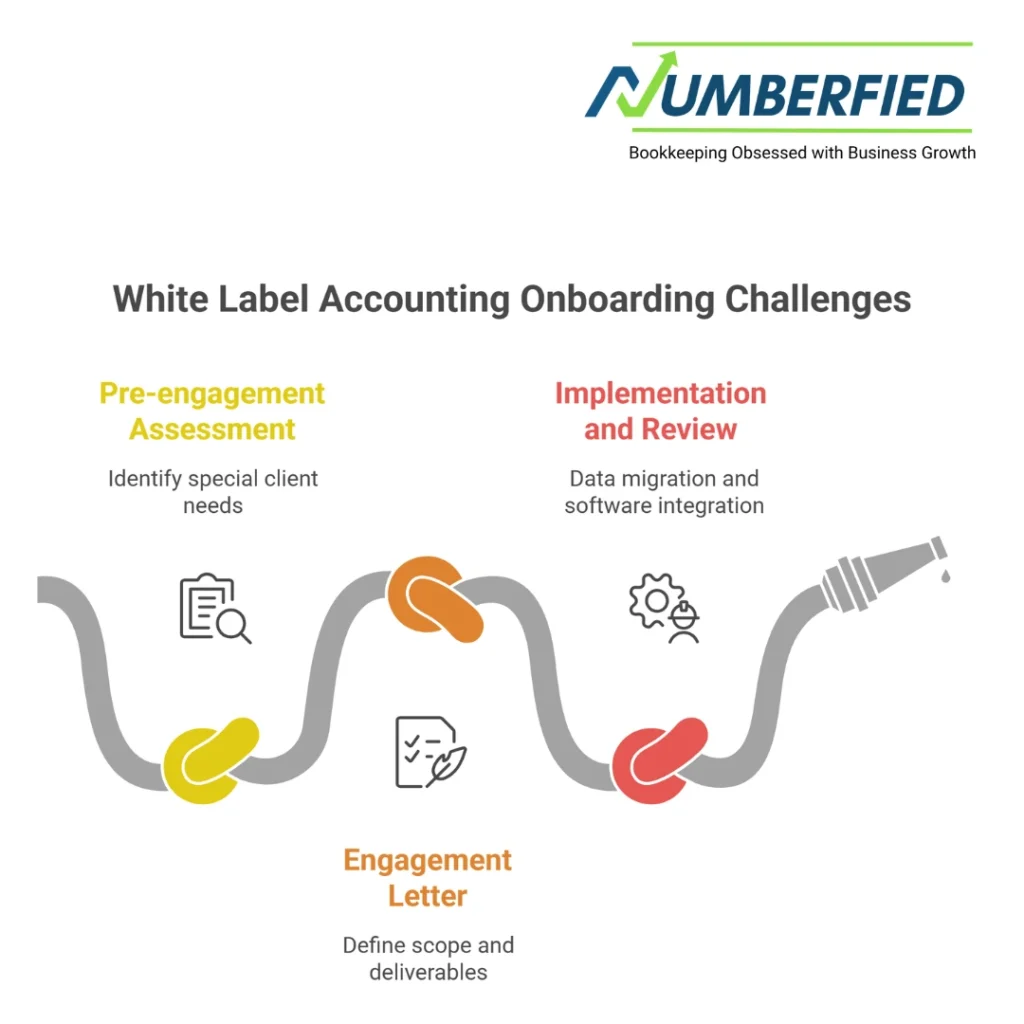
Step 1: Pre-engagement assessment
Audit existing accounting files, systems, and processes. Identify special client needs, multi-entity setups, or industry-specific requirements before signing the engagement.
Step 2: Engagement letter and scope
Define scope, deliverables, liabilities, data ownership, and confidentiality. A clear engagement letter prevents misunderstandings and aligns expectations.
Step 3: Implementation and review
Schedule data migration, configure software integrations (QuickBooks/Xero), run parallel processes for a single cycle, and perform a quality review before the full handover.
Common use cases: who benefits from white label accounting
White label accounting services fit many business models. Here are common scenarios where firms and business owners gain immediate value.
CPA firms that want to grow
CPA firms can expand services for clients without hiring by leveraging white label bookkeeping services and tax teams. This helps firms scale and offer comprehensive accounting and bookkeeping packages.
Bookkeeping firms and boutique accounting practices
Smaller bookkeeping firms benefit from back-office capacity, expert tax preparation, payroll processing, and financial reporting support to serve larger clients.
Small businesses and startups
Small businesses gain access to top-notch accounting and tax services without having to build an in-house team. White label accounting software and reporting give founders clear insights for decision-making.
How Numberfied supports firms with white label accounting solutions
Numberfied offers a complete white label accounting partner experience for firms seeking to expand services, maintain brand continuity, and deliver compliant, high-quality accounting services. Our teams integrate with QuickBooks and Xero, follow US tax laws, and provide secure workflows that protect client data.
Comprehensive service offerings
We provide bookkeeping and accounting, tax preparation, payroll, CFO advisory, and financial reporting designed for firms that want to grow without the overhead of building a large in-house staff.
Technology and integrations
Our accounting platform supports QuickBooks, Xero, and common automation tools. We customize workflows to fit your client expectations and streamline data across systems.
Dedicated onboarding and ongoing support
We manage migration, define SLAs, and maintain audit trails. For firms concerned about oversight, we provide transparent reporting, review processes, and an escalation path to ensure quality and compliance.
Actionable tips for implementing white label accounting successfully
These practical recommendations help maximize value and minimize transition risks.
Tip 1: Start with a pilot
Begin with a small subset of clients to validate processes, integrations, and communication protocols. A pilot reduces risk and provides learning to scale effectively.
Tip 2: Preserve client relationships
Keep client communication under your control. Share transition updates, set expectations, and maintain a single point of contact for strategic conversations.
Tip 3: Set measurable goals
Define KPIs like time to close, cost per client, and client satisfaction before onboarding. Measure results quarterly to track ROI and refine service delivery.
Conclusion
White label accounting solutions offer a compelling path for accounting firms, bookkeeping firms, and business owners to expand services, control costs, and improve client outcomes. Benefits include cost savings, access to specialized accounting professionals, scalability, and focus on advisory services. Challenges around privacy, integration, and oversight are manageable with clear SLAs, secure workflows, and the right technology stack. For US compliance, ensure your partner understands IRS, GAAP, payroll, and multi-state tax requirements.
If you are exploring white label accounting to grow your practice or deliver more value to clients, contact Numberfied for a free consultation to discuss a tailored plan, tool integrations like QuickBooks or Xero, and a phased onboarding approach that minimizes disruption.
Frequently asked questions
What is white label accounting?
White label accounting is an outsourced model where a service provider delivers accounting and bookkeeping services under your firm’s brand. It allows firms to offer expanded services without hiring additional in-house staff.
How does white label bookkeeping integrate with QuickBooks or Xero?
Most providers support direct integrations via APIs, bank feeds, and accountant access to QuickBooks Online or Xero. This preserves a single source of truth and automates reconciliations and reporting.
Is white label accounting secure for client financial data?
Security varies by provider. Choose partners with encrypted data transfers, role-based access controls, regular security audits, and compliance documentation to protect sensitive financial data.
Can a white label partner handle US tax compliance?
Yes, qualified partners have experience with IRS filings, GAAP reporting, payroll taxes, and multi-state tax filings. Verify the provider’s credentials and processes for tax preparation and notice resolution.
How does pricing typically work for white label accounting services?
Pricing models include per-client flat fees, hourly billing, or tiered packages based on transaction volume and service complexity. Compare the total cost against the expense of hiring in-house staff.
Will outsourcing affect client relationships?
When managed correctly, outsourcing can enhance relationships by improving responsiveness and service quality. Maintain control of client communications and brand messaging to protect relationships.
How do firms maintain oversight of outsourced accounting work?
Maintain oversight with SLAs, periodic reconciliations, sample audits, and standardized review processes. Ensure access to workpapers and reporting dashboards for transparency.
What industries benefit most from white label accounting?
Small businesses, professional services, e-commerce, franchise networks, and startups often benefit due to the need for scalable accounting, payroll, and tax services without large in-house teams.
How long does onboarding usually take?
Onboarding depends on the complexity of clients and data cleanup needs. A simple setup may take 2–6 weeks; complex multi-entity migrations can take longer. Plan a pilot to set realistic timelines.
How can I measure ROI from white label accounting?
Measure ROI by comparing in-house costs to outsourced fees, tracking client retention, revenue per client, time to close, and operational KPIs. Improved margins and the ability to expand services demonstrate ROI.
Read Also: How Bookkeeping & Accounting Services Can Transform Your Business Growth