

Introduction
Welcome! We’re the Numberfied team, and we’re glad you’re exploring how Bookkeeping Outsource Services can transform and streamline your financial operations. Whether you’re a small business owner weighing the benefits of in-house bookkeeping versus outsourcing, or an established company preparing to scale efficiently, this guide provides clear, practical insights. Bookkeeping Outsource Services not only help reduce operational costs but also improve accuracy, ensure timely financial reporting, and give you access to experienced professionals without the overhead of hiring internally. By outsourcing your bookkeeping, you can free up valuable time and resources, allowing you and your team to focus on strategic growth and core business activities while maintaining confidence in your financial data.
Key takeaways
- Bookkeeping Outsource Services centralize accurate bookkeeping and reconciliation to support cash flow and financial reporting.
- Outsource bookkeeping to access QuickBooks expertise, payroll integration, and professional bookkeeping services without expanding an in-house accounting department.
- Choosing the right outsourced bookkeeping service provider brings peace of mind, scalable support, and advisory services that help your business grow.
Why outsource bookkeeping and choose the right bookkeeping service
Understand the benefits of outsourced bookkeeping
Outsourced bookkeeping delivers consistent, accurate bookkeeping work that supports financial statements and tax return preparation. Many businesses find that outsourcing services reduces bookkeeping costs and improves cash flow monitoring. With Bookkeeping Outsource Services, you get bookkeeping expertise focused on reconciliation, financial reporting, and timely access to financial data.
How outsourced bookkeeping supports your business needs
An outsourced bookkeeping service provider handles monthly bookkeeping tasks, catch-up bookkeeping when needed, and ongoing reconciliation services. This lets your accounting department or team focus on strategy, forecasting, and higher-value advisory services. Outsourced accounting services work alongside CPAs and controllers to streamline the path from data to decisions.
When to outsource your bookkeeping
Consider outsourced bookkeeping when day-to-day bookkeeping becomes time-consuming, bookkeeping errors affect financial statements, or scaling requires flexible support. Bookkeeping Outsource Services are especially valuable for small business owners and finance teams looking for virtual bookkeeping services, cloud-based bookkeeping, or a full-service bookkeeping firm.
How Bookkeeping Outsource Services integrates with QuickBooks and accounting software
QuickBooks Online and cloud accounting setup
We help clients adopt QuickBooks Online and other accounting software to ensure an efficient online account structure. Bookkeeping Outsource Services often include cloud-based bookkeeping setup, chart of accounts organization, and automation to reduce manual bookkeeping tasks.
Monthly bookkeeping and reconciliation with QuickBooks
Monthly bookkeeping processes include bank reconciliation, expense categorization, payroll entries, and financial reporting. Outsourced bookkeeping companies often pair their virtual bookkeeping services with QuickBooks expertise to deliver accurate bookkeeping and consistently reconcile accounts.
Integrating payroll and payroll taxes
Payroll and payroll taxes are commonly integrated into outsourced accounting services. A bookkeeping service can coordinate with your payroll provider or manage payroll within QuickBooks Online so payroll taxes, deductions, and reporting align with your financial statements.
Choosing between in-house bookkeeping and an outsourced bookkeeping service
Benefits of outsourced bookkeeping vs in-house bookkeeping
Outsourced bookkeeping offers flexibility, access to a bookkeeping team with diverse expertise, and predictable bookkeeping costs. An outsourced bookkeeping firm provides reconciliation services, catch-up bookkeeping, and virtual bookkeeper support, freeing in-house staff to handle business-specific tasks and growth initiatives.
When in-house bookkeeping is preferred
Some businesses maintain an in-house bookkeeping or accounting department for immediate access to day-to-day transactional knowledge or to meet specific industry requirements. In-house work may suit organizations that require tight internal controls or on-site controller services, but it can increase bookkeeping costs and limit scalability.
Blended models and accounting support
Many companies choose a blended approach: an in-house bookkeeper complemented by outsourced accounting and bookkeeping for specialized tasks, monthly reconciliation, and financial reporting. Bookkeeping Outsource Services can act as your bookkeeping support, supplementing in-house capacity and offering advisory services when you need them.
Operational benefits of outsourced bookkeepers and bookkeeping providers
Access to bookkeeping expertise and accurate bookkeeping
Outsourced bookkeepers bring professional bookkeeping services and accurate, timely records. With experienced bookkeeping providers, you gain financial information that supports cash flow decisions and produces reliable financial statements for stakeholders and tax preparation.
Scalable bookkeeping services and the level of support
Outsourced bookkeeping and accounting services scale with your business needs, from virtual bookkeeping services to controller or CFO services. As your bookkeeping needs evolve, outsourced bookkeeping companies can provide additional support such as forecasting, advisory services, and full-service bookkeeping.
Automation and cloud-based bookkeeping
Bookkeeping automation, cloud accounting, and integration with accounting software streamline bookkeeping work. Outsourced bookkeeping services for small businesses often emphasize automation that reduces manual data entry, speeds reconciliation, and ensures financial data is accurate and timely.
How outsourced accounting services support financial reporting and tax services
Preparing financial statements and reporting
Outsourced accounting services prepare monthly financial statements, conduct month-end close, and provide financial reporting tailored to your business. These reports help owners and executives make informed decisions and support conversations with finance partners, lenders, or investors.
Coordination with CPAs and tax return preparation
Professional bookkeeping services coordinate with CPAs to streamline tax services and tax return preparation. Clean bookkeeping records and accurate reconciliation minimize surprises during tax season and speed the work of CPAs and tax professionals.
Advisory services and forecasting
Top bookkeeping providers offer advisory services, including cash flow forecasting, budgeting, and KPI tracking. Outsourced bookkeeping firms often provide controller or CFO services that help you forecast, plan, and prepare for growth with reliable financial information.
Operational workflows: what an outsourced bookkeeping firm does day-to-day
Daily and day-to-day bookkeeping tasks
An outsourced bookkeeping service handles day-to-day bookkeeping, including transaction entry, receipt management, expense categorization, and bank reconciliation. This consistent attention keeps financial data accurate and provides up-to-date insights into cash flow and payables.
Monthly bookkeeping cycle
Monthly bookkeeping cycles include month-end close, reconciliation services, preparation of financial statements, and review of variances. A bookkeeping service provider will deliver these reports on a regular schedule, enabling reliable financial management and compliance.
Catch-up bookkeeping and cleanup
If you fall behind, outsourced bookkeeping companies offer catch-up bookkeeping to bring your records up to date. These services include thorough reconciliation, account cleanup, and coordination with your accountant or CPA to resolve outstanding issues.
Choosing the best outsourced bookkeeping for your small business
Evaluating bookkeeping companies and providers
When evaluating outsourced bookkeeping companies, consider experience with your accounting software, the level of support offered, and the breadth of service,s including payroll, reconciliation, and advisory. Look for bookkeeping firms that align with your business needs and offer transparent pricing and clear communication.
Questions to ask a bookkeeping service provider
Ask potential providers about their technology stack, QuickBooks Online proficiency, available CPA coordination, and approach to data security. Clarify whether they offer virtual bookkeeping, controller services, and how they handle month-end procedures and forecasting.
Onboarding and transition planning
Effective onboarding is key to a smooth transition. Bookkeeping Outsource Services typically begin with a discovery phase, set up cloud accounting, migrate data if needed, and schedule a comprehensive month-end checklist. A good provider will minimize disruption and deliver peace of mind.
Pricing, bookkeeping costs, and ROI of outsourced bookkeeping
Understanding bookkeeping costs
Bookkeeping costs vary based on the level of support, transaction volume, and services such as payroll or controller involvement. Outsourced bookkeeping services often offer predictable pricing that can be more cost-effective than hiring in-house staff when you factor in benefits, training, and overhead.
Measuring ROI and business growth impact
ROI comes from time savings, improved financial accuracy, and better decision-making. Outsourced accounting services help business owners focus on revenue and growth while reducing bookkeeping errors that can affect taxes and cash flow.
Value beyond cost: advisory and peace of mind
Beyond bookkeeping costs, an outsourced bookkeeping partner provides advisory services, accurate financial statements, and reconciliation, delivering peace of mind. This allows the accounting department and business owners to focus on strategy and business growth initiatives.
Security, compliance, and working with professional bookkeeping services
Data security and cloud accounting safeguards
Outsourced bookkeeping providers use secure cloud accounting platforms and robust access controls to protect financial data. When you outsource your bookkeeping, ensure the provider follows best practices for data privacy, backups, and secure online account access.
Regulatory compliance and payroll taxes
Professional bookkeeping services understand regulatory requirements, including payroll taxes, sales tax reporting, and financial reporting compliance. Outsourced bookkeeping services coordinate with CPAs and tax professionals to help ensure accurate filings and timely tax return preparation.
Choosing reputable bookkeeping firms and accounting firms
Select a bookkeeping firm with clear client references, a track record of working with similar businesses, and experience integrating with accounting software and tax services. Reputable bookkeeping providers deliver accurate, timely bookkeeping and support that meet your expectations.
How Numberfied approaches Bookkeeping Outsource Services
A client-centered onboarding process
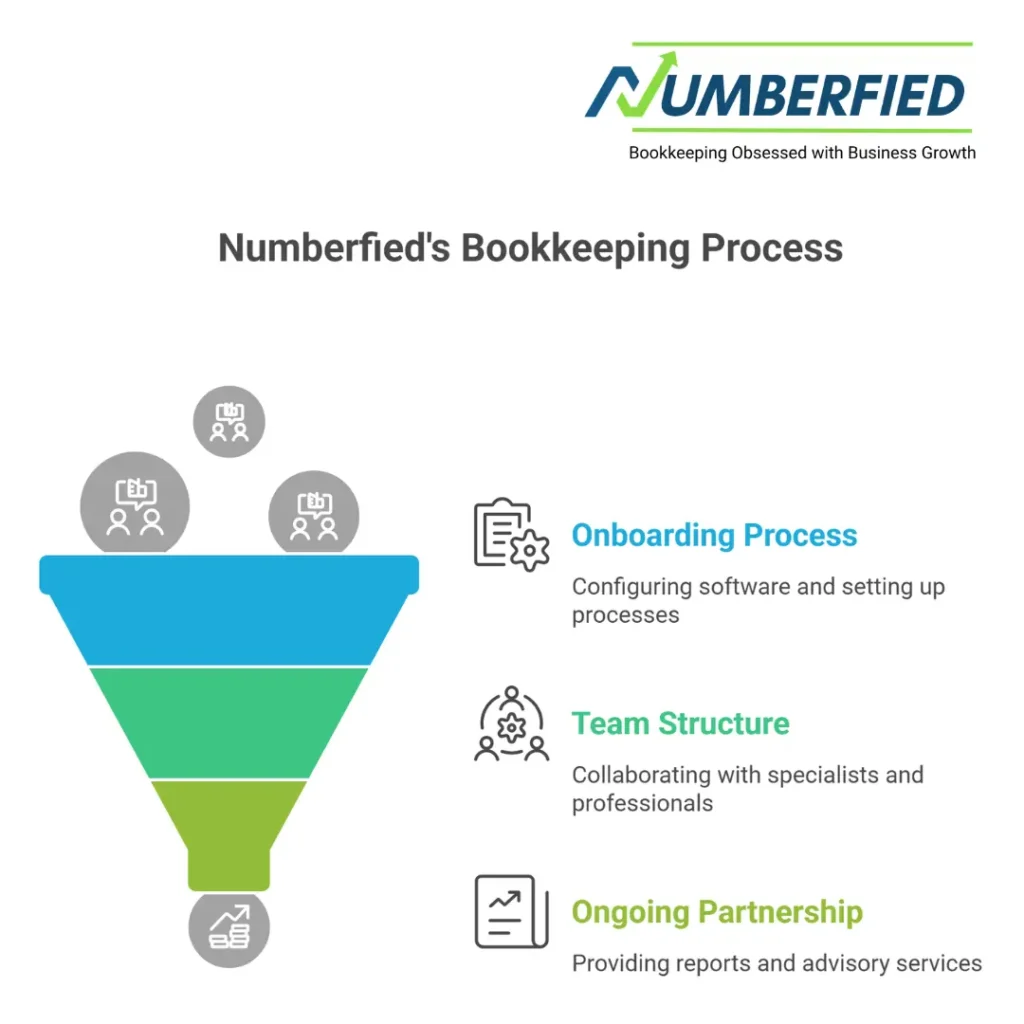
At Numberfied, our onboarding focuses on understanding your business needs, current bookkeeping status, and goals. We configure QuickBooks Online or your preferred accounting software, implement automation, and set up a recurring month-end process to deliver consistent results.
Team structure and expertise
Our bookkeeping team comprises virtual bookkeepers, reconciliation specialists, and accounting professionals who collaborate with CPAs, controllers, and CFOs as needed. This layered approach ensures accurate bookkeeping and access to advisory services when needed.
Ongoing partnership and advisory
We provide regular financial reporting, cash flow forecasting, and actionable insights that help you grow your business. When you choose Numberfied for Bookkeeping Outsource Services, you gain a partner focused on delivering clear financial information and practical guidance.
Transitioning to outsourced bookkeeping: steps and best practices
Plan the transition and set expectations
Successful transitions start with a clear project plan. Define your bookkeeping needs, identify key contacts, and set timelines for migrating data and establishing recurring deliverables. Transparency and communication reduce friction during the switch to outsourced bookkeeping.
Document workflows and responsibilities
Documenting your bookkeeping processes, approvals, and access points helps the outsourced team operate efficiently. Clarify who handles invoices, receipts, payroll submissions, and bank reconciliations to avoid duplicated effort.
Review metrics and adjust the engagement
Regularly review financial metrics and the level of support to ensure your outsourced bookkeeping engagement remains aligned with business goals. Adjust the level of service as transactional volume, payroll, or advisory needs change.
Real-world examples: how outsourced bookkeeping drives outcomes
Growing a small business with virtual bookkeeping
A small business owner used virtual bookkeeping to replace a manual in-house process. The outsourced bookkeeping service improved reconciliation, reduced bookkeeping errors, and produced reliable financial statements that supported a successful funding round and better cash flow management.
professional services firm using outsourced accounting
A professional services firm engaged an outsourced bookkeeping provider to manage monthly bookkeeping and payroll. This allowed their internal accounting team to focus on client advisory while the outsourced bookkeeper handled day-to-day bookkeeping and timely tax coordination.
catch-up bookkeeping to prepare for tax filing
When a client fell behind on records, outsourced bookkeeping and catch-up bookkeeping services restored accuracy and organized financial information for CPAs to prepare tax returns. The result was timely filing, reduced penalties, and a cleaner ongoing bookkeeping process.
Making the decision: Is outsourcing bookkeeping right for you?
Evaluate your current bookkeeping workload
Assess the time your team spends on bookkeeping tasks, reconciliation, and month-end close. If these tasks divert attention from revenue-generating work, Bookkeeping Outsource Services can help reallocate resources and increase focus on growth.
Consider the complexity of your financial information
If you have multiple revenue streams, complex payroll, or frequent financial reporting requirements, an outsourced bookkeeping team with experience in accounting and bookkeeping will improve accuracy and delivery speed. Outsourced bookkeepers are trained to handle diverse financial data and industry-specific needs.
Start with a pilot or phased approach
Begin with a limited scope, such as monthly bookkeeping and reconciliations, then expand services to include payroll, forecasting, and advisory services. This phased approach lets you evaluate the benefits while minimizing disruption.
Conclusion
Bookkeeping Outsource Services provide accurate and timely bookkeeping, reduce bookkeeping costs, support payroll and tax needs, and deliver financial reporting that helps you grow your business. Outsourced bookkeeping firms, virtual bookkeeping services, and cloud-based bookkeeping solutions offer scalability and expert accounting support. When you work with Numberfied, you get a team dedicated to clean books, clear reporting, and advisory services tailored to your business needs. If you are ready to simplify bookkeeping, improve cash flow visibility, and get peace of mind, we’d love to help.
Visit our website to learn more and start a conversation about Bookkeeping Outsource Services :https://numberfied.com/. Let’s discuss how our bookkeeping service can support your accounting department, streamline your accounting, and provide the financial information you need to move forward with confidence.
Frequently Asked Questions
What exactly are Bookkeeping Outsource Services?
Bookkeeping Outsourcing Services involve hiring an external provider to handle your bookkeeping tasks, including day-to-day entries, reconciliations, and monthly financial reporting. These services often integrate with accounting software such as QuickBooks Online and may include payroll coordination, catch-up bookkeeping, and advisory support.
How will outsourcing bookkeeping affect my in-house accounting department?
Outsourcing bookkeeping can complement your in-house accounting department by freeing up time for your in-house team and providing additional expertise. This arrangement allows your internal team to focus on strategic tasks, forecasting, and higher-level financial management, while outsourced bookkeepers handle day-to-day bookkeeping.
Can an outsourced bookkeeping service handle payroll and payroll taxes?
Yes, many outsourced bookkeeping services include payroll processing and payroll taxes, or they work closely with your payroll provider. Proper coordination ensures payroll entries are posted to the accounting system and that payroll taxes are tracked accurately for compliance and reporting.
What accounting software do outsourced bookkeeping providers use?
Most outsourced bookkeeping providers use cloud-based accounting software such as QuickBooks Online and other popular accounting platforms. They choose software that fits your business, enables automation, and ensures your online account is secure and accessible for reporting and collaboration.
How quickly can an outsourced bookkeeping firm start helping my business?
Onboarding timelines vary based on the size and condition of your books. A typical engagement may begin with a discovery call, followed by data migration, QuickBooks Online setup if needed, and a phased transition to monthly bookkeeping. Catch-up bookkeeping may extend the timeline, but professional teams aim to minimize disruption.
Will outsourced bookkeeping services coordinate with my CPA?
Yes, reputable outsourced bookkeeping companies coordinate closely with CPAs and tax professionals. They ensure financial statements are accurate, provide support for tax return preparation, and deliver documentation needed for audits or tax filings. Collaboration streamlines tax services and advisory work.
How do I choose the best outsourced bookkeeping provider for my small business?
Choose a provider with experience in your industry and proficiency with your accounting software. Verify their processes for reconciliation, security practices for cloud accounting, the level of support they provide, and how they handle onboarding and ongoing communication. References and case studies can help clarify fit.
What security measures do outsourced bookkeeping firms use to protect my financial data?
Outsourced bookkeeping firms typically use secure cloud accounting platforms with encryption, multi-factor authentication, and role-based access controls. They follow data backup protocols and ensure sensitive information is protected during transfer and storage, safeguarding your financial information.
Can outsourcing bookkeeping save my business money?
Outsourcing can reduce fixed employment costs, training expenses, and overhead associated with in-house bookkeeping. By delivering predictable pricing and efficiency through automation, outsourced bookkeeping services often deliver a strong return on investment, freeing resources for growth initiatives.
What happens after I sign up for Bookkeeping Outsource Services with Numberfied?
After signing up, we begin with discovery to understand your bookkeeping needs and current systems. We set up your accounting software, migrate or clean up data if needed, and implement monthly bookkeeping processes. We provide regular financial reporting, reconciliation services, and advisory support tailored to your goals.
Read Also: Why Numberfied’s Bookkeeping Accounting Service Is Your Small Business’s Secret Weapon