

Introduction
At Numberfied, we understand that accurate financial records are essential for growing businesses and making informed decisions. Our business bookkeeping services go beyond simple transaction tracking, providing organized, timely, and actionable financial insights that support cash flow management, tax preparation, and strategic planning. By outsourcing your bookkeeping, you gain access to expert guidance, scalable solutions, and cloud-based tools without the overhead of an in-house team, freeing you to focus on revenue, growth, and core business operations. Whether you need ongoing bookkeeping, cleanup of records, or advisory support, Numberfied delivers reliable, efficient, and tailored bookkeeping services that give you confidence, clarity, and control over your financial operations.
Key takeaways
- Business bookkeeping services organize financial records, improve reporting accuracy, and support tax preparation.
- Outsourcing bookkeeping to experts reduces errors, saves time, and frees small business owners to focus on growth.
- Modern bookkeeping integrates with QuickBooks and delivers real-time financials for better decision-making.
- Choosing the right bookkeeping services for a small business involves evaluating experience, technology, and ongoing communication.
- Numberfied offers scalable bookkeeping services that include reconciliations, payroll coordination, and tax season cleanup.
How a small business bookkeeping service supports your accounting foundation
Why clean books matter for small business growth
Clean books are the backbone of reliable accounting and confident decision-making. Proper business bookkeeping services ensure transactions are categorized correctly, bank accounts are reconciled regularly, and financial statements reflect reality. This reduces surprises and gives you a clear picture of cash flow, profits, and areas needing attention.
What expert bookkeeping delivers beyond transaction entry
Expert bookkeeping adds context to numbers. Beyond recording sales and expenses, it includes month-end close routines, variance analysis, and actionable reports. These tasks save business owners time and help accountants or CFOs provide strategic guidance, aligning daily operations with long-term financial goals.
Integrating bookkeeping into your accounting workflow
Bookkeeping services for small businesses should connect seamlessly with payroll, accounts payable, and tax preparation. Integration ensures consistent categorization and reliable financials. When bookkeeping flows into accounting processes, tax tips and compliance become easier to implement, and financials remain audit-ready.
Choosing bookkeeping services for small business owners and bookkeepers
Evaluating bookkeeping needs for your business
Start by assessing transaction volume, payroll complexity, and reporting frequency. A startup may require basic bookkeeping and startup bookkeeping services, while a scaling business might need more advanced bookkeeping and CFO-level reporting. Identifying needs helps match the right level of service and avoid overpaying for unused features.
Questions to ask bookkeeping services for a small business
Ask potential providers about their experience in your industry, their implementation process, and their software preferences, such as QuickBooks. Inquire how they handle reconciliations, backlog cleanup, and communication cadence. Clear answers show their capacity to handle your bookkeeping needs effectively.
How to evaluate a bookkeeper and accounting fit
Fit includes technical skill and cultural alignment. A good bookkeeper listens, explains financials in plain language, and proactively flags issues. Look for bookkeeping services that offer transparent pricing, defined deliverables, and a clear path to scale as your business grows.
QuickBooks, real-time financials, and accounting software integration
Why QuickBooks is central to many bookkeeping services
QuickBooks remains a popular platform for small business accounting because it connects banking, payroll, and invoicing. Bookkeeping services that specialize in QuickBooks can streamline entries, automate recurring transactions, and produce timely reports. For many business owners, this means accurate financials with less manual work.
Real-time financials and decision-making
Real-time financials provide an up-to-date view of cash flow and profitability. Bookkeeping services that maintain regular reconciliations and timely entries enable business owners and bookkeepers to respond to trends quickly. This capability supports better planning and risk management during busy or uncertain periods.
Integrating third-party tools and reporting dashboards
Modern bookkeeping services integrate with payroll providers, payment processors, and analytics dashboards. These integrations reduce duplicate entry and produce consolidated reports that are easy to interpret. The result is consistent accounting that supports scalable decision-making across departments.
Outsource bookkeeping: when to hire and how to scale
Signs your business should outsource bookkeeping needs
Consider outsourcing when bookkeeping tasks consume substantial time, errors are recurring, or reporting lags. Outsourcing frees the business owner to focus on revenue-generating activities while ensuring financials are reliable. Many small business owners find that outsourcing to a dedicated provider delivers both accuracy and predictable support.
Benefits of outsourcing to professional bookkeeping services
Outsourcing offers access to skilled bookkeepers, efficient workflows, and established controls. It reduces the burden of software setup and ongoing training. Outsourced bookkeeping services can also scale rapidly to meet seasonal demands or growth without the delays of hiring and onboarding in-house staff.
How to transition bookkeeping smoothly to an outsourced provider
An effective transition includes a documented onboarding plan, data migration, and a timeline for cleanup work. Ask the provider about checkpoints, training for your team, and how they will handle legacy issues. Clear communication and staged implementation minimize disruption and ensure accurate business bookkeeping services from day one.
Tax tips, compliance, and preparing for tax season with bookkeeping services
Bookkeeping’s role in tax readiness
Accurate bookkeeping underpins tax compliance. Regular reconciliations and categorized expenses make it much easier to prepare tax returns and respond to IRS inquiries. A proactive bookkeeping approach reduces last-minute scrambling during tax season and supports better year-round tax planning.
Common bookkeeping practices that simplify taxes
Maintain proper documentation, keep business and personal accounts separate, and reconcile bank statements monthly. Implement a consistent chart of accounts and carefully track deductible expenses. These bookkeeping practices lower audit risk and create smoother collaboration between bookkeepers and accountants during tax preparation.
How bookkeeping services support your accountant or CFO
Bookkeeping services produce the clean financials that accountants and CFOs need to prepare returns and advise on tax strategies. By delivering timely reports and clear source documents, bookkeeping providers help accountants focus on optimization rather than cleanup, improving the overall efficiency of your financial team.
Financial reporting, forecasting, and supporting your business owner’s journey
Essential reports provided by bookkeeping services
Bookkeeping services typically deliver balance sheets, profit and loss statements, and cash flow statements. These reports provide a snapshot of the business’s financial health and support monthly reviews. Reliable reporting informs decisions about hiring, investments, and operational adjustments.
Using bookkeeping outputs for forecasting and budgeting
Historical data from bookkeeping forms the basis for realistic forecasting and budgeting. Accurate transaction histories and trend analysis enable business owners to build projections and set measurable goals. Bookkeeping services that include variance analysis make it easier to interpret forecasts and adjust strategies.
How bookkeeping supports your role as a business owner
As a business owner, you need clear financial insight to prioritize opportunities and manage risks. Business bookkeeping services deliver consistent accounting data, making planning and performance tracking simpler. With reliable bookkeeping, you can be confident when negotiating with vendors, applying for financing, or presenting to stakeholders.
Specialized bookkeeping services: startups, scaling companies, and industry specifics
Bookkeeping services for startups and early-stage companies
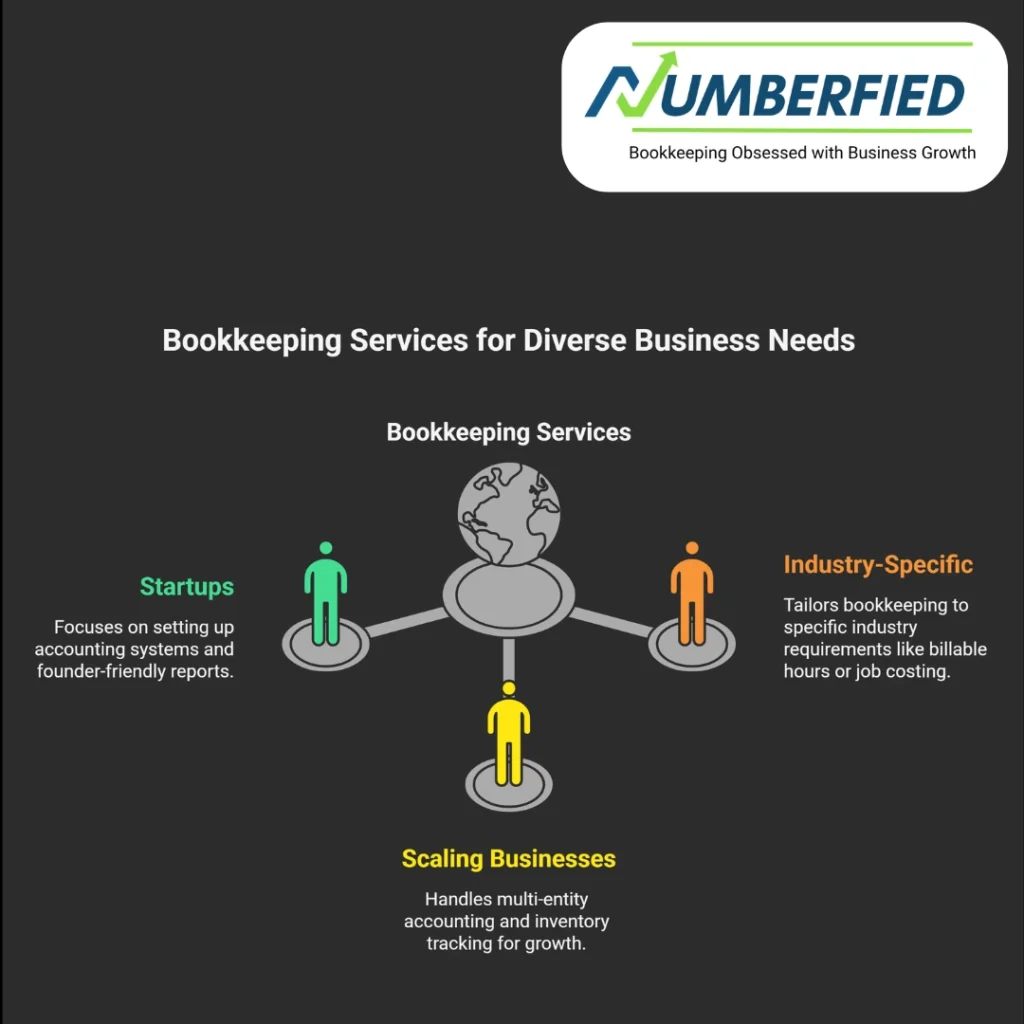
Startups benefit from bookkeeping services that set up accounting systems, establish controls, and provide founder-friendly reports. Accurate recordkeeping from the start prevents compounding errors and supports fundraising or grant applications. Tailored bookkeeping for startups balances simplicity and scalability.
Bookkeeping for scaling businesses and complex operations
As businesses scale, bookkeeping needs grow to include multi-entity accounting, inventory tracking, and more detailed cost allocations. Experienced bookkeeping services adapt workflows and tools to support increased transaction volume and sophisticated reporting demands without sacrificing accuracy.
Industry-specific bookkeeping considerations
Different industries require tailored bookkeeping practices—service providers may track billable hours, retailers manage inventory accounting, and contractors handle job costing. Choose bookkeeping services that understand your sector’s nuances to ensure compliance and meaningful financial insights.
Pricing models, transparency, and choosing the right bookkeeping services for a small business
Common pricing models for bookkeeping services
Providers use various pricing approaches, including monthly packages, hourly rates, and tiered services based on transaction volume. Transparent pricing helps you compare options and anticipate costs. Ask for clear deliverables and what is included in the scope to avoid surprises later.
What transparency looks like in bookkeeping relationships
Transparency includes clear communication about responsibilities, regular status updates, and easy access to financial reports. Bookkeeping services should provide a documented month-end close process and a single point of contact for questions. This level of clarity builds trust and predictable service delivery.
How to align service level with business bookkeeping services needs
Match the service level to your transaction volume, reporting needs, and growth plans. For some small business owners, basic bookkeeping is sufficient. For others, ongoing CFO-level insights and complex reconciliations are necessary. Start with the right package and plan to scale as your business evolves.
Best practices for business bookkeeping services and working with your bookkeeper
Establishing a consistent workflow with your bookkeeper
Define a schedule for invoicing, expense submission, and reconciliations. Consistent workflows prevent backlog and ensure that business bookkeeping services deliver timely financials. Set expectations around response times and reporting cadence to keep everyone aligned.
Documenting processes and safeguarding financial data
Document standard operating procedures for bookkeeping tasks and store supporting documents securely. Regular backups and access controls protect financial data and reduce risk. A professional bookkeeping service will enforce these safeguards and help maintain continuity during staff changes.
Collaboration between the bookkeeper, the accountant, and the business owner
Effective collaboration ensures that bookkeeping supports accounting and strategic planning. Schedule regular review meetings, share goals with your bookkeeper, and involve accountants when tax or compliance issues arise. Clear roles and communication enable bookkeeping services to add maximum value.
Case studies and practical examples of bookkeeping impact
How businesses improve cash flow with better bookkeeping
Businesses often discover cash flow improvements when bookkeeping services streamline invoicing and monitor receivables. Regular reconciliation and aging reports highlight late payments and guide collection efforts. Improved cash flow management reduces stress and supports steady operations.
Reducing tax surprises through disciplined bookkeeping
Clients who engage professional bookkeeping services report fewer tax surprises. Accurate expense tracking and timely categorization make estimated tax calculations more reliable. This preparation results in smoother tax filing and fewer last-minute adjustments.
Scaling operations with consistent financial reporting
Companies that maintain consistent bookkeeping can scale more confidently. Reliable financials enable management to evaluate new hires, expand into new markets, or invest in equipment with a clear understanding of financial impact. Bookkeeping services that support scalable reporting are a strategic asset.
Conclusion
Quality bookkeeping is both a practical necessity and a growth enabler. Business bookkeeping services organize your finances, support tax readiness, and prepare your company for scaling with accurate, real-time financials. If you are ready to improve clarity, reduce workload, and gain financial confidence, Numberfied is here to help. Visit https://numberfied.com/ to learn more, request a consultation, and discover how our bookkeeping services align with your business needs.
Frequently Asked Questions
What are business bookkeeping services, and why do I need them?
Business bookkeeping services manage the recording, organization, and reconciliation of financial transactions. You need them to maintain accurate financial records, support tax filing, and produce reliable reports that guide decisions. With professional bookkeeping, you reduce errors and free up time to focus on growing your business.
When should a small business owner outsource bookkeeping?
Outsource when bookkeeping consumes significant time, when accuracy issues surface, or when you need reliable reporting for decision-making. Outsourcing is particularly helpful during growth phases, tax season, or when preparing for financing. It provides consistent support without the overhead of hiring in-house staff.
How do business bookkeeping services work with QuickBooks?
Bookkeeping services often use QuickBooks to record transactions, reconcile accounts, and generate reports. They set up a chart of accounts, automate recurring entries, and integrate bank feeds. This results in organized financials that are easy to transfer to accountants for tax preparation or audit support.
What should I look for when hiring bookkeeping services for a small business?
Look for experience with your industry, clear pricing, and strong communication practices. Verify their ability to handle reconciliations, payroll coordination, and month-end closes. Choose a provider that offers scalable solutions and integrates with your existing systems to avoid disruptions.
Can bookkeeping services help reduce tax liabilities?
While bookkeeping services do not provide tax advice directly, they enable better tax planning by maintaining accurate records and tracking deductible expenses. Clean financials make it easier for your accountant or CFO to identify optimization opportunities and implement effective tax strategies.
How often should bookkeeping be performed for a small business?
Bookkeeping frequency depends on transaction volume and reporting needs. Many businesses benefit from monthly bookkeeping with weekly or daily transaction recording. Regular reconciliations and timely entries keep financials accurate and support real-time decision-making.
What is involved in bookkeeping cleanup services?
Cleanup services include reconciling accounts, correcting historical errors, organizing supporting documents, and standardizing categorization. The goal is to produce accurate, audit-ready financials that reflect current business realities. Cleanup lays the foundation for ongoing, reliable bookkeeping services.
How do bookkeeping services support forecasting and budgeting?
Bookkeeping services supply historical financials that are essential for forecasting and budgeting. They provide trend analysis and variance reports that help you project revenue and plan expenses. Reliable bookkeeping data enables realistic budgets and measurable financial goals.
Will outsourcing bookkeeping save my business money?
Outsourcing can reduce costs by eliminating hiring and training expenses and improving efficiency. Professional bookkeepers reduce errors and speed up month-end closes, which lowers the time accountants spend on cleanup. The net effect is often lower overall financial management costs with improved accuracy.
How do I get started with Numberfied for business bookkeeping services?
Getting started is straightforward: visit our website at https://numberfied.com/ and request a consultation. We assess your bookkeeping needs, propose a tailored plan, and outline onboarding steps. Our team will guide data migration, set up workflows, and begin delivering consistent, actionable financials.
Read Also: The Amazing Way Bookkeeping and Accounting Services in USA Can Skyrocket Your Success!