

Introduction
At Numberfied, we help small businesses stay organized and financially confident through expert bookkeeping services. When you outsource bookkeeping to our team, you gain accurate, reconciled books, real-time financial insights, and seamless QuickBooks integration, all while supporting cash flow management, tax preparation, and strategic planning. Outsourcing your bookkeeping gives you access to scalable solutions, professional guidance, and reliable financial reporting without the overhead of an in-house team, freeing you to focus on growth, operations, and achieving long-term business goals.
Key Takeaways
- Outsource bookkeeping to gain time, accuracy, and expert support without expanding your in-house team.
- Outsourced bookkeeping services include routine transaction processing, reconciliations, payroll coordination, and financial reporting.
- Choosing the right bookkeeping service hinges on communication, technology stack, pricing transparency, and a clear onboarding plan.
- Numberfied offers a tailored outsourced bookkeeping service for small businesses with virtual bookkeeper support and clean financial data delivery.
- We recommend a phased transition with clear roles, regular reviews, and cloud accounting software like QuickBooks for the best results.
Why Small Businesses Choose to Outsource Bookkeeping
Reduce administrative burden by outsourcing
Many small business owners find administrative tasks overwhelming. When you outsource bookkeeping, you remove recurring manual work from your plate and free up time to focus on strategy, customers, and growth. Outsourced bookkeeping services for small businesses are designed to handle daily and monthly essentials so owners can lead with clarity.
Improve accuracy and compliance with bookkeeping service expertise
Bookkeeping requires discipline, consistent processes, and an understanding of tax and accounting principles. An outsourced bookkeeping firm brings trained professionals who follow best practices, reducing errors and improving compliance. That reliability matters when preparing for taxes, audits, or investor conversations.
Scale financial operations without hiring in-house
Growing companies need financial processes that scale. Outsource your bookkeeping to leverage flexible support. As transaction volume increases, an outsourced bookkeeper can adapt without the overhead of recruiting, training, and managing additional staff in-house.
Understanding Outsourced Bookkeeping Work
Core services offered by outsourced bookkeeping work
Outsourced bookkeeping typically covers transaction categorization, bank reconciliations, tracking of accounts receivable and payable, payroll coordination, and month-end close tasks. These services ensure your books reflect accurate financial data for decision-making and reporting.
Technology and tools used by bookkeeping service providers
Top outsourced bookkeeping services leverage cloud accounting platforms, bank feeds, receipt capture tools, and integrations with payroll and payment processors. QuickBooks is widely used in the U.S., making workflows more efficient and accessible for small business owners and accountants alike.
Customizing services to match your business needs
Every business has unique needs. A good outsourced bookkeeping service offers customizable packages and scalable support. Whether you need full-service monthly bookkeeping or help during peak seasons, your provider should tailor a plan to match your priorities and cash flow cycles.
How to Choose the Right Bookkeeping Service
Assess experience and industry knowledge
Look for a bookkeeping firm with experience serving businesses like yours. Industry knowledge reduces the learning curve and improves the quality of financial categorization, forecasting, and reporting. Discuss specific scenarios that matter to your business during the vetting process.
Evaluate communication and reporting practices
Regular communication and clear reports are essential. Ask prospective providers how they deliver financial statements, the frequency of check-ins, and the format of dashboards. Access to reliable financial data helps you make informed decisions each month.
Confirm data security and access controls
When you outsource bookkeeping, you will share sensitive financial information. Verify that the bookkeeping service follows strong security practices, including secure cloud platforms, role-based access, encryption, and data backup routines to protect your financial data.
Preparing to Outsource Your Bookkeeping
Document your current processes before you outsource
Mapping out existing workflows, how invoices are created, how receipts are captured, and who approves payments, helps the bookkeeping service take over smoothly. Clear documentation accelerates onboarding and reduces the risk of missed items during the transition.
Choose the right cloud accounting setup
Selecting a cloud accounting platform early simplifies collaboration with an outsourced bookkeeper. QuickBooks and similar cloud solutions provide bank feeds, integration options, and permission controls that make it easier for your bookkeeping service to maintain up-to-date financial records.
Plan your timeline for handoff to an outsourced bookkeeper
Transition should be phased. Set a timeline for kickoff, data migration, reconciliation of historical balances, and the first month-end close. Allow time for training, review, and adjustments to ensure continuity and confidence in the new setup.
Day-to-Day Operations with an Outsourced Bookkeeper
Daily bookkeeping routines your provider will manage
An outsourced bookkeeper will handle daily transaction entry, bank and credit card reconciliations, invoice processing, and payment posting. These routines maintain the accuracy of your financial data and keep reports up to date for management use.
Monthly close and reporting handled by the bookkeeping service
Month-end close includes reconciliations, adjusting journal entries, and preparation of financial statements. Outsourced bookkeeping services deliver monthly reports that summarize your financial position and provide actionable insights for managing cash flow.
Collaboration between your team and the outsourced bookkeeper
Successful outsourcing is collaborative. Assign a primary contact within your company, schedule regular reviews, and agree on response times. This partnership ensures the quick resolution of questions and alignment on priorities for bookkeeping and accounting tasks.
Benefits of Outsourcing Bookkeeping
Cost predictability and reduced overhead
Outsourced bookkeeping converts variable labor costs into a predictable monthly expense. You avoid recruitment, benefits, and training costs associated with in-house staff, while gaining access to a wider range of expertise through your provider.
Access to a team of bookkeeping and accounting experts
When you outsource, you tap into a team with diverse skills, bookkeepers, accountants, and sometimes tax specialists. This collective knowledge improves financial accuracy, supports compliance, and enhances your ability to forecast and plan.
Faster financial insights and decision support
Timely bookkeeping produces reliable financial data. Outsourced bookkeeping services deliver consistent reporting that enables business owners to make informed decisions about budgeting, growth investments, and operational adjustments.
Drawbacks and How to Mitigate Them
Potential loss of direct control and how to manage it
Some business owners worry about losing direct control when they outsource. Mitigate this by setting clear expectations, defining access levels, and scheduling regular review meetings. Strong communication restores comfort while still delivering the benefits of outsourcing.
Transition challenges and best practices for a smooth changeover
Data migration, categorization differences, and timing can create friction during transition. Use a phased approach, reconcile historical balances before full handoff, and request a trial period or an initial audit to validate the provider’s work.
Balancing in-house knowledge with outsourced support
Outsource bookkeeping but retain strategic financial oversight internally. Keep one person in your team responsible for vendor communication, approvals, and understanding reports. This balance ensures outsourced work supports your long-term goals.
How Outsourced Bookkeeping Supports Growth
Freeing up your time to grow your small business
When you outsource bookkeeping, you regain hours each week that were previously spent on financial administration. That reclaimed time can be invested in sales, product development, customer service, and strategic initiatives that drive growth.
Improving cash flow management through timely bookkeeping
Accurate, current financial data enables better cash flow planning. Outsourced bookkeeping helps you track receivables, manage payables, and forecast short-term needs so you can plan investments and avoid surprises.
Providing reliable financial data for decision-making and financing
Reliable financial statements are essential for attracting investors, securing loans, and evaluating new opportunities. An outsourced bookkeeping firm prepares consistent reports that present your business clearly to stakeholders and lenders.
Pricing Models for Outsourced Bookkeeping
Flat-fee monthly bookkeeping service plans
Many providers offer flat-fee monthly plans that cover a defined set of services. These plans provide cost predictability and are often tiered by transaction volume or by additional services such as payroll coordination and tax support.
Hourly or project-based outsourced bookkeeping work
Some bookkeeping needs are episodic, such as cleanup projects or implementation of new accounting systems. Hourly or project-based pricing can be appropriate for these situations and offers flexibility without a long-term commitment.
Hybrid pricing options and what to expect
Hybrid pricing combines a base monthly fee with additional charges for extra services or higher transaction volumes. When evaluating options, ask for clarity on what is included, turnaround times, and any extra fees for special requests.
Onboarding Process When You Outsource Bookkeeping
Initial assessment and scoping with an outsourced bookkeeper
Onboarding begins with an assessment of your bookkeeping needs and existing systems. The provider will scope the work, propose a service level, and outline the data migration timeline and month-end delivery schedule.
Data migration and historical reconciliation steps
Migrating historical data requires preparation: gathering bank statements, credit card records, and past reconciliations. The outsourced bookkeeping team will reconcile opening balances, categorize historical transactions, and ensure continuity in your books.
Training and setting expectations for ongoing collaboration
Training your team on new workflows and establishing checks and communication protocols fosters a smooth, long-term relationship. Agree on reporting formats, meeting cadences, and escalation paths to keep operations running smoothly.
Integrating Bookkeeping with Accounting and Tax Support
How outsourced bookkeeping complements your CPA or accounting team
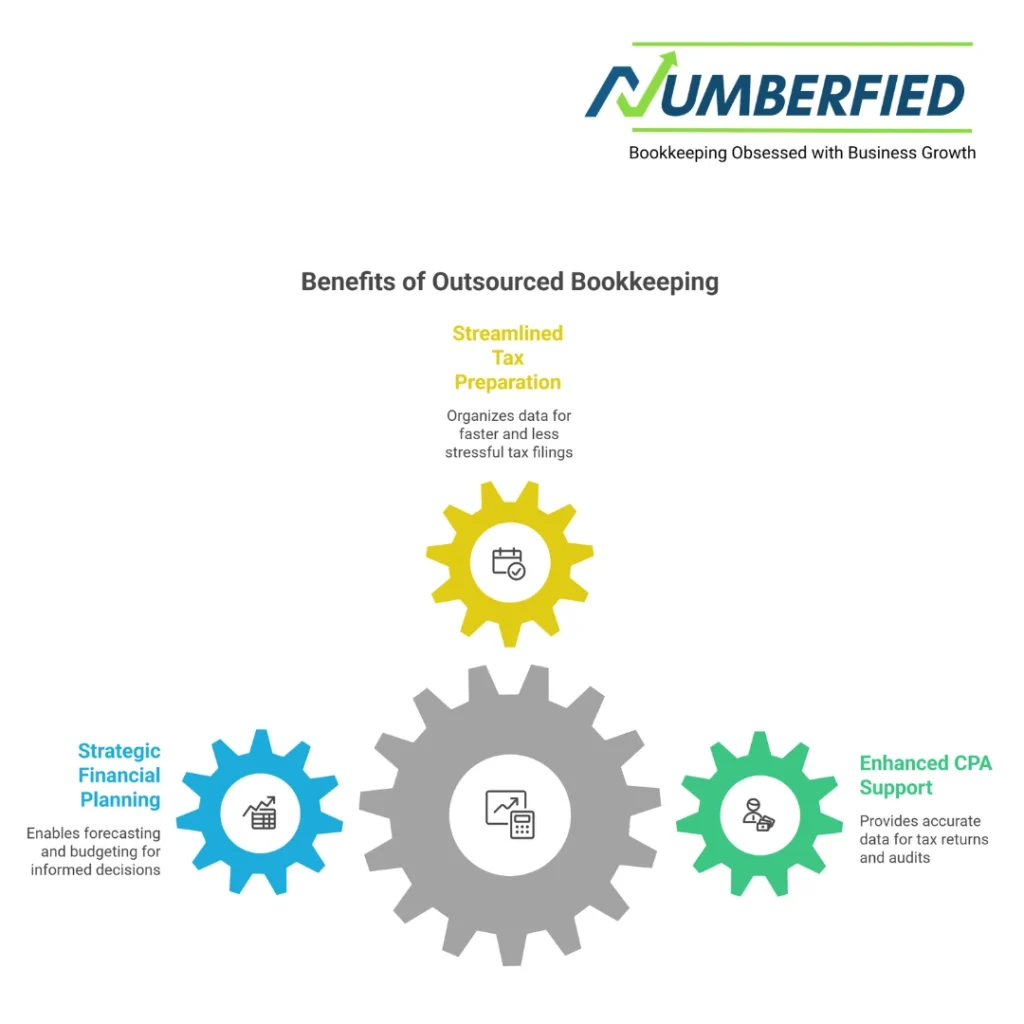
Outsourced bookkeeping provides the ongoing financial data that accountants and CPAs need to prepare tax returns, perform audits, and offer strategic advice. By keeping books current, your outsourced bookkeeper reduces the time your accountant spends on clerical tasks and improves the quality of tax planning.
Preparing for tax season with accurate bookkeeping
Accurate books make tax preparation faster and less stressful. When you outsource bookkeeping, your provider organizes income, expenses, and payroll data in a tax-ready format, minimizing surprises and last-minute cleanups before filings.
Financial forecasting and advisory services from bookkeeping data
Clean financial data enables forecasting and scenario planning. Many outsourced bookkeeping services offer advisory add-ons that translate monthly reports into forecasts, budgets, and KPI tracking to guide strategic decisions.
Why Numberfied Is a Trusted Outsourced Bookkeeping Partner
Tailored outsourced bookkeeping service for small business needs
Numberfied specializes in bookkeeping services for small businesses. We tailor our approach to your industry, transaction volume, and growth plans so you receive the right level of support without paying for unnecessary extras.
Virtual bookkeeper model that integrates with your team
Our virtual bookkeeper model combines the advantages of cloud accounting with dedicated support. You get a consistent point of contact and a team that manages day-to-day bookkeeping, reconciliations, and reporting while staying aligned with your leadership.
Secure, transparent processes and reliable financial data
Security and transparency are core to our approach. Numberfied uses secure cloud tools, clear reporting, and regular check-ins to deliver reliable financial data you can trust for decision-making, tax preparation, and performance monitoring.
Case Studies: Real Results from Outsourced Bookkeeping
How a service business streamlined operations with outsourced bookkeeping
One of our service-based clients outsourced bookkeeping to improve cash flow tracking and billing. With consistent categorization and monthly reporting, they reduced overdue receivables and improved decision-making on staffing and scheduling.
How a small retail business scaled with bookkeeping services
A retail client used outsourced bookkeeping to manage seasonal sales spikes and inventory accounting. The bookkeeping service provided accurate cost of goods sold reporting and timely cash flow insights that supported inventory purchasing decisions.
How a professional practice improved tax preparedness
A professional practice engaged Numberfied to record client revenue and expenses consistently. The clean books reduced their CPA’s time for tax preparation and produced a more predictable tax outcome with better planning.
Common Mistakes to Avoid When You Outsource Your Books
Failing to set clear expectations and KPIs
One common mistake is failing to set expectations for response times, reporting formats, and deliverables. Establishing KPIs and service-level agreements during onboarding prevents misunderstandings and keeps work aligned with business needs.
Delaying reconciliation and allowing issues to accumulate
Skipping regular reconciliation leads to compounding errors that are harder to resolve later. Regular, timely reconciliations are a cornerstone of effective outsourced bookkeeping and ensure your financial data is accurate and actionable.
Choosing price over fit when selecting a bookkeeping service
Price is important, but fit matters more. Evaluate providers on communication, technology, security, and industry experience. The right partner will save you more time and money over the long run than the cheapest vendor.
Measuring Success After You Outsource Bookkeeping
Key metrics to track with outsourced bookkeeping
Measure success through metrics like days sales outstanding, timely financial close, accuracy of reconciliations, and consistency of monthly reporting. These indicators show whether your outsourced bookkeeping service is delivering value.
Regular reviews and continuous improvement with your bookkeeping firm
Schedule quarterly reviews to assess performance, adjust service levels, and discuss strategic needs. Continuous improvement ensures your bookkeeping support evolves with your business.
How clean financial data leads to better strategic decisions
Clean, timely financial data allows you to spot trends, evaluate new opportunities, and make informed decisions about pricing, hiring, and investments. Outsourced bookkeeping is the foundation for strategic growth.
Conclusion
Outsourcing bookkeeping offers time savings, accuracy, scalability, and access to financial expertise without the overhead of in-house hires. At Numberfied, we help small businesses transition smoothly, maintain clear financial data, and use reliable reporting to grow. If you want a trusted partner to manage daily bookkeeping, prepare tax-ready records, and support your financial decisions, let’s talk. Visit our website to learn more and get started.
Contact Numberfied to discuss how our outsourced bookkeeping service can fit your business needs and help you focus on what you do best.
Frequently Asked Questions
What does it mean to outsource bookkeeping?
Outsourcing bookkeeping means hiring an external provider to handle your day-to-day transaction recording, reconciliations, and monthly financial reporting. Instead of maintaining an in-house bookkeeping staff, you rely on a dedicated outsourced bookkeeping service to keep your books current and accurate. This approach allows business owners to focus on core operations while professionals manage financial data and routine accounting tasks.
How quickly can I start after I decide to outsource bookkeeping?
Start time varies by provider and the complexity of your accounts, but onboarding often begins within days. The initial phase includes an assessment, data access setup, and data migration planning. Many bookkeeping services provide a timeline and checklist to streamline the transition, so you know when monthly reporting will be up to date under the new arrangement.
Will outsourcing bookkeeping save me money?
Outsourcing bookkeeping can reduce overhead by eliminating the costs of recruitment, training, and benefits associated with in-house hires. It also delivers cost predictability through monthly service plans. While the specific savings depend on your situation, most businesses benefit financially from improved efficiency and reduced time spent on administrative tasks.
How does an outsourced bookkeeper work with my CPA?
An outsourced bookkeeper prepares clean financial records that your CPA can use for tax returns and advisory work. The bookkeeper and CPA communicate about tax-relevant items, reconciliations, and year-end adjustments. Coordinated workflows reduce duplication of effort and improve the quality of tax planning and compliance.
Is my financial data safe with an outsourced bookkeeping firm?
Reputable bookkeeping firms use secure cloud platforms, encryption, and access controls to protect your financial data. During vendor evaluation, ask about security measures, data backup procedures, and compliance with industry standards. Proper security practices are a critical consideration when choosing a bookkeeping partner.
Can I keep some bookkeeping tasks in-house and outsource the rest?
Yes. Many businesses use a hybrid approach where routine or strategic tasks remain in-house while transactional and reconciliation tasks are outsourced. Discuss your preferences with the bookkeeping service so they can design a package that complements your internal capabilities and provides the right level of support.
What software should I use when I outsource your bookkeeping?
Cloud accounting software is recommended for efficient collaboration. QuickBooks is widely used in the U.S., and many bookkeeping firms integrate with other tools for payroll, payments, and receipt capture. Your bookkeeping provider will advise on the best software stack based on your business needs and existing systems.
How do I ensure quality and accuracy after I outsource bookkeeping?
Set clear expectations, establish a regular reconciliation schedule, and request standardized reporting. Regular reviews, KPIs, and periodic audits or cleanups help maintain quality. Communication and transparency from your bookkeeping service also play a key role in sustaining accurate records over time.
What are the common onboarding challenges when businesses outsource bookkeeping?
Common challenges include data access setup, differences in categorization, and reconciling historical records. These are typically resolved through a structured onboarding process that includes detailed checklists, phased handoff, and initial reconciliation of prior periods. A good bookkeeping partner will proactively manage these challenges.
How do I measure ROI after I outsource bookkeeping?
Measure ROI through time saved, reduction in accounting errors, improved cash flow management, and faster month-end closes. Track operational improvements, such as reduced days sales outstanding and more timely financial insights. Over time, these gains translate into better strategic decisions and measurable business growth.
Read Also: How Bookkeeping & Accounting Services Can Transform Your Business Growth