

Introduction
Outsourced bookkeeping firms can simplify finances, improve compliance, and free leaders to grow their businesses. This article explains benefits, challenges, US compliance requirements (IRS and GAAP), selection criteria, tools like QuickBooks and Xero, tax preparation readiness, transition steps, and how to evaluate ROI. Guidance is practical, actionable, and aimed at US business owners considering professional outsourced bookkeeping firms.
Quick takeaways
- Outsourced bookkeeping firms centralize daily recordkeeping, reconciliation, and reporting.
- They improve IRS and GAAP compliance when processes and documentation are strong.
- Evaluate providers on experience, technology stack (QuickBooks/Xero), security, and clear pricing.
- Transition planning and ongoing communication determine success and ROI.
Why consider outsourced bookkeeping firms?
Reduce operational overhead
Outsourced bookkeeping firms reduce internal hiring, training, and payroll costs by providing dedicated bookkeeping expertise on a predictable fee basis.
Access to specialized skills
Firms bring expertise in account reconciliations, journal entries, and month-end close procedures that many small teams lack.
Scalability and flexibility
When revenue or transaction volume fluctuates, bookkeeping firms scale resources up or down without the complexity of hiring or layoffs.
Key benefits of outsourced bookkeeping firms
Consistent month-end closes
Regular, timely closes improve visibility into financial performance and support faster decisions.
Improved accuracy and controls
Firms often implement standardized processes and segregation of duties to reduce errors and fraud risk.
Tax readiness and audit support
Outsourced bookkeeping firms prepare clean books that simplify tax preparation and make audits smoother and faster.
Common challenges and how to mitigate them
Data access and security concerns
Grant limited, audited access, enforce MFA, and require SOC 2 or equivalent security attestation from bookkeeping firms.
Loss of institutional knowledge
Mitigate by documenting processes, creating a knowledge transfer plan, and retaining a point person internally.
Communication gaps and timing
Set regular cadence for reconciliations, status updates, and KPI deliveries to keep expectations aligned with bookkeeping firms.
US compliance: IRS and GAAP considerations
IRS-focused bookkeeping practices
Outsourced bookkeeping firms must maintain accurate transaction records, preserve receipts and supporting documents, and implement retention policies that satisfy IRS documentation rules.
GAAP alignment and reporting
Ensure the provider understands GAAP recognition rules relevant to your industry, revenue contracts, and expense capitalization so financial statements remain audit-ready.
State and local tax considerations
Beyond federal rules, bookkeeping firms should track sales tax, payroll tax withholdings, and nexus-related filings to avoid penalties.
Technology stack: QuickBooks, Xero, and integrations
QuickBooks Online expertise
Many outsourced bookkeeping firms specialize in QuickBooks Online: chart of accounts design, bank feeds, reconciliations, and customized reports are core services.
Xero and alternative platforms
Xero is another common platform; verify your provider’s experience with the chosen package, multi-currency handling, and bank feed reliability.
Integrations and automation
Outsourced bookkeeping firms increase efficiency by integrating payment processors, payroll systems, expense management tools, and bill pay platforms to reduce manual entry.
Selection criteria: Choosing the right outsourced bookkeeping firms
Industry experience and references
Prioritize providers with experience in your industry and verified references who can speak to accuracy, communication, and timeliness.
Certifications and standards
Look for bookkeeping firms with Certified Bookkeeper credentials, QuickBooks/Xero certifications, and security attestations like SOC 2.
Service model and SLAs
Confirm scope, deliverables, service-level agreements, response times, and escalation paths before engagement with bookkeeping firms.
Pricing models and ROI for outsourced bookkeeping firms
Common pricing approaches
Providers charge hourly, fixed monthly, or tiered pricing based on transaction volume and complexity; choose the model that aligns incentives with your goals.
Measuring ROI
Calculate ROI by comparing internal labor costs, error-related expenses, late filing penalties avoided, and time recovered for leadership against provider fees from bookkeeping firms.
Hidden costs to watch
Watch for onboarding fees, additional charges for ad hoc services, and costs tied to out-of-scope requests when evaluating bookkeeping firms.
Tax preparation and year-end support
Preparing tax-ready books
Outsourced bookkeeping firms can produce reconciled ledgers, schedules, and supporting documentation that reduce CPA fees and accelerate tax filing.
Working with your CPA
Coordinate roles: the firm maintains books and compiles schedules, while your CPA handles tax strategy, filings, and specialized tax advice.
Year-end close checklist
Ensure bookkeeping firms deliver final reconciliations, depreciation schedules, payroll summaries, and accounts receivable/payable aging reports for year-end filing.
Transitioning to outsourced bookkeeping firms: step-by-step
Initial readiness assessment
Start with a documentation audit: current chart of accounts, bank statements, payroll records, vendor contracts, and past tax returns to assess clean-up needs.
Data migration and setup
Outsourced bookkeeping firms typically map accounts, import prior balances, connect bank feeds, and establish workflows during onboarding.
Training and knowledge transfer
Schedule cross-training sessions so internal staff understand how to submit receipts, approve transactions, and escalate issues while outsourced bookkeeping firms manage the books.
Operational best practices with outsourced bookkeeping firms
Maintain a single source of truth
Use one accounting platform and centralize documents so outsourced bookkeeping firms and your team work from consistent data.
Monthly reconciliation routine
Agree on fixed monthly timelines for reconciliations, review of P&L and balance sheet variances, and delivery of financial packs by outsourced bookkeeping firms.
Performance metrics to track
Track days to close, unreconciled transactions, timely vendor payments, and error rates to benchmark outsourced bookkeeping firms’ effectiveness.
Security, privacy, and compliance controls
Access management
Grant least-privilege access, rotate credentials, and require multifactor authentication for platforms used by outsourced bookkeeping firms.
Data handling and retention
Establish secure transfer methods, encrypted storage, and retention timelines that meet IRS and state requirements when working with outsourced bookkeeping firms.
Contracts and liability
Include clear confidentiality clauses, data breach responsibilities, and indemnity terms in contracts with outsourced bookkeeping firms.
Industry-specific considerations
Service businesses and project accounting
Service firms need time-and-material tracking, job costing, and revenue recognition expertise from outsourced bookkeeping firms.
Retail and e-commerce
Ensure the provider handles merchant fees, refunds, inventory accounting, and marketplace reconciliations accurately when engaging outsourced bookkeeping firms.
Construction and long-term contracts
Construction clients require percentage-of-completion accounting and retainage tracking; confirm that outsourced bookkeeping firms understand contract-specific GAAP rules.
Case study-style ROI examples
Reducing in-house costs
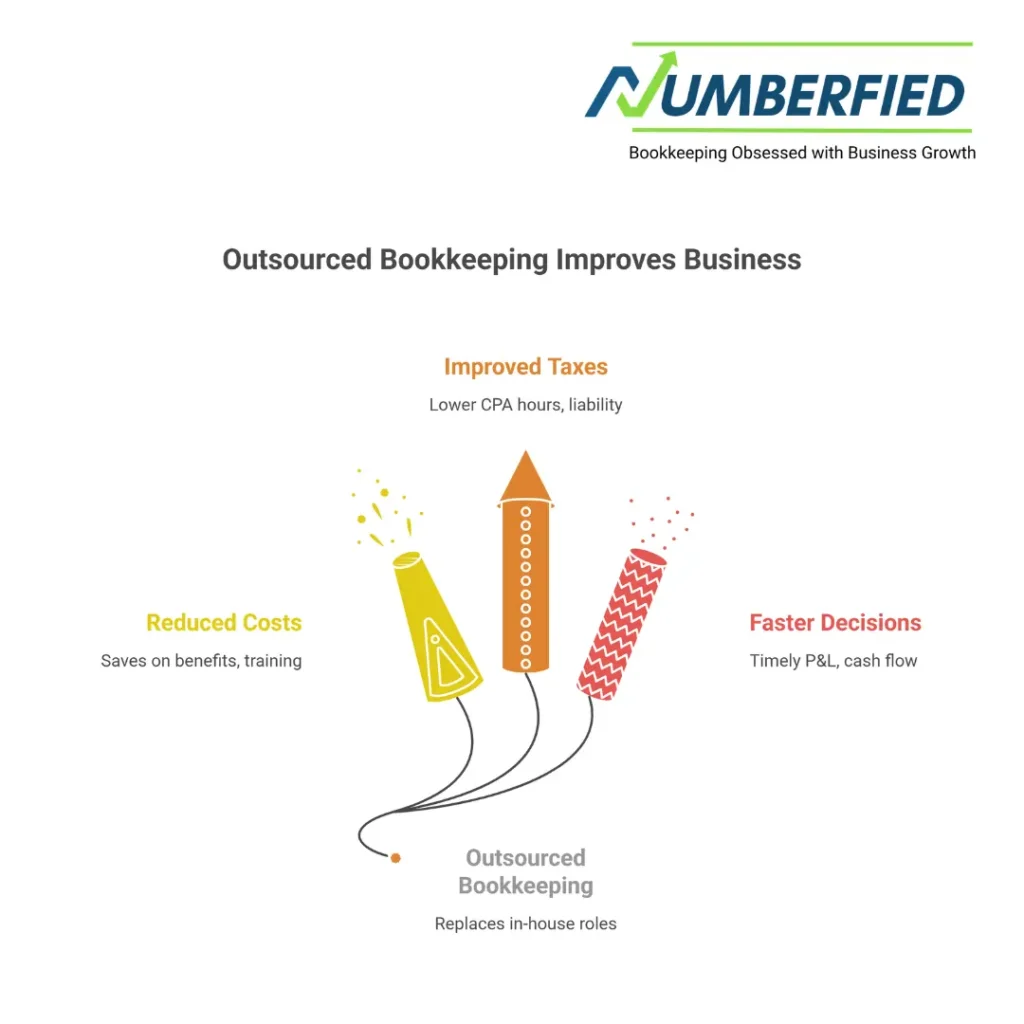
A small business eliminated two full-time bookkeeping roles and replaced them with a monthly contract, saving on benefits and training while improving month-end timeliness through outsourced bookkeeping firms.
Improving tax outcomes
By delivering reconciled ledgers and depreciation schedules, a client reduced CPA billable hours and lowered tax liability exposure using bookkeeping firms.
Faster decision-making
Timely P&L and cash flow reporting from bookkeeping firms enabled a business to secure better vendor terms and negotiate a line of credit.
How to evaluate proposals from outsourced bookkeeping firms
Compare deliverables, not just price
Ensure proposals list month-end tasks, reconciliations, reporting deliverables, and estimated hours rather than only a flat fee from bookkeeping firms.
Request sample reports
Ask for examples of P&L, cash flow statements, and reconciliations prepared by bookkeeping firms to assess clarity and completeness.
Trial period and exit terms
Negotiate a short trial or phased contract and clear exit terms to limit risk when engaging bookkeeping firms.
Working relationship: expectations and governance
Define roles and responsibilities
Document what your team will handle versus what outsourced bookkeeping firms will deliver to avoid duplicated effort or gaps.
Regular reviews and KPIs
Hold monthly or quarterly reviews to discuss KPIs, cash flow, forecast variances, and control improvements provided by bookkeeping firms.
Continuous improvement
Encourage the provider to suggest automation, process improvements, and expense controls that improve outcomes over time with bookkeeping firms.
Conclusion
Outsourced bookkeeping firms offer a compelling mix of accuracy, compliance, and scalability for US businesses. When selected and managed well, they reduce overhead, improve tax readiness, and deliver measurable ROI. Prioritize providers with relevant industry experience, strong QuickBooks or Xero capabilities, robust security controls, and clear SLAs. A structured transition plan and ongoing governance ensure accounting remains reliable and timely. For a tailored assessment of how outsourced bookkeeping firms can support your business, consider reaching out to Numberfied to discuss requirements and next steps.
FAQs
What services do outsourced bookkeeping firms typically provide?
They handle bank reconciliations, accounts payable and receivable, journal entries, payroll accounting coordination, and monthly financial reporting. Some also support tax preparation and CPA-ready schedules.
How do outsourced bookkeeping firms handle security?
Reputable firms use role-based access, multifactor authentication, encrypted storage, and may hold SOC 2 or similar attestations. Verify their policies and request security documentation before engagement.
Will outsourced bookkeeping firms work with my CPA?
Yes. They commonly prepare reconciliations and supporting schedules that your CPA can use for tax filings, reducing CPA billable hours and improving accuracy.
Which accounting software do outsourced bookkeeping firms use?
QuickBooks Online and Xero are the most common. Many firms also work with NetSuite, Sage, or industry-specific systems. Confirm platform expertise during selection.
How long does a transition take?
Typical onboarding ranges from 2 to 8 weeks, depending on data cleanliness and complexity. Plan for an initial assessment, data migration, and first-month parallel review.
What pricing models do outsourced bookkeeping firms offer?
Pricing can be hourly, fixed monthly, or tiered by transaction volume. Ask for a detailed scope to compare true costs and service levels across proposals.
Can outsourced bookkeeping firms help reduce taxes?
They improve recordkeeping and identify deductible expenses, which can reduce CPA time and help ensure accurate tax reporting, but they do not replace tax advisors for strategic tax planning.
How do I measure the performance of outsourced bookkeeping firms?
Track KPIs like days to close, unreconciled items, on-time report delivery, and reduction in CPA hours. Regular reviews help maintain standards and improve processes.
Are outsourced bookkeeping firms suitable for small businesses?
Yes. Many small businesses benefit from predictable costs, access to experienced bookkeepers, and cleaner financials that support growth and lending needs.
What should be in a contract with outsourced bookkeeping firms?
Include scope of services, deliverables, SLAs, pricing, data security requirements, confidentiality, termination terms, and responsibilities for data migration and backups.
Read Also: The Amazing Way Bookkeeping and Accounting Services in USA Can Skyrocket Your Success!