

Introduction
For decades, the gold standard of a great accountant was speed and accuracy. The hero was the professional who could close the books faster, reconcile discrepancies instantly, and ensure every decimal point was perfect. But a silent shift is underway. With Artificial Intelligence (AI) now capable of processing transactions, categorizing expenses, and even generating basic financial reports in milliseconds, the definition of “value” in accounting is changing.
The robots are good at counting the past. But they are terrible at questioning the future.
This is where the modern accountant steps in. According to industry experts and thought leaders (including a recent trending thesis in Accounting Today), the most valuable skill for an accountant is no longer just technical prowess -it is curiosity.
For readers of Numberfied, a platform that bridges the gap between compliance and growth, this is excellent news. It means that your role as a financial guardian is evolving into that of a strategic advisor. In this guide, we will explore why curiosity trumps computation, how to train this muscle, and why the future of accounting depends on asking “why?” rather than just reporting “what.”
The Evolution of Accounting: From Number Cruncher to Business Detective
The stereotype of the accountant buried behind a desk, wearing a green visor, muttering about deductions, is officially extinct. AI has automated the “drudgery.” Today, accounting is a discipline of interpretation.
The Death of Repetitive Tasks
Generative AI and machine learning models can now handle:
- Data entry: OCR technology reads receipts instantly.
- Reconciliation: AI matches bank feeds with ledger entries.
- Compliance checks: Systems flag anomalies based on historical rules.
When a machine handles the processing, the human must handle the processing of meaning. If you stop being curious, you stop being useful. A robot tells you what happened. A curious accountant tells you why it happened and what to do next.
The Shift to Strategic Advisory
Modern clients -especially the small business owners that Numberfied serves -don’t just want clean books. They want more leads, higher sales, and maximized profits. They want growth.
If an accountant only looks at the P&L statement and says, “Your office supplies are up 10%,” they add no value.
If a curious accountant looks at the same data and asks, “Why did supplies spike? Did you launch a new marketing campaign that requires printing? Did that campaign work?” -They become indispensable.
Curiosity transforms accounting from a historical record into a future roadmap.
Why AI Can’t Fake Curiosity (The Human Advantage)
Many professionals fear that AI will render their skills obsolete. However, when it comes to the soft skill of curiosity, AI is functionally blind. Large Language Models (LLMs) are predictive engines; they guess the next most likely word. They do not wonder.
AI Provides the Data, Humans Provide the Context
AI can tell you that your gross margin dropped from 45% to 38% in Q3. That is a fact.
A curious human asks:
- Was this due to a specific supplier price hike?
- Did we offer a volume discount to a major client that we shouldn’t have?
- Does the sales team know that this margin is unsustainable?
This line of questioning is the essence of accounting in the AI age. The AI gives you the “what.” The human must pursue the “why.” Without curiosity, those numbers sit dormant.
The Trust Factor
Clients trust humans who seem interested in their business. A curious accountant asks about a client’s daughter’s wedding (life planning), their new product line (growth planning), or their burnout levels (cash flow planning).
AI cannot care. It cannot be wondered if a client is happy. As Numberfied highlights, accounting services are now “growth-driven insights, not just reports.” Curiosity is the vehicle that delivers those insights. It is the skill that allows an accountant to look at a chart of accounts and see a story of entrepreneurial struggle and success, rather than just debits and credits.
How to Cultivate Curiosity in Your Accounting Practice
Curiosity feels abstract, but it is a trainable skill. For firms looking to survive the AI revolution, moving from “processing” to “discovery” is a strategic necessity.
Technique 1: The “5 Whys” Method for Financial Variances
Adopt the Toyota Production System’s “5 Whys” into your monthly review.
- Statement: Client’s cost of goods sold (COGS) increased.
- Why? Raw material prices rose.
- Why? The usual supplier had a shortage.
- Why? The client didn’t order early enough.
- Why? Cash flow was tight, so they delayed ordering.
- Solution: The accountant (curious) now realizes the client needs a line of credit or better inventory forecasting, not a new supplier.
By digging deeper than the surface number, accounting becomes a tool for solving liquidity problems.
Technique 2: Benchmarking Against “Unknown” Industries
Curiosity means looking outside your vertical. An accountant working for a restaurant should be curious about how subscription software tracks churn.
- Can a restaurant apply a “Customer Lifetime Value” model like a SaaS company?
- How do retail stores handle inventory spoilage versus a bakery handling day-old bread?
The best accountants steal ideas from other sectors. This cross-pollination is impossible for AI to perform autonomously; it requires a human asking, “I wonder if that would work here?”
Technique 3: Scheduling “Curiosity Hours”
Block out 2 hours per week where you do not process data. Instead, you explore data.
- Open the general ledger and look for accounts that haven’t moved in a year. Why?
- Look at the client’s sales tax filings. Does the volume match the marketing calendar?
- Use Numberfied’s strategic growth planning sessions not just to review past performance, but to ask, “If we fixed X, how much richer would the owner be?”
The Practical Application: Curiosity in Bookkeeping vs. CFO Services
To optimize for the keyword “Accounting,” we must differentiate between reactive tasks and proactivity. Numberfied’s model merges traditional bookkeeping with business coaching. Here is the curiosity that changes each function.
In Daily Bookkeeping (The “What”)
Traditional (No Curiosity): “Your travel expenses are over budget.”
Curious curiosity. Your travel expenses are high, but I noticed you closed three deals in that region last month. Let’s calculate the ROI of that travel. Was it worth it?”
In Monthly Financial Health Reviews (The “So What”)
Traditional: “Your net profit is 10k, but you are paying $2k in bank fees. I am curious if switching to a merchant services provider could save you 40%. Shall we analyze that?”
In Strategic Growth Planning (The “Now What”)
Traditional: “You need to cut costs.”
Curious: “Your labor costs are high, but your team seems happy. I am curious: If we raised prices by 10% to cover the labor, would volume drop? Let’s test the price elasticity.”
As Numberfied suggests, accounting services must include “Sales, Marketing & Lead Generation training” to be effective. An accountant who is curious about how sales are made is infinitely more valuable than one who merely counts the receipts after the sale.
Conclusion: The Uncanny Valley of Accounting
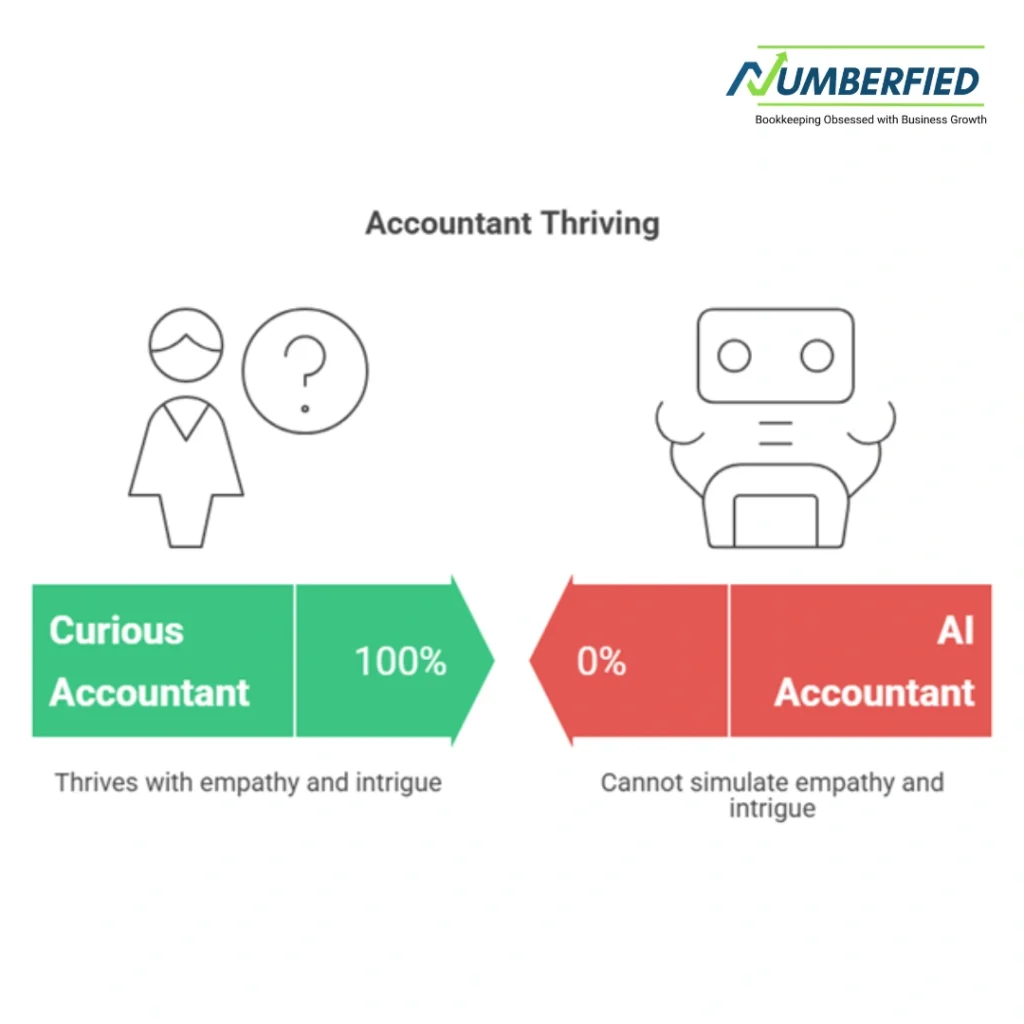
AI will continue to get smarter, faster, and cheaper. It will handle the compliance grind with terrifying efficiency. But we are entering the “Uncanny Valley” of finance: AI can simulate the logic of accounting, but it cannot simulate the empathy and intrigue of a human advisor.
The accountants who thrive will not be the ones who know the most tax codes (the AI knows them all). The accountants who thrive will be the ones who ask the best questions.
Curiosity is the ultimate differentiator.
It is what turns a tax preparer into a trusted partner. It is what transforms a bookkeeper into a growth strategist. When you pair AI’s processing power with a curious human brain, you get a superpower. You get the ability to see around corners, mitigate risks before they happen, and seize opportunities the client didn’t know existed.
At Numberfied, we see this every day. The “Virtual Accounting and Bookkeeping Services” work best not when they are silent, but when they are conversational. When the accountant asks, “Tell me more about that…”
So, as you log off Today, change yourself. Look at the spreadsheet you looked at yesterday. And ask one question you have never asked before. That question is worth more than a thousand automated journal entries.
Read Also: Why Numberfied’s Bookkeeping Accounting Service Is Your Small Business’s Secret Weapon
FAQs
Will AI completely replace the need for human accountants?
No. AI will replace tasks (data entry, reconciliation), but it cannot replace judgment, ethics, client relationships, or curiosity. Accounting requires human interpretation to apply context to the numbers.
Hocuriosityriosity actually saves a business money?
Curiosity leads to discovery. An accounting professional who asks “Why is shipping so high?” might discover a warehouse inefficiency or a billing error by a supplier, saving thousands that a standard software report would miss.
What is the best AI tool for curious accountants right now?
Tools like Power BI or Tableau (for visualization) and ChatGPT Enterprise (for analysis of unstructured data) are excellent. However, the tool is useless without a curious human to prompt the right questions about the accounting data.
I am an introvert. How can I be more curious with clients?
Curiosity isn’t about being loud; it is about listening. Instead of talking, ask open-ended questions like, “What kept you up at night last month regarding cash flow?” Introverts often make the best curious accountants because they listen deeply.
How does Numberfied incorporate curiosity into its accounting services?
Numberfied integrates Strategic Growth Planning Sessions and Weekly Business Coaching into the accounting workflow. This structure forces the financial review to include “what if” scenarios and growth projections, not just historical compliance.
Can AI hallucinations be a problem in accounting?
Yes. AI can “hallucinate” and create false numbers or logic. A curious accounting professional is essential to audit the AI’s output, catch these hallucinations, and verify sources before a client makes a major financial decision.
What is the first sign that an accountant is curious?
When they only report the numbers without any commentary or questions. If an accounting report arrives and the only message is “Here are your books,” they are a data processor, not an advisor.
How do I train junior staff to be more curious?
Stop giving them the answer. When a junior accounting staff member asks, “What is this variance?” respond with, “What do you think it is? Go interview the department head and come back with three theories.”
Does curiosity help with tax planning?
Absolutely. A curious accounting approach to taxes doesn’t just look for deductions; it looks at the client’s life plan. Are you planning to sell the business in 5 years? Curiosity changes how you depreciate assets Today.
Is traditional accounting school preparing students for this?
Most traditional programs focus on rules and compliance. However, the shift is happening. Modern programs now emphasize data analytics and professional skepticism (the academic curiosity). Continuing education in accounting must now focus on soft skills.
Ready to stop counting the past and start creating the future?
You don’t need to face the AI revolution alone. At Numberfied, we don’t just offer compliance; we offer a growth partnership. Whether you are a business owner tired of reactive advice or an accountant looking to add a growth advisory arm to your firm, our platform bridges the gap between bookkeeping and business breakthroughs.
Don’t curiosity go to waste. Book a Free Strategy Call with Numberfied Today
Let’s discuss how curious accounting can unlock your next phase of growth. Click here to join the Numberfied Community and take control of your financial future.